
Seven AI Answer Optimization Mistakes Site Owners Make
You hold position one on Google for your core commercial query, yet your brand is completely absent when a prospect asks Perplexity or Claude for recommendations. Traditional PageRank domain authority does not guarantee passage synthesis in multi-source RAG filters. Relying solely on legacy organic tactics leaves your content stranded outside modern answer engines.
Deploying an AI SEO content engine requires shifting from keyword frequency to structural clarity and extractable factual density. Below, you will uncover the seven critical AI answer optimization mistakes separating cited authorities from ignored domains, along with the precise fixes needed for your site architecture. You will also learn why one conventional publishing workflow quietly blocks models from citing your primary documentation.
What does correcting this extraction failure look like in practice?
- Situation: A site owner published regular guides, but chatbot summaries consistently cited competitors with lower domain authority.
- Action: The team pointed their sitemap to extract automated brand context files, including internal link maps and SEO guidelines, and applied disciplined AEO content optimization formatting with lead-in answer sentences.
- Outcome: Retrieval algorithms successfully parsed the clean architecture, pulling direct passages into conversational answer blocks without manual prompt engineering.
These recommendations apply specifically to indexable, factual content ecosystems seeking dual visibility across search engines and AI assistants. Inspecting your sitemap and generating grounded context files is the first operational step toward consistent citations. To understand why legacy optimization fails in this new retrieval paradigm, you must first examine the fundamental mechanics of how generative answer engines evaluate text compared to classic search crawlers.
Why Traditional Search Optimization Fails in Generative Answer Engines
Traditional search optimization fails in generative engines because large language models retrieve and synthesize discrete sentence-level facts rather than ranking whole URLs based on document-level keyword density. When an answer engine processes a prompt, it bypasses standard keyword stuffing in favor of semantic clarity that directly resolves user intent.
Why does an exhaustive 2,500-word pillar guide routinely get ignored while a competitor's concise 120-word breakdown earns the direct citation?
Generative answer optimization is the technical practice of structuring digital content so retrieval-augmented generation systems can effortlessly extract, verify, and cite individual passages. While classic search engines scan an inverted index to return a list of links, generative models use vector embeddings to locate exact answers across unstructured text.
Think of traditional SEO like cataloging an entire book in a library index, whereas generative retrieval works like a researcher tearing out single paragraphs to assemble a custom summary sheet. If your primary answer is buried beneath filler introductions or repetitive keyword strings, the synthesis model simply leaves that paragraph behind.
To master how to get cited in AI answers, publishers must account for the three-stage retrieval pipeline that governs modern answer engines:
- Semantic chunk extraction: The engine divides a page into isolated context blocks, parsing vectors rather than whole pages to identify passages that match the prompt's mathematical intent.
- Cross-source consensus verification: The system validates extracted claims against trusted sources across the index, stripping out unverified assertions or outlier claims.
- Token attribution limits: Because generative interfaces operate within strict output constraints, the synthesis model selects only the most compact, factual chunk for user-facing attribution.
When you optimize exclusively for traditional search algorithms, you format pages for document scoring algorithms that evaluate overall page length, outbound links, and site architecture. Generative engines evaluate information density at the boundary of a single paragraph. A dense section structured with direct subject-predicate-object phrasing survives semantic filtering; vague prose diluted by introductory throat-clearing fails retrieval before generation even begins.
Failing to adapt to this paragraph-level scrutiny leads directly to structural oversights that silence your domain in AI outputs. Understanding these specific failure points is essential for preserving your reach across modern generative interfaces.
Seven Critical AI Answer Optimization Mistakes Site Owners Make
Site owners fail to earn generative search citations when they design content for traditional page-level ranking rather than passage-level retrieval-augmented generation (RAG) extraction. These structural and architectural errors prevent vector search engines from isolating, verifying, and attributing factual claims to a specific domain.
Why do traditionally optimized pages disappear from synthesized responses? Retrieval engines evaluate isolated text chunks, not entire web pages.
- Relying on floating pronouns across chunk boundaries. Authors frequently begin supporting statements with ambiguous terms like "this platform" or "it" instead of repeating explicit proper nouns. When an embedding model slices an article into distinct vector chunks, isolated sentences lose their entity relationship and get discarded by semantic retrieval algorithms. Replace ambiguous pronouns with explicit brand and product nouns across every explanatory block.
- Omitting entity cross-referencing in structured data. Webmasters often generate isolated metadata objects without nesting explicit JSON-LD @id references between authors, parent organizations, and topical entities. Omitting these identifiers severs the machine-readable link between your domain and recognized knowledge graph nodes. Implement connected article schema markup to bind page entities directly to recognized authoritative database entries.
- Using loose bullet lists for multi-attribute queries. Unstructured bullet points provide weak contextual relationships between distinct entities and their corresponding attributes. Large language models parsing multi-attribute prompts struggle to connect loose list items to the correct entity during answer synthesis. Convert generic bulleted lists into deterministic Markdown comparison matrices to allow RAG parsers to evaluate paired features accurately.
- Charging a fluff tax with anecdotal introductions. Writers frequently open topical sections with 300-word narrative anecdotes and rhetorical setups before delivering actionable facts. Retrieval algorithms evaluate the direct semantic density of initial sentences within a passage, penalizing pages that force parsers to search past introductory padding. Open every informational section with a direct, factual answer sentence that can stand independently as an extracted quotation.
- Structuring content in monolithic text walls. Publishing long, unbroken paragraphs forces automated chunking tools to split arguments across arbitrary token thresholds. Slicing a core technical point mid-sentence reduces the similarity score assigned by neural re-rankers. Organize technical explanations into modular blocks under 150 words that fit cleanly within typical semantic chunk windows.
- Neglecting explicit standalone entity definitions. Articles often discuss technical concepts without stating an unambiguous definition that generative engines can extract verbatim. Entity definitions are concise declarative statements formatted to explain a term without requiring surrounding context. Format newly introduced subject terms using a direct "[Term] is [concise definition]" pattern to provide an immediate candidate answer for definition-focused queries.
- Relying on passive crawl schedules for fresh content. Content teams routinely wait for standard crawler cycles to find newly published articles instead of signaling updates immediately. Answer engines prioritize fresh retrieval sources for fast-moving queries, ignoring pages that languish in standard crawl queues. Connect your CMS directly to search indexing APIs to prompt programmatic crawl inspection the minute a post goes live.
Auditing and rewriting historical content to meet strict chunk extraction standards requires extensive manual oversight. BloGoose automates this process by turning your site structure into rank-ready, citation-optimized articles configured for search visibility and shipped directly to your CMS.
Resolving these errors begins with recognizing how generative systems fundamentally diverge from traditional indexation pipelines. The core distinction lies in how search spiders process whole documents versus how RAG systems extract isolated vector chunks.
Document Index Crawling vs Vector Chunk Extraction in RAG Systems
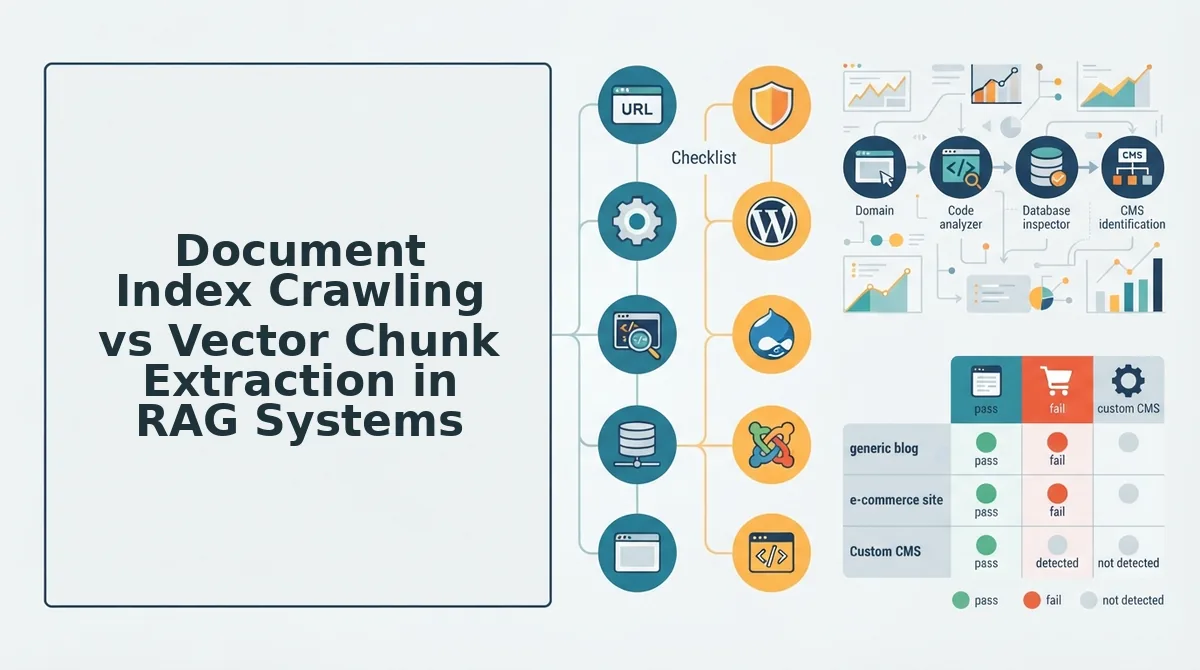
Document index crawling ingests full HTML pages to evaluate entire URLs through lexical matching, backlink equity, and page-level metadata. In contrast, vector chunk extraction in retrieval-augmented generation (RAG) systems breaks text into discrete, high-density token blocks evaluated purely on mathematical semantic similarity. While traditional search spiders tolerate boilerplate markup and scattered context across a page, generative vectorizers measure semantic entropy within individual passages. If a section contains conversational fluff or lacks clear entity definitions, its vector similarity score drops, causing AI answer engines to discard the chunk regardless of the domain's organic ranking.
Vector chunk extraction is the automated parsing of document sections into standalone semantic tokens that generative engines evaluate for contextual similarity.
Can an article dominate traditional search results while remaining completely invisible to retrieval-augmented answer engines? Yes, because vectorizers do not evaluate entire URLs; they discard fragmented chunks that exceed acceptable semantic entropy thresholds.
The Vector Chunk Disqualification Framework
| Parsing Phase | Failure Condition | Crawler Reaction | LLM Synthesis Impact |
|---|---|---|---|
| HTML Tokenization | Boilerplate and navigation mixed with prose | Ignores code noise and indexes parent URL | Disqualifies passage as high-entropy noise |
| Semantic Chunking | Context scattered across distant paragraphs | Evaluates whole-page topic clusters | Splits facts into incomplete, unusable vectors |
| Context Retrieval | Statements lack self-contained entity definitions | Matches broad queries via metadata | Vector similarity drops below retrieval thresholds |
Choose document index crawling optimization if your audience arrives exclusively through classic search where aggregate page authority offsets loose formatting. Choose vector chunk extraction optimization if your visibility depends on getting cited in AI answers and chatbot responses.
- Best for legacy search operators: Document indexing optimization, maximizing overall URL metadata and topical depth.
- Best for AEO content teams: Vector chunk extraction optimization, structuring modular semantic blocks that embedding models cleanly retrieve.
Worked Example: Restructuring for Vector Extraction
A publisher connects an XML sitemap to an automated SEO engine to update articles that ranked on search engines but failed to earn chatbot citations. The system analyzes the sitemap, extracts brand context, and detects unstructured paragraphs buried under conversational introductions. The operator runs an update that reformats each subtopic into an autonomous factual statement paired with a concise entity definition. Following the republishing run, embedding models successfully extract clean semantic vectors without token noise, allowing generative search engines to quote the factual passages directly in synthesized answers.
Our Recommendation
Our recommendation is to format every section for vector chunk extraction while maintaining traditional on-page hierarchy. Structuring content into autonomous 80-to-120 word semantic blocks satisfies classical search spiders with clear header hierarchies while delivering the precise, low-entropy token density generative answer engines require for citations.
Putting this structural recommendation into practice requires a repeatable tactical workflow applied directly to your existing content inventory. By following a structured step-by-step audit, you can quickly convert low-performing legacy articles into citation-ready assets.
How to Audit and Format Existing Articles for Generative Citations
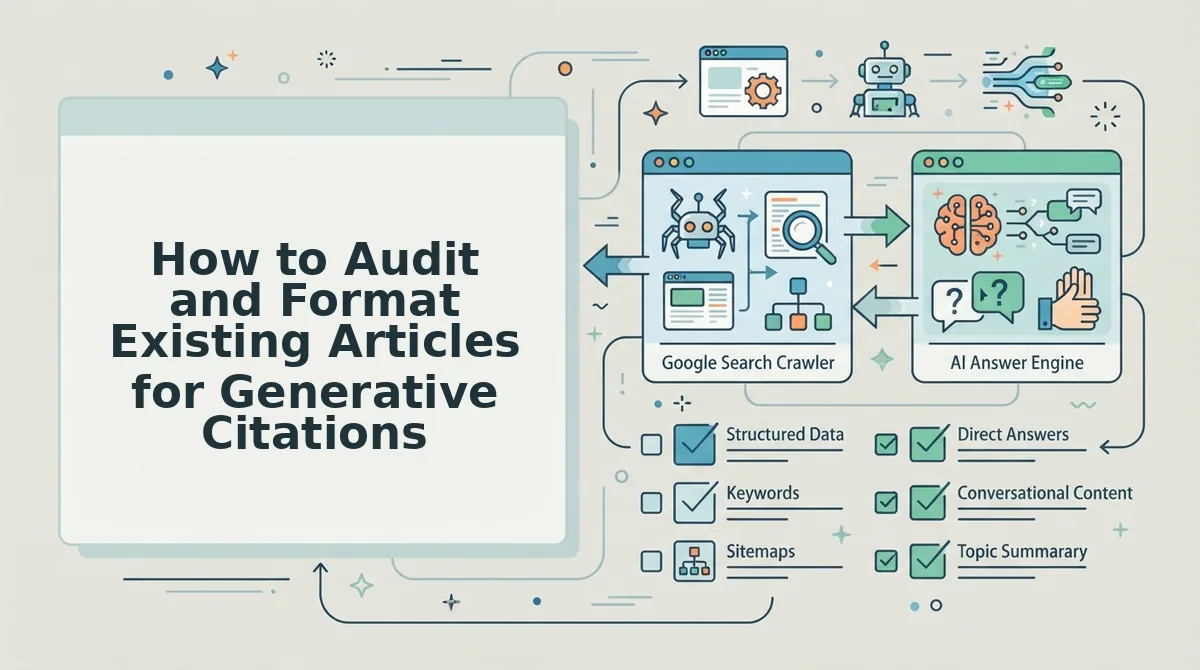
Auditing existing articles for generative citations requires removing conversational introductions, restructuring core facts into self-contained answer blocks, and submitting the updated document directly to search index pipelines. This systematic formatting allows retrieval-augmented generation systems to identify factual assertions without processing discursive filler. Content structured this way secures attribution across automated search experiences.
Prerequisites: You will need an indexed article URL, access to your CMS editor, an active Google Search Console property, and configured API credentials if utilizing programmatic submission endpoints (estimated completion time: 20 minutes per post).
Delete the first two narrative paragraphs of your target post immediately. Casual scene-setting dilutes information retrieval density and conceals target facts from automated semantic parsers.
Inverted pyramid formatting is a technical writing architecture that places the definitive conclusion and primary entity attributes at the very beginning of a passage before providing contextual background. Generative engines favor this structure because the highest-entropy data appears at the leading edge of the vector window.
- Open your CMS editor and draft a self-contained 80-word answer block (5 minutes): Click the editing pane directly beneath your primary H2 heading and remove all introductory warm-up copy. Type an inverted pyramid summary between 80 and 120 words that answers the core topic with zero conversational fluff. You should see a standalone paragraph that provides full clarity even if isolated completely from the rest of the page.
- Replace ambiguous relative pronouns with explicit named entities (5 minutes): Scan through your body paragraphs and locate every instance of indefinite language such as "it," "they," or "this system." Type the exact product name, tool designation, or technical specification in place of the generic pronoun across every sentence. You should see unambiguous noun structures that preserve factual context during vector chunk extraction.
- Reformat narrative comparison lists into semantic HTML tables (5 minutes): Select complex bullet points that compare features, protocols, or performance metrics and convert them into structured HTML table markup using standard table and header elements. You should see distinct row-and-column data cells that answer engines parse without losing contextual field associations.
- Submit the revised article through search crawler pipelines (5 minutes): Open Google Search Console, paste your edited URL into the top search bar, and select "Request Indexing." For rapid automated pipeline updates, trigger your service account to ask Google to crawl new posts using the Google Indexing API. You should see a green confirmation indicator signaling that the updated text has entered the crawl queue.
Why does this granular refactoring matter so much? Answer engines do not read articles for stylistic flair; they retrieve isolated chunks that resolve user prompts with verified factual accuracy.
Even after applying these formatting rules, technical edge cases and algorithmic filters can still impact citation rates. The following answers address the most common obstacles teams encounter during generative optimization.
Frequently Asked Questions About AI Answer Engine Optimization
Generative answer optimization succeeds when content satisfies strict vector retrieval thresholds, eliminates duplicate entity dilution, and respects algorithmic safety boundaries.
Why does a top-ranking page get omitted from Google AI Overviews?
A top organic ranking fails to guarantee citations because answer engines evaluate chunk-level semantic similarity rather than whole-domain authority. RAG pipelines measure passage relevance against strict retrieval thresholds. If an article buries key data inside introductory commentary, the retrieval model drops the chunk before synthesis.
What causes duplicate entity dilution in AI answer engines?
Duplicate entity dilution occurs when multiple site URLs target identical concepts with overlapping embeddings. This repetition fragments semantic confidence scores across internal pages. Retrieval algorithms perceive conflicting signals and discard both chunks below required similarity thresholds, citing a distinct external competitor instead.
How do algorithmic safety boundaries block generative citations?
Algorithmic safety boundaries suppress retrieved chunks containing unverified claims, emotional language, or speculative advice. Guardrail models inspect passage consensus and safety compliance before generating output. Flagged passages are disqualified during reranking, preventing inclusion regardless of conventional organic search visibility.
How do I format text to pass vector retrieval thresholds?
Place direct answers immediately beneath descriptive headings to maximize semantic retrieval. Effective chunking requires:
- Factual declarations in the opening sentence.
- Concrete entities rather than vague pronouns.
This structure ensures vector models extract complete answers without scraping filler text.
Addressing these retrieval factors manually across a large library of articles, however, quickly becomes unsustainable for scaling teams. Establishing an automated production workflow is the only viable path to securing citations consistently across all published assets.
How to Automate Citation-Ready Content Across Your Publishing Workflow
Automating generative citations requires shifting editorial pipelines from keyword density checklists to deterministic semantic structures that vector retrieval systems can parse immediately.
Marketing teams spending twelve hours hand-reformatting legacy drafts for retrieval-augmented generation systems sacrifice publishing velocity while automated architectures capture the primary citation slots. Winning answer engine visibility never required tedious manual prompt engineering; it requires deterministic, repeatable schema and data formatting.
Adopt a unified pipeline that enforces semantic compliance at scale:
- Audit semantic entity saturation and enforce strict Markdown heading hierarchies to guarantee clean vector chunk extraction.
- Publish structured drafts directly to your CMS with validated schema and instant API crawl requests to secure early retrieval indexing.
Review the BloGoose automated content platform to transform raw sitemaps and brand context into continuous, rank-ready search assets shipped straight to WordPress or your custom API.
Generative answer engines do not quote articles that merely discuss a topic; they cite documents engineered to serve as definitive factual solutions.