Free tool · nothing is uploaded
Free UUID generator
Create random version 4 UUIDs. Each one is made in your browser from 122 random bits. Blogoose does not receive them, and they are not looked up in a registry.
Version 4
New identifiers are created in this browser. They are not sent anywhere.
How a version 4 UUID is built
- Sixteen random bytes come from the browser’s cryptographic random source.
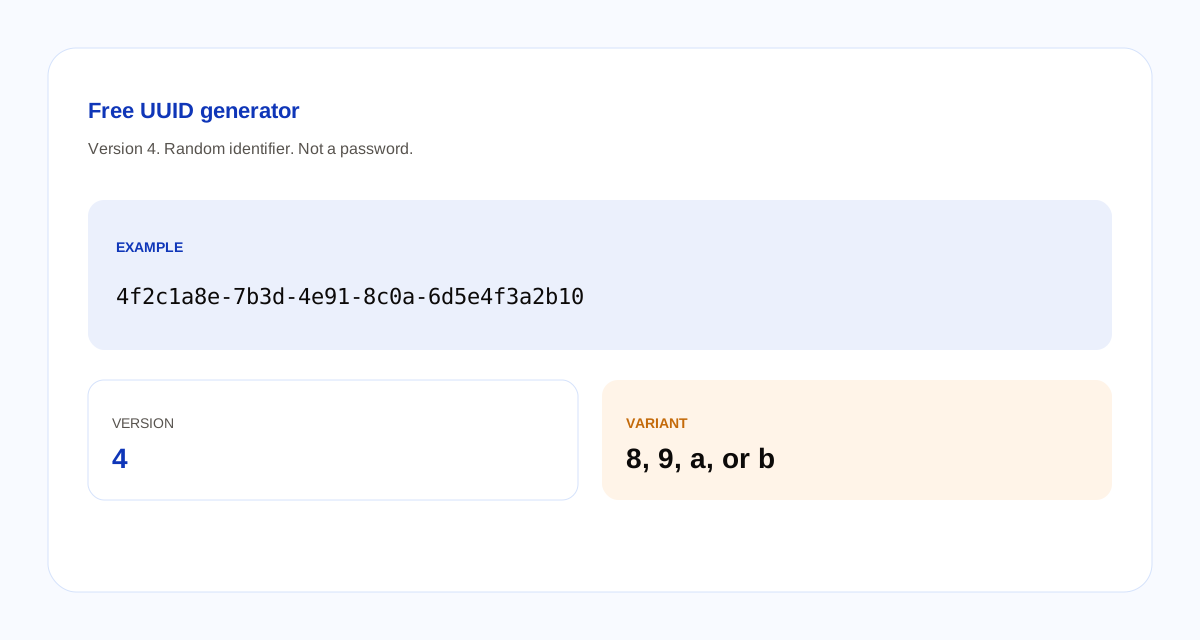
- The version nibble is set to 4. That is the first character of the third group.
- The variant bits are set so the first character of the fourth group is 8, 9, a, or b.
- The rest stays random. 122 bits vary. The written form is lowercase hexadecimal with hyphens.
- You can make 1 to 20 at a time. Generating again replaces the list. The old IDs are not stored here.
A UUID names a record. It does not prove the record exists, and it is not a password. Two generators can, in principle, produce the same value. With 122 random bits that is rare enough that systems use the value without calling a central registry. This page does not check uniqueness anywhere else.
Questions about this generator
What is a UUID?
A 128-bit identifier written as 36 characters: 8-4-4-4-12 hexadecimal digits with hyphens. A GUID is the same kind of identifier. This page makes version 4, which is random.
What does version 4 mean?
The first character of the third group is 4. That marks the UUID as random rather than time-based. The first character of the fourth group is 8, 9, a, or b. 122 of the 128 bits are random.
Is a UUID a password?
No. It is an identifier. Anyone who can see it can copy it. Do not use it as a password or as a secret token. This page does not check the ID against a registry.
Does this tool upload the IDs?
No. The identifiers are created in the browser. Blogoose does not receive them.