Free tool · nothing is uploaded
Free case converter
Paste a headline or a paragraph. This page rewrites it as lowercase, uppercase, sentence case, and title case. The text stays in your browser.
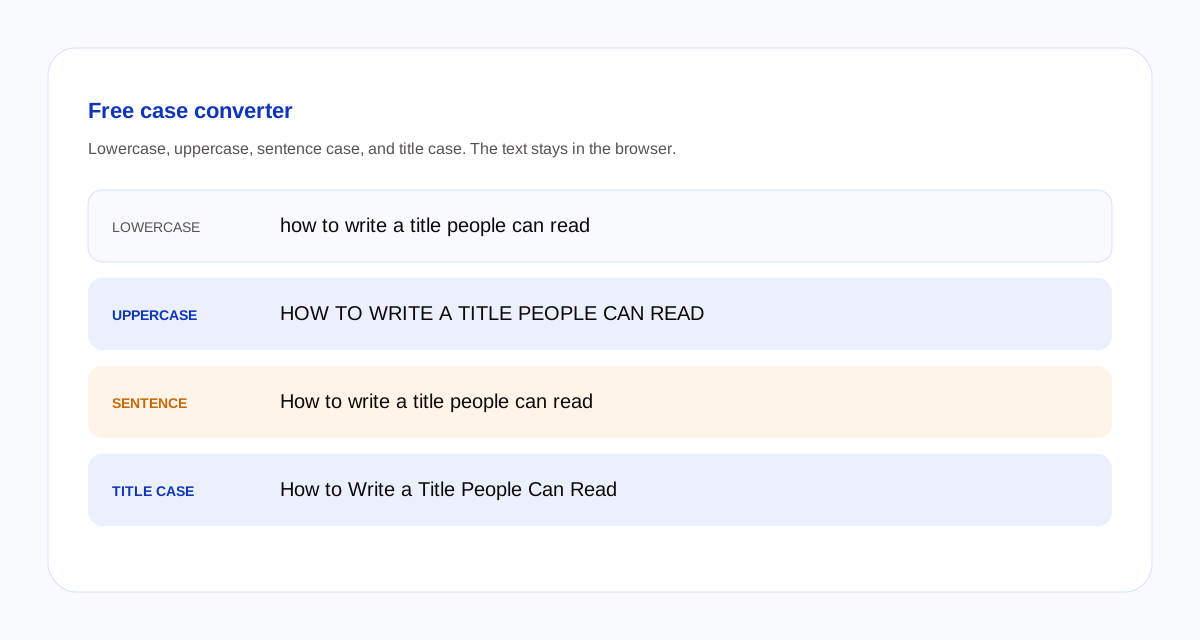
Lowercase
Uppercase
Sentence case
Title case
The four lines update as you type. They are not sent anywhere.
How each case is made
- Lowercase and uppercase use standard Unicode case mapping. They do not apply a language-specific rule such as Turkish dotted I.
- Sentence case lowercases the text, then capitalizes the first letter and the first letter after a period, question mark, or exclamation mark. A standalone i becomes I. An abbreviation such as i.e. can come out as I.E.
- Title case capitalizes the first letter of each word. These words stay lowercase unless they are first or last on the line: a, an, the, and, but, or, nor, for, so, yet, at, by, in, of, on, to, up, as, vs, via.
- A hyphenated word is capitalized on both sides, so well-known becomes Well-Known. The letter after an apostrophe stays lowercase, so don't becomes Don't.
This title case is a common style. It is not the full AP Stylebook or Chicago Manual of Style. Those books also look at parts of speech. After you have the headline, check the width in the SERP preview and read the title tag guide before you treat a character count as a Google limit.
Questions about this converter
What does this case converter change?
It rewrites the same text four ways: lowercase, uppercase, sentence case, and title case. Lowercase and uppercase use standard Unicode case mapping. They are not a language-specific rule such as Turkish dotted I.
Which words stay lowercase in title case?
a, an, the, and, but, or, nor, for, so, yet, at, by, in, of, on, to, up, as, vs, and via. The first and last word of each line are capitalized anyway. This is a common style on this page. It is not the full AP or Chicago rule book.
How does sentence case treat the word I?
Sentence case lowercases the text, then capitalizes the first letter and the first letter after a period, question mark, or exclamation mark. A standalone i becomes I. An abbreviation such as i.e. can come out as I.E.
Does this tool upload what I paste?
No. The text stays in the browser. Blogoose does not receive it.