How an AI draft quality review loop scores each section

A draft can read perfectly, ship, and still contradict itself three H3s later. That is the failure an ai draft quality review loop exists to catch, and the one a full-window skim is guaranteed to miss. You know the shape of it: the piece sounds fine, so it ships, and a week later you find the same term defined twice, differently, forty lines apart.
"Fine" is unfalsifiable. When nobody writes down what a pass looks like, no reviewer can point at a rule and say the draft broke it. What follows agrees the vibe check is failing you, then swaps it for a checkable procedure: segment the draft, score each section against a written rubric, regenerate only what fails, log the verdict.
Take a section that defines its coined term in the opening sentence and redefines it two H3s later. A whole-window read passes it; a section-level loop flags the duplicate at the voice and structure gates.
One section later clears all four gates and still breaks after a rewrite â the self-grading section covers why.
Why does reading the full chat output by hand not scale?
Reading a full chat output by hand does not scale because review sits at the end of the pipeline, where every article lands at once. Drafting got faster; the queue grew because gate placement never changed.
An ai draft quality review loop is a fixed sequence: draft, segment the article into sections, score each section against a written rubric, regenerate only the failing section, and log the verdict. The reviewer runs against the spec rather than the writing context, which is what stops a model grading its own homework. Because each verdict attaches to a section, a later reader can see which rule passed and which failed. That artifact is the difference between a review and a reread.
| Review surface | What you can see | What you can verify | What you can prove later |
|---|---|---|---|
| Scrolling chat window | Prose in one block | Whether it reads well | Nothing â no saved verdict |
| Per-section queue | Section, gate, and rubric line | Which pass condition failed | The logged verdict and the section diff |
Best for the solo operator publishing one or two posts a week: a chat window and a careful reread is honest work and costs nothing but time. Best for the publishing team shipping a ten-article cluster: the per-section queue, because at that volume the failure mode is drift, not carelessness.
Software teams land on the same conclusion from the other direction â test-first, human-reviewed work catches what a reread misses. Gates beat rereads for the same reason tests beat eyeballing, and it is why a review step belongs inside an automated SEO content pipeline rather than after it. If you are still assembling the research half of the stack, see our Surfer SEO alternatives breakdown. BloGoose crawls your domain to extract brand voice rules, so the rubric can be scored against an extracted style guide instead of someone's memory of it.
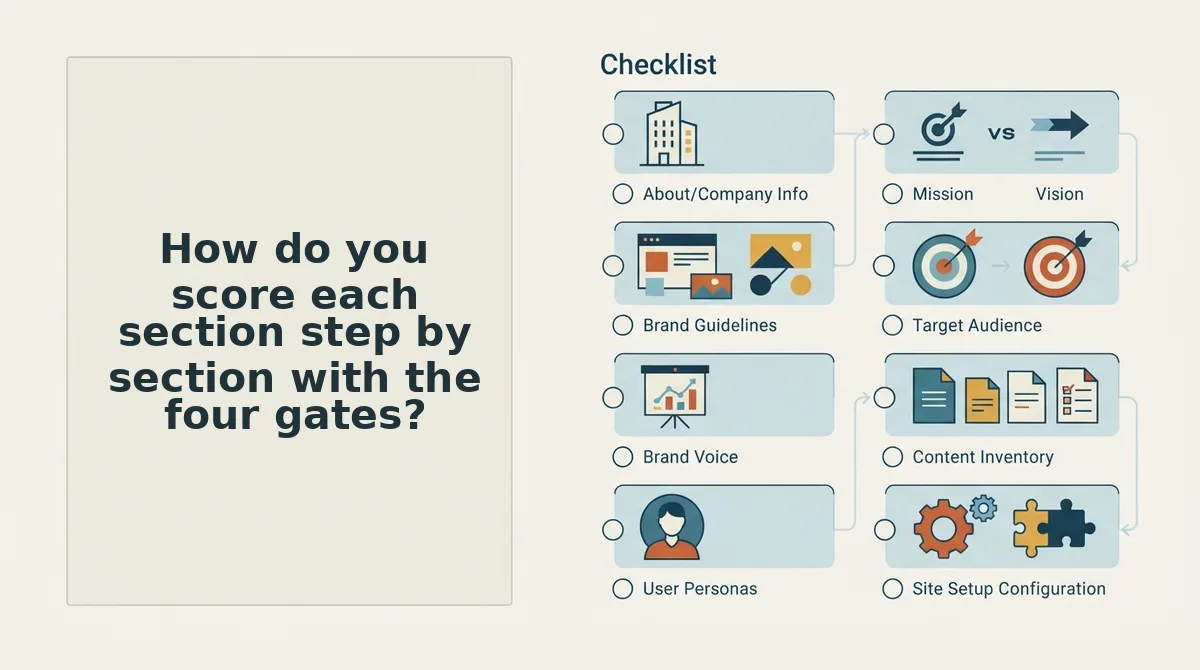
How do you score each section step by section with the four gates?
Score each section by running four gates in fixed order â context, voice, structure, citation â and recording pass or fail per gate before touching the next section. Before you start, you need three things open: the SEO content brief with its assigned question and target entities, the brand voice guide with its banned-phrase list, and a rubric file where each pass condition is one sentence a stranger could grade.
- Open the brief beside Gate 1 Context (about 5 minutes per section). Type the brief's assigned question above the section and check that the section answers it directly and names every target entity. Pass condition: "A reader who read only this section could answer the assigned question." Hard fail sends it back to drafting with the brief attached â do not patch it in place.
- Run Gate 2 Voice. Compare sentence rhythm, person, and banned phrases against the style guide, then search for any coined term and confirm it is defined exactly once, identically. A drifting or duplicate definition fails here, not at structure. Soft fails get a revision pass on the sentence, not a regeneration.
- Run Gate 3 Structure. Check heading level discipline, one idea per paragraph, list and table variety, and that no two sections open with the same construction. You should see a section that looks different from its neighbors.
- Run Gate 4 Citation. Trace every claim to the brief or a named source, confirm the answer passage is still self-contained, and confirm internal links sit inside a relevant sentence. For entity and answer formatting, see our AEO content optimization guide, and re-check any claim that depended on live SERP analysis.
- Verify the loop worked before the next section starts. Re-run the same rubric on a clean read â scoring must come out identical, and no section may pass twice for contradictory reasons. You should see the same gate verdicts both times.
Voice is where most rubrics stay vague, so the next question is how brand voice rules become pass or fail checks.
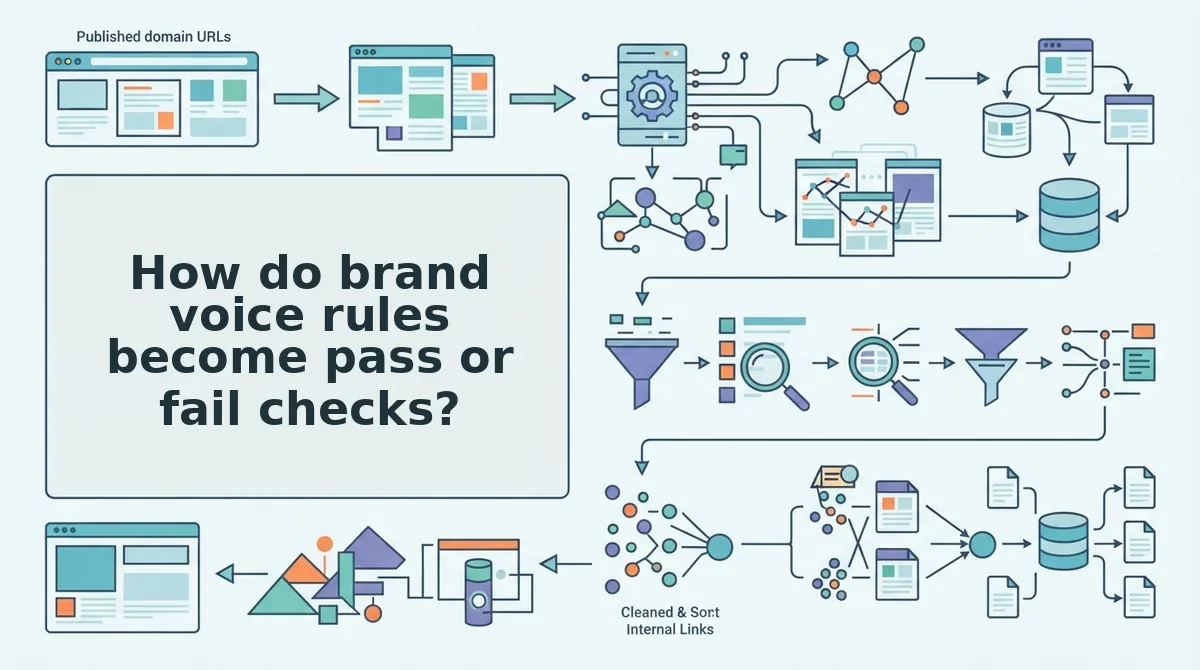
How do brand voice rules become pass or fail checks?
A voice rule becomes a pass or fail check only once it is rewritten as a sentence a reviewer can mark true or false without interpretation. Rules that stay adjectives â "warm," "plain," "direct" â get graded on mood instead of text.
To check brand voice consistency in an AI draft, compare each section against the written style guide rather than against the section above it. The reviewer asks three binary questions per section: does any sentence exceed the length cap, is every instruction in second person, and does the text contain a phrase from the banned list. Three yes/no answers produce a pass or fail in seconds, and a fail names the offending sentence instead of the vague impression that the tone slipped. Voice drift is a sentence-pattern shift mid-article, so the guide is the fixed reference and the draft is the variable.
- Write each rule as a testable sentence. Name the text feature and its threshold, not an adjective. "No sentence over 28 words" is gradable; "plain and direct" is not.
- Split a vague rule into its component checks. Worked example: "keep it plain and direct" becomes three checks â no sentence over 28 words, second person in instructions, no banned marketing phrases from the style guide. Each fails independently, so a fail points at a fixable line.
- Store the checks in saved Markdown context files. The rubric already exists as style-guide, target-keywords, and seo-guidelines files, so the loop reads them instead of re-explaining the brand each run. That is the same one-time extraction pattern as sitemap context extraction.
- Grade against the guide, never the section above. Neighbor-to-neighbor comparison passes drift along, because the drifted section becomes the new baseline. Fix the reference point to the guide.
- Retire rules you cannot convert. A voice rule with no observable text feature is decoration or a missing definition. Mark it and leave it ungraded rather than scoring a guess.
BloGoose crawls your published pages during setup and extracts those voice rules automatically, so each check is written once and reused across the whole calendar.
Why can an AI not grade its own draft in the same context?
Self-review is asking the same model, in the same conversation, to score what it just wrote â and it fails structurally rather than lazily, because the reviewer inherits the assumptions that produced the error.
Think of a building inspector who was on the crew that poured the foundation: the pour looks correct to him because it matches what he intended to build.
An AI can grade its own writing only if the grading pass runs in a separate context with a written rubric and the brief, and no access to the drafting conversation. Same context means the same wrong premise, so instructions like "be critical" change nothing measurable. Remove the drafting transcript, hand the reviewer a pass condition it can test, and the score becomes a property of the text rather than a mood the model was told to adopt.
Separation, not sternness, is the fix: a fresh pass holding the rubric and the brief. The harder failure is regression by rewrite â regenerating a full draft silently overwrites sections that already passed, so regeneration must be scoped to the failing section while approved sections are held fixed.
The stopping rule follows: stop when a pass returns only soft-fail nits and zero hard fails. A section that hard-fails the same gate three times means the rule is wrong, not the draft.
Worked example: a closing section keeps failing the citation gate because the gate demands a source the brief never supplied. The fix is a brief amendment, not another rewrite.
What to do before your next AI draft ships
Write your four pass conditions â context, voice, structure, citation â before you draft again, and save them as context files the loop reads. That single move is what breaks the pattern behind the opening question: the review queue grows because review sits at the end of the pipeline, and faster drafting only feeds it faster. Move the gate to each section and the queue stops compounding.
The same rule settles when you're done. Stop at zero hard fails and soft-fail nits only, and hold that line for every article in the calendar rather than renegotiating it under deadline.
One thing to keep: a gate you cannot fail is not a gate.
Next step: drop your domain into BloGoose so it crawls the site, extracts the voice and structure rules, and runs all four gates inside one engine instead of across a stitched-together stack.