
How to Avoid Generic AI Phrasing in Long Form Blog Posts
Every AI-generated draft you've ever rejected shares one hidden trait: it was statistically destined to sound like everyone else's. The reason you keep hitting "regenerate" isn't a weak prompt, it's that language models are built to predict the most probable next word, and the most probable word is almost never the most interesting one. If you've published long-form content that reads like a committee wrote it, you're not bad at prompting. You're fighting an architectural default.
You're right to be frustrated, and you're in good company. This guide will show you how to avoid generic AI phrasing by treating it as a probability problem you can engineer around, not a creativity problem you have to prompt your way out of. You'll learn why good prompts still produce bland output, how to identify the four specific phrasing patterns that make AI text feel hollow, and a sectional drafting protocol that forces information density over token probability.
Along the way, you'll discover why most "de-genericify your AI writing" advice misses the root cause entirely, and why the fix has less to do with writing better instructions than with restructuring how you feed context into the model. Platforms like BloGoose, which extract brand voice rules from your existing site before drafting, hint at where this is heading.
Why Does AI Writing Sound Generic Even With Good Prompts?
Generic AI writing is the predictable output pattern that emerges when a language model selects the most statistically probable next token instead of the most information-dense one. The problem is architectural, not instructional.
Think of a language model like a GPS navigation system that has logged billions of trips. When you ask it for a route, it doesn't invent a scenic backroad, it serves the route most drivers take. That's efficient for navigation, but disastrous for prose. The model isn't trying to be boring; it's optimizing for the highest-probability continuation of your prompt, and the highest-probability continuation of any sentence is the phrasing that appears most often in its training data.
This explains why even meticulously crafted prompts produce flat output. You can tell the model to "be creative" or "avoid clichés," but you're still asking it to predict words within a probability distribution that heavily favors common phrasing. The model doesn't have a taste filter, it has a frequency table.
Awa K. Penn's video on AI writing, which has accumulated 116K views, argues that prompting alone is insufficient; users need a fundamentally different approach to get distinctive output. Similarly, Future Fiction Academy's video on the topic states the problem is not the model itself but the input and process surrounding it.
What "generic" actually means in AI output is a measurable pattern: low lexical diversity, high-frequency transition words, and sentence structures that mirror the statistical center of the training corpus. The model isn't failing to be creative, it's succeeding at being average. The fix, then, isn't a better prompt. It's changing the probability landscape the model works within by feeding it context that makes distinctive phrasing the most probable choice.
The 4 Types of Generic AI Phrasing (With Examples)
Generic AI phrasing falls into four predictable categories: hedging language, throat-clearing openers, false transitions, and empty intensifiers. Each one signals low information density and can be systematically removed.
- Hedging language. Phrases like "It is important to note that..." and "It is worth mentioning that..." add zero information while padding word count. They exist because the model predicts them as safe, low-risk continuations. Cut every hedge and state the point directly; if the point isn't important enough to state plainly, it isn't important enough to include.
- Throat-clearing openers, "In today's fast-paced world..." and "In the ever-evolving landscape of..." delay the actual content by one to two sentences. These openers are the model's way of warming up before it commits to a specific claim. Delete them and start at the sentence that follows, it's almost always the real opening.
- False transitions, "Furthermore," "Moreover," and "Additionally" imply logical progression where none exists. They're filler connectors the model inserts to maintain surface-level flow. Replace each one with either a genuine causal or contrastive link, or nothing at all. If two sentences don't need a connector, the connector was padding.
- Empty intensifiers, "Very," "really," "truly," and "significantly" weaken the words they modify by signaling the writer doesn't trust the base adjective. "Very important" reads as less confident than "critical." Strip intensifiers and upgrade the root word instead.
These four patterns account for the majority of "AI-sounding" prose in long-form content. A practical way to eliminate them at the source is to maintain a banned-phrase list in your style guide, something an auto-generated style guide with banned phrase lists can enforce automatically across every draft.
Once you can spot these patterns, the next step is restructuring your drafting process so the model never produces them in the first place.
How to Fix Generic AI Writing With Sectional Drafting
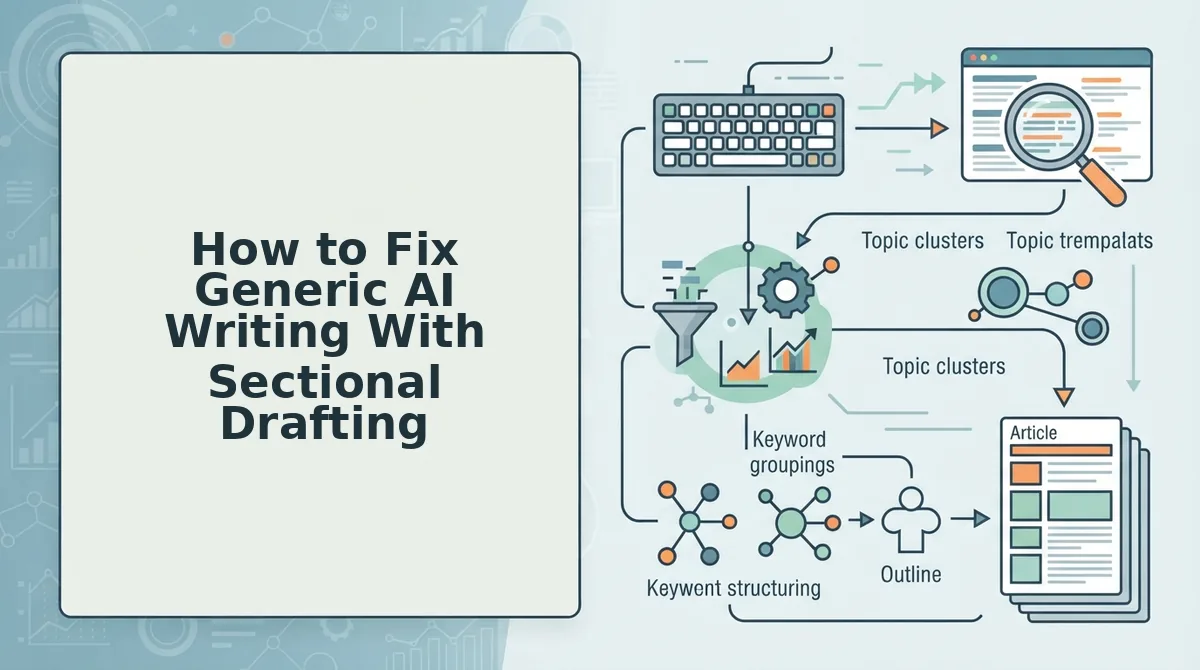
Sectional drafting eliminates generic AI phrasing by treating each section of a long-form post as an independent brief with its own context block, constraint set, and review cycle, preventing the copy-paste voice drift that plagues single-prompt drafts.
Prerequisites: A working outline with section headings, a style guide (or a style guide auto-generated from your website), and a drafting tool that supports per-section prompts. Budget 10-15 minutes per section for drafting plus a 5-minute review pass.
- Open your outline and isolate the first section. Copy only that section's heading and its intended purpose into a new prompt window. Do not include the full article. You should see a blank prompt field containing only one section's scope, not the entire post.
- Type a Role-Task-Context prompt for that section alone. William Zain's framework works best applied per section: assign the role (e.g., "You are a B2B SaaS editor"), the task ("rewrite this section to eliminate hedging"), and the context ("this section sits between the intro and the first how-to step"). Expect output that matches the section's position instead of a generic middle-of-article tone.
- Set 2-3 constraints specific to the section. Add rules like "no sentence over 18 words," "include one specific number," or "ban the phrase 'it is important to note.'" Tai Pham Phu's testing shows prompt length and detail correlate directly with output quality, longer, more specific constraints produce measurably less generic phrasing.
- Run the draft and review it independently. Read the section without looking at neighboring sections. You should see a self-contained block that reads naturally on its own, with no throat-clearing or filler carried over from the previous section.
- Repeat for each remaining section before assembling the full post. Paste all independently drafted sections into your CMS in order. The final article should read as a cohesive piece with varied sentence rhythm and no repeated transition phrases.
BloGoose automates this protocol with sectional drafting agents that generate each section with its own context block, constraint set, and review cycle, so you get the quality of manual sectional drafting without the 15-minute-per-section time cost.
7 Specific Fixes for Generic AI Phrasing
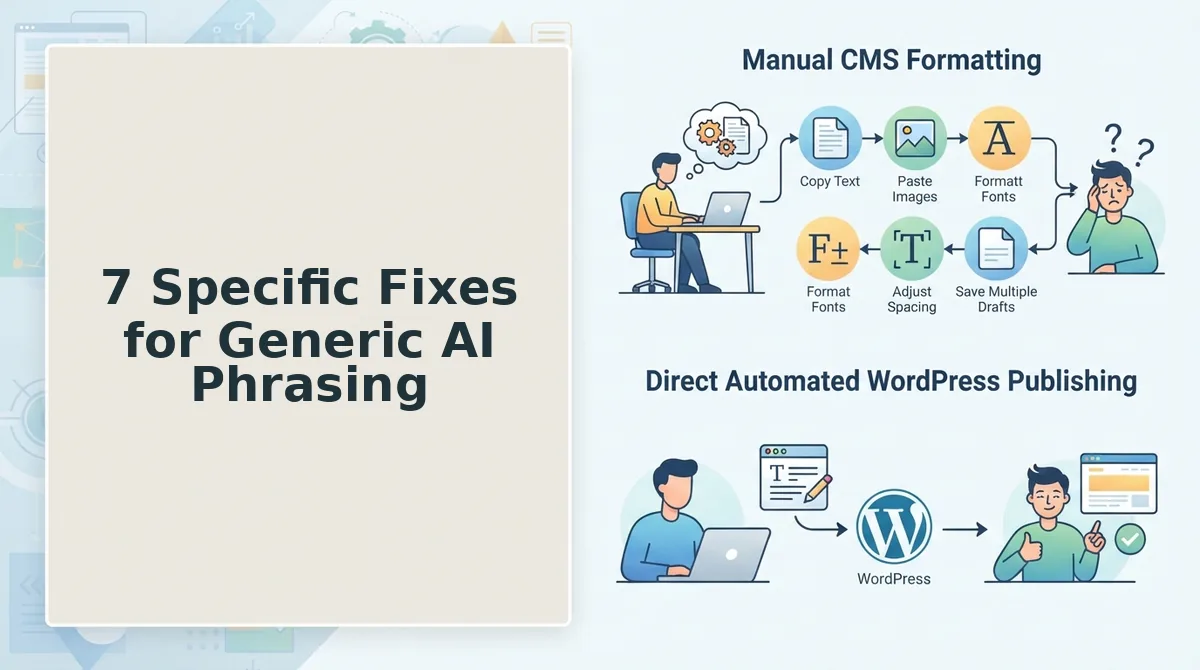
Generic AI phrasing is fixable with targeted edits, not full rewrites. Apply these seven fixes in order, each one removes a specific pattern that makes AI writing sound hollow.
- Replace hedging with assertions. Phrases like "it is important to note that" and "it may be worth considering" signal uncertainty and dilute authority. Delete the hedge and state the claim directly: "It is important to note that page speed affects rankings" becomes "Page speed affects rankings."
- Cut throat-clearing openers. Sentences like "In today's fast-paced world" and "As we all know" add zero information and delay the point. Delete them entirely, your first sentence should carry the section's main claim.
- Vary sentence structure. AI drafts default to subject-verb-object sentences of similar length, creating a robotic rhythm. Mix short declarative sentences with longer compound ones, and occasionally start with a dependent clause to break the pattern.
- Add specific numbers, names, and dates. Generic writing avoids specifics because specifics require research. Replace "many companies" with "37% of surveyed companies," replace "recently" with "in Q3 2026," and replace "experts say" with a named source.
- Use contrarian angles. AI defaults to consensus positions that read as filler. Take the opposite stance where evidence supports it: instead of "content marketing is important," write "content marketing without distribution is a cost center, not a growth channel."
- Read the draft aloud. Generic phrasing often passes visual review but fails the ear test. Reading aloud exposes repeated sentence rhythms, awkward transitions, and phrases no human would actually say in conversation.
- Use a style guide with banned phrases. Create a list of phrases your brand never uses, "delve," "navigate," "landscape," "it is important to note", and run every draft through it. BloGoose can auto-generate a style guide with banned phrase lists from your existing website, turning this fix into an automated editing pass instead of a manual checklist.
How to increase information density in AI-generated blog posts: Replace abstract nouns with concrete data points, delete every sentence that does not introduce a new fact or instruction, and add at least one specific number, name, or date per 200 words. A dense paragraph reads as researched and authoritative, while a vague one reads as filler, and information density is the single strongest signal that separates human-edited content from raw AI output.
FAQ: Avoiding Generic AI Phrasing
Direct answers to the most common questions about generic AI writing, drawn from real user searches and community discussions.
How do I humanize AI content without manually rewriting everything?
Humanizing AI content requires a systematic editing workflow, not just better prompts. Apply a fixed checklist, cut hedges, add specifics, vary sentence length, read aloud, to every draft. Tools like BloGoose's sectional drafting agents automate parts of this workflow by generating each section with its own constraints and review pass.
What are the most overused AI phrases?
The most overused AI phrases include "delve," "navigate," "landscape," "it is important to note," "in today's fast-paced world," and "furthermore." These phrases appear disproportionately in AI-generated text because they are statistically common tokens, not because they add meaning.
Can prompt engineering alone fix generic AI writing?
No. Prompt engineering alone cannot fix generic writing because the model still optimizes for token probability, not originality. Better prompts reduce generic output but do not eliminate it, a separate editing or sectional review pass is still required.
How do sectional drafting agents work?
Sectional drafting agents generate each section of an article independently with its own context block, constraint set, and review cycle. This prevents voice drift and repeated phrasing across long posts, producing output that reads like a human wrote each section separately.
If the workflow still feels manual, the next section covers how to fix the root cause instead of patching symptoms.
Stop Fighting Generic AI Writing. Fix the Workflow.
Generic AI phrasing is a probability problem, not a prompt problem. The model defaults to the most statistically likely next token, and that default is filler. Better prompts don't change the distribution. Better workflows do.
The fix is structural: classify the filler patterns you see, rewrite at the section level instead of line-by-line, and draft with constraints that force specificity. Sectional drafting works because it shrinks the context window the model can draw from, which raises the cost of vague output.
Here's the workflow in three moves:
- Classify before you edit. Label every weak sentence as hedging, throat-clearing, filler transitions, or abstract nouns. You can't fix what you can't name.
- Rewrite sections, not sentences. Delete the paragraph and redraft it against one constraint: every sentence must carry a fact, a number, or a named example.
- Automate the constraint loop. An AI SEO content engine that drafts sectionally applies these constraints by default, so you're editing fewer defaults and publishing faster.
You don't need better prompts. You need a drafting system that makes generic output structurally expensive. Fix the workflow, and the phrasing follows.