
How to Avoid Repetitive Phrasing in AI Blog Sections
You've read three paragraphs of an AI-generated blog post and already know exactly how the fourth one will sound. Same sentence opener. Same clause rhythm. Same transition word. If you've ever wondered how to avoid repetitive phrasing in AI blog sections, you're not imagining the problem. AI detectors flag repetitive sentence patterns as a primary signal of machine-generated text, and readers bounce the moment they sense the loop.
You're right to be frustrated. Most advice tells you to "vary your vocabulary" or "edit more carefully," but that's treating the symptom, not the cause. This article will show you the mechanical reasons AI writing falls into repetitive loops, and give you a repeatable drafting system that prevents the problem before it hits the page.
Here's the roadmap: first, we'll dissect the root cause of AI repetition at the model level. Then you'll learn a four-step sectional drafting method that forces structural variety. Finally, we'll hand you prompt patterns that make sentence-level monotony nearly impossible. Along the way, you'll see why a dedicated AI SEO content engine beats a chat window for consistent, varied output, and one surprising finding about context anchoring that changes how you should sequence every prompt. If you're also optimizing for AI citations, the same variety principles apply to how to get cited in AI answers.
Why AI Writing Sounds Repetitive (The Root Cause)
AI writing repetition is the tendency of large language models to reuse sentence structures, transition phrases, and clause patterns across consecutive sections of generated content, creating a mechanical, templated feel that readers and AI detectors both recognize.
Think of an AI model like a jazz musician who only knows one chord progression. It can improvise notes within that progression, but the underlying structure never changes. Repetitive AI writing works the same way: the vocabulary shifts, but the skeleton stays locked.
The first mechanical cause is context anchoring. When an AI generates section three of a blog post, it weights the patterns from sections one and two heavily. If section one opened with "When it comes to," the model is statistically more likely to open section two the same way, because that pattern now lives inside the context window. The longer your prompt chain, the more anchored the model becomes to its own earlier output.
The second cause is prompt reuse. If you paste the same instruction, "Write a section about X in a professional tone", into every prompt, you're asking for template fatigue. The model treats each request as a variation of the last, and identical phrasing is the predictable result.
The third cause is temperature settings. Temperature controls how deterministic a model's output is. Low temperature values (close to 0) make the model choose the most statistically probable next token every time, which produces safe, predictable, and repetitive, sentences. Higher temperature values introduce more randomness, but also more risk of incoherence.
Here's the passage-level answer most guides miss: AI repetition is not a vocabulary problem. It's a sampling and context problem. The model isn't choosing to repeat itself; it's being mathematically steered toward repetition by low temperature, long context windows full of similar patterns, and prompts that don't force structural variation. Fix those three inputs, and the output changes without any manual editing.
The Sectional Drafting Method: One Section, One Prompt
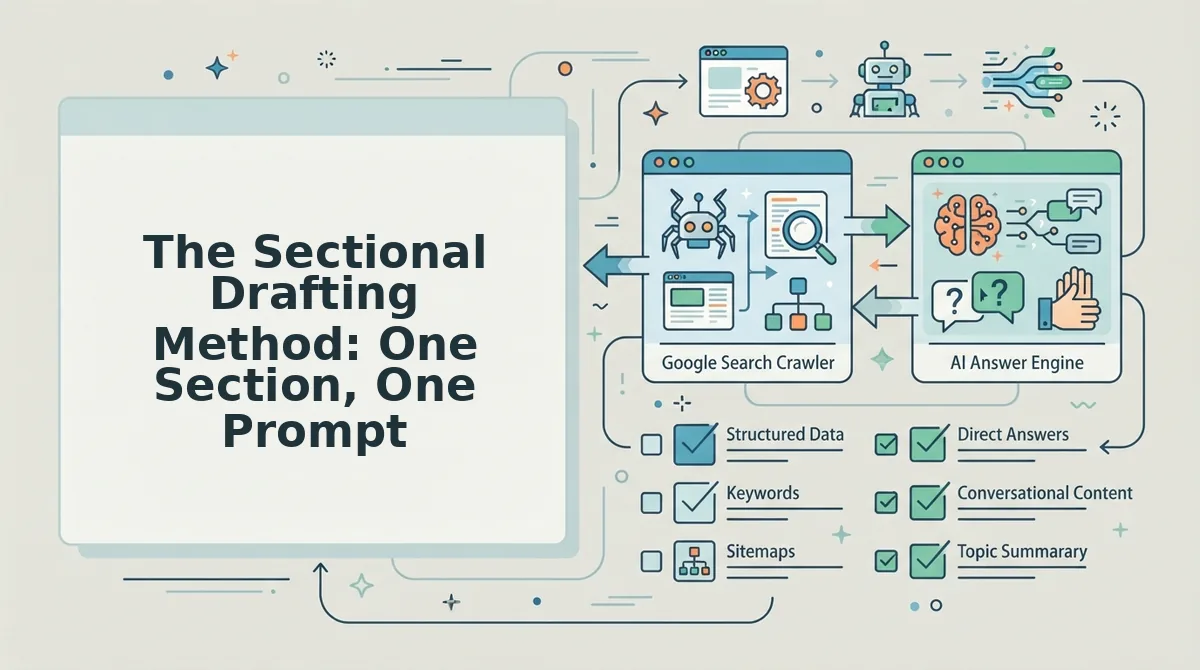
The sectional drafting method is a four-step process where each blog section gets a unique agent prompt, tone modifier, and structural template before generation, preventing the context anchoring and prompt reuse that cause repetitive AI writing.
Prerequisites: A complete article outline broken into standalone sections, access to an AI writing tool that supports custom prompts per section, and a list of at least five tone modifiers (e.g., analytical, conversational, instructional, contrarian, narrative).
- Break the outline into standalone sections. Open your outline and split it so each H2 or H3 is a self-contained unit with its own goal. A section on "pricing factors" should not depend on phrasing from "market overview." Expected outcome: each section can be drafted independently without referencing the previous one's sentence patterns.
- Assign a unique agent prompt per section. Write a one-sentence role instruction that changes for every section. For example: "Act as a data journalist explaining churn metrics" for one section, then "Act as a skeptical product reviewer" for the next. Expected outcome: the model's voice and sentence rhythm shift because the role context shifts.
- Vary tone modifiers and structural templates. Attach a different structural template to each prompt, one section gets a numbered list, the next gets a comparison table, the next gets a Q&A format. Pair each with a distinct tone modifier from your list. Expected outcome: no two consecutive sections share the same opening pattern or paragraph shape.
- Draft sections in isolation, then stitch. Generate each section in a fresh chat or with a cleared context window. Paste the finished sections together only after all are drafted. Expected outcome: the model never sees its own previous output, so context anchoring cannot influence later sections.
This method works because it attacks all three root causes at once: fresh context windows eliminate anchoring, unique prompts eliminate template fatigue, and varied structural templates force different sentence shapes. Simon Scrapes' YouTube breakdown of AI blog writing systems makes the same point, one-off prompts produce inconsistent, repetitive output, while a structured per-section workflow produces publishable drafts. ZimmWriter's Frase AI paragraph workflow applies a similar principle at the paragraph level, confirming that isolated drafting per section is a recognized best practice.
If you're running this process manually across dozens of articles, a dedicated AI SEO content engine automates the per-section prompt variation and context isolation for you. For a deeper comparison of why this beats pasting prompts into a chat window, see AI content engine vs chat window workflows.
Next, we'll look at seven prompt patterns that force sentence variety even within a single section.
7 Prompt Patterns That Force Sentence Variety
Copy-paste prompt patterns are the fastest way to break repetitive AI phrasing, because they give the model explicit structural constraints instead of vague style requests. Each pattern below targets a specific repetition failure mode and can be dropped directly into your drafting workflow.
- Vary sentence length across the paragraph. Repetitive AI text often locks into a uniform 18-22 word cadence. Add this instruction to your prompt: "Write this paragraph with at least one sentence under 8 words and one sentence over 30 words, alternating short and long constructions." This forces rhythmic contrast that reads as human pacing.
- Change the paragraph opener for each new paragraph. AI drafts frequently start consecutive paragraphs with the same grammatical unit, such as a gerund or a "This" reference. Prompt: "Begin each paragraph with a different grammatical structure, alternate between a subject, a prepositional phrase, a question, and a subordinate clause." This eliminates the monotone feel readers notice within the first three lines.
- Rewrite with different clause structure. The default AI pattern "X is Y because Z" appears in nearly every explanatory sentence. Prompt: "Rewrite this paragraph so no two consecutive sentences share the same clause order, mix subject-verb-object, dependent clause first, and inverted constructions." This breaks the template feel at the syntactic level.
- Humanize transitions between ideas. AI over-relies on "Additionally," "Moreover," and "Furthermore" as connective tissue. Prompt: "Replace all formal transition words with natural spoken connectors like 'That said,' 'Here's why,' or 'But there's a catch,' and vary them so none repeats." This restores conversational flow without losing logical coherence.
- Swap repeated key terms for context-appropriate synonyms. When AI fixates on one term, it repeats it in every sentence. Prompt: "Identify the most repeated noun or phrase in this text, then replace 60% of its occurrences with synonyms or pronouns that fit the surrounding context." This prevents keyword stuffing while preserving search relevance.
- Alternate between active and passive voice deliberately. Uniform active voice can feel mechanical in long-form content. Prompt: "Rewrite this section using active voice for actions and passive voice for results or states, alternating at least once per paragraph." This adds subtle variety without sacrificing clarity.
- Inject a short rhetorical question or fragment every 150 words. AI rarely generates sentence fragments or questions unprompted. Prompt: "Add one rhetorical question or intentional sentence fragment every 150 words to break the declarative rhythm." This mirrors how skilled human writers create emphasis and pacing. For a deeper workflow on locking these patterns into your content pipeline, see how to automate brand voice in AI blog posts.

The Repetition Audit Checklist: 10 Things to Scan For
A structured audit catches repetition faster than rereading, because it turns vague "this feels off" impressions into a scannable diagnostic. Work through this 10-point checklist on any AI draft before publishing, and you will isolate the exact failure points without rewriting everything manually.
- Repeated sentence starters. Scan the first word of every sentence in a paragraph. If "However," "Additionally," "This," or "It" appears more than twice in a row, flag the section for opener variation.
- Repeated transition words. Count occurrences of "Moreover," "Furthermore," "Therefore," and "In addition" across the full draft. More than three instances of any single connector signals formulaic flow.
- Repeated clause patterns. Look for the "X is Y because Z" or "By doing X, you can Y" template appearing in consecutive sentences. Two in a row is a warning; three is a rewrite trigger.
- Uniform paragraph length. Measure paragraph word counts. If every paragraph falls within a 15-word range, the draft lacks the natural ebb and flow of human writing.
- Synonym diversity in key terms. Search for your primary keyword and its variants. If the exact same phrase appears in every paragraph without pronouns or synonyms, it reads as stuffing, not optimization.
- Repeated adjective-noun pairs. AI often reuses the same modifier, such as "powerful tool" or "key factor." Flag any adjective-noun combination that appears three or more times.
- Identical list item structures. In bulleted or numbered lists, check whether every item starts with the same part of speech. Parallel structure is good; identical phrasing is monotonous.
- Repeated "This means" or "In other words" explanations. AI over-explains by restating the same point twice. Flag any sentence that adds no new information to the one before it.
- Uniform sentence length within paragraphs. Count words per sentence. If all sentences in a paragraph are within five words of each other, the rhythm is flat.
- Repeated opening formula across sections. Check whether every H2 section starts with the same construction, such as "When you" or "One of the." Vary section openers to maintain reader momentum. Run this checklist as part of a broader SEO content audit to catch repetition at scale across your entire site.
Before and After: Fixing a Repetitive AI Paragraph
Seeing a concrete transformation makes the sectional drafting method tangible. The example below shows one AI-generated paragraph rewritten with specific structural changes annotated, so you can replicate the fixes on your own drafts.
| Version | Paragraph | What Changed |
|---|---|---|
| Before | AI content is useful for scaling blog production. AI content is fast because it generates drafts in minutes. AI content is consistent because it follows the same style rules. AI content is limited when prompts are generic. AI content is repetitive when the model defaults to the same sentence patterns. | Every sentence starts with "AI content is." Every sentence follows the subject-verb-complement pattern. Sentence length is nearly identical at 8-10 words. No transitions or connectors. |
| After | Scaling blog production with AI is undeniably useful, drafts that once took hours now arrive in minutes. Consistency comes built in, since the model follows the same style rules across every piece. But there's a catch. Generic prompts produce limited output, and the model defaults to the same sentence patterns until you tell it otherwise. | Opener changed from subject to gerund phrase. Sentence lengths now range from 3 to 22 words. "But there's a catch" replaces a formal transition. One fragment ("But there's a catch") breaks the declarative rhythm. Key term "AI content" replaced with "the model" and "drafts" to avoid repetition. |
Best for content teams who need a repeatable before-and-after reference when training writers or configuring AI prompts: the annotated changes show exactly which structural levers to pull. Best for solo operators who want a quick diagnostic template: compare your draft against the "Before" column to spot the same failure modes. The sectional drafting method works because it forces these changes at the prompt level rather than relying on manual line edits.
Now that you have seen the transformation in action, the next step is answering the most common questions about applying these fixes consistently.
FAQ: Avoiding Repetitive Phrasing in AI Blog Sections
AI repetition stems from token prediction patterns, not a lack of vocabulary. The fix is structural: constrain each generation with varied prompt instructions, audit output against a fixed checklist, and regenerate problem sentences rather than rewriting whole drafts.
Why does my AI content repeat the same sentence structure?
Large language models default to high-probability syntactic patterns like "X is Y" or "By doing X, you can Y." Because the model optimizes for likely token sequences, it reuses familiar constructions unless the prompt explicitly demands variation in sentence length, opener type, and clause order.
What prompt should I use to make AI writing less repetitive?
Instruct the model to vary sentence openers, alternate between short and long sentences, and avoid starting consecutive paragraphs with the same word. Add constraints like "no two sentences may begin with the same part of speech" and "include at least one question, one fragment, and one compound sentence per section."
Can I fix repetitive AI writing without rewriting everything?
Yes. Run a repetition audit on the draft, mark only the offending sentences, then regenerate those lines individually with a targeted prompt such as "rewrite this sentence with a different opener and clause structure." This preserves the good content while eliminating the pattern.
How do I stop AI from starting every paragraph the same way?
Use the sectional drafting method: feed the AI one section at a time with an explicit instruction like "do not begin any paragraph with 'To,' 'By,' or 'This.'" Also include two example openers in the prompt so the model has a concrete alternative pattern to imitate.
What is the fastest way to check for repetitive phrasing in AI drafts?
Scan the first three words of every sentence and every paragraph. Tools that highlight repeated n-grams or sentence-start patterns can automate this check in under a minute.
Build a Repetition-Proof Drafting Workflow
Sectional drafting prevents repetition at the source by limiting each AI generation to one focused task with explicit variation constraints. The audit checklist catches any patterns that still slip through, turning a vague editing pass into a systematic 10-point scan. Together, they convert an unpredictable AI output problem into a repeatable quality gate.
If you are running this workflow manually, start with the sectional method on your next article and run the audit before publishing. If you publish at volume, an AI SEO content engine like BloGoose automates sectional drafting with built-in variation checks, so every section ships with opener diversity and sentence-length balance already enforced. Your next step is to take one draft, apply the audit checklist, and measure how many flagged patterns disappear after a single regeneration pass.