How Do I Balance Search Intent Across a Monthly Content Calendar?
Picture next month's plan: twelve how-to posts in a row, no comparison post, no commercial page. A reader finishes every article with nowhere to go next. The calendar looks full, but it gives readers no route toward your product.
That stacking problem is common. Most advice on how to balance search intent across content calendar slots stops at the mechanics of building one. Creators like Robin Maylone walk through six-month SEO calendars built around columns, cadence, and tool setup, but the intent mix rarely gets its own step.
This guide covers the distribution problem. You will learn to classify intent from the live search results in about three minutes per slot. You will also learn to assign every post to one of three lanes and link those lanes so each article points to a next step.
First comes a working definition and the lane vocabulary. Next is a SERP-first classification method, followed by the 30-Day Intent Grid. Along the way, you will see why the fixed informational-to-commercial ratio many teams copy is the wrong target, and what to use instead.
What does balancing search intent in a content calendar mean?
Balancing search intent in a content calendar is the practice of spreading posts across informational, comparison, and commercial lanes. No lane takes more slots than its topic cluster can support, and every post links to a post in another lane. The calendar becomes a path from learning to buying.
Start with the simplest version. Informational and commercial intent differ in what the reader does next, not in how the post is written. An informational reader wants to understand how something works and leaves once they do. A commercial reader is evaluating a specific tool and is close to acting, such as starting a trial.
Think of a well-run grocery store. Recipe cards sit near the entrance, brands share a shelf for side-by-side choosing, and checkout waits at the front. A store stocked only with recipe cards gets plenty of browsers but few paying customers.
| Lane | Reader goal | Post format |
|---|---|---|
| Informational | Understand a mechanic | How-to guide, explainer |
| Comparison | Choose between options | Alternatives roundup, X vs. Y |
| Commercial | Evaluate a specific tool | Product page, feature deep-dive |
At the advanced level, a balanced calendar depends on your cluster structure. A pillar page is the broad hub article. Supporting articles cover narrower subtopics and link back to it. If a cluster has only one product worth evaluating, five commercial posts will compete for the same query, which is called keyword cannibalization. If a cluster has twenty how-to posts and no comparison post, readers have no next step. Map your lanes during topic cluster planning, then give each lane only as many slots as the cluster supports. Each post should link up to the pillar and across to at least one other lane.

How do you identify search intent before writing a blog post?
Identify search intent by reading the live results page, not by guessing from the keyword. Pull the top ten results and label each by its dominant content type. Then read the SERP features, which are the boxes Google adds such as "People also ask," and let the majority format decide the lane.
What you need: a private or incognito browser window (or a SERP preview tool), and a spreadsheet with columns for keyword, result type, and lane. Plan on about three minutes per calendar slot.
- Search the target keyword and pull the top ten organic results (about 30 seconds). Skip ads. You should end up with ten URLs listed in your sheet.
- Label each result by its dominant content type (about 90 seconds). Tag each one as how-to, roundup, comparison, or product page. You should see one label appear more often than the others.
- Read the SERP features to see what the reader is trying to do (about 30 seconds). "People also ask" questions and video results suggest a learning task. Product carousels and review stars suggest an evaluation task. Note the task in your sheet.
- Assign the lane, or flag a dual-lane slot (about 30 seconds). The majority format wins. A close split between two formats means you should write one post that serves both needs instead of forcing it into a single lane.
Here is a worked example from this site's own calendar. A live SERP analysis guide is slotted as an informational how-to, and a nine-best-alternatives roundup is slotted as a comparison post. Each was assigned a lane based on what its top ten results showed, not on how the keyword sounded.
Running this check by hand for thirty slots takes time. BloGoose builds pillar-focused calendars from a crawl of your site, and you can review SERP preview and intent signals before you commit a slot.
Once every slot has a lane, the next job is arranging those lanes week by week.
How do you build a 30-day intent grid that never stacks one lane?
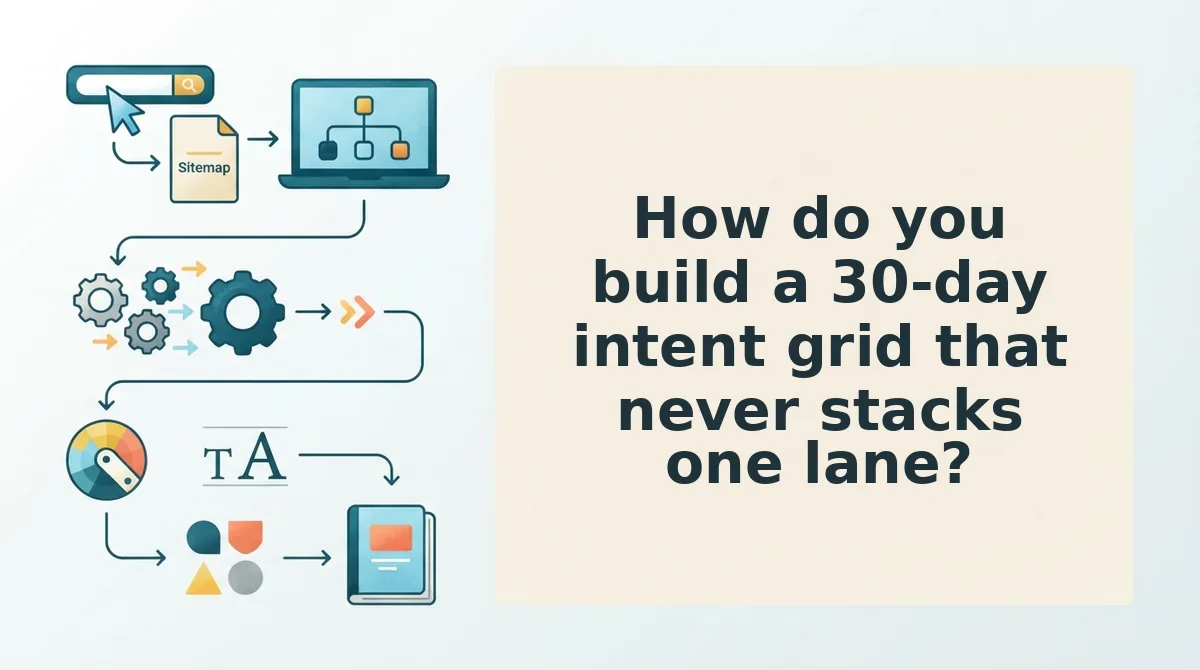
A 30-day intent grid is a four-week schedule split into three lanes (informational, comparison, and commercial) with one hard rule: no two consecutive slots share a lane. You fill it in four steps. Tag each keyword, choose a lane mix by cluster stage, place dependencies first, then check adjacency.
Prerequisites: your keyword list, the SERP classifications from the previous section, and a spreadsheet or calendar tool. Plan on about 90 minutes for a 12-post month.
| Week | Informational | Comparison | Commercial |
|---|---|---|---|
| Week 1 | Slot 1 (pillar), Slot 3 | Slot 2 | None |
| Week 2 | Slot 5 | Slot 4 | Slot 6 |
| Week 3 | Slot 7, Slot 9 | Slot 8 | None |
| Week 4 | Slot 11 | Slot 12 | Slot 10 |
- Open your keyword sheet and add a Lane column (20-30 minutes). Tag each keyword as informational, comparison, or commercial, based on the dominant format in its top 10 results. Every row should have exactly one lane tag.
- Select a lane mix by cluster stage (10 minutes). A new cluster leans heavily informational. A growing cluster adds comparison bridges. A mature cluster can carry more commercial slots. This is a judgment call, not a statistic. The grid above shows a growing cluster with 6 informational, 4 comparison, and 2 commercial posts.
- Place the pillar and dependencies first (30 minutes). A commercial post never runs before the pillar or informational post it depends on. Each commercial slot should have a published parent post above it.
- Scan the slots in order (10 minutes). Read slots 1 through 12 and swap any adjacent pair that shares a lane. Two commercial posts must never run back to back. The finished sequence should alternate with no repeated lanes.
Here is a worked example. Say you plan a commercial guide to choosing an AEO content optimization tool. Before it can rank, you need an informational post on how content gets cited in AI answers, scheduled at least one slot earlier. That earlier post gives the commercial guide a topic to rank against and a natural source for an internal link. If the order is reversed, the commercial post goes live with no context and no inbound link from its own cluster.
If tagging and sequencing by hand eats your planning week, automated SEO content workflows can build the grid from your site structure instead.
How do you audit an existing calendar for intent stacking?
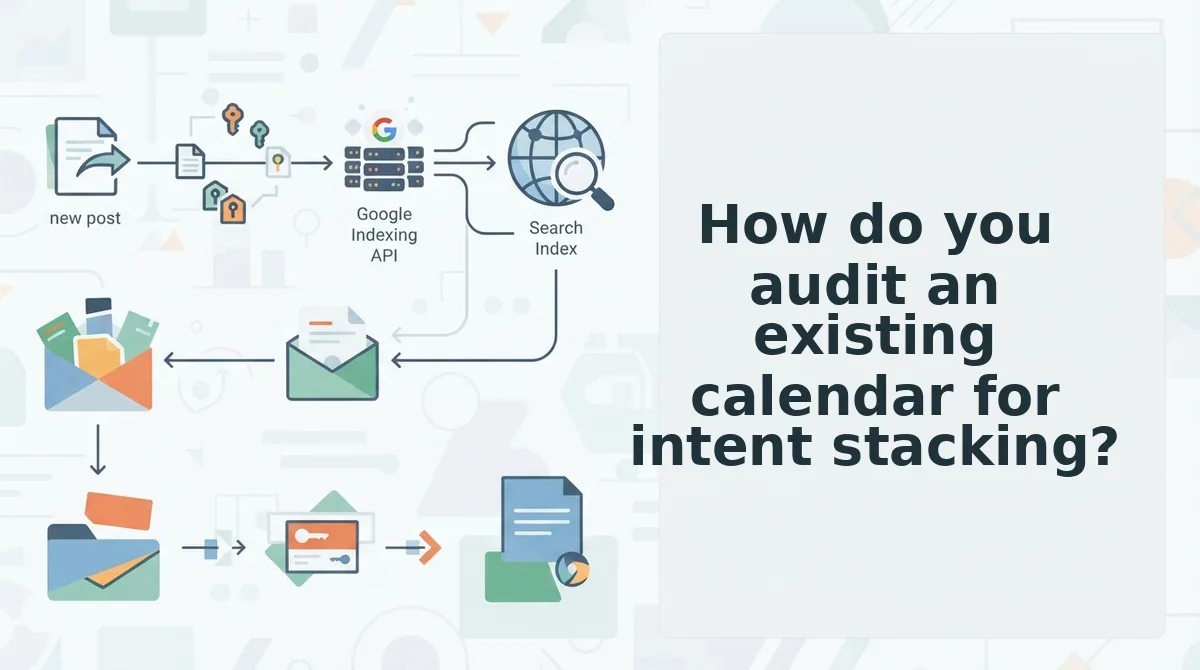
Run five checks against the slots you already have, starting with the one that costs the most traffic. You can usually fix stacking by reordering posts, so most audits need no rebuild.
- Check for adjacent stacking. Read your slots in publishing order and flag any two neighbors that share a lane. Stacked slots split crawl attention and leave readers with no next step, so fix them by swapping a flagged slot with a post from a different lane.
- Check for orphaned commercial posts. Confirm that every commercial post has a pillar or informational parent that publishes first. A commercial post without a parent has no topical support, so move it behind its parent.
- Check for missing comparison bridges. Look for clusters that jump straight from informational content to commercial posts. A comparison post such as sitemap extraction versus pSEO connects sitemap how-to content to evaluation intent, so add one bridge to each cluster that lacks it.
- Check for cross-lane cannibalization. Search your calendar for keywords that appear in two lanes, such as an informational post and a commercial post on the same term. One post can serve a secondary intent, but two posts on one term compete for the same ranking, so merge them or give each its own keyword.
- Check for dead-end internal links. Open each post's link plan and confirm it points to a post in the next funnel stage. Links that loop sideways stall readers, so add one forward link per post.
Rebalance your lanes whenever a cluster adds a new pillar, not on a fixed monthly schedule. For a deeper review of what is already live, pair these checks with an SEO content audit.
What should you change in your calendar this week?
Reclassify this month's existing slots using SERP evidence. Then move one commercial post behind the informational post it depends on. That single move costs nothing and fixes the most expensive sequencing mistake in most calendars.
This also settles the ratio question from the start of the article. No fixed informational-to-commercial split applies to every site. The right mix depends on how mature each cluster is, and the adjacency rule keeps that mix from collapsing into one lane.
If you want to go further, take these next steps in order:
- Run the five-check audit on your current calendar so every lane has a parent, a bridge, and a forward link.
- Let BloGoose build the next month. Drop your domain into the BloGoose setup wizard once your lanes are clear. It reads your sitemap and plans an intent-balanced 30-day calendar, so you skip the hand-built grid.
Once intent order becomes a scheduling rule, each post sets up the one after it.