How to balance search intent in a content calendar

Your analytics dashboard shows steady impressions, yet qualified pipeline remains flat. Most publishing schedules fail because calendars appear organized and rigorous on spreadsheets while failing completely in revenue delivery due to zero commercial evaluation paths. Deploying an AI SEO content engine requires knowing how to balance search intent in a content calendar, ensuring educational reach connects directly with high-intent decision pages so organic traffic actually converts.
Balancing search intent means structuring editorial schedules across informational, commercial, and comparison layers rather than defaulting entirely to top-of-funnel guides. You will learn how to map search queries to exact buyer lifecycle stages, weight production ratios, and route organic readers directly toward conversion actions. We will also examine why high-volume informational clusters often suppress revenue until paired with a specific architectural link pattern covered later in this guide.
Consider this operational scenario:
- The situation: A blog schedule is filled exclusively with how-to queries that draw page views but generate no signups.
- The action: The team pulls topic generation from live SERP competitive gaps, balancing informational indexing guides with commercial alternatives and direct platform comparisons.
- The outcome: Organic visitors enter through technical tutorials and immediately navigate along explicit evaluation paths.
This framework applies to search visibility on standard engines and AI citation engines, though conversion rates still depend on your product's underlying offer. To eliminate manual spreadsheet planning, configure an automated engine to crawl your sitemap and extract structured markdown files that govern topic intent across every run. Before executing this automation, you must first clarify what search intent mapping looks like within an operational workflow.
What Search Intent Mapping Means for an Editorial Roadmap
Search intent mapping aligns target search queries with concrete content deliverables so every article matches the exact stage of problem-solving a user expects. Instead of treating keywords as generic writing prompts, it turns search motivations into technical production requirements.
Search intent mapping is the process of categorizing target search queries by user motivation, informational, commercial, comparison, or transactional, and pairing each query with a dedicated editorial format. In organic search workflows, this alignment dictates whether a team produces an explanatory guide, a feature comparison table, or a conversion landing page. By defining user expectations before drafting begins, editorial roadmaps eliminate content mismatches that cause high bounce rates. For Answer Engine Optimization and standard search engines, accurate intent mapping ensures crawlers extract direct answers, structured summaries, and evaluation criteria from the exact sections where readers need them.
Why do so many publication schedules collapse despite high publishing volume?
Teams often treat every keyword identically. Think of an editorial calendar without intent mapping like a restaurant kitchen preparing three-course meals for drive-through customers: serving an exhaustive historical essay to someone seeking a software pricing table wastes production effort and frustrates the visitor.
From Query Classification to CMS Deliverables
Operational intent mapping shifts focus away from abstract theory and toward clear publishing deliverables across four functional categories:
- Informational queries: These target technical tutorials and foundational overviews, answering questions like Google Indexing API configuration through structured, step-by-step instructions.
- Commercial queries: These capture teams evaluating tools through queries for an automated blog publishing engine, requiring workflow breakdowns and capability checklists.
- Comparison queries: These address operators replacing disconnected multi-tool setups, requiring side-by-side matrices contrasting fragmented software against consolidated platforms.
- Transactional queries: These direct ready-to-buy users straight to service tier breakdowns, account registration forms, or direct API integration documentation.
At an advanced operational level, mapping intent prevents keyword cannibalization across topic clusters by separating broad educational guides from targeted conversion assets. When an autopilot content engine analyzes your XML sitemap to extract brand context files, it builds a pillar-focused calendar that assigns each query to its correct editorial layer automatically. This structured workflow ensures your WordPress or API pipeline receives rank-ready articles formatted for AI chatbot citations and rapid search indexing without manual spreadsheet triage. Once those query types are cataloged, maintaining an effective editorial pipeline requires distributing production across a balanced funnel ratio.
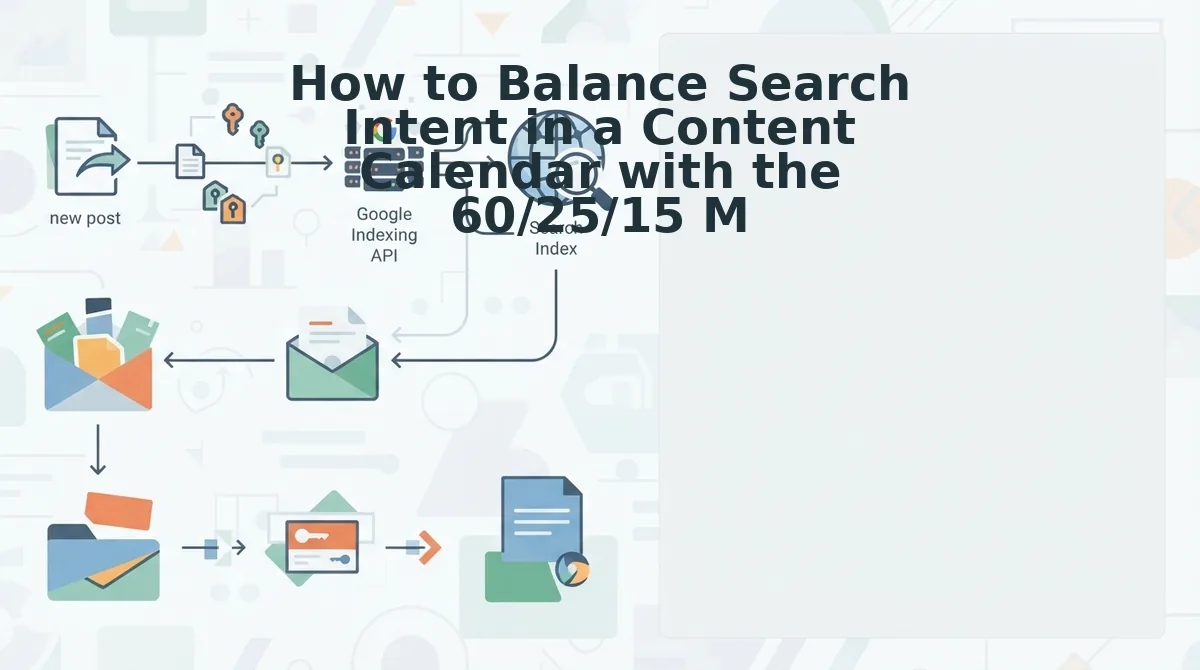
How to Balance Search Intent in a Content Calendar with the 60/25/15 Model
Balancing search intent requires allocating monthly content production across top-, middle-, and bottom-funnel queries rather than over-indexing on raw traffic.
Most publishing calendars default to a 90/10 informational split. Teams churn out dozens of top-of-funnel glossaries, generate traffic spikes, and wonder why pipeline numbers stay flat.
Raw impressions do not pay domain renewals.
When planning a standard sprint of 12-to-16 monthly articles, applying the 60/25/15 formula establishes clear production quotas across every intent tier. Pairing informational coverage with commercial audits ensures search engines understand your topical depth while giving qualified visitors clear conversion paths.
| Intent Tier | Monthly Quota (12 - 16 Posts) | Target Query Types | Best For Persona |
|---|---|---|---|
| 60% Informational | 7 to 10 articles | Indexing mechanics, step-by-step guides, technical definitions | Solo operators building baseline domain authority and top-of-funnel reach |
| 25% Commercial Investigation | 3 to 4 articles | Tool alternatives, category comparisons, product teardowns | Growth leads capturing buyers evaluating competing market solutions |
| 15% Transactional Conversion | 2 articles | Direct workflow solutions, setup tutorials, feature integrations | Founders ready to convert bottom-funnel organic demand immediately |
Different publishing models prioritize distinct business objectives. Here is how to evaluate your strategy against your team structure:
- Choose 90/10 Informational if you rely strictly on display advertising revenue where sheer pageview volume outweighs visitor qualification.
- Choose 100% Bottom-Funnel if you run an established domain with mature authority and only need to harvest immediate transactional demand.
- Choose the 60/25/15 Model if you are scaling sustainable organic acquisition across standard search engines and AI answer engines simultaneously.
Standalone editorial tools like Surfer SEO excel at manual, real-time keyword scoring within active document editors, while platforms like Jasper provide versatile enterprise copywriting for multi-channel corporate campaigns. However, manual workflows often cause calendar drift because teams naturally avoid researching complex commercial comparison pages by hand.
Our recommendation is adopting the 60/25/15 split executed through structured topic clusters. Grounding your schedule in a strict ratio forces systematic internal linking from top-of-funnel explainers down to commercial product teardowns. If you want to bypass manual keyword spreadsheets and multi-tool stack sprawl, BloGoose automatically inspects your sitemap, identifies competitive gaps, and drafts voice-accurate clusters mapped directly to search intent. Translating this distribution framework into weekly execution requires a structured scheduling matrix.
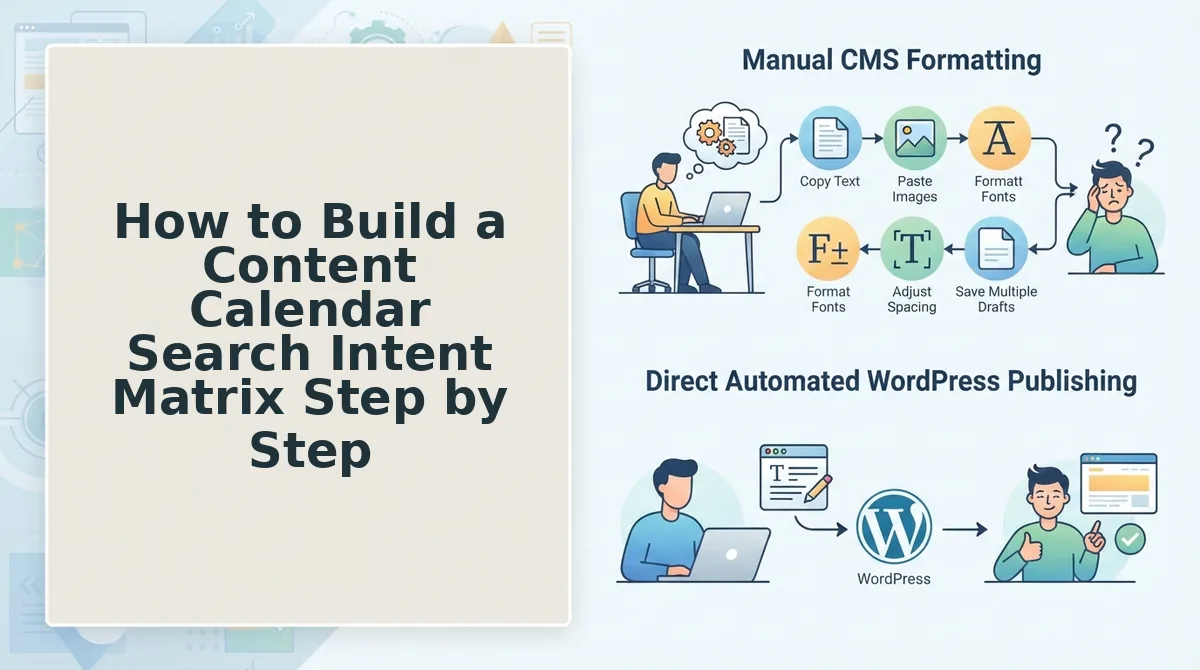
How to Build a Content Calendar Search Intent Matrix Step by Step
To build a content calendar search intent matrix, you must systematically categorize keyword targets by searcher motivation and sequence them across weekly production cycles to route organic traffic toward high-converting landing pages. A content calendar search intent matrix is a structured scheduling framework that pairs search query types with matching editorial layouts and downstream internal linking paths.
Imagine facing an unorganized spreadsheet containing 200 raw search terms on Monday morning with zero visibility into which post supports which product page. Without intent mapping, teams default to churning out disconnected guides that attract readers but fail to generate revenue.
Prerequisites: You need an exported spreadsheet of your target search queries, a catalog of your product or service landing page URLs, and 45 minutes of planning time.
- Filter your raw keyword list by informational, commercial, and transactional indicators (Time: 10 minutes). Open your search data export and add a column titled Intent Category. Tag research-driven queries containing terms like how or why as informational, brand comparison searches as commercial, and direct purchase phrases as transactional. Expected outcome: Every target keyword is cleanly sorted into an intent classification without unassigned rows.
- Map each query into a 4-week publishing distribution matrix (Time: 15 minutes). Populate a four-week editorial sprint calendar using a balanced 60/25/15 ratio. Schedule top-of-funnel informational explainers during Weeks 1 and 2, commercial comparisons in Week 3, and bottom-of-funnel transactional conversion articles in Week 4. Expected outcome: Your calendar displays a predictable publishing flow that prevents keyword cannibalization.
- Draft operational outlines using dynamic SEO content briefs for every calendar entry (Time: 10 minutes). Select an assigned row in your scheduled sprint and generate an editorial blueprint detailing required heading depths, target entities, and exact format types. Expected outcome: Writers receive unambiguous instructions specifying whether a piece demands step-by-step how-to guidance or side-by-side feature comparisons.
- Configure downstream link equity routes for every scheduled article (Time: 10 minutes). Open your site architecture map and assign two relevant commercial destinations to every informational topic on your schedule. What happens when an informational reader reaches the end of your guide? They must encounter an immediate, contextual bridge to your product. Expected outcome: The matrix records distinct internal anchor text links that pass authority from broad guides directly into conversion-focused pages.
However, scaling this matrix across dozens of closely related terms creates severe ranking risks if intent boundaries blur. Maintaining consistent authority across your roadmap requires strict architectural guardrails to prevent overlapping URLs from competing against one another.
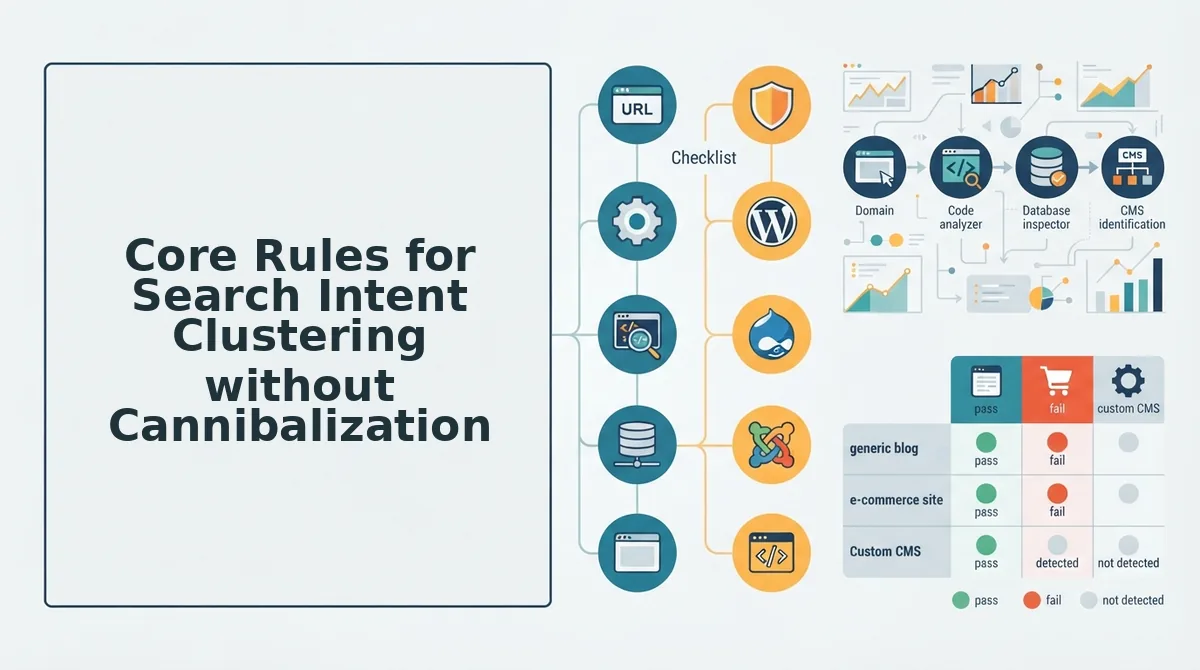
Core Rules for Search Intent Clustering without Cannibalization
Clustering search intent without cannibalization requires assigning each keyword to a single primary URL, isolating distinct funnel stages onto separate pages, and routing page equity through structured internal links. This separation prevents overlapping articles from competing against each other for identical positions in search engine result pages.
How do you scale organic coverage across dozens of related terms without watching your own pages cannibalize each other's rankings?
- Strict Query Intent Separation: This rule isolates pure educational guides from commercial conversion pages across entirely separate URLs. Embedding intrusive checkout modules directly inside high-intent informational guides breaks search engine behavioral metrics and causes intent dilution because users seeking answers bounce when confronted with premature friction. Audit the top-ten live SERP results before drafting to confirm whether Google ranks pure explainers or commercial alternatives for that specific phrase.
- Upward Equity Funnels: This technique links narrow, transactional landing pages upward to broad informational topic hubs using descriptive anchors. Channelling search equity toward top-level parent guides reinforces pillar authority while clearly signaling the topical parent-child hierarchy to search engines. Configure internal contextual links at the close of every transactional feature page that navigate search engines back to the central educational guide.
- Downward Commercial Routing: This architecture directs high-traffic informational readers toward transactional landing pages using focused, text-based recommendations. It preserves informational intent on the host page while capturing qualified user traffic ready to evaluate software or services. Insert mid-body contextual bridge links within top-of-funnel posts that direct readers to dedicated conversion pages rather than forcing checkout operations into the article body.
- Technical URL Consolidation: This standard merges near-identical query variations under a single definitive destination to prevent fractional indexation. Splitting organic equity across slight keyword synonyms confuses search crawlers and scatters ranking signals across multiple weak URLs. Apply verified canonical URL configurations across parameter variations and overlapping archive paths to guarantee search engines index only your primary asset.
- Entity-Driven Task Assignment: This practice assigns a unique user problem and schema entity definition to every asset in your content calendar. Search engines evaluate distinct user tasks to determine whether two similar articles deserve separate entries in their index. Review Google Search Console query clusters to verify that each target article satisfies a distinct searcher task before greenlighting production.
While these governance rules safeguard upcoming production, your existing content library requires regular operational diagnostics to catch legacy misalignments. A comprehensive calendar audit reveals existing imbalances before they degrade search performance.
How to Audit Your Editorial Calendar to Verify Intent Balance
Auditing your editorial calendar for intent balance requires benchmarking historical URLs against your target intent ratios, isolating orphaned commercial pages, and confirming that search engines index your updated topical clusters. A structured audit ensures your publishing schedule supports both discovery queries and bottom-funnel conversion terms without skewing heavily toward top-of-funnel traffic.
An editorial intent audit is a systematic evaluation of published and scheduled assets to verify that content distributions match user buying stages. Without this check, teams often accumulate organic impressions from educational guides while bottom-funnel comparison and product pages remain undiscovered and unranked.
Imagine launching forty high-traffic educational posts over two quarters, only to see pipeline revenue stagnate because none of those readers ever encounter a product alternative or evaluation page.
Before beginning, ensure you have your XML sitemap URL, your current CMS post inventory, and active access to your search indexing tools. This protocol takes roughly twenty minutes to complete across three distinct diagnostic phases.
- Export your full URL inventory from your CMS or XML sitemap into a spreadsheet, then tag every published URL as informational, commercial, comparison, or transactional. You should see a clear percentage breakdown across your entire domain rather than an untagged list of post titles.
- Evaluate your catalogue for informational overload by calculating whether educational articles exceed your target allocation, while checking internal links pointing to high-intent product alternatives. You should see every informational post linking directly to at least one contextual comparison guide or commercial landing page.
- Calculate your comparison coverage ratio by dividing the number of direct alternative and evaluation assets by your core informational pillar topics. Your ratio should reflect adequate middle-funnel bridging, confirming that prospective buyers have direct decision-making resources.
- Inspect your search console server responses and indexing logs for updated URLs to confirm whether Google has indexed the adjusted internal link architecture. If newly balanced clusters sit unindexed in server logs, manually ask Google to crawl new posts to expedite crawler retrieval across those updated paths.
Is manual spreadsheet auditing draining team velocity?
BloGoose automates this entire pipeline by crawling your existing XML sitemap, extracting brand context files, and generating pillar-focused editorial calendars. It drafts citation-optimized articles and publishes directly to WordPress or your custom API with AI included, eliminating manual spreadsheet coordination entirely. As editorial teams shift from legacy scheduling to intent-balanced roadmaps, several strategic and technical questions frequently emerge.
Frequently Asked Questions About Balancing Search Intent
Balancing search intent in an editorial calendar requires assigning one dominant intent to every target URL to eliminate keyword cannibalization and protect long-term organic rankings.
Can a single article rank for transactional and informational terms simultaneously?
No, a single article cannot rank simultaneously for transactional and informational terms without severe rank decay. Search engines assign distinct dominant intents to individual queries, meaning mixed content dilutes topical relevance. Maintain a strict demarcation protocol by publishing separate educational guides that funnel authority to distinct transactional landing pages through contextual links.
How do I identify the dominant search intent of a keyword?
Analyze the top five organic results on the live search results page. If step-by-step guides and definitions dominate the SERP, searchers require informational content. If pricing grids and comparison tables appear, commercial intent rules. Always align your drafted format with the structure search engines already reward.
What ratio of informational to transactional content works best?
The standard model allocates 60 percent informational, 25 percent commercial, and 15 percent transactional topics. Why separate them so strictly? Blending aggressive sales copy into educational research confuses search crawlers and diminishes engagement. Informational volume builds topical authority, which then fuels your commercial landing page rankings.
Why does search intent shift over time for existing content?
Search intent evolves as buyer sophistication increases and search engine algorithms refine what best satisfies a query. High-level research queries frequently shift toward commercial comparisons as product categories mature. Routine calendar audits catch these shifts early, ensuring existing URLs are refreshed to match live search engine expectations.
To turn these principles into a repeatable editorial workflow, keep the following execution safeguards close at hand.
Actionable Checklist for an Intent-Balanced Content Pipeline
An intent-balanced content pipeline converts organic search impressions into dependable revenue only when informational search authority systematically funnels internal link equity directly into bottom-funnel commercial decision pages.
Most editorial teams chase publishing velocity, treating top-of-funnel traffic volume as an end goal. The hidden breakdown stems from this precise trap: publishing dozens of unlinked informational explainers strands valuable search equity on informational pages that never invite a commercial transaction.
Are your top-funnel discovery topics actively driving qualified readers toward a buying decision?
- Audit internal equity pathways: Verify that every set of informational explainers contains descriptive in-content links routing authority straight into your targeted commercial comparison articles.
- Lock intent targets prior to drafting: Assign explicit SERP intent classifications to separate URLs to prevent keyword cannibalization between educational overviews and bottom-funnel product solutions.
- Streamline cluster deployment: Automate real-time SERP topic research and direct CMS publishing with the $199 flat Pro plan to maintain structured topical consistency without stack sprawl.
A content calendar compounds revenue only when top-of-funnel educational authority is systematically engineered to feed bottom-funnel commercial decisions.