What eight context files should an AI content engine generate?
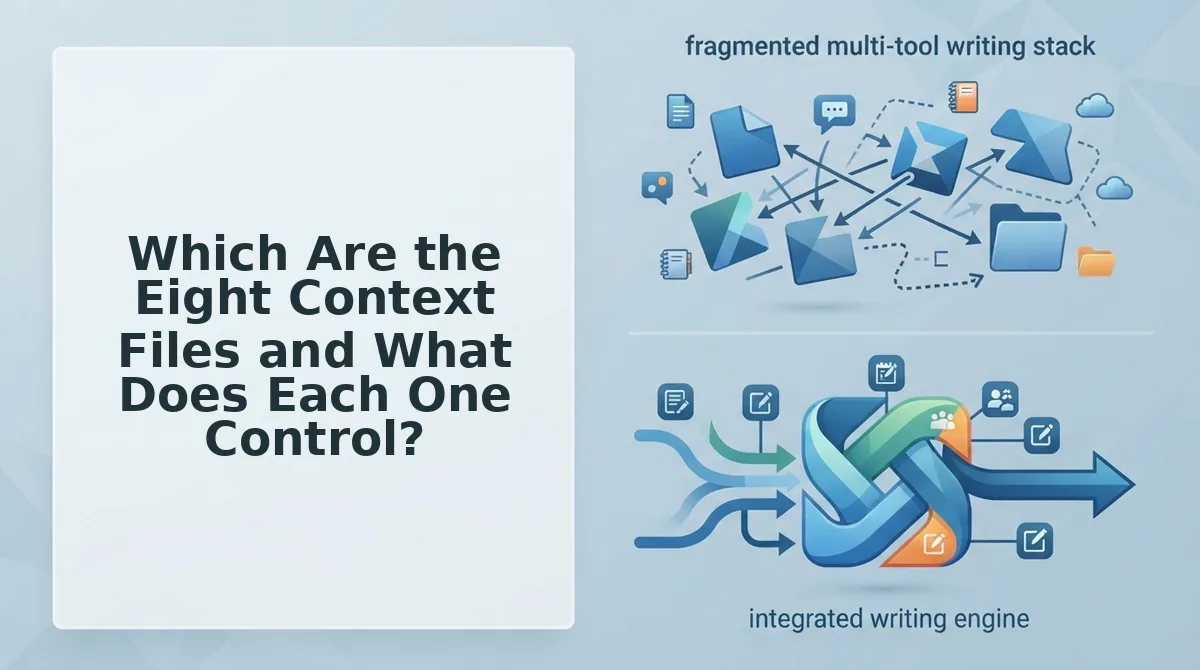
Ask a blank chat window to write your next post and you get a different writer every session â same logo, new personality. A second tab for keywords, a third for links, a fourth for the brand deck, and you have rebuilt the 12-tab content stack. The fix is not a better prompt. It is the eight context files for an AI content engine that hold what a prompt forgets between sessions: style-guide.md, brand-voice.md, target-keywords.md, competitor-analysis.md, writing-examples.md, internal-links-map.md, seo-guidelines.md, and features.md.
The list is not the hard part â anyone can name eight Markdown files. What breaks drafts is the ordering underneath, and the moment two files quietly disagree about the same sentence. That second failure is the one almost nobody documents, and it explains most "why does this draft sound off?" reviews.
Below: what a context file is and what has to exist before you generate one, then each file mapped to the decision it owns and the draft output it governs. Stay for the precedence order that settles conflicts first.
What Is a Context File and What Do You Need Before Generating One?
A context file is a plain-text Markdown document that stores one repeatable decision your content engine must make on every draft, so the decision survives across sessions instead of being retyped as a prompt. Four things must exist before you generate the first one.
In practice, a context file is a versioned document stored beside your content project that the drafting engine reads before it writes a word. It holds rules rather than requests: which heading depth to use, which phrases are banned, which queries a piece may target. Because it lives as plain text, it diffs cleanly, gets reviewed in a pull request like code, and can be edited by a content lead who has never opened a terminal. Nothing compiles it and no index has to stay warm â it is just text the engine loads on every run.
The prerequisites are unglamorous and usually skipped:
- A crawlable site with an XML sitemap, so the engine reads published pages instead of guessing your voice.
- A publishing destination â WordPress or a custom API â so rules end in shipped drafts.
- A named human owner for each file, accountable for its edits.
- One decision per file, so no two files can rule on the same output.
Markdown beats a JSON config or a vector store here for a boring reason: it is reviewable. A JSON blob buries intent in nesting, and a vector store adds a pipeline that has to stay alive. A prompt is a one-off instruction; a context file is persisted state â which is the whole of context engineering vs prompt engineering, a distinction already covered at length in talks such as "Context Engineering vs. Prompt Engineering" (IBM Technology) and "Context engineering explained" (Google Cloud Tech).
Once those four things exist, automated SEO content stops being a retyping exercise and becomes the maintenance of eight short documents.
Which Are the Eight Context Files and What Does Each One Control?
Each file owns exactly one decision type, which is what stops two files from contradicting each other on the same call. Order them as below: structure first, then voice, then the topic, then everything downstream of the topic.
- style-guide.md â structural rules. It fixes heading depth, list usage, and paragraph length so a draft reads as one publisher. It alone decides that H2s never nest past H3.
- brand-voice.md â tone DO and DON'T. It holds the tone lists and banned phrases extracted from your existing pages. It alone decides whether a sentence can open with "we're excited."
- target-keywords.md â query assignment. It names which queries a piece may target and where the primary term must appear. It alone decides the H1 and the first-100-words placement.
- competitor-analysis.md â gap positioning. It records what rivals cover and what they skip, and nothing else. It never rules on voice or keyword choice; that boundary is what keeps it useful.
- writing-examples.md â sentence rhythm. It supplies two or three published excerpts the engine should imitate, no more. It alone decides cadence, not vocabulary.
- internal-links-map.md â anchors and destinations. It pairs approved anchor text with real URLs. The engine never invents a link; if the pair is absent, the link does not ship.
- seo-guidelines.md â title pattern, meta length, schema. It defines the title formula, the character ceiling for meta descriptions, and the schema type each template expects.
- features.md â capability claims. It lists what the product actually does and what it must never claim. It alone decides whether a draft can mention a feature.
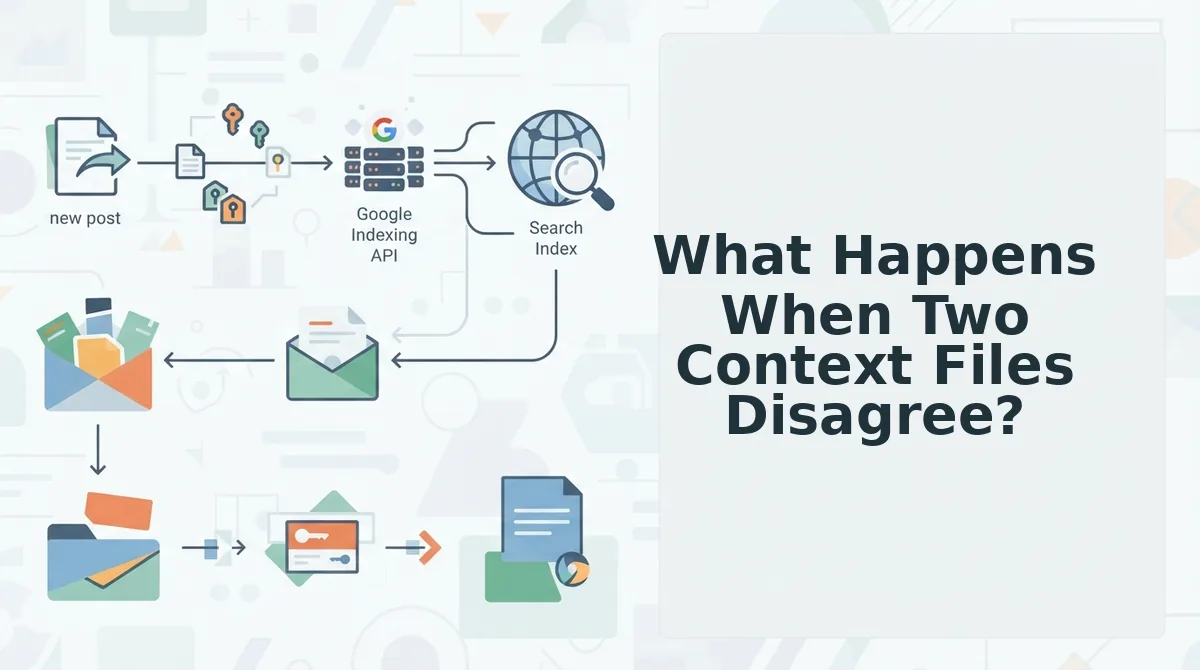
In the BloGoose setup flow, a sitemap crawl and CMS detection produce the raw material for all eight, then each file is edited as plain text and committed. Pair the set with an SEO content brief per article, and the AEO optimization layer inherits clean rules instead of re-deciding them per post. BloGoose then drafts from that set and publishes straight to WordPress or a custom API.
| File | Decision it owns | Draft output it governs |
|---|---|---|
| style-guide.md | Structure | Heading depth, list and paragraph length |
| brand-voice.md | Tone | Voice DO/DON'T, banned phrases |
| target-keywords.md | Topic | Title pattern target, primary term placement |
| competitor-analysis.md | Gap positioning | Section coverage, differentiators |
| writing-examples.md | Rhythm | Sentence length and cadence |
| internal-links-map.md | Linking | Anchor text and destination URLs |
| seo-guidelines.md | Metadata | Title, meta length, schema |
| features.md | Claims | Feature mentions and limits |
That still leaves the question every draft review eventually hits: what happens when two files disagree?
What Happens When Two Context Files Disagree?
Two context files disagree most often on style, and the fix is a fixed precedence order: seo-guidelines.md > brand-voice.md > writing-examples.md for style conflicts, and target-keywords.md > competitor-analysis.md for topic conflicts.
| Conflict | Winning file | Reason |
|---|---|---|
| Title or meta length | seo-guidelines.md | Hard constraint |
| Word choice inside a draft | brand-voice.md | Rule beats sample |
| Which subtopic leads | target-keywords.md | Specificity |
The logic is one rule: hard constraints outrank preferences, and specificity outranks generality. A 60-character title limit is not negotiable; a fondness for long sentences is. Writing-examples.md sits last because a sample can be misread, while a stated rule cannot.
Do context files conflict? Yes, and they should. Eight files fed by a crawl, a keyword list and a competitor scrape will overlap wherever a topic sits near a boundary. The fix is not fewer files but a stated precedence order: seo-guidelines.md beats brand-voice.md beats writing-examples.md on style, target-keywords.md beats competitor-analysis.md on topic. Without that order, the model resolves every tie silently, which is how tone drift enters a draft. With it, conflicts become deterministic and reviewable, and a disagreement shows up as one predictable choice instead of a coin flip.
The honest caveat: eight files cannot rescue a bad keyword choice. Precedence settles conflicts; it does not make a weak topic worth writing.
What we'd choose: put the order in the first lines of the bundle and pin title patterns to title tags, so the constraint lives in one place. Best for solo operators who review drafts alone and need the tie-break to be obvious; teams with a second reviewer can absorb more ambiguity.
Precedence only helps if the output proves it was applied.
How Do You Check the Engine Actually Used the Files?
Test it on one live draft, not an abstract audit. Pull the last article your engine shipped and run three passes against it.
- Pattern pass: title and meta length match the pattern in seo-guidelines.md
- Banned-phrase scan: search for every phrase brand-voice.md forbids
- Link resolution: each internal link exists in internal-links-map.md
That closes the loop opened at the start: the eight files are not a priority ranking. Each owns one decision type, so verification is simply checking the file that owns the decision.
A compliant draft on a badly chosen keyword still earns zero traffic.
Then schedule refreshes by how fast each file rots:
- Quarterly: target-keywords.md, competitor-analysis.md
- After each publishing block: internal-links-map.md
- Twice a year: brand-voice.md, writing-examples.md
- Annually: style-guide.md, features.md
competitor-analysis.md decays fastest and loudest. A stale style-guide.md is quieter and worse â it breaks formatting with nobody noticing.
BloGoose rebuilds all eight from your own domain during setup, then ships drafts straight to WordPress. When a cadence date comes due, run a content refresh before your next scheduled post instead of hand-editing files under deadline pressure.
Eight files, one owner per decision â that is what makes an AI draft auditable rather than merely plausible.