Byword bulk keyword uploads vs site-crawled context files
One hundred keywords in, one hundred articles out. The spreadsheet is doing precisely what you asked, and that is the problem: it knows nothing about the site those hundred articles are about to land on.
If you have run a batch like this, you already felt the drift â the same intro rhythm in article forty that you never wrote once. Weighing Byword bulk keyword uploads against crawling your own domain for context is really one question: what does each input carry, and which of those things can you afford to leave blank?
First, a disambiguation. Byword bulk keyword uploads are not Google Ads Editor bulk keyword uploads, despite XYZ Lab's higher-view tutorial ranking on the adjacent term. One buys traffic; the other writes articles from a list.
What follows compares the two inputs on voice fidelity, link inventory, intent mix, setup effort, and fit for a site with no pages yet. Keep one thing in mind as you read: a single input question decides both how much voice drifts across fifty articles (section 4) and where internal links come from when nobody supplies them (section 7). No vendor demo in the current video landscape puts the two inputs side by side â Byword's own walkthroughs are short and thinly viewed â so this comparison is built from documented mechanics, not demos.
Which input wins? The verdict and the four criteria behind it
Domain crawl wins for any site that already publishes pages; a keyword list wins on speed and on greenfield launches with nothing to crawl.
Verdict: crawl your domain if it has real pages. Voice rules and internal link targets arrive as a byproduct of the input, and a flat keyword list cannot reconstruct either one. Upload a list when there is no site to read, or when a small topic set genuinely does not need site-wide context.
Byword's list-first path has an honest advantage: nothing needs to be reachable, indexed, or technically healthy before the first run starts [verify]. That matters for a new domain or a client site you do not control.
| Criterion | Keyword list | Domain crawl | Why it matters |
|---|---|---|---|
| Voice fidelity | Carries none unless voice is supplied separately | Derived from published pages | Prevents drift across 50+ drafts |
| Internal link inventory | Absent â targets must be added by hand | Existing URLs become targets | Links are the cluster's connective tissue |
| Intent and topic mix | Explicit in the list | Inferred from what already ranks | Wrong mix means cannibalized pages |
| Setup effort | Fast to start | Slower before article one | Front-loaded work vs. rework later |
| Greenfield fit | Strong | Weak | No pages means no context |
BloGoose's own limits belong here, not in a footnote. Its crawl returns nothing useful for a domain with no published pages, it depends on a reachable sitemap, and it adds setup time before your first article exists.
Best for the solo operator launching a new niche site: a keyword list. Best for the content lead at an established publisher: a domain crawl.
What Byword bulk keyword uploads actually do
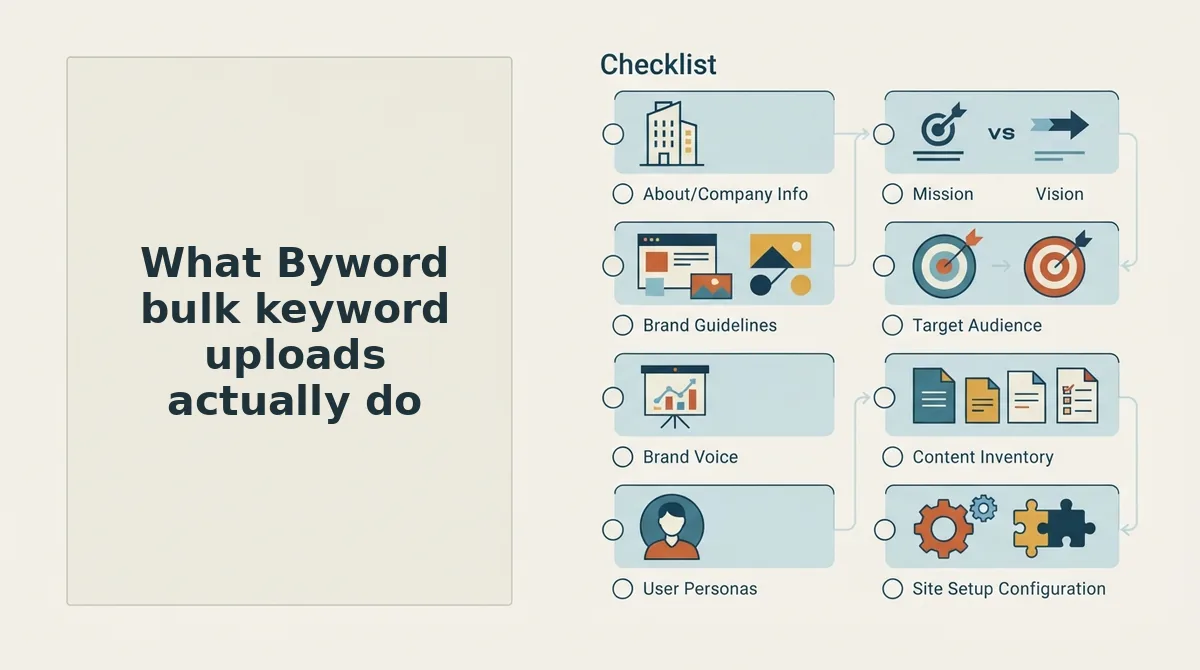
Byword bulk keyword uploads are a production input rather than a research method: a list or file of keywords is submitted at once, and a batch run turns that list into drafts.
Simple: one list, one run
Think of a keyword list like a parts order sent to a factory floor. It names every component, but it says nothing about the finish, the tolerances, or how the parts bolt together. The run still happens; the specification is just missing.
Intermediate: one row, one article
An operator exports a keyword list from a research tool and starts a batch run in Byword [verify]. Each row maps to one draft [verify], so a list of sixty keywords is sixty articles to review, not one.
Advanced: what the list cannot carry
Batch entry points assume the list is the whole brief [verify]. Anything not encoded per row â voice rules, product facts, existing URLs to link to â has no path into the output.
The workflow is thinly documented. Byword's own "Byword's Batch Generator" and "Keyword Research in Byword" videos sit in the 171â373 view range, far below the adjacent-term tutorials ranking around them, so capability, limits, and pricing all carry [verify] flags pending official documentation.
So what changes when the input is your domain instead of a spreadsheet?
How is Byword bulk keyword upload different from site-crawled context files?
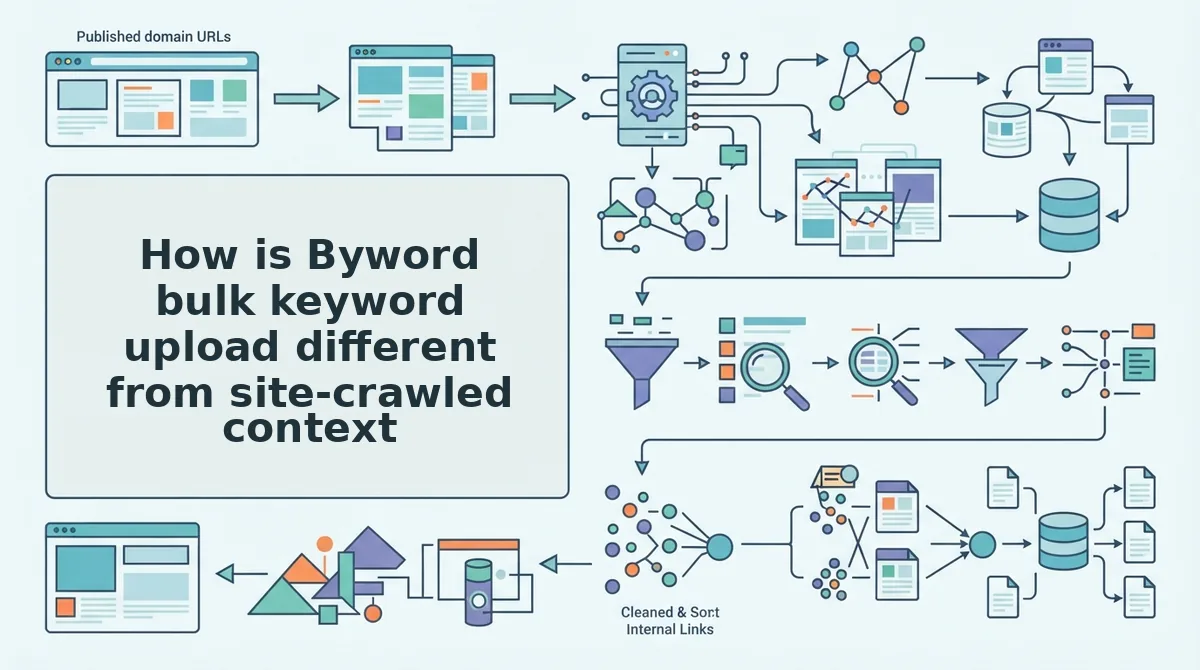
Byword bulk keyword upload turns a list of keywords into briefs, so each row carries a topic and little else. Site-crawled context files read the domain first: sitemap located, pages inspected, CMS detected, then eight editable Markdown files written, including style-guide.md and writing-examples.md. One input supplies topics; the other supplies the conditions a topic is written under.
Both are legitimate ways to feed a batch. They differ in what they can physically hand the model, not in how clever the prompt is.
| What the input must carry | Byword bulk keyword upload | Site-crawled context files (BloGoose) |
|---|---|---|
| Topic | One keyword per row, chosen by the operator | Derived from published pages and existing site structure |
| Search intent | Inferred from the keyword string alone; the row adds no page context | Read off pages that already exist or rank for the term |
| Existing URLs | Absent unless pasted in by hand | Enumerated from the XML sitemap |
| Voice rules | Not carried; supplied separately per prompt or template | Written to style-guide.md and writing-examples.md |
| Product facts | Not carried | Drawn from inspected page copy |
| Link inventory | Not carried | Mapped in internal-links-map.md |
| Competitor context | Not carried | Only where published pages already discuss competitors |
Best for a solo operator validating a new niche: bulk keyword upload. It starts on a domain with nothing published, and a curated list beats a crawl when there is nothing to read.
Best for an established site with a voice worth preserving: site-crawled context files, because the output is inspectable before a run. See Voice accuracy at volume: what each input gives the model
Tone drift is usually diagnosed as a prompting failure. It is more often a supply failure â the model wrote exactly what it was given, and what it was given contained no tone.
Set the two inputs side by side and the gap is structural:
- Keyword list supplies: topics, target terms, article count, ordering.
- Keyword list omits: sentence rhythm, banned phrases, product facts, customer language, existing URLs.
- Crawl supplies: the XML sitemap, published pages, and two inspectable files â style-guide.md and writing-examples.md â plus the link inventory those pages already contain.
That last difference compounds. A Markdown file can be opened and corrected by a human before the next run; a pasted keyword list has no surface to correct.
The finding teased at the top holds at scale: voice consistency is an input-count question, not a model-quality question. Fifty articles inherit whatever the input carried â or fail to inherit what it never had.
Two moves worth making. If the list is your only input, attach a short style file with three banned phrases and two sample paragraphs, and treat it as a required field. If you have a live site, let the crawl do that work: BloGoose reads your domain, extracts brand voice rules, and writes them into files you can edit before anything publishes. Pair that with AEO content optimization so the same voice rules carry into answer-engine passages, not just body copy.
The batch that sounds like you is the batch that was handed your voice, not asked to guess it.