Why writing examples from published posts beat prompt rules
Your prompt says "conversational." Article one nailed it. Article fourteen didn't.
So you rewrote it. Then came a banned-words list, a tone-adjective stack, a "don't sound corporate" paragraph â and drift still showed up around post ten. The variable you keep tuning isn't the one that's broken.
The input type is. A prompt rule describes your voice in adjectives; writing examples from published posts reproduce it as text the model can pattern-match. That swap explains most of what feels like model inconsistency.
- What a brand context file from a crawl contains
- How many examples hold tone across a 30-day calendar
- Where prompt-only setups break first
Scope note: this covers voice specification only â not keyword selection or internal linking. It won't rescue a site with no published archive to learn from.
In practice: drop your domain into the setup wizard. It locates the sitemap, reads the published pages, and writes the voice rules into a brand context file that feeds every draft â instead of a prompt you re-edit per article.
The mechanism is structural, not stylistic.
Why Do Writing Examples From Published Posts Beat Prompt Rules?
Writing examples from published posts beat prompt rules because rules describe a voice, while examples are the voice. An AI writer can imitate a real paragraph more reliably than it can interpret an adjective like "friendly."
Writing examples from published posts are excerpts of a brand's own live articles that an AI writer reads as a reference before drafting. They work through the lossy-description principle: a style guide compresses a voice into a few adjectives and rules, and compression throws information away. A published post compresses nothing.
It shows the full pattern at once, including how long sentences run, how a section opens, and whether the writer addresses the reader as "you." The model copies what it sees instead of guessing what "conversational" meant. That is why examples hold tone more consistently than instructions.
Think of it like music. Describing a song as "upbeat with a moody bridge" gives a cover band very little. Handing them the recording gives them everything, including the details you never thought to mention.
Those unmentioned details matter most. Specimens carry the rules nobody wrote down.
Five Ways Prompt-Only Setups Fail
- Negation failure: "Don't sound corporate" puts "corporate" into the prompt and summons it. An example of non-corporate writing avoids naming the problem.
- Adjective stacking: "Warm, bold, witty, concise" pulls in four directions, so the output averages them into nothing distinct.
- Register mismatch: Register means the level of formality. Prompt-only drafts often open casually, then turn stiff in the H3s.
- Banned-word whack-a-mole: Ban one cliché and a synonym takes its place, so the list keeps growing.
- Decay across a calendar: Article 1 sounds right. By article 20, the tone has drifted.
Rules still have a job, and it is an important one. Rules win on hard constraints: word count, banned claims, CTA placement, and compliance.
The workable split is simple. Use examples for how the brand sounds and rules for what the article must or must not contain, including structural requirements for AEO content optimization.
That raises a practical question: which published posts should become the examples?
How Do You Build writing-examples.md From Your Own Sitemap?
You finish holding an editable Markdown file of real published samples â not a rewritten style guide, and not a prompt you retype from memory. That distinction is the entire payoff: the file contains your actual sentences, and anyone on the team can open it, remove a weak example, and add a better one without touching a prompt.
The prerequisites are deliberately thin. You need an XML sitemap that lists your published posts, pages that are publicly reachable, and about twenty minutes.
Here is the sequence, in order:
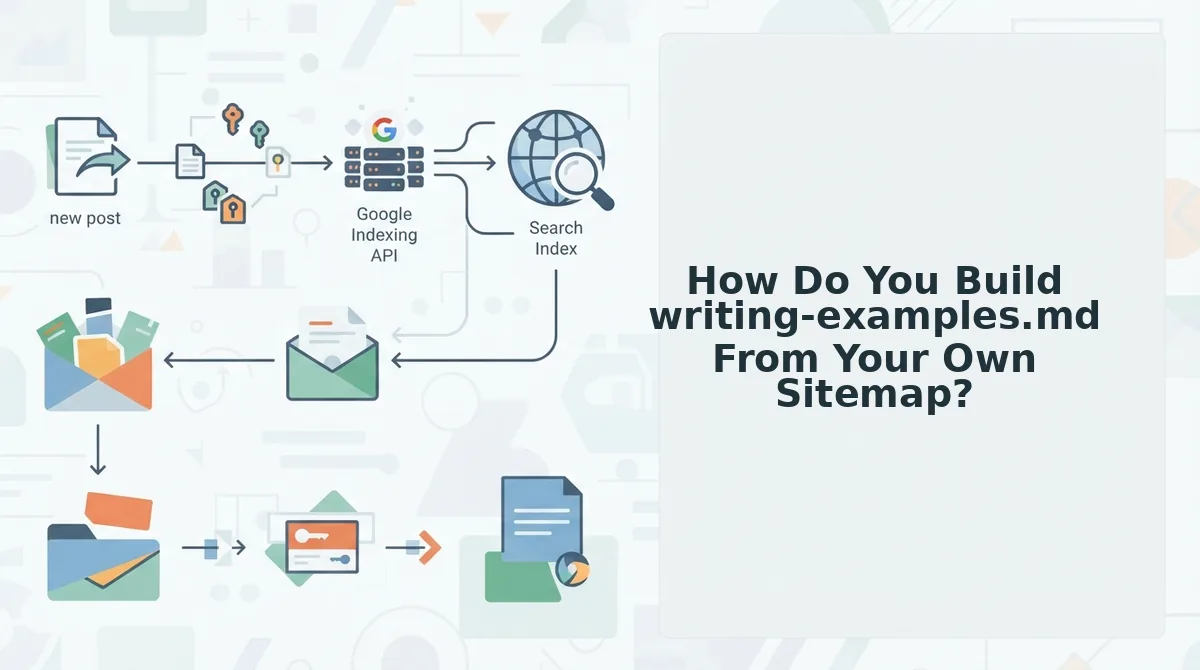
- Sitemap discovery. The crawler locates the sitemap from your domain â no plugin export, no hand-copied URL list.
- Page inspection. It reads published pages instead of asking you to paste examples by hand, which is what separates sitemap context extraction from a folder of samples you maintain yourself.
- Sample selection. Strong posts are mined by section type â intros, H3 transitions, closers â so the file captures register changes rather than one flattering paragraph.
- The file itself. Plain Markdown you review and edit. BloGoose writes writing-examples.md alongside seven other context files â eight Markdown files total, including style-guide.md and target-keywords.md.
Two moves are worth making before you run it. Un-draft anything worth sampling, because the crawl only reads pages it can reach. Then decide which three or four posts represent the voice you want repeated for the next ninety days, not the voice you had two years ago.
That also settles the question the article opened with. The finding isn't that examples beat rules as an abstract principle â it's that your own published archive already contains the examples, and the only real work is extracting them into a file precise enough to hold at article twenty.
If you want to see what the crawl returns before committing a calendar to it, point BloGoose at your domain and open the samples file first; it is the clearest read on whether the extraction understood your voice. A style guide tells an AI what your voice should sound like, while a file of your published sentences shows it â and only one of those survives a full publishing calendar.