How do I validate a blog topic with live SERP data?
You can spend a full day polishing a 1,500-word draft and still learn the live top 10 for that query never wanted a tutorial. The cost isn't the writing â it's answering a question the results page wasn't asking.
Validate a blog topic with live SERP data before the outline exists. Six gates, in order: intent match, coverage overlap, who holds the page, information gain, format and length, cluster fit. Each returns a pass or a fail, and any fail sends the topic back to the calendar instead of into the drafting queue.
Competing organic results for this query are roughly 1,300 to 1,800-word checkbox workflows [est.], with no thresholds and no kill criteria. The gap is judgment, not coverage â which is why a written SEO content brief outperforms another outline template.
The video layer agrees: a 9,769-view Rank Math walkthrough of how to read a SERP sits beside a 6-view Rankergent demo of automated briefs. Readers want a decision, not an interface tour. Gate 4 is where that decision gets made, and it is the gate most checklists quietly skip.
What Does Validating a Topic Against the Live SERP Actually Mean?
Validating a topic against the live SERP means reading the ten results Google currently returns for your exact query and issuing a go/no-go verdict â not gathering reassurance that the topic is probably fine.
SERP validation is the practice of pulling a date-stamped top 10 for a target query, classifying what each result actually is, and converting that read into a pass or fail decision before a brief gets written. Think of a building inspection before a renovation: the inspector doesn't admire the house, they hunt for the thing that stops the project.
Four terms carry the rest of this article. The SERP is the results page itself, in the order and format Google serves it. Search intent is the job the searcher wants done â a guide, a list, a comparison, or a discussion thread. Information gain here means one named sub-question the live top 10 leaves unanswered: checkable, not a vibe. SERP overlap is the set of URLs that repeat across your query variants, which is the input gates 2 and 6 both need.
Three things must be open before gate 1: a clean-session top 10 pulled today rather than a cached screenshot, the query variants you would actually target, and your own cluster's existing URLs. Without all three, gates 2, 3, and 6 have nothing to compare against, and the verdict becomes an opinion. Prerequisites are cheap; missing them is what turns validation into theater.
The output is a verdict plus a one-line reason you can defend out loud â "fail, gate 4: the top 10 already answers every sub-question, nothing left to add." BloGoose runs a version of that read automatically, crawling a domain and drafting a calendar with the intent mix already classified.
How Do You Run the Six Gates Step by Step?
Run all six gates in one sitting with a date-stamped top 10 open in a clean browser session: intent match, coverage overlap, page authority, information gain, format and length, cluster fit. Budget 45 to 60 minutes total, and stop at the first gate the topic fails.
Before you start: open a private window, build a sheet with one column per gate, and have your query variant list and your cluster's existing URLs ready. No keyword tool is required until gate 3.
- Open the live top 10 and bucket the intent. Tag each result as guide, listicle, comparison, or UGC thread, then note which format holds the majority. You should end with a 10-cell tally. If UGC threads appear at all, treat that as a rewrite invitation rather than a closed door. (10 min)
- Scan H2 overlap across the top 10. Paste every H2 into your sheet and count repeats; three or more pages covering the same sub-topic means coverage is already complete. Then run the same count across your query variants â the URLs that recur are your SERP overlap. (15 min)
- Score who holds the page. Rate each of the ten results on authority, freshness (updated within 12 months), UGC presence, and page type. Six or more established sites with recent updates answers "is my keyword too competitive" without a difficulty number. (10 min)
- Hunt for one unanswered sub-question. List the sub-questions all ten results answer, then the ones none of them do. One named gap is information gain; zero gaps is a fail. This is the gate that most often ends the topic. (10 min)
- Derive format and length from the median of the top 5. Count words on the first five results, take the median, then add the section all five skip. You should leave with a target range and one mandatory section, not a single number. (10 min)
- Check cluster fit and internal links. Confirm the topic belongs in an existing topic cluster and that two or three internal link targets exist â pillar, sibling, and one supporting page. No fit means no publish, whatever gates 1 through 5 said. (5 min)
A top 10 that mixes how-to guides with tool demos is the usual shape for this query. The missing asset there isn't a seventh tutorial; it's the decision criteria that tell a reader which workflow to pick, which is why a comparison page wins the click and is also the fastest route to get quoted in AI answers.
Here is what those verdicts look like once the thresholds sit side by side.
What Do the Pass and Fail Thresholds Look Like Side by Side?
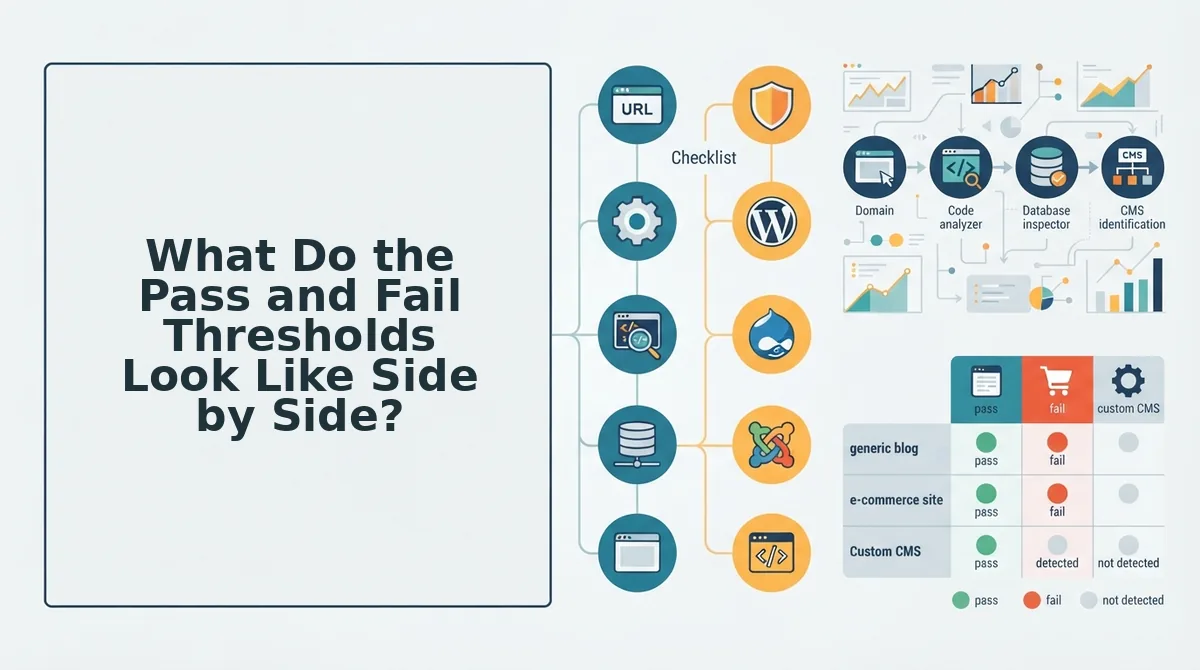
A gate passes when the live top 10 already matches your intent, format, and angle. It fails when you have to argue your way past what the results show. 4 of 6 passes equals write. Fewer than 4 equals reframe. The thresholds below turn that binary into something you can screenshot.
| Gate | Question it answers | Pass threshold | Fail action |
|---|---|---|---|
| 1. Intent | Does the live top 10 agree on what this query is? | 7 of 10 results share one dominant type: guide, listicle, comparison, or UGC | Rewrite the brief to the dominant type |
| 2. SERP similarity | Are the rankers solving the same job? | 3 or more results overlap on the same sub-questions | Swap the modifier; the angle is already occupied |
| 3. Competition | Can you match the field? | Two or more top-5 pages are shallower than your outline | Move to a longer-tail variant of the query |
| 4. Content gap | Is your claim already made? | The claim is absent or made thinly in the top 5 | Reframe the scope, not the idea |
| 5. Depth | Does the field skip a section? | A sub-question in your brief is unanswered in the top 5 | Make it a section, not a standalone post |
| 6. Quotability | Can an AI answer quote you directly? | You can write a 40â55 word self-contained answer | Reshape the H2s into question form |
A failed Gate 4 usually means the scope is wrong, not the idea. If the claim you wanted to make is already made and made well, you have three reframes: narrow the modifier until the claim is new, switch to the format the rankers are not using, or target the gap left by a forum thread sitting inside the top 10. The "how long should a post be" question behaves the same way â it fails as a standalone topic and passes as a section inside a larger one. Kill the angle, keep the subject.
Most "validate your topic" advice is validation theater because it has no fail state. Competitor workflows that walk you through keyword metrics inside a tool are genuinely useful for volume and difficulty, but volume never tells you to stop. A threshold that can't reject a topic isn't a threshold.
Best for solo operators: the six-gate threshold set, because it produces a yes/no before you spend a writing session. Best for editorial leads: the reframe routes, because they salvage a subject you already have audience demand for instead of dropping it. If several gates keep failing on the same cluster, that is a signal about your existing pages too â run a content audit before drafting anything new. BloGoose crawls your sitemap, extracts your voice rules, and builds the calendar from pages you already own, so the next brief starts past Gate 1.
How Do You Check the Validation Actually Held?
A single SERP pull is a still photo. Validation only holds if you re-pull the same query later and diff it against a date-stamped snapshot of your original verdict.
That is the step almost every checklist skips. Save the top 10 with the pull date and your gate scores, then compare at 30 days. Ranking movement inside the top 5 is the signal â not the single ranking you recorded on day one. Two movements invalidate the original verdict outright: a new authoritative incumbent entering the top 5, or a new result answering the sub-question you were counting on as your gap. Either one sends you back through Gate 4 before the next piece ships.
Practitioners pull this programmatically rather than by eye. The live SERP analysis guide covers the mechanics of the 30-day re-check.
The next step is one action: drop your domain into BloGoose, and the crawl, brand-voice extraction, and 30-day calendar start from pages you already have. A topic you validated once is a hypothesis; the second pull is what turns it into a publishing decision.