Prompt chaining for long-form blog posts vs an automated engine
The sixth prompt of the afternoon is usually a re-paste: the same brand rules, pasted again, because section four now sounds like a different company wrote it. That is the moment prompt chaining for long-form blog posts stops feeling like control and starts feeling like cleanup.
If that loop is familiar, you are not doing it wrong. Chaining prompts â passing each output in as the next input â genuinely beats a single mega-prompt on long drafts. But the retyping is a tell. Teams that re-inject voice rules mid-chain are already running a broken handoff, they just have not named it yet. And more prompts feels like more control, though the two stop tracking each other well before the final section.
This comparison separates the decision into three parts: where a hand-built chain still earns its keep, what breaks once the calendar grows past a handful of posts a month, and the six artifacts a chain has to hand forward for any of it to hold. Nobody in this debate agrees on where the volume line actually sits, which is why it gets skipped. One of those six â the section spec with voice rules attached â stops most tone drift on its own.
Is prompt chaining or an automated content engine better for long-form blog posts?
Neither wins outright. Manual chaining is better for low-volume, high-judgment posts where you want to intervene mid-draft; an automated engine is better once voice rules have to survive a standing calendar without anyone re-pasting them.
Prompt chaining is a sequence of prompts where each output becomes the next input. A handoff artifact is the file or text block that carries decisions â audience, angle, voice rules â from one link in that chain to the next. Sectional drafting means writing one section per step instead of one prompt per post.
Manual chaining wins on control and on low-to-moderate volume, where a hand-built chain with clean artifacts beats onboarding a platform and lets you correct direction mid-draft. An engine wins once the calendar stops being occasional: when identical artifacts have to reach dozens of drafts a month and no human is re-typing tone into step four. Where the crossover sits is a judgment call about your review hours, not a measured benchmark.
| Dimension | Manual prompt chain | Automated content engine |
|---|---|---|
| Mid-draft control | Full â edit any step | Constrained â rules are inputs |
| Voice across 10+ sections | Depends on re-pasting | Rules attached to each spec |
| Setup effort | Per post | Front-loaded, then reused |
| Cost of post #30 | Same as post #1 | Lower â artifacts persist |
| Meta and index payload | Manual, easily skipped | Produced every run |
| Claims and legal checks | Yours | Still yours |
Best for the solo operator or subject-matter expert publishing a few posts a month where the hard part is the argument, not the throughput.
Best for the content lead or agency running a standing calendar across writers. That is the case BloGoose builds for: it crawls the site, extracts brand voice rules, and publishes finished drafts to WordPress or a custom API, turning these handoffs into pipeline steps instead of files you maintain. See the automated SEO content workflow.
Which six handoffs decide the comparison?
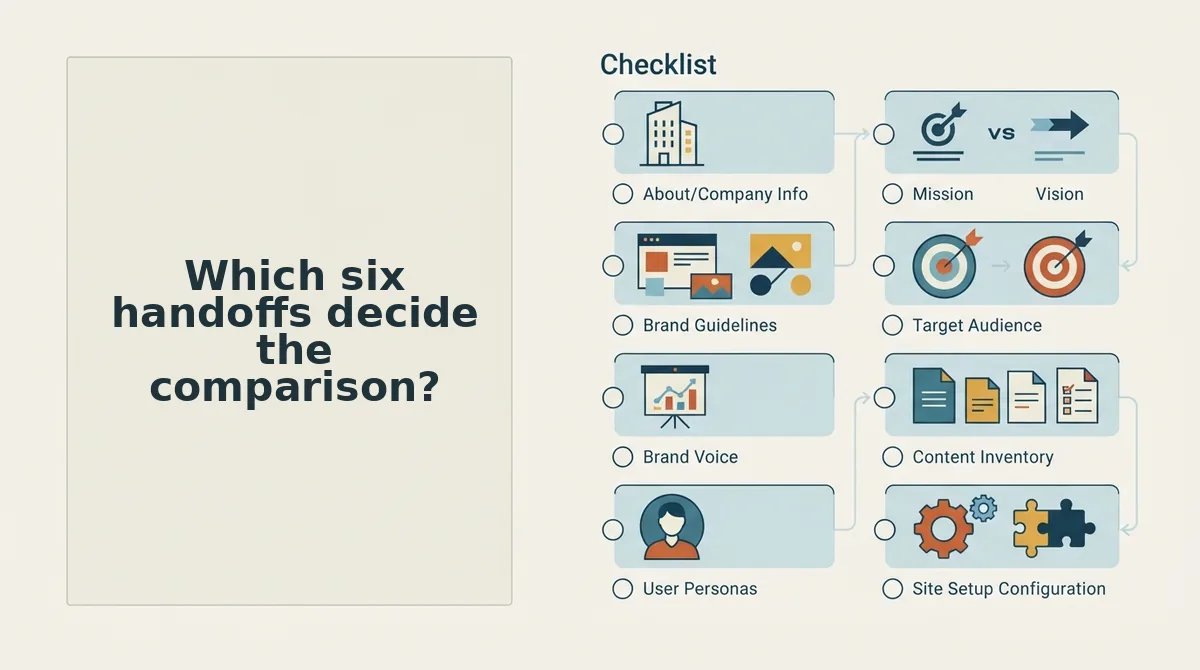
These six artifacts are the real state a chain passes forward; prompt wording is downstream of all of them. Treat each as a diagnostic â if the artifact does not exist in your workspace, that is the failure you are already seeing.
- Niche note. One page fixing audience, offer, and the angle the site owns. Skip it and every later step re-guesses who it writes for, which is how a post ends up arguing with your own pricing page.
- SERP gap brief. What the ranking pages cover and what they miss. Without it, chained drafts restate competitors and earn no information gain.
- Outline. Section order, target length, one claim per section. Missing this, structure wanders and later steps repeat earlier points.
- Section spec with voice rules. Per-section intent plus tone, attached to the instruction. This is the highest-leverage artifact: the model stops re-inferring tone from the last paragraph it read, which is the actual cause of tone drift.
- Per-section QA checklist. Claims, product accuracy, legal caveats. Chaining never removes this step; it only moves it earlier.
- Meta and index payload. Title, meta description, internal links, schema. Omit it and the draft publishes clean and unindexed.
| Artifact | What breaks if skipped | More reliable producer |
|---|---|---|
| Niche note | Generic angle, wrong reader | Manual judgment |
| SERP gap brief | No differentiation | Either |
| Outline | Repetition, drift in scope | Engine |
| Section spec + voice | Tone drift by section four | Engine |
| QA checklist | Unverified claims ship | Manual |
| Meta + index payload | Published but unindexed | Engine |
Only one of those columns hands the advantage to an engine without argument: carrying identical artifacts across many drafts. Start with the SEO content brief â it feeds items two through six.
Where a hand-built chain still wins is narrower than its advocates admit.
Where does a hand-built prompt chain still win?
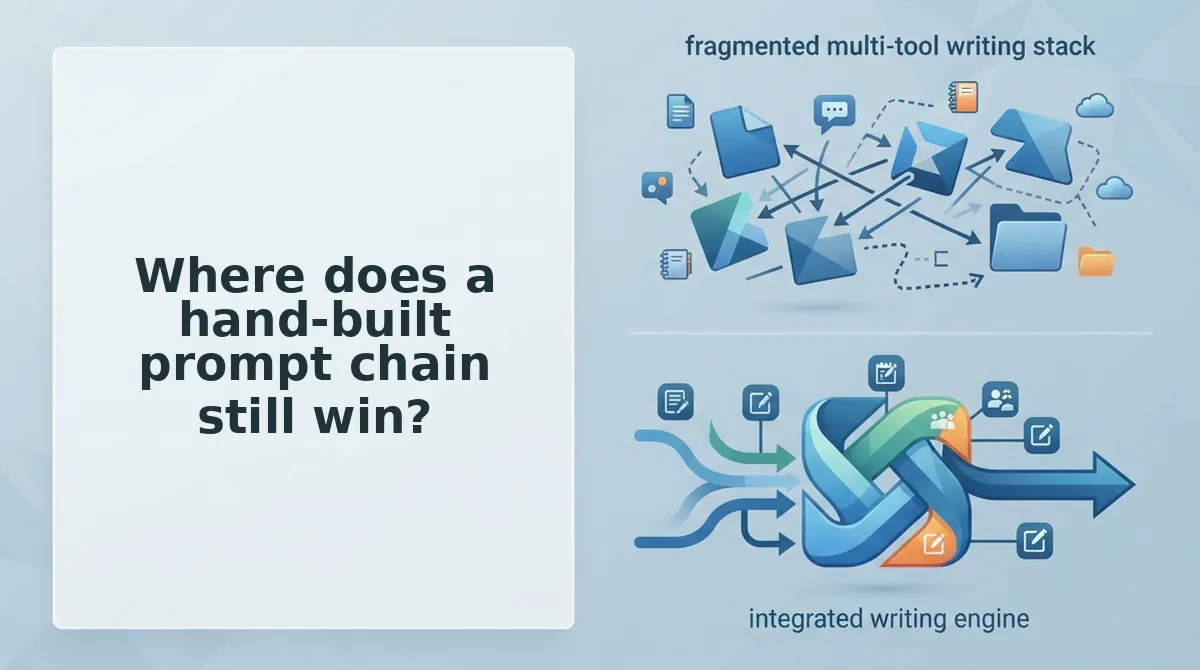
Prompt chaining is the practice of splitting one long article into a sequence of smaller prompts, where each step reads the previous output before producing the next. It still wins in one specific situation: when a human is already reading every sentence anyway.
At the simple end, a three-link chain â outline, draft, edit â run in one sitting beats a single mega-prompt for anything past 1,000 words, because each link carries one instruction instead of nine.
In the middle, the chain starts carrying artifacts rather than just instructions: an outline the draft must obey, a section spec per heading, and a QA checklist applied before assembly. Think of it as a relay race where the baton matters more than the runners â the output of one leg is the input of the next, and one dropped handoff fails the whole race no matter how fast anyone ran.
At the advanced end, regulated or claims-heavy topics justify seven or eight links, with a dedicated claim-checking step and a legal read inserted before the meta link.
Why the voice drifts by section four. Drift is not the model forgetting your voice; it is the absence of a persistent brief file handed between steps. Each link re-reads the previous output as its primary context, so a small phrasing choice in section two becomes the reference point for section five. Three or four of those compounding nudges later, the draft sounds like a different site. Re-attach the voice rules at every link and the drift stops.
Each added link buys a little quality and costs one more human review pass, so the curve flattens rather than climbing forever. That tradeoff is our reasoning from watching the workflow, not a measured benchmark.
The fixes stay mechanical, not creative:
- Re-attach the voice-rules file at every link instead of trusting it to survive the chain.
- Write a section spec per heading â length, claim to make, evidence allowed.
- Run a contradiction check against the outline before assembly; the symptom is section six arguing with section two, and the cause is no shared state between them.
The chain genuinely wins on regulated topics, claims-heavy copy, and small calendars where a human already reads everything â the control is worth the labour there. Before you scale it, run an SEO content audit so the chain is drafting against a real gap rather than a guessed one.
When does an automated content engine beat the chain?
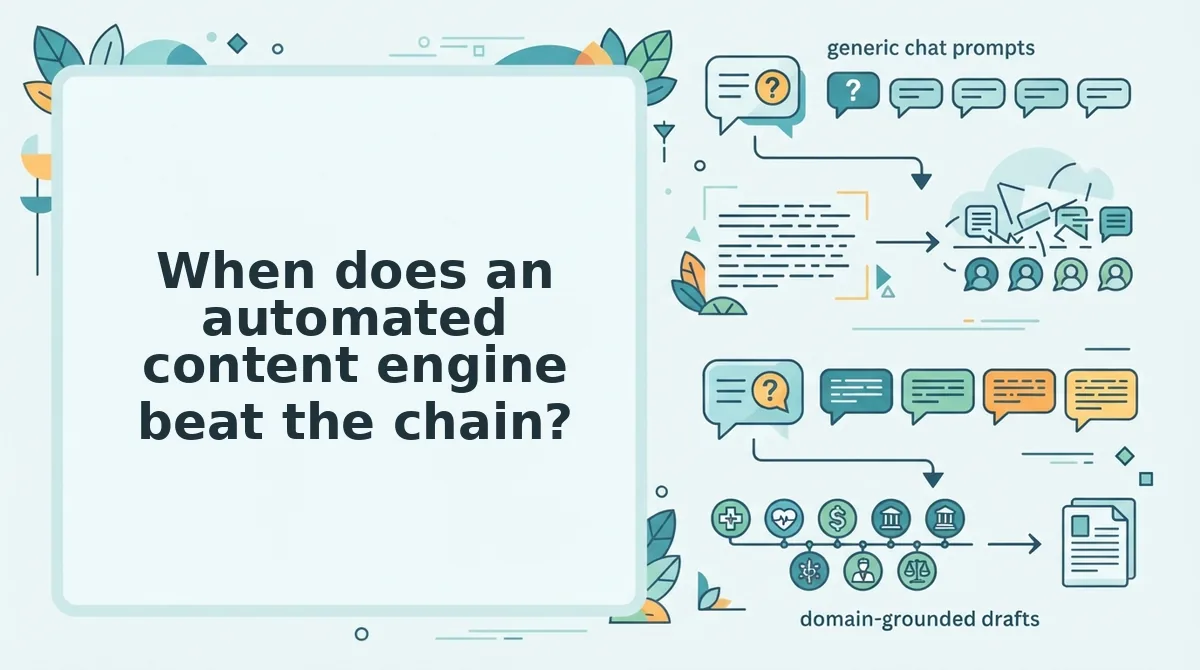
An automated content engine wins once your bottleneck is continuity rather than craft â when voice rules, outline, QA and publishing all have to survive a 30-day calendar without a human re-pasting a brief at every step.
Credit where it is due first: a hand-built chain gives sentence-level control that no engine matches, and a careful operator can course-correct mid-draft in ways a batch run cannot.
| Criterion | Hand-built chain | Automated engine |
|---|---|---|
| Voice rules | Retyped or re-pasted each run | Derived from the sitemap and existing pages |
| Mid-draft control | Sentence-level, at every link | Brief-level; less granular inside a section |
| Calendar continuity | Breaks when the operator gets busy | Holds across the full 30 days |
| Publishing and indexing | A separate Monday chore across tabs | Part of the run |
| Quality checks | A full reread at the end | A repeatable per-section check |
That last row is what makes volume survivable. Per-section QA as a fixed check beats a reread, because a reread is the first thing to get skipped when the calendar slips.
Publishing and indexing deserve the same scrutiny. Most chain tutorials treat the draft as the finish line, which is a large part of why their output never gets quoted in AI answers â the page exists but was never structured for retrieval. Pairing the run with real AEO content optimization and a planned set of topic clusters is what turns published drafts into citable ones.
Best for the solo operator shipping fewer than eight posts a month with high stakes: the hand-built chain. Best for the content lead running a cluster calendar with a fixed publishing cadence: the engine.
The honest concession: an engine is the wrong tool for one article carrying legal or reputational weight. Chain that one by hand.
BloGoose runs the workflow this table describes â crawl the domain, extract voice rules, plan the calendar, draft, check, publish.
Where does BloGoose stop and a human have to start?
Four things a run does not settle, stated as limits you can hold us to rather than fine print buried at the bottom of a page.
Evidence and sourcing, because the draft cannot verify a claim it was handed. Claims about regulated products, which need a qualified reader. Product and pricing accuracy inside the draft, since your catalogue changes faster than any brief. And the editorial call on whether the piece should exist at all â that judgment is the part of the job that does not automate.
The promised payoff from the start of this article: past roughly six links, the review burden outgrows the quality gain. That is the real answer to whether chaining is worth it, and it is why the handoff artifacts matter far more than the prompt wording everyone trades.
It also means manual chaining is sometimes the better call, not the lesser one. Below a few posts a month, with a human already reading every line, a chain is cheaper and more precise than any platform.
When volume does outgrow it, drop your domain into the setup wizard and let the first calendar be the test. Then plan a content refresh cycle for whatever the audit flags as already slipping.
The boundary is not a weakness in the tool â it is where your judgment finally gets to do work only you can do.