Jasper long-form editor vs sectional AI agents for blog posts
Choosing between the Jasper long-form editor vs sectional AI agents comes down to a question no vendor comparison answers: how much context does one generation step have to hold? Decide it before the feature matrices. Keep a long-form editor when posts run below roughly 1,200 words and voice continuity matters more than throughput. Switch to sectional agents when posts are long, fact-dense, or written to be quoted in AI answers.
That rule comes from mechanism, not measurement â no controlled benchmark of these two approaches backs it, so treat what follows as reasoning about how each system holds context rather than a performance claim.
Two mental models, not two vendors: one canvas that keeps growing, or one bounded brief per heading, restarted fresh on every call. BloGoose â an AI SEO content engine that crawls your site, extracts brand-voice rules, and drafts heading by heading â sits firmly in the second camp.
The seam problem is real, though: sections drafted in isolation can drift apart. There is a fix for it, and it arrives right after the scoping table.
The Real Difference Is Where the Context Lives
A long-form AI editor is a single growing document held in one model context and generated sequentially; a sectional AI agent is a bounded brief per heading, with fresh context on every call. Everything else in this comparison follows from that split.
Think of the long-form editor as one long call with a colleague who remembers everything said so far; a sectional agent is a relay of short handoffs, each carrying its own briefing note. One keeps the thread, the other keeps each leg short.
The mechanic underneath is context pressure. A context window is the working memory a model can see during a single generation step, and it is finite.
That limit produces a scoping model you can apply before you buy anything:
| Section length | Context one generation step must hold | Failure symptom that appears first |
|---|---|---|
| Short â a few paragraphs | Outline plus the immediately adjacent text | Barely visible; voice holds |
| Medium â roughly 300â600 words | Outline, the previous section's ending, live claims | Points restated in two headings |
| Long â 800+ words in one pass | Full argument, every prior claim, brand rules | Mid-article tonal slide |
| Whole post in one canvas | The entire document, compressed to fit | Outline items silently dropped |
Why do long AI blog drafts go flat in the middle? Because a single generation step has to hold the outline, the brand voice rules, and every claim already made. As that load grows, the model compresses: earlier specifics blur, hedging creeps in, and the voice that opened the piece stops matching the voice closing it. Sectional drafting avoids that by shrinking the load â each heading gets a bounded brief instead of a whole document. The cost moves rather than disappears: brief quality becomes the limiting factor, and transitions between sections need a dedicated pass.
Longer sections in one canvas raise what each step must carry; shorter sections with per-heading briefs shift the burden to brief quality instead.
That is why the brief becomes the real product in a sectional setup. A live SERP brief is what stops a heading from drifting into generic advice â and BloGoose automates the input side by crawling your sitemap, reading published pages for voice rules, then drafting each section against its own scoped brief.
Where Jasper's Long-Form Editor Still Wins
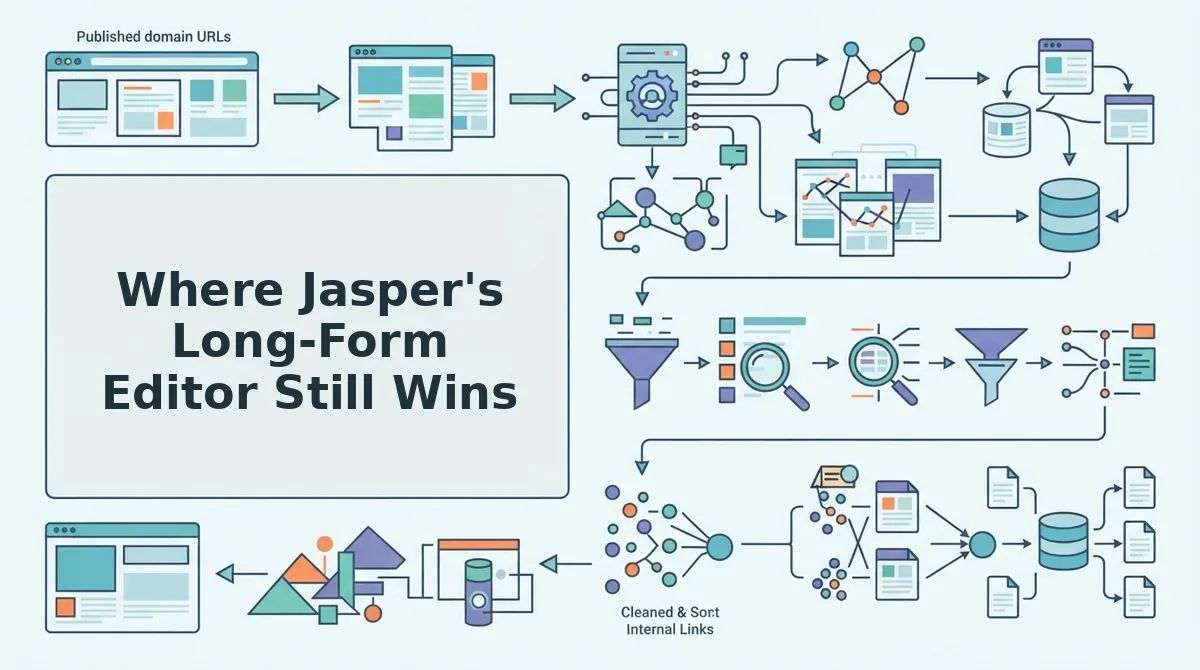
Jasper's long-form editor wins wherever an argument has to build across the whole post â callbacks, escalation, and a single thesis that tightens from section to section. That is a structural advantage, not a rewriting one.
Sequential generation over one growing document means each new paragraph can still see every promise the earlier ones made. A callback lands because the setup is in scope. An escalation works because the third point knows what the first two conceded.
Single-pass revision compounds the same way: correct a claim once and every dependent sentence inherits the fix. Under per-heading briefs, that same correction has to be replayed in each brief or it leaks.
| Dimension | Long-form editor | Sectional AI agents |
|---|---|---|
| Voice across 1,800 words | Strong â one continuous context | Depends on brief discipline |
| Argument build and callbacks | Native | Requires an explicit thread in every brief |
| Fixing one factual claim | Propagates automatically | Must be updated per section |
| Passage-level citability in AI answers | Needs artificial subheads | Pre-chunked by design |
Best for the solo operator or founder writing a 900-word opinion piece, launch narrative, or essay where a single voice carrying the reader is the whole point.
That strength stops exactly where a paragraph has to survive on its own.

Where Sectional AI Agents Win on Control and AI Citations
Sectional AI agents win on posts that are long, fact-dense, and likely to be revised: they scope context to one heading at a time, regenerate a single block instead of a whole canvas, and produce a draft that is already divided into citable passages. Jasper's long-form editor still wins when one writer has to carry a single argument from the first line to the last.
| Decision factor | Jasper long-form editor | Sectional AI agents |
|---|---|---|
| Context scope | One context held across the entire document | Context bounded to a single heading, with brand context files re-injected each time |
| Tone handling | Voice inherited once at the top of the draft | Voice re-asserted at every seam by a per-heading injection |
| Revision unit | Whole-document re-edit | One weak H2 re-run on its own brief |
| Grounding data | Spread thinly across the full draft | A live SERP brief scoped to one heading |
| Passage structure | Chunked after the draft is finished | Pre-chunked by heading at draft time |
Those three mechanics â per-heading voice injection, section-level regeneration, and a heading-scoped SERP brief â all exist only because the generation step never sees the whole post at once. A team comparing Surfer SEO alternatives usually stops at the feature grid and misses this.
The citation advantage is a structural argument, not a measured result. Passage-level retrieval rewards self-contained blocks, and a per-heading draft is already blocked that way before anything else touches it â reasoning from how retrieval works, not a tested finding. See the AEO content optimization guide for the retrieval side.
Best for a brief-driven team: sectional agents, where different people own headings. Best for a solo editor holding one argument: Jasper's long-form canvas.
The Tone-Drift Tradeoff Nobody Measures
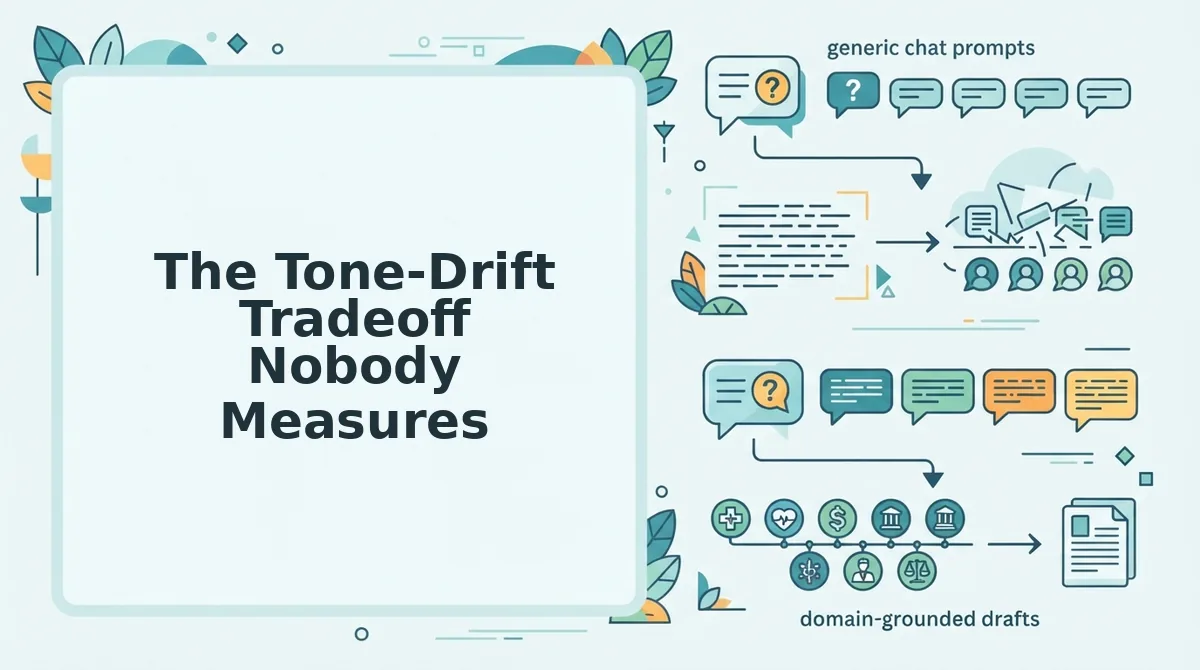
Tone drift is the gradual divergence of a draft's voice from your brand voice as the document gets longer, and sectional drafting does not remove it â it relocates it.
Inside a heading, per-section drafting usually reduces drift, because a short block of text is easy to keep on-voice. Then the seam arrives, where two independently briefed sections meet with no shared memory of what came before. Think of a relay team where each runner is handed the baton and a note, but never sees the race plan.
Seam failures have recognizable shapes: a section that restates the one above it, a callback joke that lands twice, an argument that resets instead of escalating. Once you know the shapes, you can scan for them in about the time it takes to read the draft.
How do you stop an AI blog post from sounding inconsistent between sections? Outline first, with one thesis per heading and an explicit order. Assert the voice at document level rather than hoping each section inherits it. Then run a whole-document coherence edit before publishing, reading only for transitions, repeated points, and escalating claims. That single pass is cheaper than a full redraft, and it is the mitigation â not a different tool. A single-prompt AI blog post avoids seams by construction and pays for it elsewhere.
"Will it sound like one writer?" is the wrong question. The right one is where the voice is re-asserted, and whether a cheap coherence pass closes the gap.
Speed including editing cannot be compared honestly without measurement, so watch three variables instead: sections regenerated per revision, minutes to a publishable seam, and how much of the document a single fix touches. BloGoose's workflow handles the first and third by design â voice rules extracted once from your site, re-applied per heading, with only the affected section re-run.
A Four-Question Framework for Choosing Your Workflow
Before opening either tool, answer four questions:
- Does the argument build across the post, or sit in independent blocks?
- How many verifiable facts does each heading carry?
- How often will this be revised?
- Who edits at the end?
Long, fact-dense, frequently revised, team-edited: sectional drafting plus a closing coherence pass. Short, cumulative, single-author: a long-form canvas. That is the whole decision, and it is the point the intro left open â the category you pick matters less than where the context lives and where the voice gets re-asserted.
Question one sets the stakes, since a post whose argument escalates needs shared memory and a post of independent blocks does not. Question two decides grounding: more sourced claims per heading favors a bounded brief that keeps that evidence tight. Question three is about the revision unit, because regenerating one section beats re-editing an entire canvas. Question four is about ownership, since sectional drafting suits a brief-driven team and a single-pass editor suits one writer.
Run it on the hard case. One writer, a 4,000-word pillar with 11 headings, each carrying its own sourced claims and due for two rounds of review: the four answers flip toward sectional drafting with a coherence pass at the end, even though the same writer would pick the canvas for a 900-word post.
Start by dropping your domain into BloGoose's setup wizard. It crawls your sitemap, extracts your brand voice into reusable rules, and builds a calendar of headings you can draft one at a time â the sectional workflow, with the voice assertion already built in.