Single platform content engine vs multi tool SEO stack for blogs
Count the tabs between a keyword export and a publish button: keyword tool, brief doc, chat window, image generator, CMS. Five tabs, and each one is a place where context has to be re-typed by hand.
That is the real stake in the single platform content engine vs multi tool SEO stack decision. You already know the "12-tab content stack." You may also suspect the alternative is just "another chat window with hopes." Both complaints are legitimate, so the answer here is a routing rule rather than a feature list.
This comparison delivers a verdict for two reader shapes, a six-seam inventory of where handoffs break, the capability floor a single engine must clear, the lock-in test, and a migration sequence at the end.
One finding stays off every pricing page: the decision turns on who owns the seams between tools, not on which tool wins its own category. A platform that crawls your domain, holds brand voice across drafts and publishes to WordPress or a custom API, as BloGoose does, is one way to close those tabs, but only if it clears that floor first.
Which Should You Build On? The Verdict Comes First
Default to a single platform content engine if you publish multiple posts per week and nobody owns the seams between tools; keep a multi-tool stack if one specialist owns SEO and you run a small number of high-value clusters where research depth beats volume.
Should you use one platform or several tools for blog content? Use several tools when a specialist owns the workflow and volume is low, because each specialist is genuinely deeper at its one job. Use one engine when volume is high and handoffs are unowned, because the cost lives in re-entry and drift rather than in any single tool's features. Count your weekly posts and your named owners; those two numbers settle it.
A single platform content engine is one system that crawls your site, holds brand context, drafts, generates images and publishes. A multi-tool SEO stack is separate specialist subscriptions joined by exports and copy-paste.
| Criteria | Multi-tool stack | Single content engine | What decides it |
|---|---|---|---|
| Manual handoffs | Six or more per article | Designed to be zero | Who absorbs re-entry when a term changes late |
| Where brand context lives | In a doc, re-pasted per session | Extracted from your live pages on setup | Whether voice survives a second edit pass |
| Keyword research depth | Deeper volume and SERP history | Sufficient for clustered briefs | How competitive your clusters are |
| SERP data freshness | Depends on the subscription tier | Bundled with the engine, not separate | Whether you act on data weekly or quarterly |
| Publish path | Manual paste into the CMS | Direct to WordPress or custom API | Publishing cadence per week |
| Schema and AEO output | Add-on or manual markup | Generated with the draft | Whether AI answers are a channel for you |
| Exportability of context | Native, since nothing is unified | Only if voice rules export as portable text | Your tolerance for lock-in |
| Team fit | Rewards one technical owner | Rewards a solo operator or generalist | Headcount assigned to content ops |
Credit where it is due: specialist keyword tools still hold an edge on historical volume and competitor gap analysis, and a human editor still beats any generator at long-form revision. That edge is real, and it is exactly why the stack persists.
Best for the stack: an agency content lead with a dedicated technical SEO owner running four to six high-value clusters a quarter. Best for the engine: a solo operator or DTC founder shipping eight to twelve posts a month with no one assigned to the seams â the profile BloGoose is built around, since its setup starts by crawling your domain and extracting voice rules rather than asking you to write a prompt.
Where does the cost actually show up? It shows up in re-entry, not subscription fees. Every time a document crosses a tool boundary, someone retypes the target term, the voice notes and the intent, and each retyping is a chance to substitute a near-synonym or drop a constraint. Two stacks with identical invoices can differ by hours per article purely on how many times that loop repeats, which is why counting tabs predicts workload better than comparing feature lists does.
Where the Multi-Tool SEO Stack Actually Breaks
A handoff is any transfer of a document or decision between two tools; context drift is what the receiving tool loses about voice, target term or intent during that transfer. The stack breaks at six named seams, and each seam carries a re-entry cost and a drift risk.
- Keyword export to brief. Re-entry cost is low and drift risk is low, because a spreadsheet travels cleanly. What still leaks is the reasoning: export files rarely carry why a term was chosen, so the brief inherits a target without an argument behind it.
- Brief to draft. Re-entry cost is high, since the chat window needs the brief, the voice notes, sample published pages and the negative constraints pasted in. Drift risk is high as well, because each new session drops the voice rules, which is the "another chat window with hopes" failure in one sentence.
- Draft to edit and voice repair. Re-entry cost spikes when a target term changes after the draft exists, because the window must be re-briefed with the brief, the voice notes and the earlier draft pasted back in. Drift risk is medium: edits fix sentences but seldom re-check intent. That re-entry is the tax.
- Edit to images. Re-entry cost is medium, as alt text, captions and the article's core claim must be restated to a separate generator. Drift risk is medium too, visible in the folder named final-final where images lose their source claim.
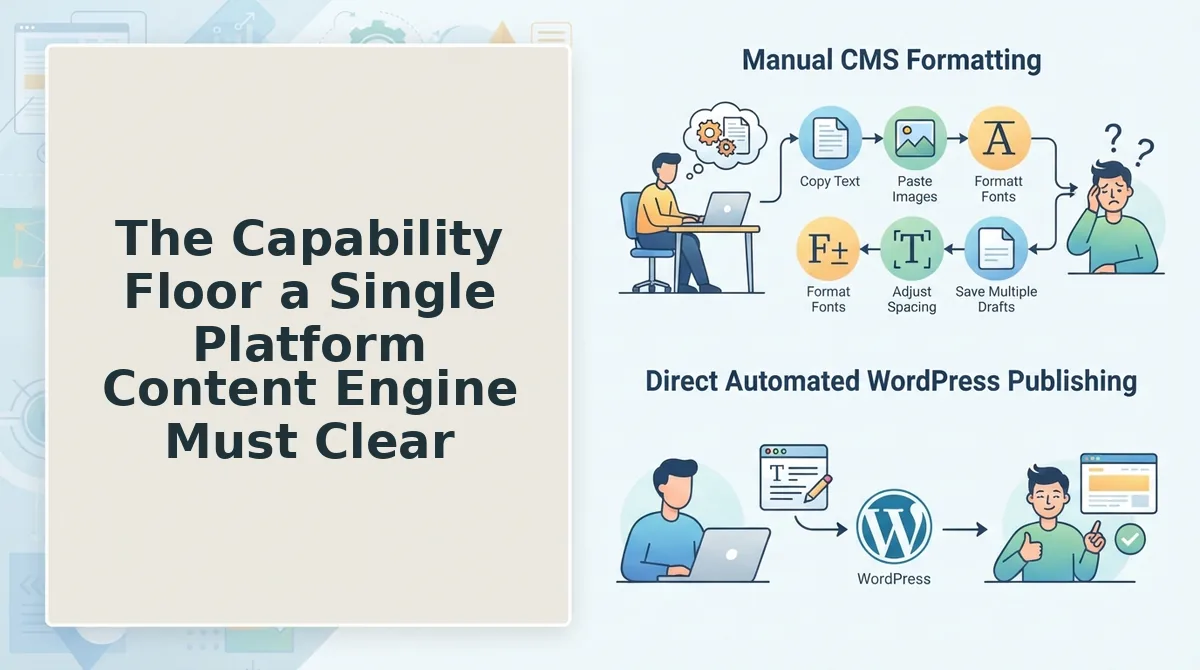
- Images to CMS upload. Re-entry cost is high and drift risk is high, because formatting, headings, internal links and metadata get rebuilt by hand. Any element the paste drops, drops silently.
- Publish to indexing. Re-entry cost is low but drift risk is the highest of the six: schema, sitemap pings and internal link checks are separate chores that quietly get skipped, so the article exists without being fully machine-readable.
The phrase "replace half your stack," pushed in coverage such as the Next Level AI video, is a marketing frame rather than evidence; that video is affiliate-monetised, so its incentive is naming categories you can buy. Practitioners including James Dooley and Daniel Foley Carter still debate which tool categories a technical stack even needs, which tells you the stack has no settled shape to defend.
The stack remains the correct answer in one case: a single specialist owner, a handful of high-value clusters, and research demands a generalist engine cannot meet. Read the list as a diagnosis, not a verdict.
That seam inventory sets the bar the alternative has to clear, which is the subject of The Capability Floor a Single Platform Content Engine Must Clear.
The Capability Floor a Single Platform Content Engine Must Clear
A single platform content engine clears the capability floor when it passes six pass-or-fail checks on a trial account: live SERP data, brand context that survives a full rewrite, schema in the published markup, inline image generation, direct publish, and exportable context files. That sounds tidy. It is not the same as passing.
A content engine is software that crawls your site, extracts brand context into reusable files, plans and drafts articles, and publishes them without a human moving data between tools. The mechanics are unglamorous: sitemap crawl, eight Markdown context files, sectional drafting, inline images, publish via WordPress or a custom API.
Run these six checks in order, and note the pass condition for each:
- Live SERP data. Pass if the tool returns the current ranking pages for your query, not a static difficulty score. Test it against live SERP analysis on a term you already rank for.
- Brand context that survives editing. Pass if a full rewrite of one section still sounds like your site, with no re-prompting.
- Schema output. Pass if structured data appears in the published page source, not only in a preview panel.
- Inline image generation. Pass if images land inside the draft at section level without a separate tool.
- Direct publish. Pass if the article reaches WordPress or your API and the URL resolves.
- Exportable context. Pass if you can download the context files as plain Markdown and read them.
The honest carve-out: check one is the only place a specialist keyword tool consistently beats a general engine. Research depth is a database problem, and general engines summarize rather than index. That gap is why the recommendation keeps one specialist rather than none â and why AEO content optimization still needs a human choosing the query.
Can one engine match a specialist keyword tool? Mostly, with that single exception. A general engine can pull live SERP results, hold voice across a rewrite, emit schema, generate images, and publish without a copy-paste step. What it rarely matches is database depth: a specialist tool indexes far more query variants, filters, and competitor positions than a general engine surfaces. Take a keyword you already rank for, run it through both, and compare the variant list side by side. If the engine surfaces the long-tail terms the specialist shows, it passes. If it hands you a summary score instead, it does not.
| Setup | Strongest at | Weakest at | Best for |
|---|---|---|---|
| Single platform engine | Removing handoffs from brief to publish | Keyword database depth | The solo operator publishing 4â8 posts a month alone |
| Multi-tool stack | Research depth and editorial control | Re-entry cost at every seam | The agency team with a dedicated editor per cluster |
| Engine plus one specialist | Coverage of both, with one documented seam | One extra subscription to justify | The growth lead who needs scale without losing query choice |
If your bottleneck is the sixth tab of a spreadsheet rather than the research itself, the engine is the leverage point â and the crawl is where it starts.
Where BloGoose Stops Short and When the Stack Still Wins
BloGoose is an AI SEO content engine that crawls your site, learns its voice from context files, plans a calendar, drafts and publishes articles â and it stops short in four specific places. Naming them is more useful than another feature list.
Think of it like a house's load-bearing walls versus a specialist contractor. The engine can carry the structure of your publishing rhythm; it cannot replace the surveyor who tells you the ground is wrong.
Simple limits first. It does not carry a specialist-grade keyword database, so research depth is not its strength. No vendor benchmark exists that lets you compare its output against a rival engine, so treat any ranking claim as unproven. Migration is real work, not a switch.
Intermediate: the engine also cannot tell you whether your cluster strategy is correct. It executes the plan you bring; it does not adjudicate the plan's logic.
Advanced: the real trade-off is ownership of the seams. Handing brand context to any engine creates lock-in unless that context is portable. The ownership test is concrete: brand context lives in editable Markdown files â style guide, target keywords, internal links map â so you can open the folder and check portability before you commit, not after.
That is why the rule is a spine plus one exception, not a hedge: run a single engine as the spine, keep exactly one specialist tool where research depth decides the outcome â a shortlist like Surfer SEO alternatives is the right place to pick it â and document why that seam exists so it never quietly becomes five. And treat "replaces half your stack" as a promise to test against the capability floor above, not a specification you accept on faith.
How Do You Migrate Without Losing Rankings?
Migrate by running the engine against one page you already rank for, so the comparison is controlled rather than hopeful. Export context first, rebuild the link map second, and change URLs last â or not at all.
The sequence, in order of action:
- Export the context. Re-export the Markdown files and diff them against your current style guide, so the engine starts from your site's real voice rather than a generic one.
- Map the internal links. Rebuild the internal link map for the pillar you are testing â the seams here are where rankings drift after migration.
- Draft one existing pillar. Pick a page with rankings you can read, and draft it in the new workflow end to end.
- Compare section by section against the live page. Note what the engine dropped, not just what it added.
- Handle URLs and indexing only where something actually changed. Rewrite redirects for moved paths, then request indexing after publishing â not on unchanged URLs.
That closes the loop the earlier sections opened: the platform-versus-stack question is never settled on a comparison table. It is settled by one controlled page, measured. Nothing in this plan makes migration instant â it makes it attributable, which is the only version worth running.
The step is to drop your domain into the setup wizard and inspect what sitemap context extraction produces before you touch a live URL. Once one pillar survives that comparison intact, the rest of the cluster is arithmetic â and your calendar stops depending on how many tabs you are willing to keep open.