How to Structure Blog Outlines That Answer Engines Can Cite
You paste a topic into a chat window, get back "Introduction / What is X / Benefits / Conclusion," and publish. The post ranks weakly and never gets quoted by an answer engine. An answer engine is an AI system, such as a chatbot or AI search summary, that answers questions directly and may cite its source pages.
That frustration is fair. Most video tutorials teach prompt-based outlining ("outline in minutes," Gemini outline workflows) and skip how to make sections answer-first. This guide shows you how to build blog outlines answer engines can cite, with a 7-step plan and a pass/fail test.
You will move from research to question H2s, answer leads, entities, facts, passages, and schema slots. One heading-level change matters most, and it happens before you write a paragraph.
How should I structure a blog outline so AI answer engines cite it? Use question-based H2s, a 1-2 sentence direct answer under each, one defined entity and one quotable fact per section, and self-contained 80-120 word passages. No outline guarantees citation, because answer engines choose sources opaquely.
What Does a Citable Blog Outline Need Before You Start?
A citable blog outline needs a clear target and four inputs gathered before you write a single heading. The target is simple: every section can be lifted out and quoted as a complete answer.
A citable outline is a section plan where each heading leads to a standalone, quotable answer. Think of it like a recipe box: any card can be pulled out and still work without the rest of the cookbook.
- Answer engine: an AI chatbot or AI search summary that answers questions directly and may cite sources.
- AEO (answer engine optimization): structuring content so answer engines can extract and quote it.
- GEO (generative engine optimization): making content more likely to appear in AI-generated responses.
- Passage: a short, self-contained block of text a system can retrieve on its own.
- Answer lead: the 1-2 sentence direct answer that opens a section.
Before outlining, gather these inputs, ideally in one SEO content brief:
- SERP notes: the consensus headings top results share, plus the gaps they skip.
- A question list from People Also Ask and community threads, in the asker's own words.
- Brand context files: voice rules, target-keywords.md, and internal-links-map.md.
- A source list of studies or data you can actually cite.
The contrarian point: your outline is the AEO, not the draft. If you fix structure during editing, you rewrite whole sections, so citation-worthiness is decided at the heading stage.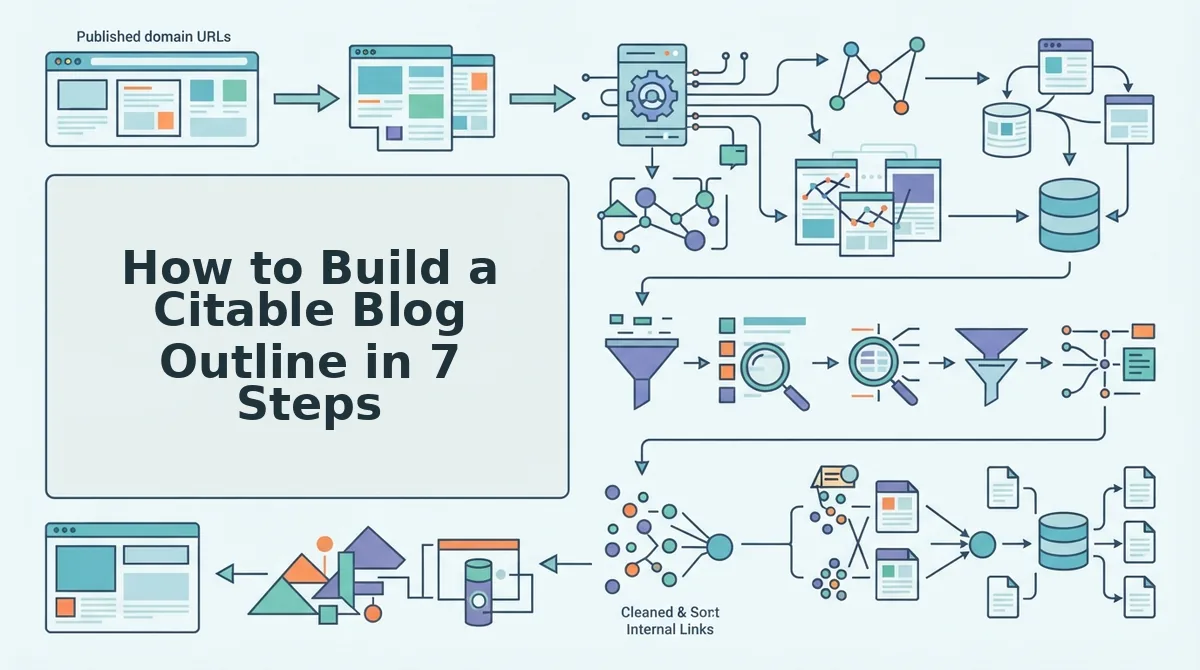
How to Build a Citable Blog Outline in 7 Steps
A citable blog outline takes seven steps. Research the live SERP and social conversations, turn real questions into H2s, and write a one-to-two-sentence answer lead under each H2. Then name and define the main entity, slot one quotable fact per section, plan a self-contained 80-120 word passage for key sections, and add FAQ, schema, and internal-link slots. Each step gives answer engines a clean unit they can extract. The outline becomes a map of answers that can be quoted out of context.
Before you start: Open the live search results for your target query, the People Also Ask box, and relevant community threads. Keep your brand files, internal-links-map.md and target-keywords.md, within reach.
- Map your research to outline elements. Start from what ranks and what people ask, not from a prompt. Use this mapping:
- SERP consensus headings â required sections
- People Also Ask and community questions â question H2s
- SERP gaps â information-gain sections
- internal-links-map.md â link slots
- target-keywords.md â keyword placement slots
- Rewrite real questions as H2s. Copy the phrasing from People Also Ask and community threads instead of inventing labels. Each H2 should read like something a reader would actually type or speak.
- Write the answer lead before the section. Draft a one-to-two-sentence answer under every H2 before you outline anything else. For example, "Benefits of X" becomes "Why does X matter for [audience]?" followed by a two-sentence answer lead. Each heading now resolves its own open loop.
- Name and define the main entity. Add one "[Term] is [definition]" sentence to each section. An answer engine can then quote the definition without guessing what the section covers.
- Slot one quotable fact per section. Reserve a line for a verifiable fact and its source. If you have no source yet, leave the slot empty. You can fill an empty slot later, but you cannot fix an invented statistic.
- Plan one self-contained passage. Mark each key section for an 80-120 word passage that makes sense out of context. If the passage depends on the previous paragraph, rework the plan. An AEO content optimization tool can keep this rule consistent across a whole cluster.
- Add FAQ, schema, and link slots. Put an FAQ block, article schema, and internal-link placeholders in the outline itself. Every link and keyword placement should be assigned before drafting starts.
Worked Example: Planning Links During Outlining
Step 7 usually fails when links are added after the draft is finished. BloGoose avoids this by reading the site's brand context files, internal-links-map.md and target-keywords.md, while it builds the outline.
It prefills the link slots and keyword slots from those files. Internal links are planned from the start instead of bolted on later. The draft then follows a structure that already knows where each link and keyword belongs.
If you want this outline discipline without the 12-tab content stack, BloGoose crawls your site, learns your brand voice, plans a 30-day calendar, and publishes finished articles to WordPress or your custom API.
An outline built this way still needs a final check before drafting begins.
How Do You Check That the Outline Is Cite-Ready?
An outline is cite-ready when every H2 passes the Cite-Ready Outline Test. The seven checks are a question heading, an answer in sentences one and two, a defined entity, one quotable fact, a self-contained passage, a source slot, and an information-gain note. Run all seven before drafting.
- Question heading. Phrase the H2 as the query a user would type into an answer engine, so the heading matches search intent.
- Answer lead. Put the direct answer in sentences one and two, because engines usually extract a section's opening lines first.
- Defined entity. Name the subject explicitly instead of writing "it," so the passage still makes sense out of context.
- Quotable fact. Plan one specific number, step, or definition that an engine could lift word for word.
- Self-contained passage. Reserve one 80-120 word block that answers the heading without relying on surrounding text.
- Source slot. Mark where a study or primary source belongs. Our guide to citing sources covers how to fill it.
- Information-gain note. Write one line on what this H2 adds that the pages already ranking do not.
A generic prompt outline with the H2s Introduction, What Is X, Benefits, Tips, and Conclusion fails five of the seven checks. It has no question headings, no answer leads, no named entities, no quotable facts, and no information gain. The rebuilt outline from the previous section passes every check:
| Before | After |
|---|---|
| Introduction | What Is a Citable Blog Outline? |
| Benefits | Why Do Answer Engines Quote Some Passages? |
| Tips | How Do You Build One in 7 Steps? |
What makes a passage quotable?
A quotable passage is a block of text that an answer engine can lift and cite without needing anything around it. It meets four conditions: it is self-contained, it names its entity instead of leaning on pronouns, it makes one clear claim, and it answers the question in its opening sentences rather than building up to the point. Where a study or primary document supports the claim, the passage cites that source directly, which gives the engine a verifiable reason to attribute it.
Passing all seven checks raises the odds of citation, but it does not guarantee it.
Questions About AEO Blog Outlines
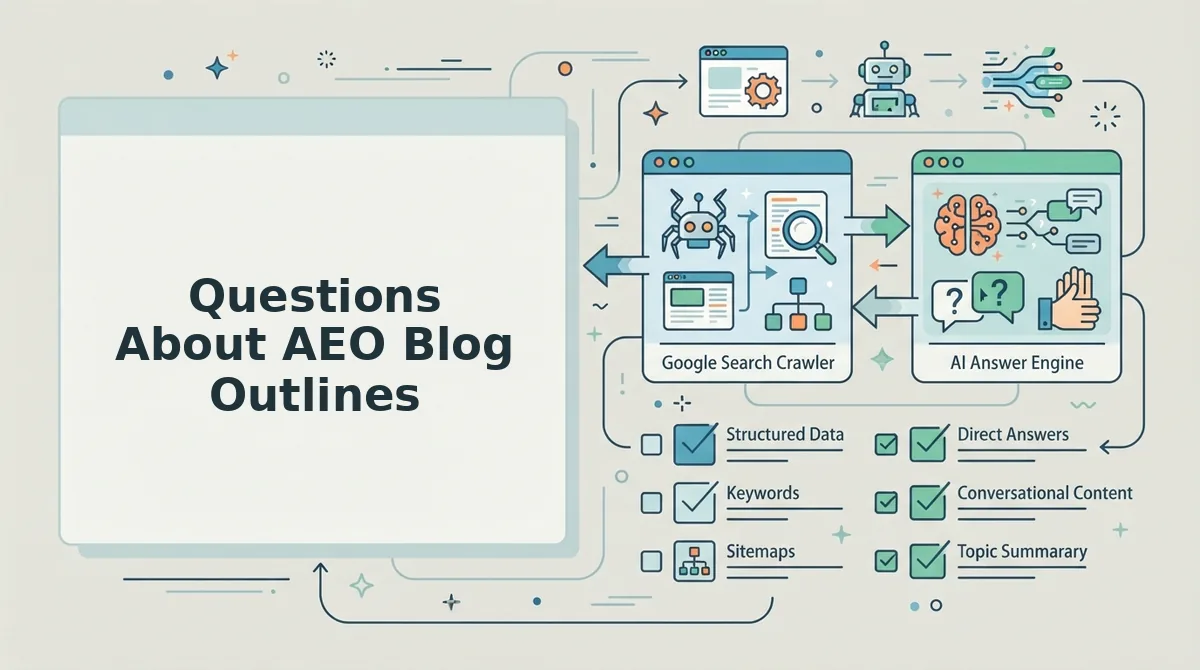
Most follow-up questions about AEO outlines cover AI-generated drafts, Google rankings, and terminology.
Does a ChatGPT- or Gemini-generated outline work for AEO?
A ChatGPT- or Gemini-generated outline works only as a starting draft. Fast generic prompts produce generic H2s with no SERP gaps, no answer leads, and no information gain. Before drafting, rewrite the headings as real queries and add an answer lead to each one.
Do I need to rank on Google to get cited by AI?
Ranking on Google helps, but it is not the whole picture. Google rankings and AI citations overlap, yet answer engines select individual passages rather than whole pages. Clear, self-contained structure improves your chances whether or not the page holds a top position.
Is GEO different from AEO?
GEO and AEO overlap so heavily that most teams treat them as the same practice. Both mean structuring content so that AI systems can extract, trust, and cite it. The outline checks in this guide apply to either label.
Should every H2 be a question?
Most H2s should be questions, because question headings mirror how people phrase queries. A step-by-step heading or a closing heading can stay declarative, as long as its first sentence still delivers a direct answer.
Start With the Outline, Not the Draft
Citation is decided at the outline stage. If an H2 fails the seven checks, polished prose will not make it quotable.
Pick one upcoming post, run its outline through the Cite-Ready Outline Test, and rewrite only the H2s and answer leads before you draft.
To apply the test to every post, use BloGoose, the AI SEO content engine. It crawls your sitemap, reads your Markdown brand context files, researches the live SERP and social conversations, and plans a 30-day calendar. It then drafts answer-first sections and publishes them to WordPress or a custom API. That replaces the chat window and the 12-tab stack, so every outline is cite-ready from the start.