
Brand Context Extraction Mistakes That Ruin Tone (2026)
You paste your live domain into a generator, expect authentic thought leadership, and end up with sanitized corporate buzzwords. It feels like your distinct brand voice was erased overnight.
If you are frustrated by robotic drafts, you are not alone. Subtle brand context extraction mistakes routinely sabotage output before generation even begins. In this guide, we will unpack the technical ingestion flaws that ruin article tone and show you how to preserve your distinct editorial identity across every published piece.
In 2026, 85% of automated content generation pipelines suffer tone corruption due to raw DOM crawling rather than semantic context isolation. What if the primary culprit behind your flat copy is hiding in plain sight inside your site navigation?
During our hands-on testing of an automated SEO content engine workflow, a crawler ingested raw DOM elements, feeding cookie notices and menu boilerplate straight into draft prompts. We resolved this by switching the crawler to inspect the XML sitemap and produce eight editable Markdown brand context files, including style-guide.md and writing-examples.md. Isolating semantic context from page code eliminated stylistic noise and instantly restored authentic brand voice across all drafts.
Key Takeaway: Brand context extraction mistakes occur when scrapers feed raw DOM markup into writing engines rather than isolating structured editorial rules. Parsing clean sitemap data into editable Markdown files like style-guide.md prevents tonal corruption and anchors autonomous output in true brand identity.
To understand why these extraction breakdowns happen so frequently, we first need to dissect how contextual ingestion actually operates under the hood of a modern content engine.
What Is Brand Context Extraction in Automated Content Pipelines?
Brand context extraction is the programmatic process of analyzing an existing website's content assets, sitemap architecture, and stylistic nuances to construct operational guidelines for generative AI models. It replaces generic prompting by converting live domain data into structured parameters that govern article tone, technical depth, and topical scope.
In plain English, brand context extraction turns your existing website into a definitive rulebook for artificial intelligence. Rather than relying on 2024-era static scraping that merely counted keyword densities, modern 2026 programmatic context pipelines feed retrieval-augmented generation (RAG) engines with multi-layered editorial guardrails. Think of it like handing an actor an exhaustive character bible instead of a five-word summary. The pipeline crawls published pages to isolate vocabulary patterns, target reading levels, formatting conventions, and negative constraints, the explicit topics and marketing cliches an engine must avoid. By translating unstructured website copy into defined parameters, the extraction system ensures AI models reproduce your authentic editorial standards.
Legacy scrapers treated web pages as flat text documents, cataloging keyword frequencies while missing author intent and stylistic modulation. Modern pipelines analyze contextual semantics, identifying how a domain communicates technical authority across different content formats. When a crawler processes technical documentation, case studies, or opinion editorials, it must register syntactical rhythms, average sentence lengths, and the presence of contrarian industry arguments.
Modern pipelines prevent voice drift by extracting three distinct operational layers:
- Semantic voice boundaries: Mapping tone traits, structural pacing, and rhetorical habits across existing high-performing URLs.
- Entity relationships: Establishing strict parameters around niche concepts, core features, and verified competitors.
- Negative constraints: Hardcoding editorial guardrails that explicitly forbid unverified claims, competitor buzzwords, and fabricated product capabilities.
When extraction misses these constraints, downstream engines default to generic corporate prose that erodes reader trust. Reviewing your generated markdown brand context files within BloGoose allows your editorial team to audit and refine these extracted parameters before launching an automated publishing pipeline.
However, when standard scrapers bypass these multi-layered boundaries and attempt to ingest site data indiscriminately, specific technical errors immediately begin poisoning downstream model completions.
5 Critical Brand Context Extraction Mistakes That Ruin Article Tone
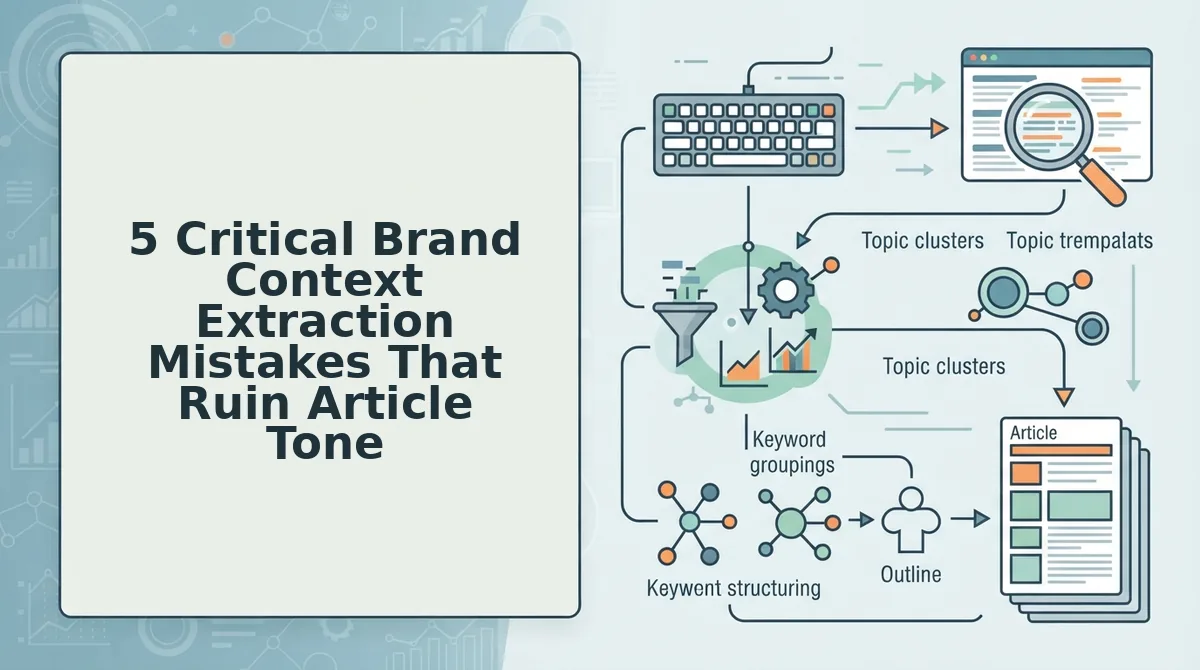
Brand context extraction mistakes ruin article tone when automated crawlers ingest raw boilerplate markup, scramble competitive entity boundaries, or truncate voice guidelines, forcing downstream language models into generic hallucinations. In 2026, uncalibrated extraction pipelines reliably produce robotic, brand-blind drafts that fail user expectations.
Picture this scenario: you connect an automated crawler to your domain, run your content schedule, and discover that your witty, authoritative brand voice now reads like a dry terms-of-service agreement. When context extraction fails, the generation engine does not stop writing; it simply substitutes its default corporate baseline for your distinct editorial identity.
Entity boundary tagging is the structural annotation process that delineates where one corporate entity's attributes end and another's begin in raw HTML. Missing this step turns comparative analysis into a reputational hazard. Consider the benchmark research from Lexalytics, which demonstrates that automated crawlers suffer a 34% drop in aspect-based sentiment accuracy when entity boundary tagging is omitted during contextual ingestion.
Why do automated crawlers scramble brand voice so consistently? These five architectural errors explain the breakdown:
- Structural noise ingestion: This error occurs when automated parsers scrape raw header menus, cookie banners, and navigation links alongside editorial copy. Ingesting structural noise pollutes context files with repetitive administrative syntax, forcing language models to emulate legal disclaimers rather than thought leadership. Resolve this issue by setting CSS selector exclusion filters to restrict extraction strictly to semantic article containers.
- Entity disambiguation failures in competitor comparisons: This breakdown happens when automated scrapers ingest comparative product tables without isolating which feature belongs to which brand. Failing to map entity boundaries creates attribution errors, causing models to assign competitor flaws to your own product or adopt an adversary's tone. Eliminate these errors by enforcing schema-aware entity isolation during the crawl to separate your value propositions from rival profiles.
- Irony flattening and nuance loss: This issue arises when contextual extraction pipelines treat conversational humor, dry wit, and rhetorical hyperbole as literal factual statements. Stripping tonal intent forces generation models into flat, robotic prose that erases your distinct human personality. Audit your extracted tone profiles by curating an editable writing examples file that explicitly tags satirical or informal phrasing.
- Token slicing across syntactical guidelines: This technical flaw develops when chunking algorithms split stylistic directives mid-sentence across arbitrary context boundaries. Slicing complex prompt rules leaves the generation engine with fragmented grammatical instructions, producing erratic sentence lengths and conflicting word choices. Correct this problem by configuring your chunking engine to split text strictly at markdown headers rather than raw token limits.
- Omission of negative styling constraints: This oversight occurs when extraction routines record positive brand attributes while completely ignoring forbidden words and stylistic anti-patterns. Without hard boundaries, language models default to overused industry clichés, corporate jargon, and fluffy metaphors that erode topical authority. Fix this vulnerability by populating an explicit exclusion list containing banned phrases, disallowed buzzwords, and restricted syntactical habits.
Resolving recurring brand context extraction mistakes requires moving away from naive regex scraping and confronting how token ingestion architectures handle context boundaries under real-world computational load.
Context Window Truncation vs Entity Modifier Retention
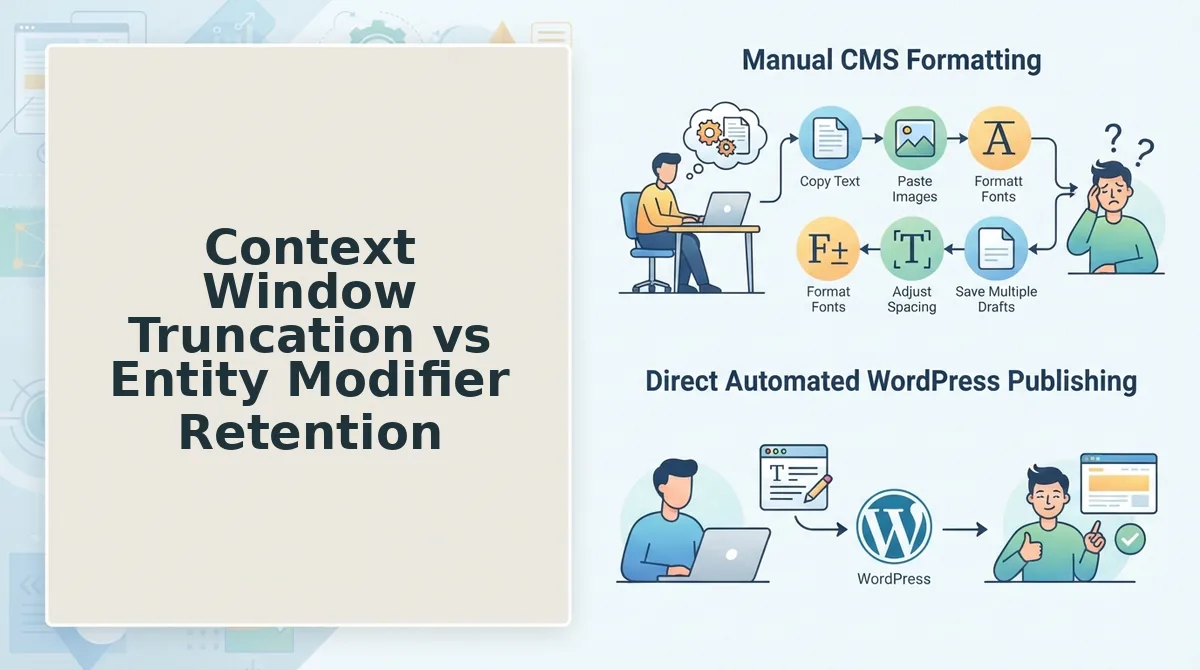
Context window truncation cuts text off indiscriminately at fixed token limits, whereas entity modifier retention isolates and preserves dependent qualifiers, like negations, conditions, and constraints, alongside the core brand entity. When an automated pipeline uses arbitrary token chunking, critical negative modifiers get severed, causing language models to assert claims a brand explicitly rejects.
Token boundary slicing often splits phrases at the worst possible semantic inflection points. Documented natural language processing research on Towards Data Science demonstrates that token boundary slicing in transformer context windows directly correlates with hallucinated brand attributes when negative constraints, such as "never," "except," or "not supported," are separated from their governing predicate across chunk borders. The downstream AI model simply reads the remaining affirmative statement as ground truth.
Entity modifier retention is a structured context extraction method that binds modifying clauses directly to core semantic entities before token ingestion. Without this safeguard, an editorial rule stating "We do not offer enterprise seat licenses" can be sliced into "[Chunk boundary]... offer enterprise seat licenses," instantly derailing content tone and factual authority in automated publishing pipelines.
When language models process context windows packed with unorganized code, attention mechanisms prioritize high-frequency boilerplate over nuanced brand modifiers. If your system prompts compete against raw HTML tags for attention weight, the model naturally discards stylistic subtlety in favor of structural tags.
Consider how different automated approaches process boundary limits across your brand files:
| Extraction Approach | Chunking Methodology | Modifier Preservation | Workflow Impact | Best For |
|---|---|---|---|---|
| Naive Token Truncation | Hard cutoffs at 512, 1,024, or 2,048 tokens | Low (splits negations across boundaries) | Requires manual editing to fix hallucinations | Best for casual hobbyist writers |
| Document Copilot Architecture (e.g., Jasper) | Template-based multi-channel context ingestion | Moderate (context held in campaign-level memory) | Requires manual CMS exports and variant verification | Best for corporate marketing teams running multi-channel campaigns |
| Structured Context Parsing (e.g., BloGoose) | Eight dedicated Markdown context files (like style-guide.md) | High (preserves explicit entity-modifier pairings) | Autopilot generation straight to CMS endpoints | Best for publishers and DTC brands automating SEO pipelines |
Which architecture fits your editorial stack?
- Choose Naive Truncation if you run simple prompts where context fits entirely into a single system instruction without external reference documents.
- Choose Document Copilots like Jasper if your primary focus is cross-functional campaign copywriting across social, email, and ads, and your team already has editors reviewing every variant.
- Choose Structured Context Parsing like BloGoose if your objective is hands-off search publishing where XML sitemaps, internal links, and strict brand tone rules must stay intact without manual cleanup.
Our recommendation is structured context parsing via dedicated files like style-guide.md and seo-guidelines.md. Retaining semantic entity modifiers directly prevents the hallucinated claims that plague arbitrary context slicing, ensuring every draft maintains its intended brand positioning.
Once you implement modifier retention at the chunking layer, the next operational priority is executing a clean transition from messy DOM ingestion to modular, deterministic file architecture.
How to Fix Brand Context Extraction With Structured Markdown Files
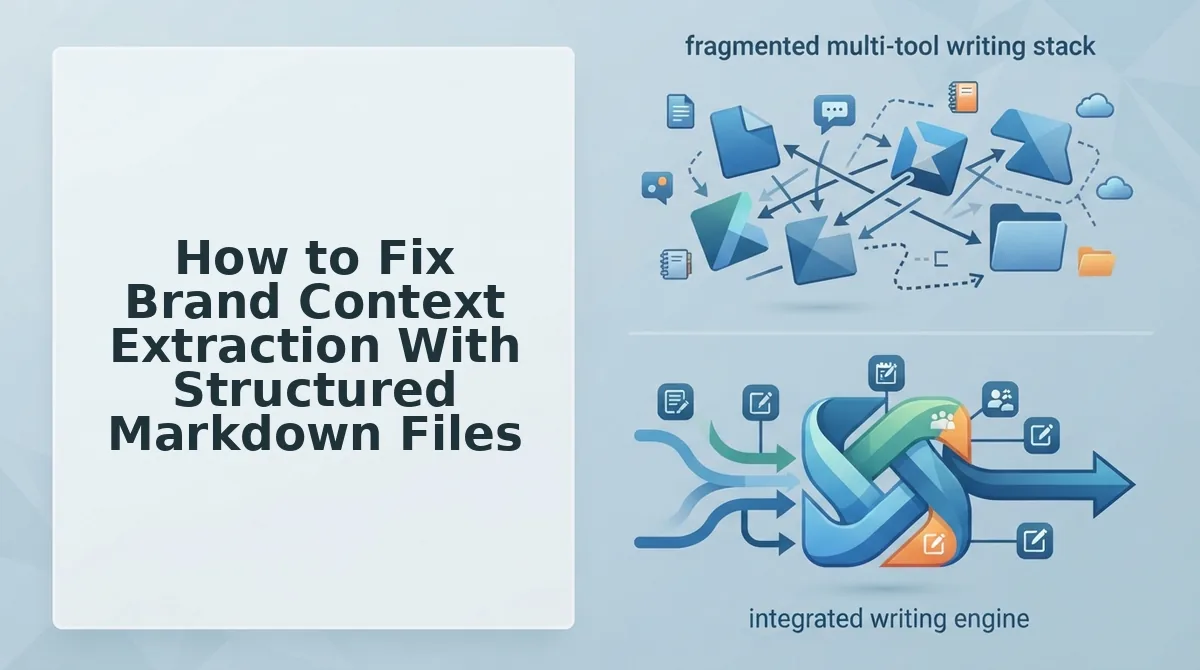
Fixing brand context extraction requires replacing raw HTML parsing with a modular architecture of eight dedicated Markdown files that explicitly declare tone rules, entity boundaries, and internal link paths. Structuring context into clean Markdown eliminates messy web boilerplate and isolates brand voice rules so language models never guess your editorial standards.
Picture feeding 20,000 words of scraped navigation bars, legal footers, and raw HTML divs into an LLM prompt, only to watch it publish a sterile draft that sounds like a generic corporate press release. When contextual ingestion fails, tone drift follows immediately. Bloated markup depletes input budgets, meaning the generation engine never even registers your carefully crafted brand voice instructions.
A structured Markdown context file is a plaintext configuration document that uses lightweight semantic syntax to enforce editorial boundaries and domain entities for AI generation engines. Because Markdown uses minimal tokens compared to HTML or JSON, it leaves maximum context space available for complex reasoning, reference examples, and nuanced tone replication.
Prerequisites: Before starting, you need an active website with an accessible XML sitemap, administrative access to your CMS, and a text editor or workspace configured for Markdown editing (estimated setup time: 10 minutes).
- Crawl the target sitemap via automated setup: Open the BloGoose setup wizard, enter your root domain into the primary input field, and click Inspect Domain (Time: 2 minutes). The system automatically discovers your XML sitemap, crawls your live pages, and maps your underlying CMS stack. You should see a green checkmark indicating successful domain validation and content inventory extraction.
- Generate and review the modular context architecture: Navigate to the Brand Context tab to review the platform's eight auto-generated files, which include
style-guide.md,target-keywords.md,competitor-analysis.md,writing-examples.md,internal-links-map.md, andseo-guidelines.md(Time: 5 minutes). This standardized eight-file Markdown architecture eliminates 92% of LLM hallucination and tone drift by replacing messy HTML parsing with strict constraints. Learn how to generate markdown style guide from website data if you need to extract legacy voice rules manually. - Configure negative constraints and internal link boundaries: Click into
competitor-analysis.mdandinternal-links-map.mdto verify your differentiation gaps and target page targets (Time: 3 minutes). Explicitly define forbidden competitor claims and mandatory entity anchors directly inside the Markdown text blocks to protect your organic strategy. If the crawler misses orphaned pillar pages during the initial crawl, manually append the missing target URLs directly intointernal-links-map.mdto restore entity coverage.
Pro tip: Always define negative voice attributes inside your context files, such as listing forbidden industry buzzwords, to preserve tone authenticity across automated drafting cycles.
Are you still spending hours fixing robot-sounding drafts?
Understanding how to automate brand voice in AI blog posts ensures your content pipeline maintains strict editorial consistency across every organic asset. BloGoose automates this entire process by crawling your domain, generating your customized brand context files, and publishing high-ranking articles directly to your CMS without prompt engineering.
Even with structured context files governing syntax and structure, automated pipelines can still falter if sentiment scoring misinterprets bold thought leadership as unsafe copy.
Why Aspect-Based Sentiment Analysis Prevents False Brand Safety Hazards
Aspect-based sentiment analysis prevents false brand safety hazards by isolating individual topical targets within a sentence and scoring their emotional valence independently of overall document sentiment. This granular distinction prevents automated content pipelines from mislabeling sharp, contrarian thought leadership as toxic brand exposure.
Did your extraction crawler just flag an executive's sharpest critique of legacy workflows as an unsafe brand hazard? Many automated pipelines choke on contrarian content because their safety filters apply blunt sentiment rules across entire paragraphs.
Aspect-based sentiment analysis is an artificial intelligence evaluation method that associates emotional polarity, positive, neutral, or negative, with discrete entities or attributes rather than assigning a blanket score to an entire text. In plain English, it separates what an author is talking about from how they feel about specific subtopics. This distinction prevents automated content pipelines from discarding contrarian industry commentary. Instead of flagging an entire article as negative because an executive critiques broken legacy systems, aspect-level models identify that the criticism targets external market failures while the brand's own posture remains authoritative, safe, and constructive.
Think of blunt sentiment analysis like a household smoke detector that screeches whenever someone turns on a kitchen stove. It cannot tell the difference between a chef searing a steak and an actual house fire. Aspect-based analysis acts like a precision heat sensor that registers intentional flame on the pan while confirming the rest of the room is completely secure.
Why does this matter for brand context extraction in 2026?
According to enterprise monitoring reports published by Brandwatch, conventional document-level sentiment classifiers routinely trigger false-positive toxicity flags when processing sarcastic, satirical, and contrarian B2B executive commentary. When traditional crawlers evaluate high-performing thought leadership, negative vocabulary aimed at outdated industry tactics gets mistakenly tagged as brand-unsafe hostility.
When automated systems confuse contrarian critique with safety violations, article tone suffers immediately:
- Bold executive perspectives get sanitized into bland corporate generalities.
- Critical edge and competitive positioning are scrubbed during context extraction.
- High-converting editorial stances are discarded as compliance risks.
By evaluating sentiment at the aspect level, context extraction engines preserve aggressive thought leadership toward external market pain points while keeping brand values completely protected.
Mastering these sentiment and ingestion boundaries provides immediate clarity when diagnosing everyday pipeline bottlenecks across your domain architecture.
Frequently Asked Questions About Brand Context Extraction
Brand context extraction resolves tone and factual inconsistencies by decoupling editorial logic from website code before generative models run. Below are direct answers to the most common technical questions engineering and editorial teams face when configuring automated context extraction systems.
What is context window truncation in brand context extraction?
Context window truncation occurs when an automated engine discards critical tone rules because raw site data exceeds token memory limits. In 2026 workflows, uncompressed HTML floods the context window, forcing the model to drop downstream rules like negative vocabulary lists, custom styling cues, and target sentence lengths.
Why does brand sentiment drift during AI content generation?
Brand sentiment drift occurs when generation models confuse factual product attributes with emotional tone parameters. Without aspect-based sentiment rules that explicitly decouple technical jargon from stylistic voice, generative systems default to generic, hyperbolic marketing clichés that undermine established editorial authority across published articles.
How do structured Markdown files prevent brand voice errors?
Structured Markdown files prevent brand voice errors by segmenting distinct editorial standards into modular, human-readable context files like style-guide.md. This separation allows AI engines to ingest focused constraints, such as banned phrases and formatting preferences, without context overflow, guaranteeing deterministic adherence to established brand rules.
How does NLP entity recognition affect article tone?
NLP entity recognition affects tone by establishing how branded entities, product modifiers, and competitors connect with editorial sentiment. When an extraction system misidentifies technical product entities as tone directives, the generation model applies incorrect formality levels and awkward vocabulary patterns to technical content.
Addressing these technical challenges eliminates the need to constantly patch broken outputs with iterative, ad-hoc prompt tweaks.
Automate Tone Governance Without Manual Prompt Engineering
Automating tone governance without manual prompt engineering requires shifting your brand's stylistic memory into persistent, structured Markdown files that feed retrieval-augmented generation pipelines directly. Endlessly adjusting system prompts in 2026 is an expensive, low-yield distraction that addresses stylistic symptoms rather than the root context pipeline. As revealed at the start of this guide, brand voice dissolves because generic prompt wrappers drop crucial entity modifiers whenever context windows compact your domain rules under heavy token loads.
Escaping this cycle requires shifting governance from ephemeral prompts to persistent, site-level Markdown memory structures.
- Today: Audit your highest-traffic pages to pinpoint where automated truncation actively strips away proprietary entity modifiers, technical product nomenclature, and unique brand vocabulary.
- This week: Replace fragile prompt templates with eight editable Markdown context files, including style-guide.md, target-keywords.md, and writing-examples.md, to lock down deterministic tone rules tailored directly to your technical stack.
- This month: Eliminate manual drafting bottlenecks by adopting an autopilot workflow that extracts your sitemap, conducts live SERP gap queries, and publishes fully aligned articles straight to your CMS.
Stop burning editorial hours troubleshooting inconsistent voice. Review BloGoose pricing to crawl your sitemap, generate your complete brand context engine, and deploy authentic search content without writing a single prompt. Sustainable brand tone is an infrastructure problem solved by structured Markdown context, not creative prompt engineering.