
How to Break a Blog Draft Into Sections for AI Agents
You split a 3,000-word draft into five tidy sections, hand each one to a different AI agent, and get back five posts that sound like they were written by five different companies. That's the failure mode most teams hit when they break a blog draft into sections for AI agents using headings alone as the dividing line.
You're not wrong to parallelize. Splitting work across agents is the only way to scale content without hiring a room full of writers. But headings define topics, not contracts, and without a contract, every agent fills the gaps with its own assumptions about tone, audience, and depth.
Here's the fix: before you hand off a single section, define a Section Contract, a five-field brief that tells each agent exactly what the section must accomplish, who it speaks to, and how it hands off to the next one. This article walks through what a Section Contract is, how to build one, and three concrete methods for passing context between agents without losing your brand voice.
Along the way, you'll see why the pipelines in tools like Atlasml Ai and n8n tutorials skip the one step that matters most, and how a platform like BloGoose handles it by extracting brand context from your existing site automatically.
What Is a Section Contract for AI Agents?
A Section Contract is a five-field brief attached to every blog section before an AI agent writes it, specifying the goal, audience, keyword intent, format, and handoff instructions. It turns a heading into a complete assignment.
Think of a Section Contract like a job ticket at an auto repair shop. A heading tells the mechanic "fix the brakes." A job ticket tells them which car, what symptoms the driver reported, which parts to use, and what to check before handing the keys back. The heading is necessary. The ticket is what prevents a $2,000 surprise and an angry customer.
The Five Fields of a Section Contract
Every Section Contract contains five fields, and skipping any one of them is how tone drift and duplicate content creep into multi-agent pipelines.
- Goal: What must this section accomplish? For example, "Define the term and give one concrete example the reader can reuse."
- Audience: Who is reading this section, and what do they already know? A section aimed at a technical founder should not re-explain what an API is.
- Keyword and intent: Which query does this section target, and what is the searcher trying to do, learn, compare, or buy?
- Format: What structure should the output take? A numbered list, a comparison table, a definition paragraph, or a step-by-step walkthrough.
- Handoff: What must the next agent know to continue without repeating or contradicting this section?
Example Contract for a "What is X" Section
Here is a filled-in contract for a definitional section targeting an informational query:
- Goal: Define the term in one sentence, then explain it with one analogy a non-technical reader understands.
- Audience: Content managers who know SEO basics but have never run multi-agent pipelines.
- Keyword and intent: "What is a Section Contract", informational, searcher wants a clear definition fast.
- Format: Definition sentence first, then one analogy paragraph, then a bulleted list of the five fields.
- Handoff: Pass a three-sentence summary plus the five field names to the agent writing the next section on context-passing methods.
When every section carries a contract like this, agents stop improvising. They execute. And the assembled draft reads like one writer produced it, not five. Platforms like BloGoose automate this by crawling your existing site and extracting the brand rules that feed every contract, so you don't hand-write five fields for forty sections.
How to Pass Context Between AI Agents Without Losing Voice
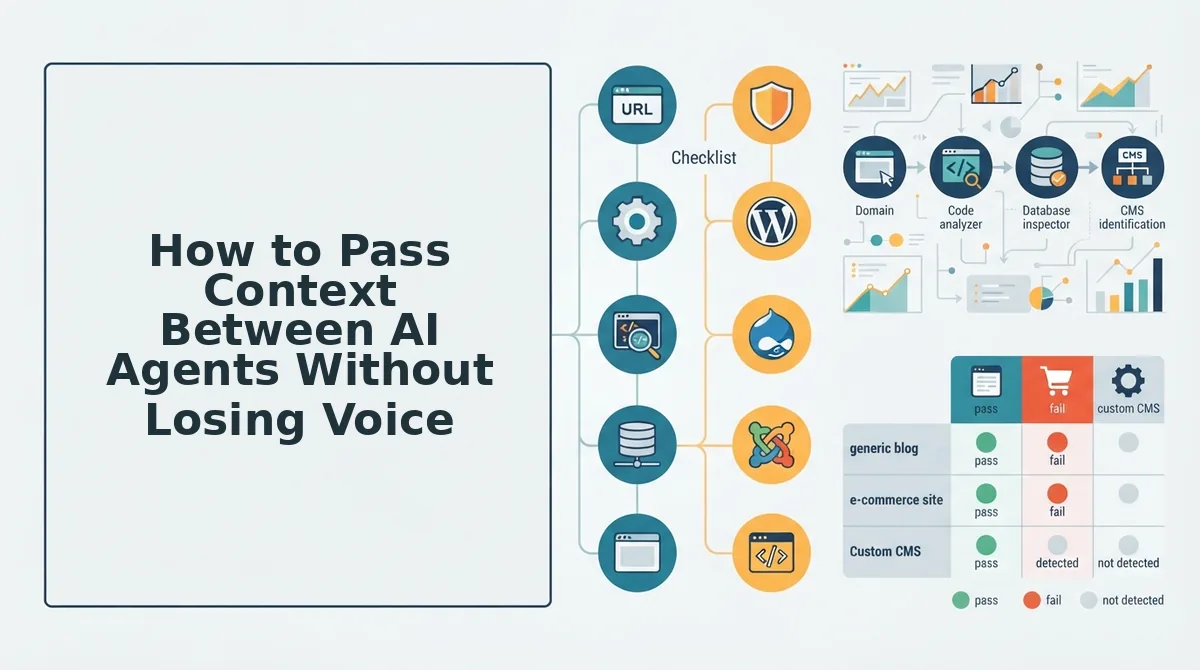
Passing context between AI agents means giving each agent the output of the previous section plus a shared reference file, so every section inherits the same voice, terminology, and scope. Without this, each agent starts from zero and invents its own style.
Prerequisites: A completed Section Contract for each section, a brand voice document (or extracted brand context from your site), and a pipeline tool that lets you pass variables between agent steps.
- Write a previous-section summary after each agent finishes. Take the completed section and compress it into three sentences: what it covered, which key terms it introduced, and what it deliberately left out. Pass this summary as the first input to the next agent. You should see the next section open by referencing the prior one instead of restating it.
- Create a shared style anchor file. Write one brand voice document, tone, sentence length rules, banned phrases, formatting preferences, and attach it to every agent prompt in the pipeline. Every agent reads the same anchor, so voice stays consistent even when topics change. This takes about 30 minutes to write once and saves hours of per-section editing.
- Use a brand context file extracted from your live site. Instead of writing the style anchor by hand, point a crawler at your domain and let it extract voice rules from your published pages. BloGoose's 8-file brand context system does exactly this, it crawls your sitemap, detects tone patterns, terminology, and formatting habits, then packages them as reusable context files that every agent in the pipeline receives automatically. This is the same principle behind brand context extraction for AEO optimization, applied to multi-agent drafting.
Each method works alone, but combining all three, summary, anchor, and extracted context, produces the tightest voice consistency across a long draft. The summary handles continuity, the anchor handles style, and the extracted context handles authenticity.
Once context flows cleanly between agents, the next question is how finely to slice the draft itself.
Section Granularity: When One Section Becomes Multiple Agent Tasks
Section granularity is the practice of sizing a blog draft section so a single AI agent can complete it in one focused pass without losing context, drifting intent, or diluting keyword relevance.
Think of section granularity like cutting a steak for a child: too large, and the child chokes or gives up; too small, and you spend all dinner slicing instead of eating. AI agents behave the same way with word count and scope.
Start simple: a 150-word section on "what is a CDN" is one task. An agent can hold the definition, one example, and one transition sentence in a single context window. Now scale to intermediate: a 450-word section on "how CDNs reduce latency" actually contains three sub-tasks, explaining edge servers, describing cache hit ratios, and walking through a request flow. That is three agent passes, not one.
Advanced granularity emerges when you apply three rules as a decision matrix:
- 300-word rule: Sections over 300 words split into sub-tasks. Agent focus degrades beyond that threshold because the model must juggle too many claims, examples, and transitions at once.
- Intent-shift rule: A section answering two search intents becomes two sections. "What is a CDN and how do I set one up" mixes informational and transactional intent, split them.
- Keyword-density rule: A section targeting a second keyword becomes its own task. If "edge caching" needs to rank independently, it deserves a dedicated agent pass with its own heading and contract.
Applying these rules before you dispatch agents prevents the most common failure mode: a section that starts as a definition and ends as a tutorial, satisfying neither intent.
Sectioning Workflows in Practice: LangGraph, n8n, and BloGoose
Three tools dominate sectioning workflows for AI blog pipelines, each with a distinct philosophy: LangGraph gives you planning-based sectioning with explicit agent roles, n8n offers visual pipeline sectioning with guardrail nodes, and BloGoose automates sectioning from SERP research and brand context.
| Tool | Sectioning Approach | Setup Effort | Best For |
|---|---|---|---|
| LangGraph | Planning-based: you define agent roles and section contracts in code | High, requires Python and graph orchestration knowledge | Engineering teams building custom multi-agent research pipelines |
| n8n | Visual pipeline: drag-and-drop nodes with guardrail checks between sections | Medium, no-code but manual node configuration per workflow | Ops-minded solo operators who want visual control over each step |
| BloGoose | Automated: crawls your site, extracts brand voice, and sections drafts from SERP research | Low, domain input triggers the full pipeline | Founders and content publishers who need rank-ready sections without orchestration overhead |
LangGraph's strength is precision: you can assign a dedicated agent to each section with explicit input and output schemas, which is powerful when you need deterministic control. n8n's strength is transparency: every guardrail node between sections is visible, so you can audit exactly where a draft got truncated or reformatted.
BloGoose's strength is that automated sectioning from SERP research removes the manual contract-writing step entirely. Instead of you deciding where "what is a CDN" ends and "how to configure one" begins, the platform reads the search results, detects intent shifts, and splits sections accordingly, then applies your brand voice rules to each section automatically.
If you are currently hand-writing section contracts in LangGraph or dragging guardrail nodes in n8n, the bottleneck is not the AI, it is the orchestration. BloGoose collapses that loop into a single setup step.
FAQ: Breaking Blog Drafts into Sections for AI Agents
How do you break a blog draft into sections for AI agents?
Split the draft at intent boundaries, not paragraph boundaries. Each section should answer one search intent, stay under 300 words, and target one primary keyword. Assign each section to a single agent pass with a written contract stating the goal, audience, and transition requirement.
What is the best section size for AI agent drafting?
150 to 300 words per section works best. Below 150 words, agents over-explain to fill space. Above 300 words, agents lose focus and drift into adjacent topics. If a section exceeds 300 words, split it into two sub-tasks with separate contracts.
How do you keep AI agents from repeating content across sections?
Pass a running outline of already-written sections as context to each new agent. Include the previous section's final sentence and instruct the agent to start with a non-overlapping transition. Explicitly list forbidden phrases from earlier sections in the contract.
Section granularity, workflow tooling, and repetition control all point to one conclusion: the section contract is the unit of quality in multi-agent blog pipelines. Start sectioning your blog drafts for AI agents today.
Start Sectioning Your Blog Drafts for AI Agents Today
Section contracts, context handoffs, and granularity rules are not optional polish, they are the difference between agents that assemble drafts and agents that produce publishable articles. The three-step process works because each step removes a specific failure mode: contracts eliminate ambiguity, handoffs preserve voice and intent, and granularity prevents scope collapse.
Here is the synthesis most teams miss: the section is the unit of trust in multi-agent pipelines. When you define what each section must contain, pass the accumulated context forward, and split sections at natural task boundaries, you stop debugging agent behavior and start scaling output.
Start with one article. Define a contract for each section. Pass context explicitly. Apply granularity rules before you build the workflow, not after it breaks.
If you want this process automated, crawling your site, extracting brand voice, sectioning drafts, and publishing without manual orchestration, the AI content engine at BloGoose handles the sectioning, context passing, and publishing pipeline end to end.
Agents don't fail because they lack intelligence, they fail because they lack boundaries.