Byword bulk keyword lists vs live SERP topic research
Uploading a spreadsheet of 500 terms into a bulk generator often yields a queue of drafted posts that stall in indexation limbo. Navigating Byword bulk keyword lists vs live SERP topic discovery is the central fork in programmatic SEO: choosing between ungrounded volume generation and real-time intent extraction. You recognize the exhaustion of the 12-tab content stack, where juggling keyword exports, separate drafting tools, and manual CMS uploads leads to diminishing organic traffic.
This comparison breaks down how static CSV ingestion compares directly against real-time search engine result page grounding across workflow velocity, content cannibalization risk, and ranking durability. You will learn the exact operational trade-offs of both architectures so you can choose the right model for your publishing pipeline.
While batch processors generate hundreds of articles in minutes, relying on raw search strings without live validation introduces a silent architectural flaw that causes pages to compete against each other, a structural trap explained below. Implementing an AI-powered SEO content engine provides an alternative by anchoring every generated outline to live SERP dynamics and direct publishing rails.
Is Bulk Keyword Upload or Live SERP Research Better for Blog Topics?
Bulk keyword upload is better for programmatic directory builds targeting fixed parameter combinations, while live SERP research is superior for editorial blog topics requiring real-time intent verification and citation discovery. Bulk lists prioritize generation speed across disconnected strings, whereas live SERP topic discovery extracts current competitor gaps, People Also Ask entities, and ranking page layouts directly from search results before drafting begins.
Choosing between bulk keyword lists and live SERP topic discovery depends entirely on whether your site requires sheer output volume or deep query alignment. Static bulk keyword lists excel when you possess pre-clustered, verified data sets for templated directory pages, making them the fastest choice for technical aggregators. However, live SERP discovery is necessary for authoritative blog topics because it parses real-time search engine result page queries, protecting your domain from intent mismatch. Operators needing hands-off execution can rely on platforms that automate crawling and direct CMS delivery without managing spreadsheet lists.
| Evaluation Metric | Bulk Keyword Upload | Live SERP Topic Discovery |
|---|---|---|
| Primary Strength | Rapid multi-article batch generation from a single CSV export. | Real-time extraction of live search intent, SERP features, and ranking entities. |
| Cannibalization Protection | Low; relies on external spreadsheets to detect overlapping target queries. | High; inspects live URLs to ensure distinct search queries map to unique pages. |
| SERP Freshness | Static; does not detect shifting layouts, video blocks, or emerging PAA queries. | Dynamic; pulls active ranking structures at the moment of content creation. |
| Best For | Programmatic sites generating massive volumes of templated e-commerce or directory pages. | Content publishers, digital agencies, and brands building topic clusters that rank. |
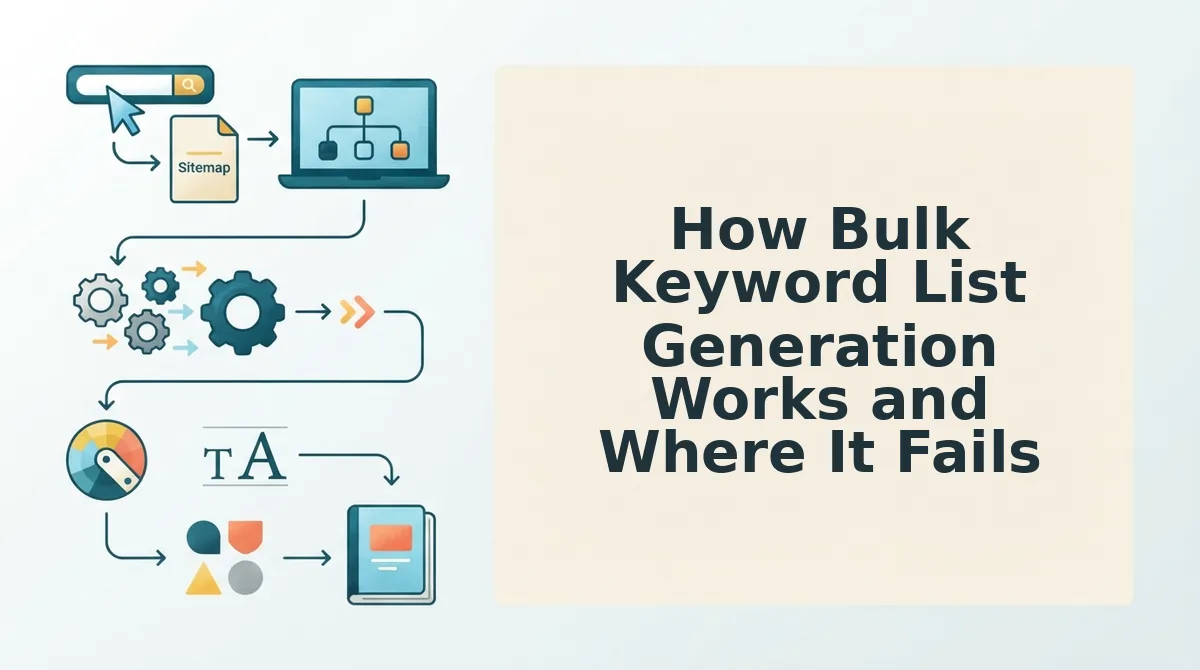
How Bulk Keyword List Generation Works and Where It Fails
Bulk keyword list generation is a programmatic production workflow where an operator uploads a flat spreadsheet of search terms into a generation engine that drafts an individual article for every row without validating real-time search results. The platform treats every keyword string as an isolated directive, executing templated prompts across the entire batch.
Think of bulk keyword uploading like ordering hundreds of identical suits from a catalog using only general waist sizes: production is fast, but none of the garments are tailored to the actual measurements of the people wearing them. The system assumes that every keyword string represents an isolated, singular intent suitable for a standalone page.
At an intermediate level, this disconnected processing creates search intent drift. Search intent drift occurs when an ungrounded generator produces informational guides for keywords that search engines currently resolve with calculators, comparison grids, or local aggregations. Because the engine reads only the string rather than the live results page, it generates structurally misaligned copy that search engines routinely filter out.
At an advanced level, the primary architectural flaw of bulk keyword generation is internal keyword cannibalization driven by failed SERP clustering. When programmatic lists feed dozens of closely related variations into a drafting tool, multiple articles inevitably target topics where top-ranking pages already satisfy all variants on a single URL. Because the engine fails to group keywords that share three or more overlapping ranking URLs, it deploys redundant pages across the site.
This structural redundancy strains your domain's crawl budget and triggers automated filters designed to penalize scaled content abuse, diluting domain authority across competing internal links. Without real-time SERP grouping mechanics, bulk lists turn massive content production into an indexation liability.
Understanding these systemic batch failures highlights the necessity of examining the mechanics of live SERP topic discovery.
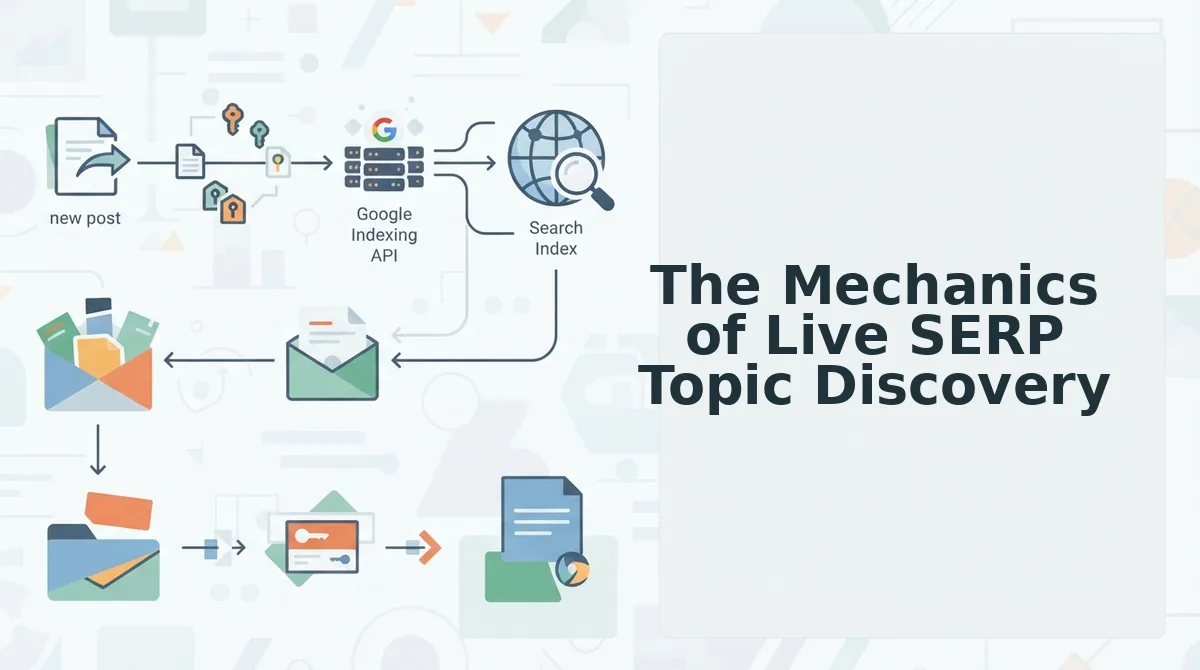
The Mechanics of Live SERP Topic Discovery
Live SERP topic discovery extracts current search engine results page features, top-ranking URLs, and People Also Ask queries in real time to establish true search intent before writing begins. This dynamic workflow prevents content duplication by aligning your outline with Google's active layout patterns rather than outdated keyword lists.
Prerequisites for this workflow include an active web browser or SERP scraper, access to your website's XML sitemap, and a baseline seed phrase. The following four steps take approximately 15 minutes per cluster to map out defensible organic targets.
- Type your core seed phrase into a search engine using an incognito window or your chosen scraping interface. Expected outcome: You should see the unpersonalized, live page layout displaying organic listings, video carousels, featured snippets, and People Also Ask accordions within 5 seconds.
- Click and expand the top four People Also Ask accordions to trigger contextual sub-questions, then copy these phrases into your outline document. Expected outcome: A list of 6 to 10 verified secondary questions appears in your editor, revealing the exact subtopics required for complete coverage.
- Open the top three organic competitor URLs in separate tabs and inspect their document outlines using the Rank Math SERP analysis workflow or browser developer tools. Expected outcome: You should see recurring H2 tags, average word counts, entity density patterns, and specific media formats that Google rewards for that search intent.
- Select your primary angle by identifying competitive gaps across those ranking URLs and map them into cohesive topic clusters. Expected outcome: A structured list of distinct, non-overlapping article targets that eliminate cannibalization risks.
Conducting real-time live SERP analysis ensures your articles target real-time search engine result page queries instead of dead intent. When a target query suddenly shifts from informational definitions to commercial software alternatives, a live extraction reveals that shift immediately through modified page layouts and changing rich results.
Instead of manually auditing every layout shift across dozens of search terms, BloGoose crawls your target domain and automates live query analysis natively to produce rank-ready articles.
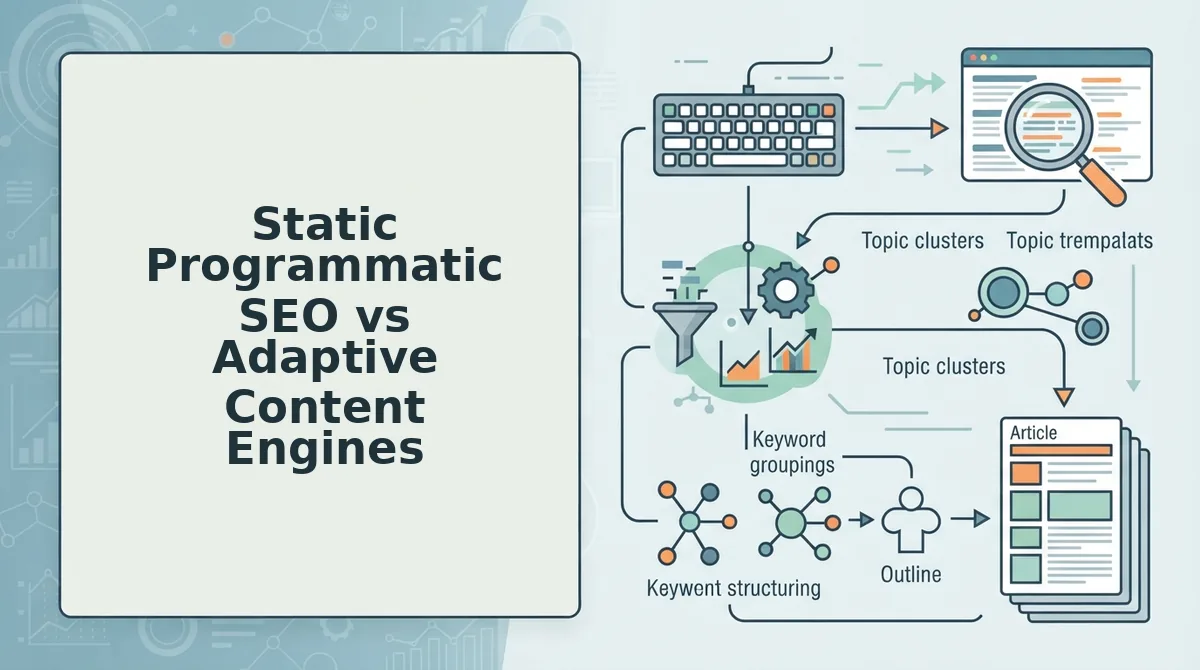
Static Programmatic SEO vs Adaptive Content Engines
Static programmatic SEO generates mass articles by pairing template prompts with a bulk keyword upload, whereas adaptive content engines extract real-time SERP intent and brand context before drafting. While static generation offers maximum raw output for structured datasets, adaptive systems protect sites from search intent drift and ranking drops.
The standard programmatic approach popularized by standalone batch tools is ideal for creating thousands of templated directory pages, local service listings, or ecommerce variations from structured spreadsheets. In contrast, an adaptive engine handles dynamic competitive shifts by parsing real-time entity density, user queries, and search features before generating long-form editorial content.
| Feature / Metric | Static Programmatic SEO | Adaptive Content Engines |
|---|---|---|
| Data Source | Static CSV rows and bulk keyword lists | Live SERPs, XML sitemaps, and real-time queries |
| Workflow Architecture | Fragmented 12-tab content stack (sheets, chat windows, CMS) | Unified autonomous pipeline (crawl to direct CMS publishing) |
| Intent Verification | Manual pre-filtering or unverified assumptions | Dynamic layout parsing and competitor gap identification |
| Answer Engine Readiness | Generic prompt responses | Structured data and built-in AEO optimization |
| Best For | Publishers building programmatic database directories | Teams wanting rank-ready automated SEO content |
Static generation delivers unbeatable speed when your primary goal is indexing thousands of repetitive parameter pages. However, scaling informational authority requires continuous extraction of real-time search results so your production pipeline does not push thin content against established enterprise competitors.
How to Move from Static Lists to Verified SERP Clusters
Transitioning from static keyword spreadsheets to verified search clusters requires filtering every keyword against active page overlap before generating content. Deduplicating target terms against live competitor rankings ensures you only publish articles when Google recognizes a genuinely unique search intent.
To eliminate keyword clashing across legacy spreadsheets, start by analyzing the top 10 URLs for your target phrases. If two distinct keywords share four or more identical URLs in the top 10 results, search engines view them as the same topic. Merging those keywords into a single SEO content brief resolves search intent drift and prevents the self-cannibalization common in raw programmatic generation.
Complete this three-step workflow to operationalize your existing keyword inventory:
- Extract the top 10 organic ranking URLs for your core spreadsheet terms to locate duplicate intent clusters.
- Consolidate overlapping keywords into distinct pillar themes that match verified search layouts.
- Feed validated themes alongside your domain's brand voice rules directly into an automated publishing loop.
Drop your website domain into the setup wizard at BloGoose to inspect your technical site context and convert target topics into voice-accurate, CMS-ready articles automatically.
Grounding your publishing schedule in live search intelligence guarantees that every published page holds a distinct competitive purpose across organic search and AI answer engines.