Chat window drafting mistakes that weaken long-form SEO posts
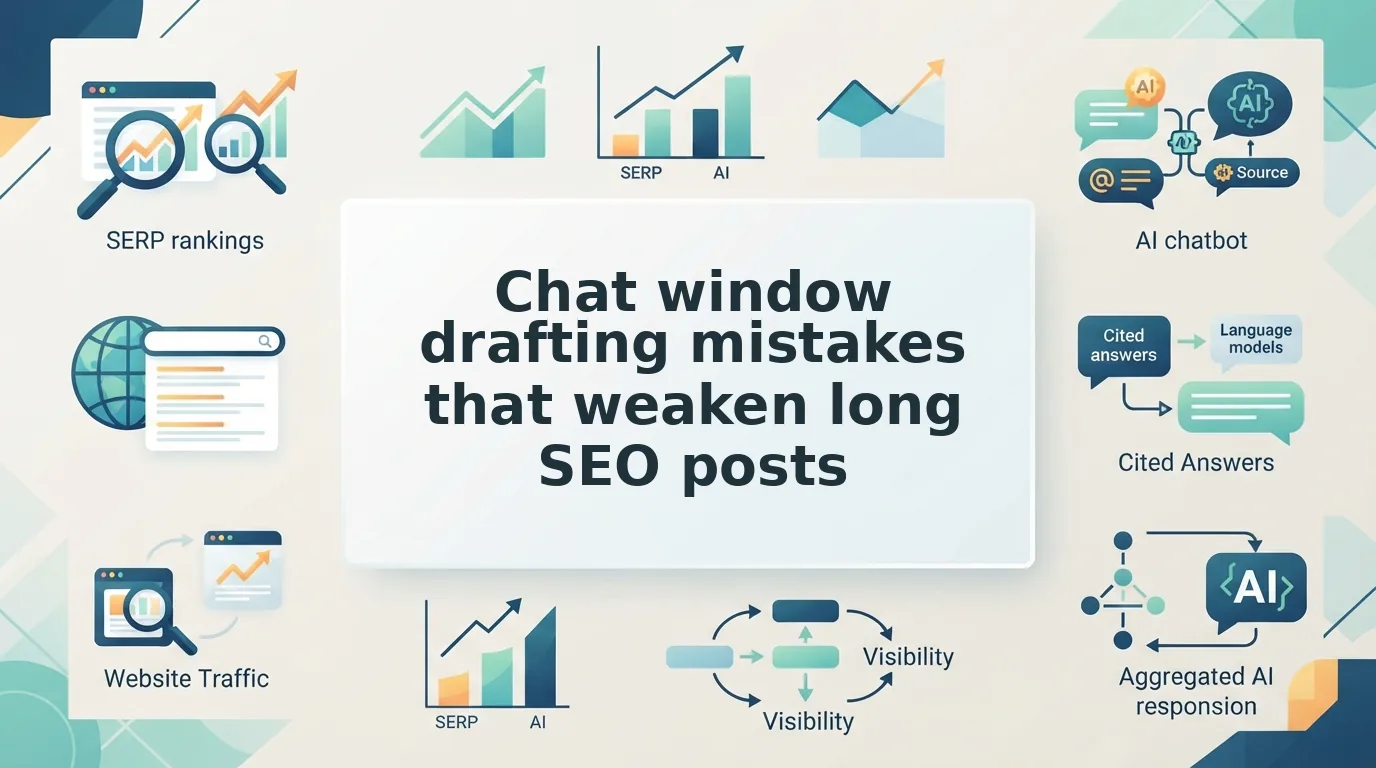
An hour into planning, the model suggests an angle you ruled out forty minutes earlier. Most writers read that as a prompt-writing failure. It is a thread failure â one of the seven chat window drafting mistakes that quietly strip the SEO out of a long post.
You already have the research, the brand and the target query, so effort is not the gap. What a chat window cannot do is keep a brief, a site's link architecture and a verification trail alive across a hundred messages.
The fix runs in two halves: brief and context first, then assembly. Have four things open before you type â the target URL, a live SERP read for the primary query, your brand context file, and five to eight internal URLs with exact anchors. Finish and you hold a section-by-section draft where every H2 answers a question the live SERP covers, every internal link is supplied rather than guessed, and every claim traces to a source you can open. An AI SEO content engine runs that same sequence for you.
The pattern is already visible in the tooling content competitors skip. The Dreaming Jester long-chat video opens on this exact failure: an hour in, the model proposes an angle the writer already killed. Stepwise's context window video shows the same decay with a name given in message one, gone by message 200.
Three of the seven mistakes are structural, and re-prompting makes all three worse.
How to fix the brief and context mistakes, step by step
Build a four-field brief from a live SERP read, hold it in one thread instead of chaining prompts, and re-paste the brand context file at the start of every pass. The three steps below take about 25 minutes and stop the drift that surfaces around prompt forty.
Have ready: the target URL, a live SERP read for the primary query, your brand context file, and a word band. A structured SEO content brief template works; so does a blank doc.
- Open the SERP and type the four fields (10 minutes). Read the top five results for your primary query, then write the primary query and intent, the subtopics those results actually cover, the target URL, and the word band. You should see four plain lines with no tone notes and no adjectives.
- Paste the brief once and stop chaining (2 minutes). Put those four fields at the top of a fresh thread and treat them as the contract. Prompt chaining quietly rewrites the brief with every new message, which is why the fortieth prompt drifts even when the model is behaving normally. You should see the same four fields unchanged at message 40.
- Re-paste the brand context file before every pass (5 minutes per pass). Upload it again rather than trusting a thread to remember it. Brand voice drift is a file problem, not a prompt-length problem: tone reverting to averaged web English at prompt forty means the context was never re-supplied. You should see vocabulary and sentence rhythm matching your last published post. Check every figure against its origin before it survives, the same discipline as citing sources manually.
BloGoose crawls your domain once and stores the voice rules it extracts, so each pass starts from the file instead of a re-paste. Once the brief survives forty messages, move to assembly.
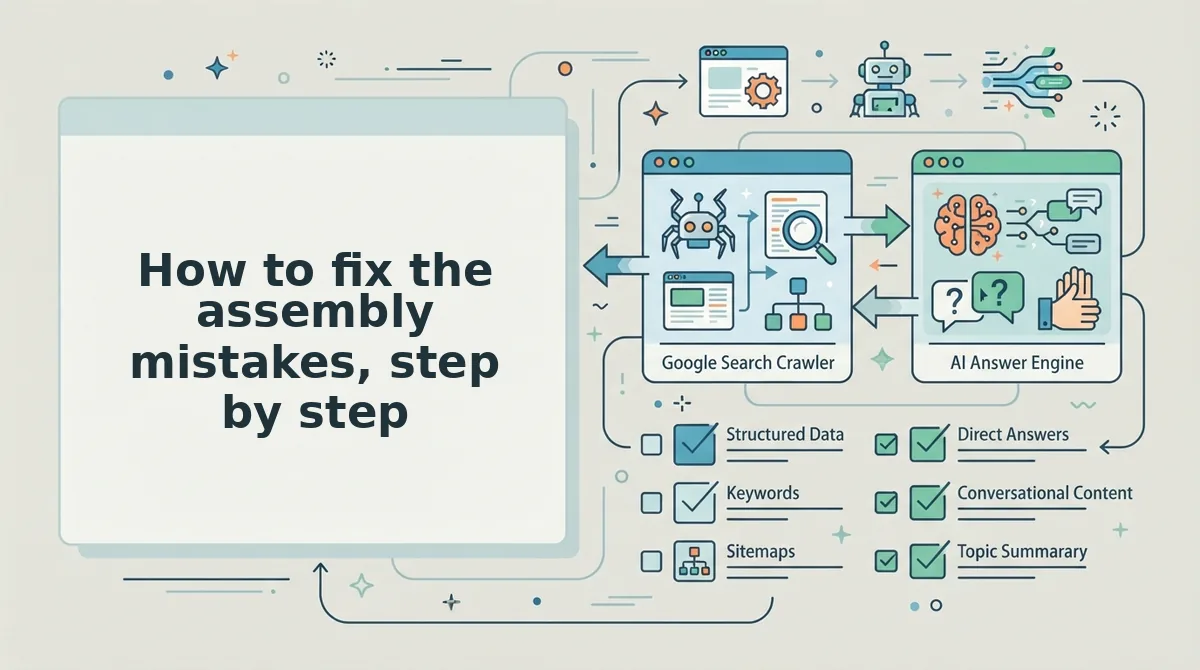
How to fix the assembly mistakes, step by step
Supply the internal link map, size each pass to one section, write each H2 toward a single quotable passage, and wire schema, images and links before the draft is called done. Budget about 40 minutes.
Have ready: the brief-layer draft, five to eight internal URLs with exact anchors, and CMS access to the schema and image fields.
- Paste the internal link map (8 minutes). List five to eight URLs with the exact anchor text you want, beside the H2 that should carry each one. The model cannot infer your site architecture from a domain, so the map is a supplied artifact, not a request. You should see each URL used once, with no invented anchors.
- Size each pass to one section (2 minutes). Assign one H2 per thread and write the scope rule into the brief. You should see output under roughly 500 words, with no links and no schema.
- Draft one quotable passage per H2 (15 minutes). Aim for 80 to 120 words that stand alone, containing no statistic you cannot open and check. You should see a block that still makes sense lifted out of the post.
- Wire the publish tail before sign-off (10 minutes). Fill schema fields, alt text and the internal links in the CMS draft, not in the chat. You should see a preview with validating structured data and no broken links.
How long should a passage be to get quoted in an AI answer? Target 80 to 120 words, self-contained, and answer the question in the first sentence. A quotable passage names its subject instead of leaning on the heading above it, carries one concrete number or definition, and stops before it needs the next paragraph to make sense. Under 60 words it usually lacks the detail an answer engine lifts; past 150 the claim dilutes across conditions. Write one per H2, place it directly under the heading, and confirm each figure traces to a source you can open.
| Symptom | Cause | Fix |
|---|---|---|
| Tone reverts to generic English | Context file not re-supplied | Re-paste per pass |
| Links missing or invented | No link map provided | Paste URLs and anchors |
| A ruled-out angle returns | Thread decisions lost | Restate the brief |
| Chat window is enough | Chat window will fail |
|---|---|
| One section, under 500 words | Whole post with links and schema |
| No internal links or images | Multiple H2s needing a topic clusters map |
Starting a new chat treats the symptom and throws away every decision the old thread earned, which is why the pattern returns in both long-chat videos. Compare a single-thread single-prompt AI blog posts attempt against automated SEO content that keeps the brief on file, and the difference is the retained context, not the model.
Next: how do you check the draft actually worked?
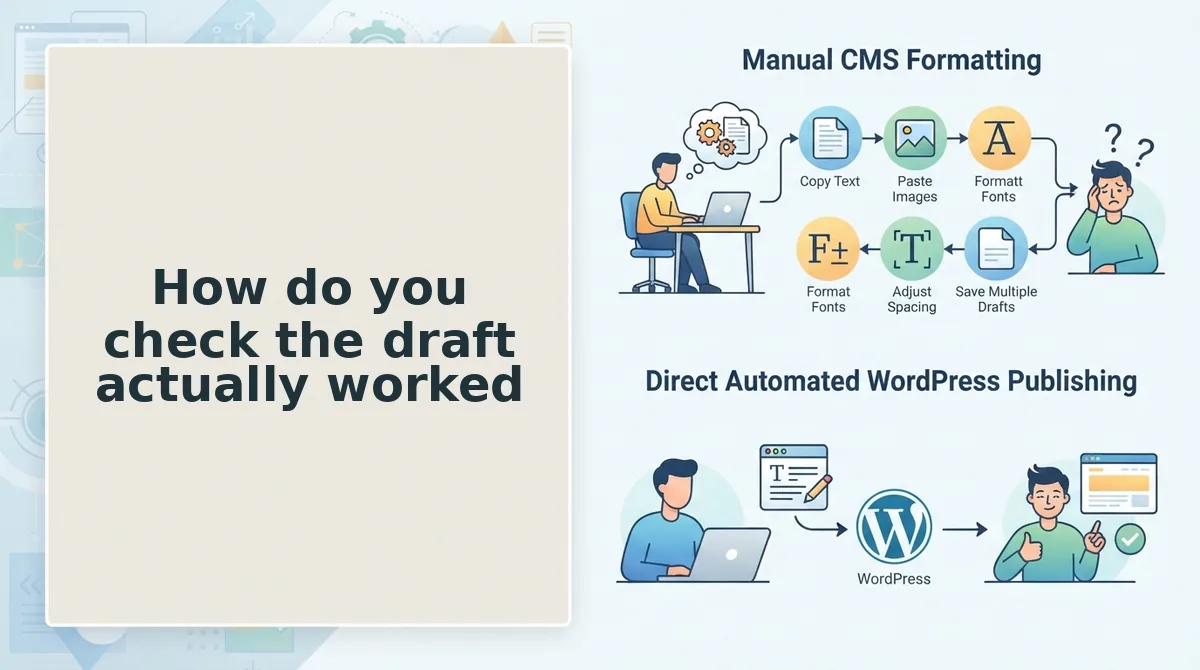
How do you check the draft actually worked
A draft passes on four checks: each H2 answers a question the current SERP leaves open, every internal anchor matches a supplied URL, every number traces to an openable source, and one 80â120 word passage stands alone. Fail any one and the draft is not finished.
Run the checks as pass-fail, not as a read-through. A draft that failed on identical criteria usually reads well and still ships invented anchors and hedge-softened statistics.
| Check | Pass condition | What it catches | Best for |
|---|---|---|---|
| Editorial read-through | An editor confirms the draft answers the brief | Tone, flow, argument gaps | Best for solo operators drafting subjects they already know deeply |
| Link diff | Every anchor appears on the supplied link map | Invented URLs and mismatched anchors | Best for publishers running internal-link-heavy clusters |
| Source audit | Every number opens in a tab | Hallucinated or misattributed data | Best for teams in regulated or YMYL niches |
| Standalone passage read | One 80â120 word block makes sense with no surrounding text | Context-dependent prose that cannot be quoted | Best for teams optimizing for AI answer citations |
A stat you cannot open is deleted, not softened. Words like "roughly" or "studies suggest" still ship as claims, and an unsourced claim is the failure, not the phrasing around it. The read-through has real strengths â it catches tone and argument problems no diff will â but it cannot see an anchor that does not exist.
The link check is mechanical: diff the draft's anchors against the supplied map. Any anchor not on that list was invented, however plausible it reads.
To test quotability, read one 80â120 word passage aloud with no heading above it and no explanation before it. If a listener cannot tell what question it answers, the passage fails and needs its subject named in the first sentence. This read-aloud test is the fastest proxy for whether an AI answer engine can lift the block cleanly, because extraction has no access to the paragraphs you wrote around it.
Publishing teams that want this verification built into the draft rather than bolted on afterward can see how AEO optimization structures answer passages at generation time.
What to do about scope, statistics, and starting over
Three decisions cover what the seven steps leave open: keep keyword lists out of drafting prompts, delete any statistic you cannot open, and rescue a decayed thread by extracting its decisions rather than restarting.
Should I paste my whole keyword list into one prompt?
No. A keyword list is a planning input, not a drafting input. Pasting it into a drafting prompt pulls the model toward keyword density and away from answering the query. Use the list to choose your H2s, then draft against the brief.
How do I verify a statistic before it ships?
Open the source. If the number does not appear on a page you can load, delete the sentence rather than hedging it. Softened phrasing still publishes as a claim, and a claim without an openable source is the failure.
Can I rescue a chat thread already deep in the decay zone?
Yes, and it usually beats restarting. Write the agreed decisions â angle, brand rules, link map â into a file, open a fresh thread with that file attached, and keep the old thread as reference. You keep the thinking and drop the drift.
How to stop repeating the same chat window mistakes
The mistakes stop when the brief, the brand file, and the link map live outside the thread. Repairing prompts treats the symptom; moving the context removes the failure class.
Brief failures came from drafting with no SERP to beat. Context failures came from a window that decays, drifts, and contradicts itself. Assembly failures came from links, statistics, and schema the model could not see.
Those three artifacts â brief, brand file, link map â must outlive any single chat window. That is the finding the whole failure stack points to: helpful content survives the thread that produced it only when the context was never inside the thread to begin with.
Start by pasting your domain into the BloGoose setup wizard, so the crawl builds the brand file and internal link map once and every later post drafts against them instead of against a scrolling conversation.