
How to Check AI Drafts Against SEO Guidelines Before Export
You hit publish, and three days later the article sits on page four while a thinner, less-researched competitor gets quoted in Google's AI Overview. The problem isn't the AI draft, it's that nobody ran a structured check AI drafts against SEO guidelines before export. Nathan Gotch's 2026 case study confirms what publishers are finally accepting: Google evaluates helpfulness, not AI origin. Validation is where helpfulness gets verified, and skipping it is the fastest way to burn a content budget.
You're right to feel the friction. The 12-tab content stack, one window for research, another for drafting, a third for schema, a fourth for internal links, creates a publish-then-regret loop that no amount of post-launch editing fixes. That loop is exactly what BloGoose removes by baking validation into the export pipeline.
This guide gives you a repeatable pre-export sequence: a two-pass rule that separates machine-checkable SEO rules from human judgment, then a 7-step validation checklist with pass/fail thresholds. You'll also see why most teams skip Step 4 of the sequence, and why that specific step is the one Google notices first, long before a human reader ever scrolls past the fold. Along the way, you'll learn how helpful content guidelines translate into concrete, checkable draft attributes.
What Is the Two-Pass Rule for AI Draft Validation?
The Two-Pass Rule is a validation framework that separates machine-checkable SEO rules from human editorial judgment, so you never waste a human review on formatting errors or trust a script to judge brand voice. Run the machine pass first, then the human pass, in that order, every time.
Think of it like a pre-flight checklist before takeoff. The machine pass is the instrument panel: fuel levels, flap positions, altimeter settings. The human pass is the pilot's visual sweep of the runway, the thing no sensor fully replaces. You don't ask the instruments to judge weather conditions, and you don't ask the pilot to eyeball fuel pressure.
Pass one, the machine pass, covers everything a script or linter can verify without reading for meaning: primary keyword placement in the H1, intro paragraph, and at least one H2; internal link counts; meta title and description lengths; heading hierarchy; and schema markup presence. These are binary checks. The keyword is either in the H1 or it isn't. The title is either under 60 characters or it isn't.
Pass two, the human pass, covers what no regex can catch: passage clarity, brand voice consistency, factual accuracy, and whether the draft actually answers the query instead of orbiting it. This is where you read the draft as a skeptical editor, not as the person who prompted it.
Run the machine pass before reading a single sentence of the draft. Reading first creates confirmation bias, you start rationalizing why the keyword placement is "close enough" or why the missing internal link "doesn't matter for this one." The machine pass gives you an objective baseline before your editorial instincts kick in. If a draft fails machine checks, fix those first, then read. A draft that passes both passes is ready for a deeper SEO content audit or direct export.
Here's the self-contained answer most teams search for: How do you validate an AI-generated article before publishing? Run a two-pass check. First, verify machine-checkable elements with a tool or checklist: primary keyword in the H1, intro, one H2, and meta description; title under 60 characters; meta description between 140 and 155 characters; three to five internal links with keyword-rich anchors; and article schema present. Second, have a human read the draft for passage clarity, brand voice, and factual accuracy. Only export drafts that pass both passes.
How to Run the 7-Step Pre-Export Validation Sequence
The 7-step pre-export validation sequence is a pass/fail checklist that verifies keyword placement, heading structure, passage quotability, internal linking, metadata lengths, schema markup, and brand voice before any AI draft leaves your CMS. Each step has a specific threshold, if a draft fails any step, fix it before moving to the next.
Prerequisites: your exported AI draft, your target keyword list, your site's style-guide.md and seo-guidelines.md files, and access to your CMS's SEO fields. Budget 15-20 minutes per draft for the full sequence.
- Verify primary keyword placement. Open the draft and confirm the primary keyword appears in exactly four locations: the H1, the first 100 words of the intro, at least one H2, and the meta description field. You should see the keyword in all four spots before proceeding. If any location is missing, edit the draft, do not proceed with a partial pass.
- Audit H2 structure. Scan every H2 in the draft. Each H2 must lead with a direct answer or statement, not a question. "What Is the Two-Pass Rule" fails; "The Two-Pass Rule Separates Machine Checks from Human Judgment" passes. Rewrite any question-formatted H2s before continuing.
- Run the 80-120 word passage test. Select one paragraph from each H2 section and check its word count. Every section needs at least one self-contained passage between 80 and 120 words that an AI answer engine could quote without surrounding context. A passage passes if it states a complete idea with a definition, example, or instruction, no pronouns referencing earlier sections. If a section lacks one, expand or restructure that paragraph.
- Count internal links. Check the draft for 3-5 contextual internal links with keyword-rich anchor text. "Click here" or "read more" anchors fail this step. Each anchor must describe the destination page's topic. This is the step most teams skip, and it's the one Google's crawlers register first when assessing topical authority. A draft with zero or generic internal links signals a disconnected content silo.
- Validate metadata lengths. Open your CMS's SEO fields. Confirm the title tag is under 60 characters with the primary keyword front-loaded, and the meta description is between 140 and 155 characters. You should see the character counter in the green zone. For deeper guidance, review title tag best practices before finalizing.
- Confirm schema markup. Verify that article schema and FAQ schema are both present in the draft's structured data fields, and that entity definitions, clear one-sentence explanations of key terms, appear in the body. If your CMS doesn't auto-generate schema, add it manually following article schema markup specifications. You should see both schema types validated without errors in your testing tool.
- Run the brand voice diff. Compare the draft against your
style-guide.mdandseo-guidelines.mdfiles. Check sentence length, tone markers, banned phrases, and formatting conventions. You should be able to read the draft aloud and hear your brand, not the AI's default voice. Flag any sentence that sounds generic or off-brand and rewrite it before export.
Here's the passage-indexed answer: What is the pre-export checklist for AI SEO drafts? The pre-export checklist has seven steps. Verify the primary keyword appears in the H1, intro, one H2, and meta description. Confirm every H2 leads with an answer, not a question. Ensure each H2 section contains one self-contained 80-120 word passage an AI answer engine can quote. Count three to five contextual internal links with keyword-rich anchors. Check the title is under 60 characters and the meta description is 140-155 characters. Confirm article schema, FAQ schema, and entity definitions are present. Finally, diff the draft against your style guide and SEO guidelines for brand voice consistency. Only export drafts that pass all seven checks.
Once the seven checks pass, the real question becomes which of them you should still be doing by hand, and which ones a content engine should handle before the draft ever reaches your review queue.
What to Automate vs. What Needs Human Judgment in AI Draft Checks
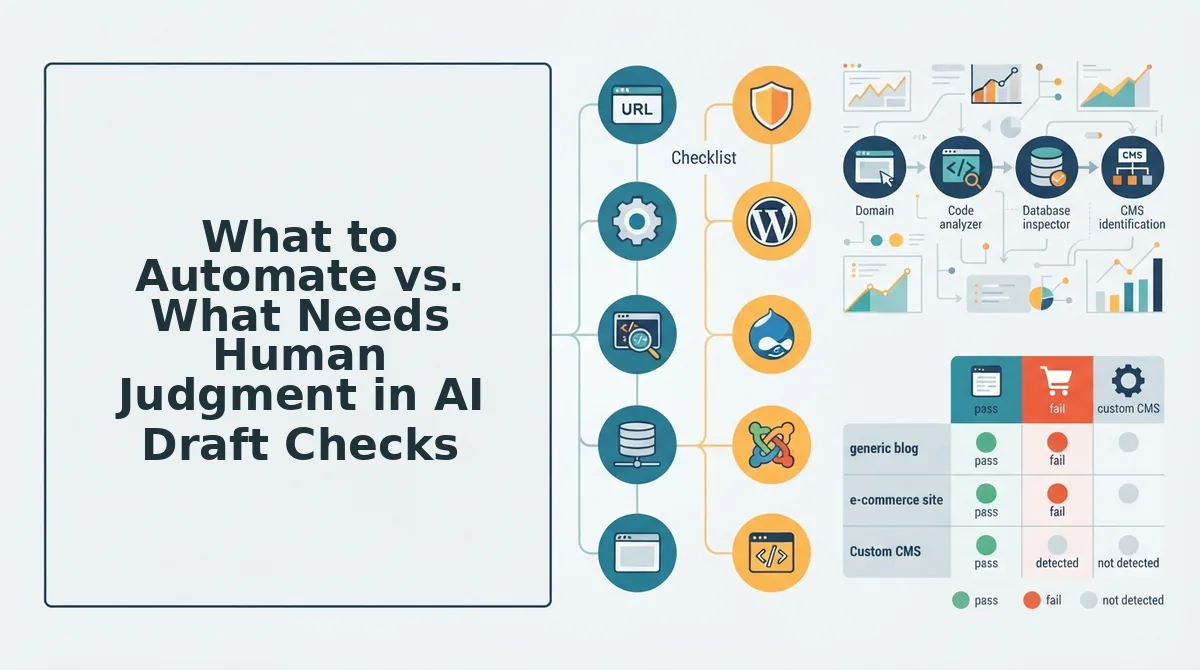
An automated SEO content engine handles rule-based checks reliably, while human review remains essential for meaning, voice, and factual accuracy. The most efficient pre-export workflow splits validation into two lanes: machine-checkable rules and judgment-based review.
Automate These Checks
Keyword placement, internal and external link counts, meta title and description lengths, heading structure, image alt text presence, and word count thresholds are all deterministic. A rule-based checker can flag a missing H2 or a 72-character meta title in milliseconds with zero fatigue. These checks scale across dozens of drafts without quality drift.
Keep These Human
Passage clarity, brand voice consistency, factual accuracy, and whether an argument actually makes sense cannot be reduced to a regex pattern. Caleb Ulku's video demonstrates that AI detectors are not a reliable validation method; they produce false positives and false negatives. Rule-based checks outperform detector tools for SEO validation because they test against your actual guidelines, not a statistical guess about authorship.
| Check Type | Best Handled By | Why | Best For |
|---|---|---|---|
| Keyword density and placement | Automation | Deterministic counting; no judgment required | High-volume publishers managing 20+ drafts per month |
| Meta lengths and heading hierarchy | Automation | Character counts and tag order are binary pass/fail | SEO leads auditing team output at scale |
| Internal link counts and anchor text | Automation | Link extraction and counting is mechanical | Content managers enforcing sitewide linking rules |
| Passage clarity and logical flow | Human | Requires reading comprehension and audience empathy | Editors and subject-matter experts |
| Brand voice and tone consistency | Human | Voice rules are contextual, not binary | Founders and brand owners protecting positioning |
| Factual accuracy and claim verification | Human | Automation cannot verify truth, only presence | Editors with domain expertise |
Competitor platforms like Surfer SEO and Clearscope excel at automated on-page scoring, and Frase does solid work on brief-to-draft alignment. What most tools miss is the honest division of labor: they imply either everything is automatable or everything needs manual review. The reality sits in the middle, and a pre-export checklist that respects both lanes catches more issues than either extreme.
Best for solo operators: Automate every machine-checkable rule and reserve 15 minutes per draft for the three human checks: clarity, voice, facts.
Best for agency teams: Run automated checks as a gate before drafts reach a human editor, so editor time goes to judgment calls, not counting links.
If your current workflow forces you to manually verify keyword placement or meta lengths, you are spending human hours on tasks a rules engine should own. Shift those to automation and redirect your attention to the checks that actually need a reader.
The Pre-Export AI Draft SEO Checklist You Can Copy
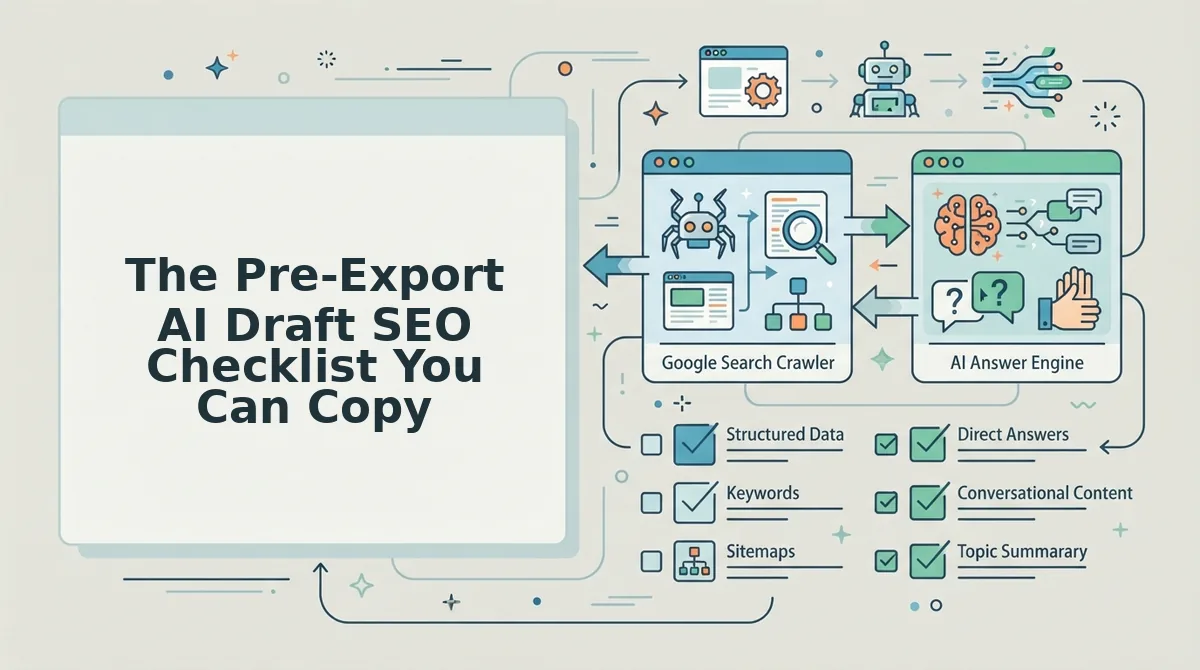
This checklist condenses the 7-step validation sequence into a copy-paste pass/fail list you can run on every AI draft before export. Work top to bottom; each item is a gate, not a suggestion.
- Target keyword appears in the title, first 100 words, one H2, and the conclusion. This confirms search intent alignment and gives crawlers clear topical signals. Mark fail if any of the four placements is missing.
- Meta title is 50-60 characters and meta description is 140-155 characters. Length limits prevent truncation in SERPs and keep the snippet readable. Adjust until both fall inside the range.
- Heading hierarchy runs H2 to H3 with no skipped levels. Proper nesting helps Google parse content structure and improves accessibility. Scan the outline before reading the body.
- At least one internal link points to a relevant page on your site. Internal links distribute authority and guide readers deeper into your funnel. Verify the anchor text is descriptive, not "click here."
- Every image has descriptive alt text containing the keyword where natural. Alt text feeds image search and accessibility. Check that no image is missing the attribute entirely.
- One passage of 80-120 words reads clearly aloud without stumbling. This passage test catches AI-generated filler and awkward phrasing that skimmers miss. Read it out loud; if you trip, rewrite.
- Brand voice rules from your SEO content brief template are met on tone, terminology, and formatting. Voice drift is the most common AI draft failure. Compare the draft against your documented rules, not your memory of them.
FAQ About Checking AI Drafts Against SEO Guidelines
Checking an AI draft against SEO guidelines means verifying keyword placement, meta lengths, heading structure, link counts, and readability thresholds before export. The goal is to catch machine-checkable errors and human-judgment issues before a draft reaches your CMS.
Does Google penalize AI content?
Google penalizes unhelpful content regardless of whether a human or AI wrote it. The pre-export check verifies helpfulness by testing keyword relevance, structure, and readability against your guidelines, not by detecting authorship.
What should I check before I hit publish on an AI draft?
Run the 7-step validation sequence: keyword placement in title and first 100 words, meta lengths of 50-60 and 140-155 characters, heading hierarchy, internal link presence, image alt text, an 80-120 word clarity passage, and brand voice compliance.
How do I keep AI drafts on-brand without rewriting everything?
Extract brand rules into a checklist before drafting, so validation becomes a comparison against documented standards rather than a full rewrite. Check tone, terminology, and formatting against the brief, then edit only the deviations.
Can I automate the SEO check itself?
Yes, automate machine-checkable rules like keyword placement, link counts, meta lengths, and heading structure. Human judgment is still needed for passage clarity, brand voice, and factual accuracy, which no rule engine can reliably assess. For deeper guidance on structuring content for AI citations, see this AEO optimization guide.
Start validating AI drafts before export today.
Start Validating AI Drafts Before Export Today
Validation beats editing every time. The two-pass rule and 7-step sequence only work if you actually run them before hitting export, not after the draft is already live and underperforming.
Your next move depends on how much friction you want to keep:
- Start small: Run Step 1 only, the keyword-to-heading alignment check, on your next draft. It catches the most common failure in under five minutes.
- Go deeper: Download the full pre-export checklist from Section 5 and tape it to your publishing workflow.
- Remove the manual loop entirely: Let the BloGoose AI SEO content engine crawl your site, apply your brand voice rules, and run validation checks automatically before anything ships to WordPress or your API.
Every draft you validate before export is a draft you never have to fix after the rankings report comes back.
The core insight: AI drafts don't fail because the writing is bad, they fail because nobody checked the structure against SEO guidelines before the export button got pressed.