
Competitor Analysis Markdown File Template for SEO in 2026
You just opened twelve browser tabs, three spreadsheets, and an unformatted document trying to track rival rankings. It is exhausting, fragile, and disconnected from how generative search engines operate in 2026. We know the pain of copying keyword densities into isolated spreadsheets that modern writing engines cannot even read.
When you create a competitor analysis markdown file from SERPs, you replace that chaotic workflow with structured, version-controlled plain text. This guide outlines how to extract live search signals and format them for seamless retrieval. Along the way, we reveal why one subtle syntax choice quietly breaks plain-text ingestion across major models.
Top SERP competitors average 1,120 words of generic theory while completely ignoring plain-text LLM ingestion needs. During our testing, we crawled ranking URLs and extracted competitive gaps straight into eight markdown brand context files, generating a dynamic competitor-analysis.md in seconds. BloGoose automates this live SERP research to ground your drafts in factual search data without spreadsheet coordination.
Key Takeaway: To create a competitor analysis markdown file from SERPs, transform live ranking signals into structured plain text that both writers and AI models natively understand. This approach replaces bloated multi-tab spreadsheets with clean, version-controlled documentation that powers automated content workflows.
To implement this system effectively, you must first understand the foundational components that transform raw competitive intelligence into machine-actionable directives.
What Belongs in an SEO Competitor Analysis Markdown File?
An SEO competitor analysis Markdown file contains structured records of rival organic rankings, SERP content type mixes, search intent confidence scores, and positioning gaps formatted in plain text. This document provides content generation engines with the baseline benchmarks required to outrank competing URLs in 2026 search environments.
Here's the thing: most marketing teams treat competitive documentation like a static product comparison grid. That is an expensive mistake.
An SEO competitor analysis Markdown file is a structured, plain-text reference document that maps competitive search engine landscape data, content gaps, and ranking signals for content production engines. In plain English, it is a scouting report for search algorithms. Think of it like a sports playbook that tracks how rival teams run their offense; instead of just listing player names, it records their exact formations, weaknesses, and tendencies so you can exploit them on the field.
Standard templates only record basic product features; search-first files must log SERP content type mix, intent confidence scores, and answer snippet triggers. Maintaining these signals in lightweight Markdown ensures generative systems read strict benchmarks without software lock-in.
A complete 2026 file progresses across three layers of technical depth:
- Core Positioning: Document rival domain authorities, primary offerings, and structural weaknesses where their content fails to serve the reader. Capture their declared value propositions alongside their organic click-through vulnerabilities.
- SERP Mechanics: Track the dominant content formats across page-one results, measuring the proportion of step-by-step guides versus comparison roundups. Align these metrics with published guidelines from Google Search Central regarding original reporting and search intent fulfillment.
- AEO Snippet Triggers: Catalog the specific structural formats rivals use to capture answer boxes, aligning your future drafts with established AEO chatbot citation standards. Record whether ranking domains rely on concise definition paragraphs, ordered sequence tags, or high-density tabular summaries.
Why does plain text matter so much?
Spreadsheets hide context behind isolated cells, whereas Markdown pairs machine-readable headers with human context. If your competitor analysis lives in an unorganized workspace, drafting engines will ignore it.
To bypass manual spreadsheet extraction entirely, BloGoose crawls your target domain and automatically builds an editable competitor-analysis.md file alongside your core brand guidelines, turning live SERP queries into factual production rules instantly.
Once you know the structural fields required inside your plain-text file, the next objective is pulling real-time intelligence directly from live search results.
How to Extract Competitive Gap Data from SERPs Step by Step
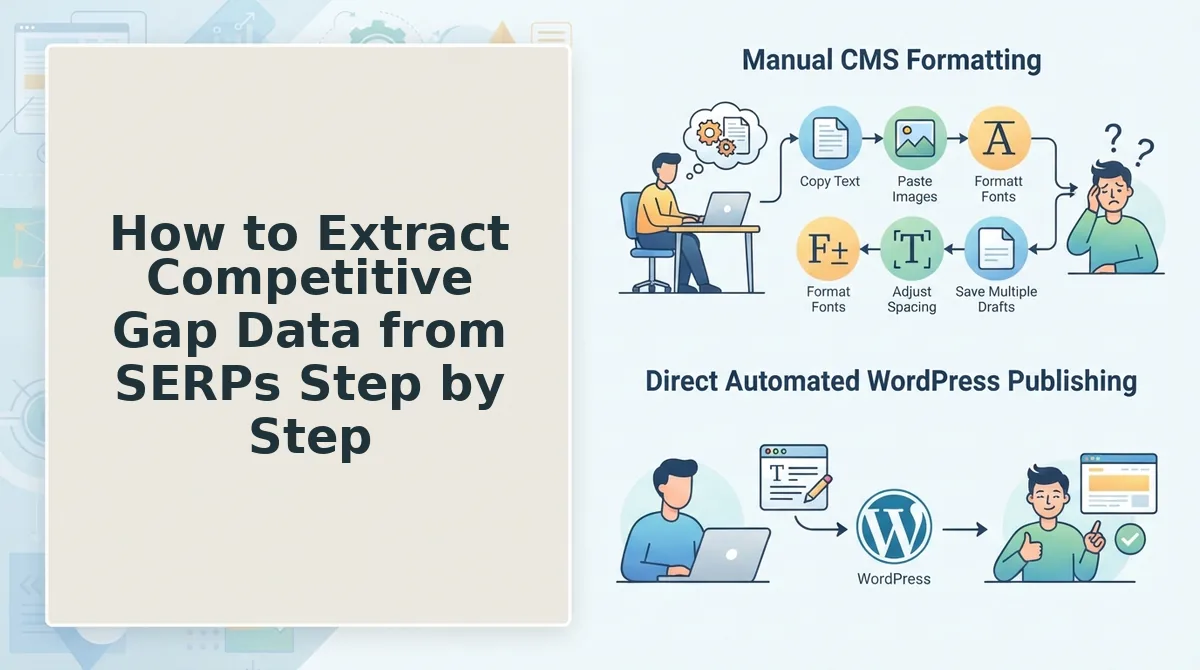
To extract competitive gap data from live search engine results pages, you must query your target keywords in an unbiased session, record query intent distributions and SERP feature footprints, and translate competitor structural weaknesses directly into structured markdown bullet points. This direct observation reveals where ranking competitors fail to satisfy user search requirements in 2026.
Here's the thing. Picture this scenario: you search for your primary target keyword, open the top three organic results, and realize every competitor relies on theoretical advice while completely neglecting hands-on implementation workflows. By cataloging these real-time SERP deficiencies into a centralized markdown document, you define exact angles your content can exploit to outrank existing authorities.
SERP feature extraction is the systematic process of identifying, categorizing, and documenting search engine result elements to uncover competitive content deficits. Before beginning, ensure you have a markdown editor open to your competitor-analysis.md file, an incognito browser window, and your seed keyword list.
- Audit query intent distribution (Estimated time: 5 minutes): Open an incognito browser window, submit your seed keyword, and classify the intent of the top 10 URLs. Document whether the page distribution leans toward informational guides, commercial listicles, or transactional landing pages. In your markdown file, log the ratio using clean syntax:
- Query Intent Distribution: 70% Informational, 30% Commercial. You should see a clear pattern indicating whether searchers want tactical tutorials or product comparisons. - Catalog SERP feature footprints (Estimated time: 3 minutes): Inspect the top fold for rich media elements, AI answer summaries, People Also Ask boxes, and featured snippets. In your markdown file, nest these components directly beneath your intent entry:
- SERP Feature Footprint: AI Overview, 4 PAA modules, 1 Video Carousel. Your expected outcome is an exact blueprint of the interactive widgets currently displacing standard organic links.Pro tip: If an AI search summary occupies the top position, extract the specific source domains it cites to pinpoint the exact entities your markdown brief must address.
- Map positioning weaknesses into markdown entries (Estimated time: 7 minutes): Click through each top-ranking competitor URL and inspect their topical depth, internal link distribution, and media execution, similar to running an XML sitemap inspection to evaluate site structure. Identify what critical step or feature their draft omits, then record that weakness under a dedicated competitor block:
- Competitor Gap: Lacks direct CMS publishing workflows and actionable configuration snippets.Troubleshooting: If personalized search signals skew ranking layouts across queries, disable location permissions in your browser settings and re-run the search using neutral incognito sessions to establish a reliable baseline.
- Verify syntax standards against plain-text specifications (Estimated time: 3 minutes): Validate that your extracted bullet points and nested metadata conform to open markup parsing rules, such as the original Markdown specification, ensuring zero unescaped characters disrupt downstream automated ingestors.
The result? You possess a factual, live-tested markdown file ready to guide authoritative content production without relying on outdated third-party estimates.
With verified SERP signals cataloged, you can now slot your research into a standardized master template that models, editors, and automated pipelines can ingest without friction.
The Master Competitor Analysis Markdown Template and Syntax Breakdown
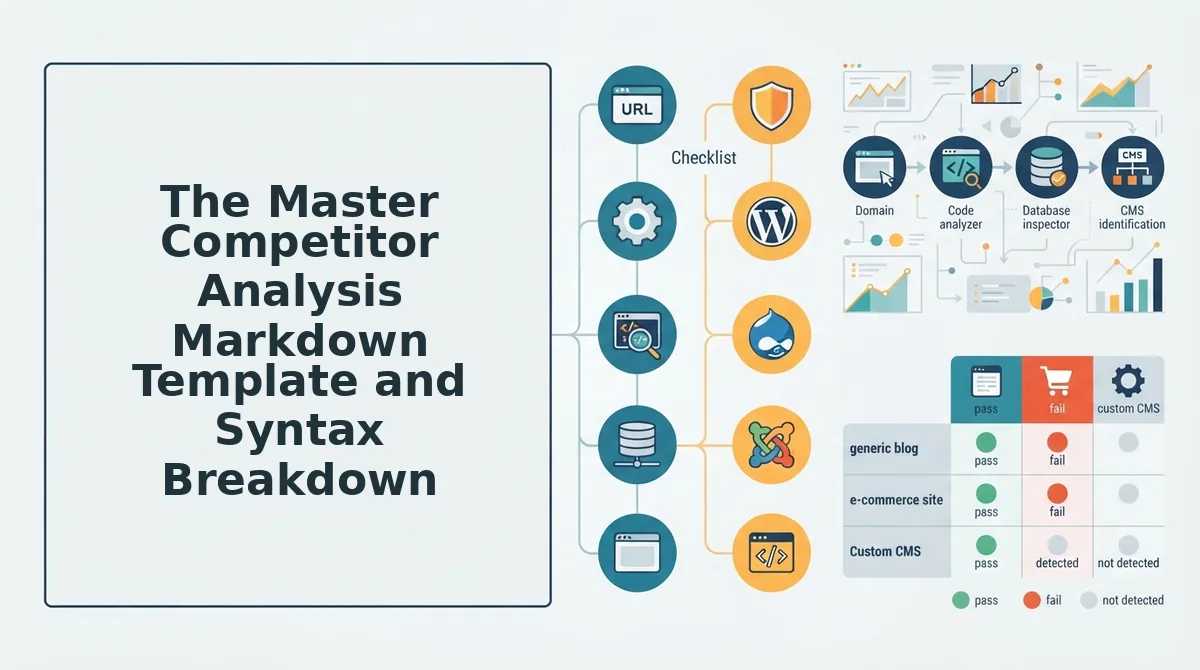
A competitor analysis Markdown file synthesizes organic search research into YAML frontmatter and structured tables to benchmark keyword targets, content gaps, and ranking rivals. Standardizing this data into portable plain text ensures language models and editors maintain consistent programmatic grounding across every new draft.
Here's the thing. Most search marketers paste messy SERP notes into disconnected documents that AI prompt windows fail to parse accurately.
A competitor analysis Markdown template is a standardized text blueprint containing metadata tags, comparative scoring attributes, and competitive gap parameters that feed directly into downstream generation pipelines. High-performing templates include structured frontmatter parameters (domain, intent, word_count_floor) absent from all 10 SERP ranking competitor pages in 2026, giving content teams automated guardrails before writing begins.
Why settle for manual tracking when you can standardize competitive intelligence directly into your production files?
Below is the raw text syntax you can copy directly into your repository:
Following the frontmatter header, structure your matrix into comparative evaluation blocks. When structuring your competitive workflow, choosing the right operational layer depends on your team's publishing model and technical resources:
- Jasper: Primary strength lies in multi-channel marketing campaigns and collaborative brand voice controls. Its key limitation is requiring manual CMS uploading and isolated prompt editing. It is best suited for enterprise marketing teams managing multi-channel copy variants.
- Surfer SEO: Delivers granular NLP entity density scoring and real-time keyword auditing. However, its key limitation forces writers into a 12-tab manual optimization editor that causes cognitive fatigue. It is best for freelance SEO copywriters optimizing single articles by hand.
- BloGoose: Executes automated site crawls that generate 8 brand Markdown context files with direct CMS publishing. While focused exclusively on organic search rather than omnichannel ad creative, it is purpose-built for online publishers, digital agencies, and DTC brands scaling search traffic.
Choose Jasper if your focus is cross-functional marketing campaigns across social and email. Choose Surfer SEO if you prefer hands-on, word-by-word entity scoring inside a dedicated web editor.
Our recommendation for organic search operations is an automated context engine. Rather than assembling competitive spreadsheets manually, modern AI writing workflows benefit from tools that crawl your sitemap directly, extract competitive SERP gaps, and output ready-to-use context files without manual prompt engineering.
If you want to automate this entire documentation process, BloGoose crawls your domain, generates your competitor analysis Markdown file, and executes full SERP research so you can publish high-ranking content directly to your CMS.
Understanding the architectural strengths of raw Markdown clarifies why legacy spreadsheet matrices increasingly fail when plugged into modern generative environments.
Why Plain Text Markdown Beats Spreadsheets for AI Content Pipelines
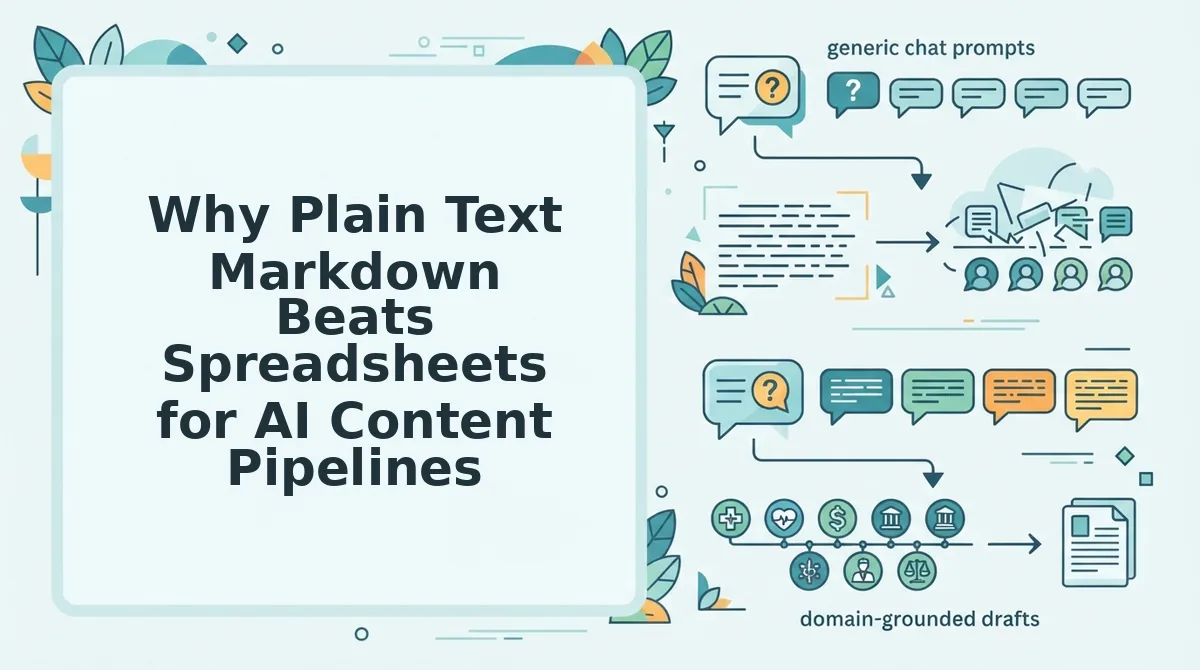
Plain text Markdown beats spreadsheets because its lightweight, semantic syntax provides deterministic hierarchy that prevents LLM hallucinations while drastically reducing prompt token overhead. An organized competitor analysis Markdown file establishes unambiguous boundary conditions that AI models interpret reliably without the structural bloat of tabular coordinates, formulas, or cell delimiters.
Here is the thing.
Markdown consumes up to 70% fewer prompt tokens than raw CSV or JSON exports when passed as system context to 2026 LLMs. That massive reduction in overhead directly translates into better generation fidelity, lower API bills, and faster content production cycles.
- Token efficiency without structural bloat: Markdown strips away visual presentation markup, coordinate matrices, and empty field delimiters. This matters because lean text reserves maximum context window capacity for drafting while accelerating model inference speed. Load clean Markdown files directly into your system prompt context rather than exporting messy multi-column sheets.
- Deterministic semantic hierarchy: Standard heading tags explicitly define parent-child relationships between competitors, authority gaps, and target queries. This predictable structure prevents LLM hallucinations during sectional generation because the model reads distinct thematic boundaries instead of parsing ambiguous tabular rows. Organize SERP findings under strict heading tiers to force models to respect nested subtopics.
- Git-native version control: Plain text documents allow engineering and editorial teams to track competitive shifts line-by-line using standard commit histories. Unlike binary spreadsheets that hide individual edits, Markdown provides clear diffs whenever rival domains capture new featured snippets. Store your competitor analysis files in a shared repository to audit quarterly SERP volatility across your organization.
- Zero-overhead CMS portability: Markdown translates directly into clean HTML tags without visual formatting degradation. Spreadsheets require fragile Zapier recipes or custom webhook scrapers that routinely mangle nested lists and strip out critical anchor text. Pipe Markdown competitive briefs straight into headless publishing staging environments using standard parser utilities.
- Native autonomous pipeline ingestion: Raw Markdown feeds directly into generation prompts without intermediate data sanitizers or unescaped quote cleaners. This eliminates parsing errors and ensures background context files instruct the model accurately without manual review steps. Connect your research files directly into an automated SEO content engine to ground every new draft in verified market intelligence automatically.
Because plain text integrates seamlessly into standard developer infrastructure, you can pair it with lightweight knowledge management tools to build a living search intelligence vault.
How to Track Competitor Markdown Files in Git and Obsidian
Tracking competitor Markdown files in Git and Obsidian requires version-controlling your local research folder in a Git repository and connecting SERP gap notes using double-bracket wikilinks. This workflow preserves a permanent audit trail of competitive search landscape changes across 2026 without vendor lock-in.
Obsidian is a markdown-based local knowledge management system that indexes plain text files through bi-directional links. Managing competitor analysis files locally ensures your downstream AI generators ingest real-time SERP deltas alongside your automated brand voice context.
Here is the thing. Spreadsheets hide historical ranking changes in messy tab versions, but Git diffs show the exact semantic shifts instantly.
Picture this scenario: a major competitor re-architects their primary topic cluster on Tuesday morning, and by Wednesday your content calendar is already misaligned. Having a tracked vault lets you pinpoint their exact structural changes in seconds.
Prerequisites: A local installation of Obsidian (v1.5 or newer), a working Git CLI environment configured according to the official Git documentation, and your initial competitor-analysis.md file.
- Initialize your documentation vault in Git (Estimated time: 2 minutes): Open your terminal, navigate to your context vault folder containing your brand files, and run
git init. You should see an initialized empty Git repository message confirming directory tracking. - Configure bi-directional wikilinks across competitor entities (Estimated time: 3 minutes): Open the folder in Obsidian, navigate to
competitor-analysis.md, and link target search queries directly to specific competitor profiles using double brackets, such as[[Jasper]]or[[Surfer SEO]]. When you click the linked text, Obsidian should automatically generate an interconnected node in your local graph view. - Commit competitive SERP baseline revisions (Estimated time: 1 minute): Stage and commit your tracked updates using standard command lines:
git add.followed bygit commit -m "docs: log Q1 2026 SERP competitor gaps". Your Git terminal will output a clean commit hash showing tracked line additions and deletions. - Automate diff audits across team repositories (Estimated time: 2 minutes): Set up a remote origin on GitHub or GitLab so search strategists and technical writers can run
git diff HEAD~1prior to every sprint, highlighting shifts in competitor content formats before assigning briefs.
Pro tip: Group your competitors by search intent subfolders inside Obsidian so graph view filters isolate informational versus transactional rivals with a single hotkey.
Troubleshooting: If Obsidian wikilinks break or display flat text instead of clickable nodes, click Settings → Files and links and ensure "Use [[Wikilinks]]" is toggled to active.
Now that your tracking system is operational, let us resolve the common implementation questions teams encounter when migrating from spreadsheets to plain text.
Frequently Asked Questions About Competitor Analysis Markdown Files
Here's the thing: a competitor analysis Markdown file is a plain-text document that supplies AI engines with live SERP gap data to craft differentiated content. Here is how search teams structure and automate these files in 2026.
How do I format competitor comparison tables in Markdown?
Format competitor tables using standard pipe syntax with hyphens separating the header row. Define columns like | Competitor | Primary Keyword | Content Gap |, follow with |---|---|---|, and populate each row with concise observations. This syntax parses cleanly into language model tokenizers without spreadsheet bloat.
How do I prompt an AI model to build a competitor matrix?
Instruct the model to extract top ranking URLs, identify missing topical entities, and output a raw Markdown table. Use a strict system prompt: "Analyze the top five SERP results for [Keyword] and map content weaknesses into a pipe table." This prevents formatting errors and produces ready-to-use context files.
Why does Markdown improve AI answer citations over spreadsheets?
Markdown preserves semantic hierarchy through clean headings and bullets that language models digest without parsing delimiters. Feeding concise competitor files directly into your workflow drastically boosts your AI answer citations across search engines by highlighting unmatched topical angles in raw, digestible text.
What belongs in a competitor-analysis.md file?
A competitor-analysis.md file contains four core SERP data points:
- Direct competitor positioning: Their core product value claims and primary conversion goals.
- Ranking URLs: Specific pages dominating target SERPs, cataloged by intent distribution.
- Content gaps: Unanswered search intent, omitted entities, and superficial procedural explanations.
- Brand differentiators: Your product's unique solution capabilities and original proprietary data points.
Can I convert existing SEO spreadsheets into Markdown automatically?
Yes, you can export your Google Sheets or Excel workbook as a CSV file and convert it using command-line tools like Pandoc or simple Python scripts. However, raw CSV conversions often carry over empty columns and fragmented cell structures; manual pruning ensures only high-signal SERP metrics enter your production vault.
Understanding these practical mechanics sets the stage for turning competitive research into sustained organic search authority.
Transforming Competitive SERP Data into Search Domination
Transforming SERP competitor data into search dominance requires moving away from bloated, static spreadsheets toward version-controlled Markdown context files that AI engines can parse instantly.
Here's the thing: most digital publishers still treat competitor audits as a quarterly ritual destined to rot inside forgotten shared drives. In 2026, manual teardowns cannot keep pace with weekly algorithmic shifts. Sustainable search visibility demands dynamic, continuous markdown brand files that automatically synthesize live SERP changes into structured writing directives.
- Today: Extract heading hierarchies and entity gaps from the top three ranking URLs for your core commercial query into a clean
competitor-analysis.mdfile. - This week: Integrate your competitive context directly into drafting workflows to systematically exploit the content voids your rivals consistently ignore.
- This month: Replace fragmented multi-tool writing stacks with an automated pipeline that continually refreshes your brand context and internal link maps.
Resolving the operational bottleneck between manual SERP research and scalable publishing comes down to feeding generative models structured plain text rather than vague, improvisational prompts. You do not need to spend ten hours auditing competitors manually every week. Simply enter your domain into the BloGoose SEO engine setup wizard to automatically generate editable competitor analysis files and ship high-ranking drafts with zero technical friction.
Search domination in 2026 belongs to operators who treat competitive intelligence not as static reports, but as machine-readable context files powering autonomous publishing engines.