Consolidate SEO content tools into a unified team workflow
Your team runs five different SEO tools, yet nobody can say which one actually moves the needle. If you've ever exported a keyword list from one dashboard only to paste it into another, you already know the problem isn't effort. It's fragmentation.
You're right to feel the friction. The promise of "best-in-class for every step" has quietly become a manual handoff nightmare. This guide gives you a concrete audit framework to consolidate SEO content tools into one workflow your whole team can actually follow, and a surprising finding about which tool category is the easiest to eliminate first. Here's the roadmap: audit every tool against your workflow, map the six core functions of a content stack, then identify redundant outputs and manual handoffs. Platforms like BloGoose already collapse research, drafting, optimization, and publishing into a single pipeline, but you need to see your own redundancy before any tool swap makes sense.
How to Audit Every SEO Tool Against Your Content Workflow
Before you start, gather your tool list, monthly costs, and a simple workflow diagram showing research, drafting, optimization, and publishing stages.
- List every tool and its monthly cost. Open your billing dashboard or finance spreadsheet and export every SaaS subscription related to content production. You should see a complete inventory with no orphaned tools hiding in team member expense reports.
- Map each tool to a workflow stage. Create four columns. Research, Drafting, Optimization, Publishing, and place each tool under exactly one column. Tools that don't map to any stage are already redundant.
- Run the 3-Question Elimination Test on each tool. Ask: (a) Does this tool produce output another tool already produces? (b) Does this tool require manual export/import between steps? (c) Does this tool's cost exceed 10% of your content budget? Three "yes" answers mean eliminate it.
- Flag manual handoffs between surviving tools. Look for any workflow where you copy data from one dashboard to another. Each handoff is a candidate for consolidation into a single platform.
- Calculate your consolidation score. Divide the number of remaining tools by your original count. A score below 0.6 means you've cut 40% or more of your stack without losing output.
Pro tip: Don't audit tools in isolation. Map them to workflow stages first, research, drafting, optimization, publishing. Tools that don't map to a stage are already redundant. For a deeper breakdown of how to evaluate content quality during this process, see this SEO content audit guide. Once your audit is complete, a platform like BloGoose can replace the surviving fragmented tools by handling research, drafting, optimization, and publishing in one automated pipeline.
What Are the 6 Core Functions of an SEO Content Stack?
An SEO content stack is the set of tools a team uses to research, create, optimize, and publish search content, and it breaks down into six core functions: SERP research, keyword clustering, content generation, optimization scoring, image creation, and CMS publishing. Think of it like a kitchen: you don't need six different knives when one chef's knife handles most cuts.
At the simple level, each function answers one question. SERP research asks "what's ranking?" Keyword clustering asks "which terms belong together?" Content generation asks "who writes the draft?" Optimization scoring asks "how close are we to the target?" Image creation asks "what visual supports the piece?" CMS publishing asks "how does it go live?"
Here's where most teams discover they're paying for the same capability twice. The Consolidation Capability Matrix shows how easily each function merges into a unified platform: keyword clustering (high), content generation (high), CMS publishing (high), SERP research (medium), optimization scoring (medium), image creation (medium). The high-consolidation functions are the fastest wins, they're already automated in platforms like BloGoose, which handles topic clusters, drafting, and publishing in one flow. The medium functions often stay as standalone tools or integrate via API.
Next, you'll learn how to spot redundant outputs and manual handoffs hiding in your current stack.
How to Identify Redundant Outputs and Manual Handoffs
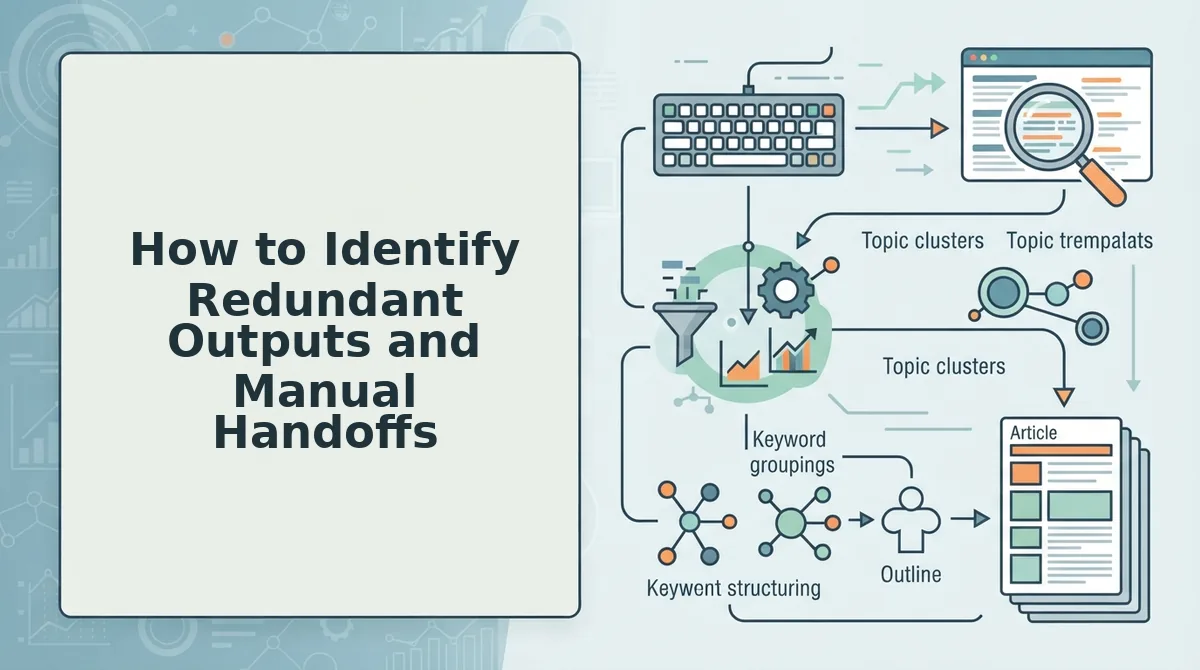
Redundant outputs are deliverables that two or more tools produce in slightly different formats, forcing you to reconcile them by hand. Manual handoffs are the copy-paste moments between tools that eat hours and introduce errors. Both are visible once you map your workflow end to end.
- Trace the SERP-to-CMS journey for one article. Follow a single keyword from initial research to final publish and write down every tool that touches it. The most common loop is SERP data to keyword doc to content brief to CMS upload, and each arrow represents a manual export/import step that a unified pipeline can eliminate.
- Flag any deliverable you retype or reformat. If you copy keyword lists from a rank tracker into a spreadsheet, then paste that spreadsheet into a brief template, those are two redundant outputs. Consolidating them into one SEO content brief generated from live SERP data removes both the duplication and the reformatting time.
- Count the number of times content leaves one tool and enters another. Every export/import boundary is a handoff where context gets lost. Copy Samurai's YouTube video on keyword consolidation with ChatGPT demonstrates this directly: keyword-level consolidation works best when one system holds the data from start to finish instead of passing it between chat windows and spreadsheets.
- Identify outputs that no one actually reads. Many stacks generate reports, drafts, or spreadsheets that exist only because a previous tool required them as input. If a deliverable has no reader and no decision attached to it, it is a redundant output you can delete from the workflow entirely.
- Look for the same data entered twice. When your target keyword appears in your research tool, your brief, your CMS metadata, and your publishing checklist, you have four manual entry points for one fact. A single pipeline writes the keyword once and propagates it everywhere.
- Measure handoff time per article. Time the copy-paste, reformatting, and upload steps for one piece of content. Multiply by your monthly publishing volume. That number is the hidden cost of your multi-tool workflow, and it is usually the first thing a consolidated engine eliminates.
- Prioritize the handoffs that block publishing. Rank your redundant steps by how often they delay an article going live. Fix the highest-frequency blockers first, because those are the ones costing you both time and ranking velocity.
Can One Tool Replace Your Entire SEO Stack?
One tool can replace most of your content production stack, but not all of it. Research, drafting, optimization, and publishing consolidate cleanly into a single pipeline. Technical SEO audits, backlink analysis, and rank tracking remain specialized enough that dedicated tools still earn their place.
| Function | Consolidates Well? | Why | Best For |
|---|---|---|---|
| Keyword research & SERP analysis | Yes | Data feeds directly into briefs without export/import loops | Content teams publishing weekly or more |
| Content drafting & optimization | Yes | Brand voice and on-page rules apply automatically during generation | Founders and solo operators without editors |
| Publishing & CMS integration | Yes | Finished articles ship directly to WordPress or a custom API | Agencies managing multiple client sites |
| Technical SEO audits | No | Requires deep crawl diagnostics and server-level access | Technical SEO specialists and developers |
| Backlink analysis | No | Depends on proprietary link indexes updated continuously | Link builders and digital PR teams |
| Rank tracking | Partially | Daily position data needs dedicated infrastructure | SEO managers reporting to stakeholders |
Nathan Gotch's YouTube video on SEO content optimization tools confirms the fragmented landscape: most practitioners run three to five tools just to produce one article. An AI SEO content engine like BloGoose collapses the four content-facing functions, research, drafting, optimization, and publishing, into one workflow, while you keep specialized tools for audits and backlinks. Best for content-heavy teams: consolidate the content pipeline first, then evaluate whether your remaining tools still justify their subscriptions.

How to Run a 2-Week Pilot Before Canceling Anything
A pilot de-risks migration by running one content cluster end-to-end through the new pipeline before you cancel any existing subscription. You need your current tool list, one target keyword cluster, and access to the new platform's setup wizard.
- Export all data from your current tools. Download keyword lists, content briefs, published articles, and brand guidelines as CSV or document files. Store them in one folder so nothing is lost if you cancel a subscription later.
- Document your current workflow step by step. Write down every tool, every handoff, and every output for one article. This becomes your baseline for comparing the pilot results.
- Set up the new pipeline. Enter your domain into the setup wizard and let the platform's site crawl and brand context extraction run. You should see your sitemap detected, pages inspected, and brand voice rules extracted automatically within the first session.
- Run one content cluster end-to-end. Pick a pillar topic with three to five supporting articles. Generate the briefs, drafts, and optimized final versions entirely inside the new pipeline. You should see each article move from research to publish-ready without a single export or copy-paste.
- Compare output quality against your baseline. Score the pilot articles on brand voice accuracy, on-page optimization, and time from brief to publish. If quality matches or exceeds your current output and time drops significantly, the pilot is a success.
- Cancel redundant subscriptions and migrate remaining workflows. Week 3 is for cutting tools that only handled research, drafting, optimization, or publishing. Keep specialized tools for technical audits and backlinks, then move your remaining content clusters into the new pipeline.
Next, lock in the gains by setting automation rules that keep the new workflow running without manual intervention.
How to Lock in the New Workflow with Automation Rules
Automation rules are trigger-based instructions that move content through your pipeline without a human stopping to click "next." Think of them like a thermostat: you set the temperature once, and the system adjusts itself every time conditions change.
Start simple. Create a rule that fires when a draft is marked "ready", it automatically notifies the editor and attaches the keyword brief. No more Slack pings or spreadsheet updates.
Move to intermediate rules once that feels stable. When an article publishes, trigger an indexing request through the Google Indexing API so Google crawls the new URL within hours, not weeks. Automated indexing after publishing closes the gap between hitting publish and appearing in search results.
Advanced rules chain events together. A publish event can simultaneously log the URL in your performance tracker, schedule a 30-day content refresh reminder, and push the article to your internal linking queue. The goal isn't fewer tools. It's fewer places where work stops.
FAQ: Consolidating SEO Content Tools
How many SEO tools does a content team actually need?
Most teams need 3 - 5 tools after consolidation: one for keyword research, one for drafting and on-page optimization, one for publishing, plus specialized tools for technical SEO audits and rank tracking. Teams that consolidate below this threshold typically sacrifice either research depth or publishing speed.
What's the biggest mistake teams make when consolidating?
Canceling tools before testing the new pipeline. Teams often terminate subscriptions the same week they adopt a replacement, then discover workflow gaps mid-campaign. Run a two-week pilot with both stacks running in parallel before canceling anything.
Why does my team keep adding tools after we consolidate?
Because the consolidation didn't include automation rules. Without triggers that move content from research to publishing automatically, team members recreate manual handoffs and reach for point solutions to fill the gaps.
How do I consolidate SEO tools without losing historical data?
Export all keyword rankings, content briefs, and performance reports to CSV before canceling any subscription. Most platforms offer bulk export. Store the files in a shared drive, then import the essential datasets into your consolidated platform's tracking module.
Can one platform handle both SEO writing and publishing?
Yes. Platforms like BloGoose combine research, drafting, optimization, and direct publishing to WordPress or a custom API. This eliminates the export-import loop between your writer and your CMS, which is where most workflow friction accumulates.
What should I automate first after consolidating?
Automate the publish-to-index step first. Connecting your publishing event to the Google Indexing API means new content gets crawled within hours instead of waiting for Google's natural crawl cycle, which can take days or weeks for smaller sites.
Make the Consolidation Stick
Consolidation is not a one-time cleanup, it's a structural change to how your team ships content. The seven-step checklist, audit, map, identify redundancies, evaluate platforms, pilot, migrate, automate, works because each step builds on the previous one. Skip the pilot and you'll discover gaps in production. Skip the automation rules and stack sprawl returns within a quarter.
They stop asking "which tool does this?" and start asking "which trigger moves this forward?"
Start with a site crawl and brand context extraction at BloGoose's AI SEO content engine to see which of your current tools become redundant when research, drafting, optimization, and publishing live in one pipeline. Your next article can be the first one that never stops moving.