Content calendar planning mistakes that waste crawling budgets
Editorial calendars that celebrate 100% on-time publishing often quietly waste technical visibility behind the scenes. Content teams applaud green rows in their spreadsheets, yet search bots consume finite host crawl allocations on orphan URLs before discovering authoritative pillar assets. Scheduling articles without an AI SEO content engine mapped directly to your site architecture rapidly burns your crawl budget on disconnected nodes.
You spend hours coordinating publishing cadences, yet your newest articles wait weeks for Googlebot to take notice. In this guide, you will learn the exact planning structural errors that derail bot traversal, from unlinked topic bursts to poorly sequenced subcategory updates.
Eliminating these crawling bottlenecks requires three technical prerequisites:
- Active Google Search Console access to monitor index coverage logs.
- A clean XML sitemap reflecting your current URL hierarchy.
- An explicit search intent map to prevent internal topical cannibalization.
We explore the scheduling missteps that confuse search engine spiders, including the counterintuitive reason why releasing cluster articles in chronological batches actually stalls indexing. Note that these strategic frameworks apply strictly to site architecture and publishing sequencing, rather than resolving server latency or hosting infrastructure limits.
Step 1: Audit Existing URLs to Eliminate Keyword Cannibalization
Auditing existing URLs for keyword cannibalization requires cross-referencing planned editorial topics against live sitemaps and search console impressions before assigning new briefs. This pre-flight check prevents search engines from wasting crawl budget indexing duplicate pages that compete for identical search intents.
Keyword cannibalization is an SEO defect where multiple pages on the same domain target identical search queries, diluting crawl equity and organic ranking signals. Unchecked cannibalization causes search bots to expend limited crawl requests re-evaluating repetitive URLs rather than discovering fresh content.
Prerequisites for this audit include access to Google Search Console and your production XML sitemap. Estimated time: 15 minutes.
- Open Google Search Console, select Search results under the Performance menu, and set the date range to the past three months. Expected outcome: A baseline view of your total clicks, impressions, and top-ranking search queries.
- Filter the report by typing your proposed article topic into the Query filter, then click the Pages tab. Expected outcome: A clear list showing every existing URL on your domain that already registers impressions for the target phrase.
- Download your live XML sitemap in a browser tab and run a keyword text search across all indexed slugs. Expected outcome: Verification of published or legacy URLs that share topical overlap with your planned headline.
- Select your editorial action: if an existing page ranks within the top 20 query impressions, assign an update to that URL instead of launching a duplicate draft; if no URL appears, approve the brief. Expected outcome: A verified editorial slot that prevents duplicate crawling.
What happens when you bypass this verification?
Consider an editorial team preparing a new article on content calendar planning. A writer drafts the piece from scratch, unaware that a published guide already sits on page two of Google with steady search impressions. Running the pre-flight check reveals the existing URL logged inside Search Console. Instead of publishing a cannibalizing page that forces crawlers to divide request limits between two overlapping posts, the team expands the original URL, concentrating ranking equity onto a single destination.
Organizing your architecture into discrete topic clusters keeps every page tied to unique search intents. BloGoose inspects published pages and your XML sitemap during initial domain setup, helping you map keyword coverage accurately before scheduling new production.
Step 2: Sequence Core Pillar Pages Before Child Cluster Spokes
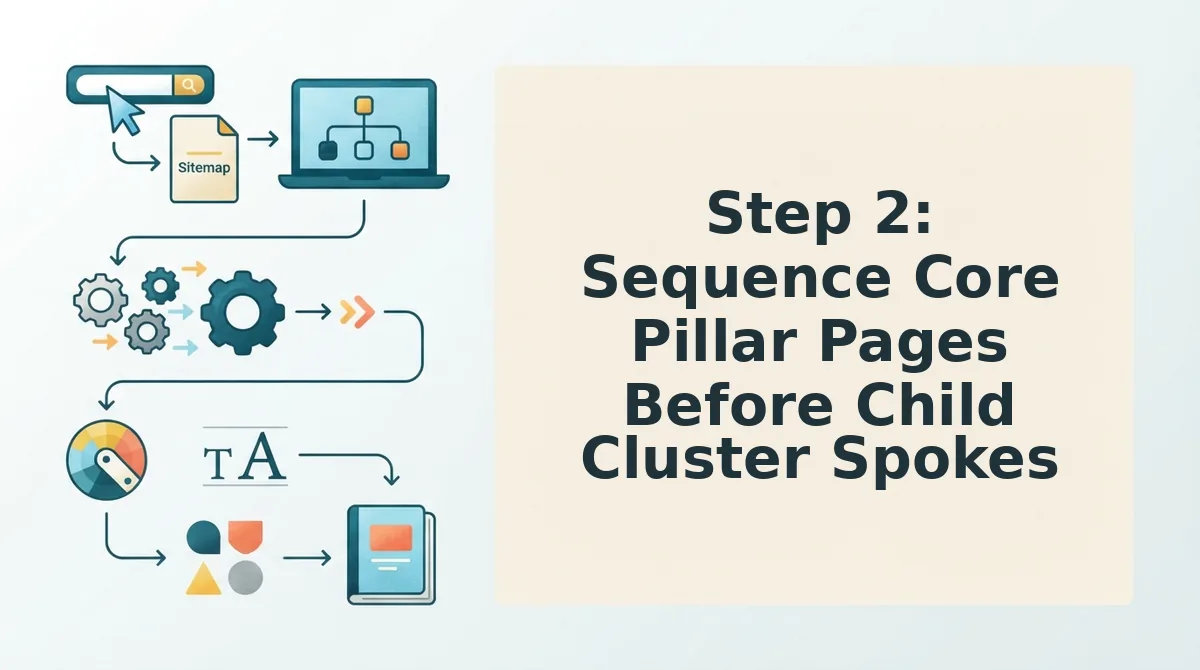
Content calendars must sequence the publication and indexing of core pillar pages before their supporting child cluster spokes to establish clear topical hierarchy and crawl paths. When child articles go live first, search bots consume crawl budget on isolated subtopics that lack semantic grounding.
Why does Googlebot frequently crawl supporting cluster posts while refusing to index the primary pillar page? The issue stems from structural timing rather than content quality.
The Cluster Desynchronization Model is an architectural failure where search engine crawlers encounter specialized child pages before the parent pillar page exists to define their topical authority. Think of a content cluster like a tree: if you attempt to hang branches in midair before planting the trunk, the entire structure collapses. When crawler bots discover newly published spoke URLs through sitemaps or feeds, they attempt to follow contextual anchor paths back to a broader entity. If that parent pillar is absent, unpublished, or returning errors, the crawler hits a dead end. Search engines register isolated pages as low-priority periphery documents, misallocating crawl bandwidth to context-free endpoints.
How does publishing sequence alter crawler behavior across an unindexed topic cluster?
- Phase 1: Trunk Establishment. Publish the primary pillar page first so search bots map high-level entity definitions and foundational topical relevance.
- Phase 2: Bidirectional Ingestion. Deploy child spokes that link directly to the established pillar URL, allowing bots to recycle crawl cycles back into your core asset.
- Phase 3: Authority Consolidation. Update the pillar page with outbound internal links toward each indexed child spoke to complete the closed semantic loop.
Publishing supporting spokes ahead of the foundational page fragments PageRank distribution. Cluster desynchronization forces search engines to crawl dead-end spokes without contextual parent anchor paths, burning crawl allocations on low-tier queries while leaving central hub pages unvisited. Always index your pillar URL first to anchor internal links before distributing crawl equity downward.
Step 3: Replace Annual Megaliths with 30-Day Crawl Sprints
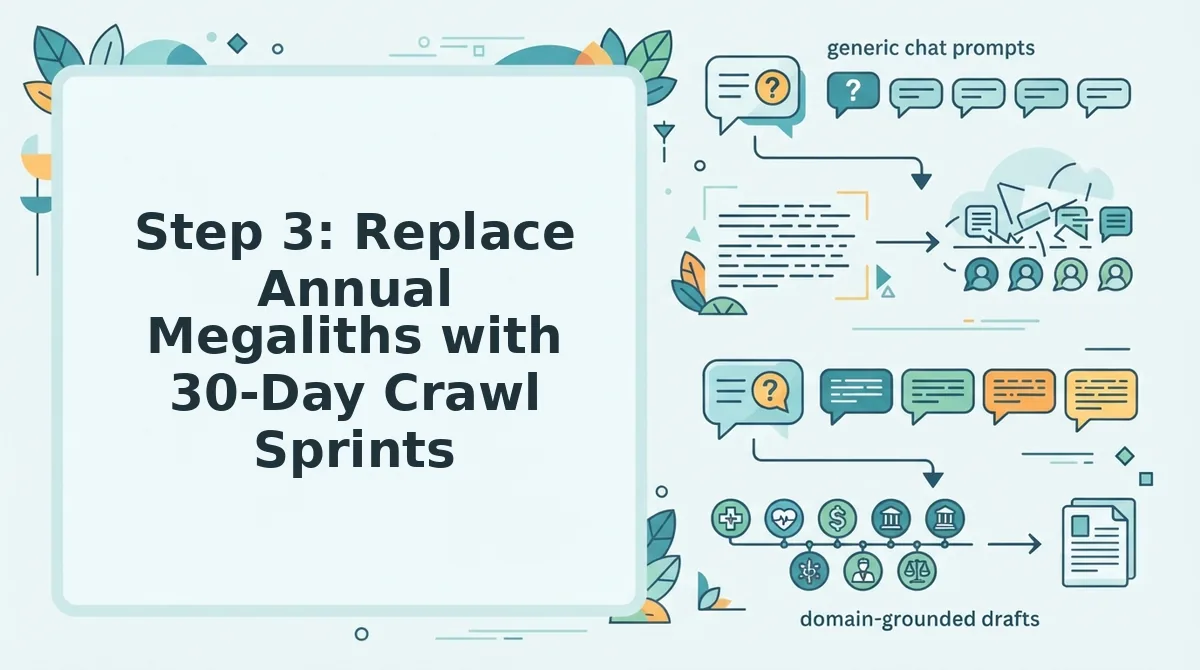
Replacing an annual editorial roadmap with a 30-day crawl sprint aligns publishing frequency with search engine discovery limits, preventing crawl budgets from stalling across stale URL backlogs. Planning twelve months in advance creates structural indexation lag. Search engine algorithms adjust topical entity weights continuously, meaning dormant spreadsheets leave queued URLs disconnected from active search trends long before bots ever visit them.
A 30-day crawl sprint is an agile publishing cycle where tightly themed cluster URLs are drafted, internally cross-linked, and submitted together within a one-month window. Long-range editorial calendars regularly fail during execution. Creator economy educators Kimberly Ann Jimenez and Jade Beason frequently highlight how rigid batching schedules and disconnected scheduling systems generate severe workflow fatigue, stranding unfinished clusters in draft status while search engines crawl empty directories.
| Cadence Model | Crawl Budget Efficiency | Execution Vulnerability | Best For |
|---|---|---|---|
| 12-Month Megalith Calendar | Low. Static drafts and delayed publishing dilute link-equity signals across stale queues. | Relevance decay. Intent shifts render unreleased drafts obsolete before discovery. | Enterprise corporations constrained by rigid annual legal and compliance roadmaps. |
| Quarterly Batching Blocks | Moderate. Produces predictable content waves, though burst publishing causes uneven bot visits. | Production bottlenecks where editorial delays on one spoke stall the entire cluster. | Large agency teams managing mature domains with established daily crawl activity. |
| 30-Day Crawl Sprints | High. Immediate internal linking and fast deployment accelerate bot discovery paths. | Requires systematic topic clustering tools to prevent repetitive keyword overlaps. | Growth leads, founders, and lean teams prioritizing fast search visibility. |
Decision Framework: Choosing Your Content Cadence
Choose a 12-month calendar if your organization requires annual board approvals for all marketing topics. Choose quarterly batching if you maintain dedicated editorial review teams and have surplus crawl equity. Choose 30-day crawl sprints if you must react to emerging search trends, preserve indexing budgets, and prevent team burnout.
Our recommendation is to run focused monthly intervals using an autopilot 30-day content calendar generator. Confining topics to shorter sprints ensures that every published URL immediately supports an active pillar, giving web crawlers an efficient, cohesive architecture to index without operational drag.
Step 4: Connect Calendar Outputs Directly to Automated Indexing Pipelines
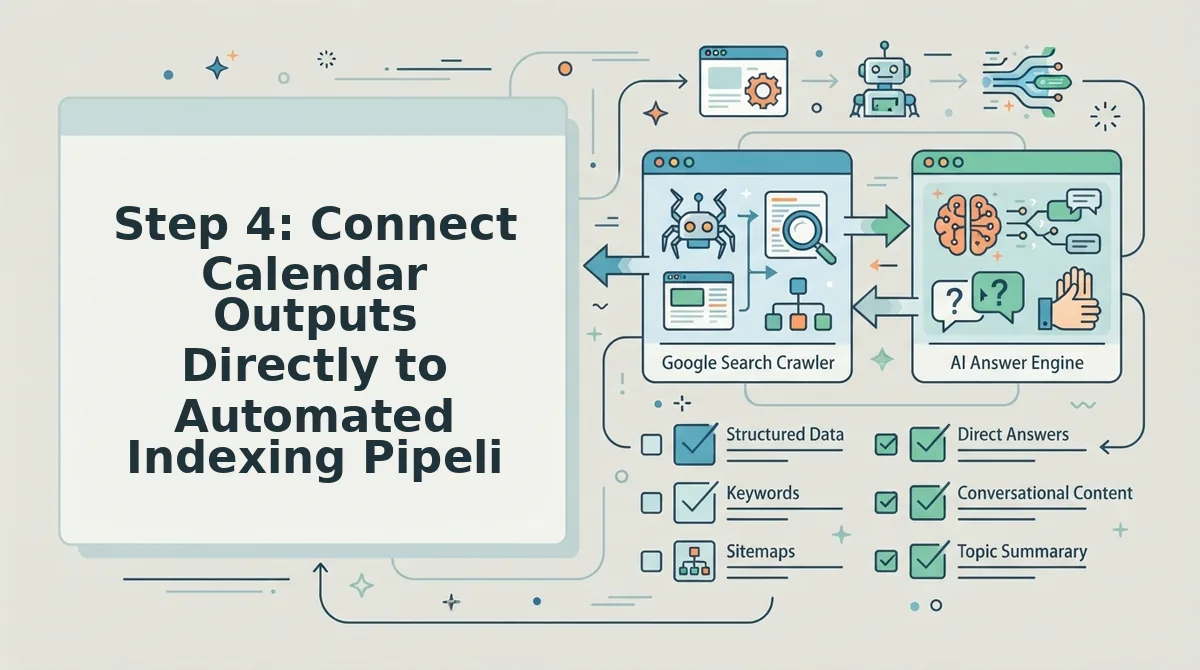
Connecting calendar outputs directly to an automated indexing pipeline eliminates discovery lag by dispatching crawl requests the exact moment content goes live. An automated indexing pipeline is a programmatic bridge between your CMS and search engine APIs that submits published URLs for immediate bot retrieval.
Consider a frequent scenario: an editorial team finishes a batch of planned cluster articles, uploads them to WordPress, and marks the calendar tasks complete. Weeks pass, yet search bots never arrive because passive discovery forces engines to poll static XML sitemaps on unpredictable revisit cycles.
Prerequisites for this 15-minute setup include Google Search Console administrative access, an active Google Cloud project with the Indexing API enabled, and your CMS administrative credentials.
- Generate a service account key: Open Google Cloud Console, navigate to IAM & Admin, select Service Accounts, and download a private JSON key file. Expected outcome: A secured JSON credential file is saved to your local environment.
- Assign ownership permissions: Open Google Search Console, click Settings, select Users and permissions, and add the service account email as an Owner. Expected outcome: The service account appears in the verified users list with full administrative rights.
- Configure publish-event pings: Connect your deployment platform to dispatch URL endpoints, allowing you to ask Google to crawl new posts automatically upon publication. Expected outcome: Live URLs trigger instant HTTP 200 responses from search engine indexing endpoints.
The mechanics of programmatic indexing service accounts versus passive XML sitemap polling explain why automated pipelines preserve crawl budget. Standard XML sitemaps function as passive directories; crawlers visit them only when routine scheduling permits. In contrast, an API service account transmits an event-driven payload directly to search engines. This explicit signal routes crawlers straight to newly published pages, bypassing wasteful crawling of unchanged archives.
A publisher previously faced multi-week discovery delays after manually uploading cluster articles to an unmonitored CMS. By connecting calendar releases directly to an API-driven pipeline, every published post immediately notified Google service accounts. Search engines crawled the cluster URLs on the day of release, confirming internal link connections without waiting for deep sitemap crawls.
To eliminate stack sprawl and manual CMS uploading, switch to an autopilot content engine that builds pillar-focused calendars and ships rank-ready drafts directly to WordPress with automated publishing workflows.
How to Verify Your Calendar Stops Wasting Crawling Budgets
You verify that your content calendar stops wasting crawling budget by cross-referencing crawl request status codes and crawl purpose distributions 48 hours after launching a content sprint. Proper scheduling ensures search engines prioritize brand-new cluster URLs instead of burning limits on redundant rescans.
Forty-eight hours after deploying a synchronized cluster sprint, inspect your diagnostic trends to evaluate actual bot behavior. Google Search Console Crawl Stats is a technical diagnostic tool that monitors search bot requests, server responses, and host availability. If the calendar is sequenced properly, spiders immediately shift toward discovery.
- Audit the crawl purpose breakdown between Discovery and Refresh: This breakdown reveals whether spiders are processing net-new articles or re-evaluating established pages. An unbalanced schedule triggers excessive refresh activity on old URLs while starving new cluster nodes. Check this metric in your crawl stats to confirm scheduled sprint additions drive predominantly Discovery requests.
- Monitor crawl request status codes for 200 versus 304 or 404 responses: This data tracks HTTP server responses generated during bot visits. High frequencies of 404 errors or unnecessary 304 signals prove bots are consuming resources on broken links or static assets. Filter your logs to verify new posts return clean 200 OK headers without dragging bots into redirection chains.
- Parse server access logs for calendar parameter bloat: This audit tracks raw server hits across date archives, category tags, and dynamic filters. Flawed calendars often expose pagination or search parameters that divert Googlebot from essential landing pages. Review raw log files post-publish to verify that search engines touch only clean, canonical article paths.
- Validate index coverage status changes across newly published batches: This workflow confirms whether crawled URLs advance into the live search index. Schedules plagued by cannibalization produce high crawl volumes followed by exclusions like Discovered - currently not indexed. Inspect your indexing report weekly to verify that crawled batch pages convert into indexed URLs.
- Review host response times during batch publishing events: This metric measures server latency while search engines crawl scheduled cluster launches. Server lag prompts bots to throttle request rates, stranding secondary spoke content without retrieval. Monitor latency graphs during deployment intervals to confirm host response speeds remain rapid under sustained crawling pressure.
Frequently Asked Questions About Content Calendars and Crawl Budgets
Poor content calendar scheduling wastes search crawling budgets by forcing search engines to repeatedly process orphaned URLs, duplicate variants, and broken cluster hierarchies.
What is the ideal calendar planning horizon to balance crawl budgets?
A rolling 30-day planning horizon best balances crawl budgets against bot discovery cycles. Search crawlers typically revisit established authority domains every two to four weeks. Aligning thirty days of content ensures parent pillars and child spokes get discovered together, preventing bots from re-crawling disconnected, partial clusters.
Why does publishing spoke pages before pillar content waste crawl budget?
Publishing spoke pages before foundational pillar content wastes crawl budget by creating temporary orphan pages. Search bots crawl the spoke URL, find no contextual parent links or semantic anchors, and deprioritize re-crawling until the pillar arrives weeks later, requiring redundant crawl passes to index the relationship.
How does scheduled bulk-publishing impact search bot indexing?
Scheduled bulk-publishing floods servers with hundreds of simultaneous URLs, triggering automatic crawl rate limits. Rapid spikes degrade server response times. When latency climbs, search engine bots immediately throttle crawl frequency, leaving uninspected articles trapped in discovery queues for weeks.
How do you detect content calendar crawl waste in server logs?
Detect calendar crawl waste by auditing server logs for crawl request imbalances. When crawlers burn requests on paginated archives while new articles remain unindexed for weeks, your calendar sequencing is broken.
Transition to Crawl-Optimized Content Orchestration
Crawl-optimized content orchestration replaces static scheduling spreadsheets with automated publication pipelines that sequence pillar hubs before dependent cluster spokes to preserve bot resources.
Teams trapped in tool sprawl push disconnected drafts across fragmented systems, stranding search engine spiders in dead-end link loops. Operators running synchronized autopilot clusters feed search engines logical topical hierarchies that validate and index on first discovery.
Execute this final operational checklist before deploying your next publishing cycle:
- Verify every child spoke links directly back to an existing, fully indexed pillar URL.
- Deploy articles in dense, topical 30-day cluster sprints rather than sporadic standalone posts.
- Connect CMS publishing webhooks directly to automated search engine indexing pipelines.
To eliminate manual coordination and publish synchronized clusters directly from your site structure, review our workflow and test 3 free articles on your CMS today.
Search bots do not crawl publication calendars; they crawl unified site architecture designed to reward immediate topical depth over disconnected output volume.