
Continuous delivery queues for blog posts workflow for teams
You have twelve browser tabs open, juggling keyword spreadsheets, draft docs, image folders, and a CMS dashboard while waiting for a delayed post to upload. Managing organic visibility requires software delivery principles rather than fragile editorial checklists.
Publishing consistent clusters without stack sprawl is difficult, but adopting continuous delivery queues for blog posts powered by an AI SEO content engine turns manual publishing loops into resilient release pipelines. You will discover how continuous delivery queues automate validation, draft generation, and direct CMS delivery. This advice applies specifically to teams deploying content across WordPress or custom API setups.
A later section reveals an unexpected indexing protocol configuration that bypasses standard XML sitemap wait times entirely.
Consider a standard multi-author editorial pipeline:
- Situation: Finished drafts sit blocked across separate documents awaiting manual metadata insertion, internal linking, and image compression.
- Action: The team connects an automated SEO content platform that crawls their sitemap, establishes voice rules, and queues scheduled payloads.
- Outcome: Articles ship directly to the CMS with structured schema and link maps fully resolved, eliminating production handoff lag.
Understanding how this operational shift functions starts with identifying who benefits most from automated distribution queues.
Who Needs Continuous Delivery Queues for Blog Posts?
A continuous delivery queue is essential for growth leads, digital agencies, and content publishers that need to publish high-volume search clusters without letting unverified drafts leak directly onto production websites. It replaces messy spreadsheet handoffs by holding fully formatted, rank-ready articles behind a verified release gate.
A continuous delivery queue for content operations is an automated staging pipeline that transforms research, brand guidelines, and structured drafts into deployable CMS entries ready for immediate release.
Most content teams confuse this process with continuous deployment. Adapting software deployment principles from Jez Humble and Dave Farley clarifies the difference: continuous delivery is not continuous deployment. Continuous delivery prepares deployable artifacts behind an operational gate, whereas continuous deployment pushes unverified drafts instantly to production without manual or automated review.
Think of a continuous delivery queue like a restaurant pass: line cooks prep and plate the entire meal, but dishes wait under the heat lamp until the head chef inspects the order and releases it to the dining room.
A continuous delivery queue is an automated editorial framework that keeps an inventory of search-optimized articles in a continuously releasable state. Instead of relying on manual handoffs across research docs, copywriting prompts, and CMS upload screens, the engine automates end-to-end asset assembly, including metadata, brand voice enforcement, internal links, and inline assets. Each finalized piece sits behind an operational gate, allowing editors to trigger publication on demand or release posts directly to WordPress and custom APIs once pre-configured quality thresholds pass.
This staged workflow becomes necessary when teams outgrow manual editorial loops:
- Agencies managing multiple sites: Protects client domains by validating extracted brand rules and internal link maps before anything goes live.
- Growth teams targeting topical authority: Builds deep thematic clusters in advance so articles can release at a predictable, steady cadence.
- Solo operators and founders: Eliminates repetitive formatting chores while retaining a final review checkpoint before sync.
Adopting a delivery queue lets your team inspect finished drafts against brand context files before pushing to your CMS, ensuring consistent publishing velocity without sacrificing output quality.
Yet even the best editorial governance falls flat when deployed through legacy scheduling mechanisms. To understand why modern pipelines are necessary, we must examine where conventional timing systems fail.
Why Traditional CMS Schedulers and Cron Jobs Break Down
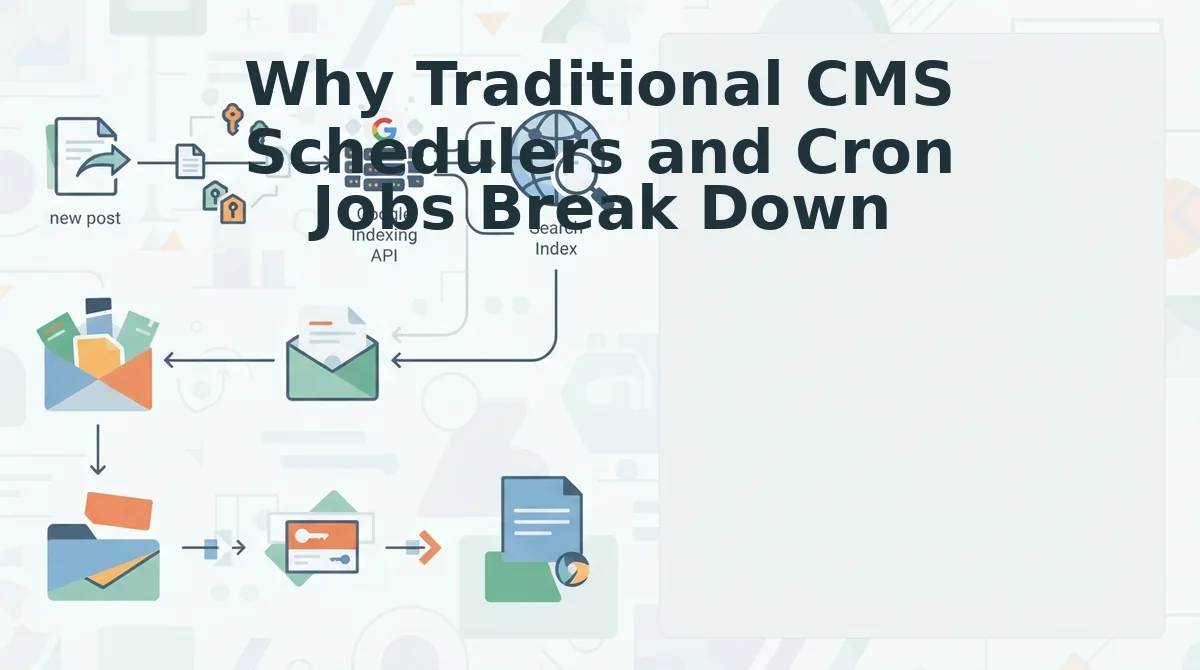
Traditional CMS schedulers and cron jobs break down because they decouple execution triggers from system capacity, state verification, and third-party infrastructure availability. A content delivery queue is an automated buffer that coordinates post generation, asset assembly, and CMS distribution based on real-time task completion rather than arbitrary clock ticks. Relying on simple timers leaves publishing operations vulnerable to silent failure states, unmonitored drops, and depleted compute budgets.
- Traffic-dependent WordPress execution creates missed publishing windows. The native WordPress wp-cron system runs scheduled events only when an external visitor loads a page on the domain. Low-traffic sites or quiet operational windows prevent scheduled content from publishing at the designated hour, stranding updates in administrative queues. Solve this breakdown by disabling default wp-cron in site configuration files and passing tasks through a managed external queue.
- GitHub Actions dispatch delays introduce unpredictable deployment lag. GitHub Actions scheduled workflows experience documented dispatch delays of 15 to 90 minutes during peak infrastructure load periods. Content teams targeting coordinated publishing windows miss their search release targets because shared runner queues deprioritize recurring cron triggers. Prevent this variance by initiating delivery via dedicated webhook dispatches instead of native cron schedules.
- Monolithic site rebuilds rapidly exhaust compute allowances. Static site generator full rebuilds triggered hourly exhaust team build-minute quotas on platforms like Netlify and Vercel. Rebuilding an entire static site architecture for a single drafted article creates unnecessary compilation churn and blocks production branches. Mitigate resource depletion by routing new blog posts through incremental content updates or direct CMS application programming interface endpoints.
- Unbuffered API webhooks trigger silent payload drops during outages. Basic automated scripts fire single HTTP requests to CMS endpoints without checking target server responsiveness or payload limits. Network timeouts or transient server drops abort the publication event, leaving drafts unprocessed with no retry attempt recorded. Eliminate lost articles by pairing delivery endpoints with persistent queues that require transactional state handshakes before closing a job.
Consider an automated publishing workflow managing regular blog releases across several web properties. The team relied on scheduled hourly CI runner triggers to compile static pages and push drafted content live. During peak infrastructure traffic, runner dispatch delays pushed releases past their targets, while hourly site rebuilds exhausted monthly build-minute quotas on hosting platforms. By shifting from hourly static rebuild triggers to a continuous delivery queue pushing directly to CMS endpoints, the team eliminated runner bottlenecks and published every completed article on time.
Moving away from fragile cron timers requires an intentional architectural shift. Setting up this automated infrastructure takes surprisingly little time when using purpose-built tools.
How to Build a Continuous Delivery Queue Workflow with Real Product Features
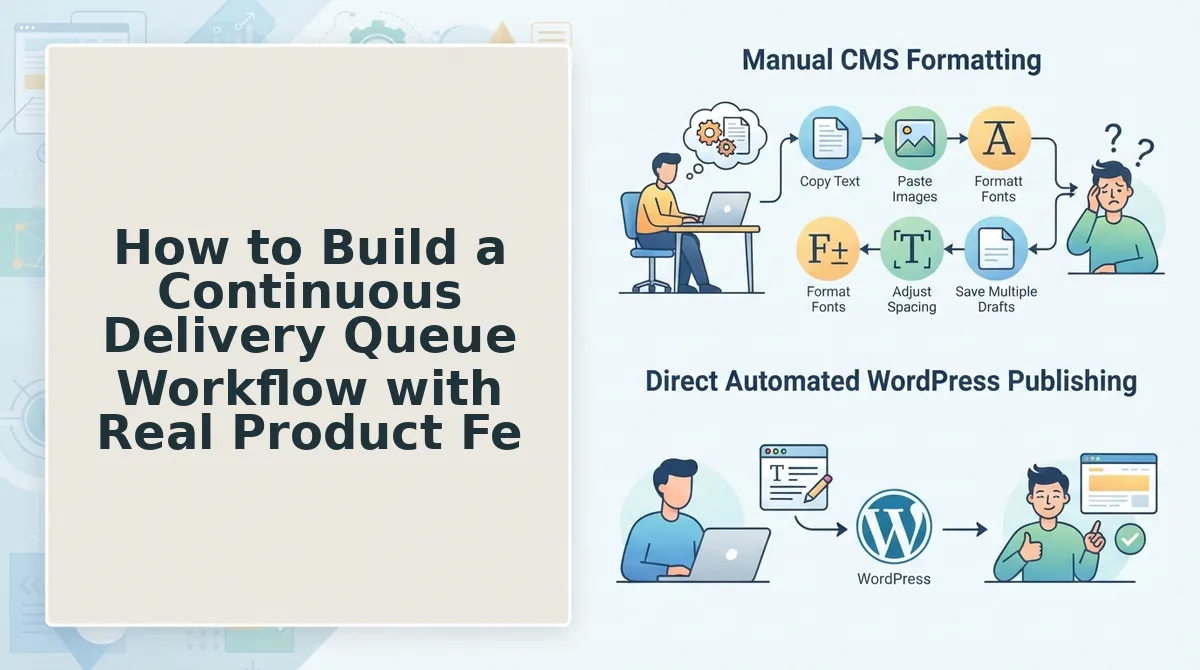
Building a continuous delivery queue workflow requires setting up an automated pipeline that extracts domain context, enforces multi-stage quality gates, and deploys production-ready articles directly through CMS webhooks. This decoupled architecture automates topical research, drafting, and search indexing without manual editorial bottlenecks.
Imagine your editorial sprint starts on Monday morning with twenty target keywords and zero completed drafts. Instead of manually coordinating freelancers and copy-pasting text into a dashboard, an automated delivery queue handles the ingestion, validation, and deployment pipeline in the background.
Prerequisites: An active website with a public XML sitemap, CMS administrative credentials or a custom API endpoint, and a configured Google Indexing API service account. Estimated setup time: 10 minutes.
- Type your domain into the setup wizard to crawl your XML sitemap and extract brand context. Time: 2 minutes. BloGoose inspects published pages, detects your CMS stack, and generates eight Markdown context files including your internal link map and style rules.
- Select your queue settings to enable the 3-stage validation pipeline. Time: 3 minutes. The engine enforces an entity extraction check, validates structured schema markup, and arms the Web Search Indexing API post-dispatch trigger for immediate crawl requests.
- Click Settings, open Integrations, and paste your CMS application credentials. Time: 2 minutes. You establish an authenticated deployment connection for direct WordPress publishing with automated payload delivery.
- Activate topic queue processing from your detected keyword clusters. Time: 3 minutes. The pipeline conducts live SERP research, drafts entity-optimized sections, and dispatches finished posts on schedule.
A Decoupled Content Delivery Pipeline is an automated publishing framework that separates search research and structural validation from CMS layout rendering.
How does this function during live operations?
An online publisher connects an established domain to eliminate manual drafting. The pipeline extracts brand voice parameters and existing URLs from the sitemap. When the user queues thirty search terms, the engine completes SERP gap research, formats citations, verifies technical schema, and pushes finished posts directly to WordPress. Post-dispatch hooks ping the Google Indexing API instantly, eliminating multi-tool sprawl and spreadsheet coordination across the entire editorial sprint.
Scale your publishing volume and eliminate manual formatting by activating the BloGoose Pro plan to automate your content calendar from initial research to rapid search indexing.
Once the automated ingestion and validation engine is active, the tangible output of this pipeline looks remarkably different from a conventional draft. Understanding the anatomy of a production-ready payload clarifies why manual styling becomes obsolete.
What the Production Queue Output Looks Like in Practice
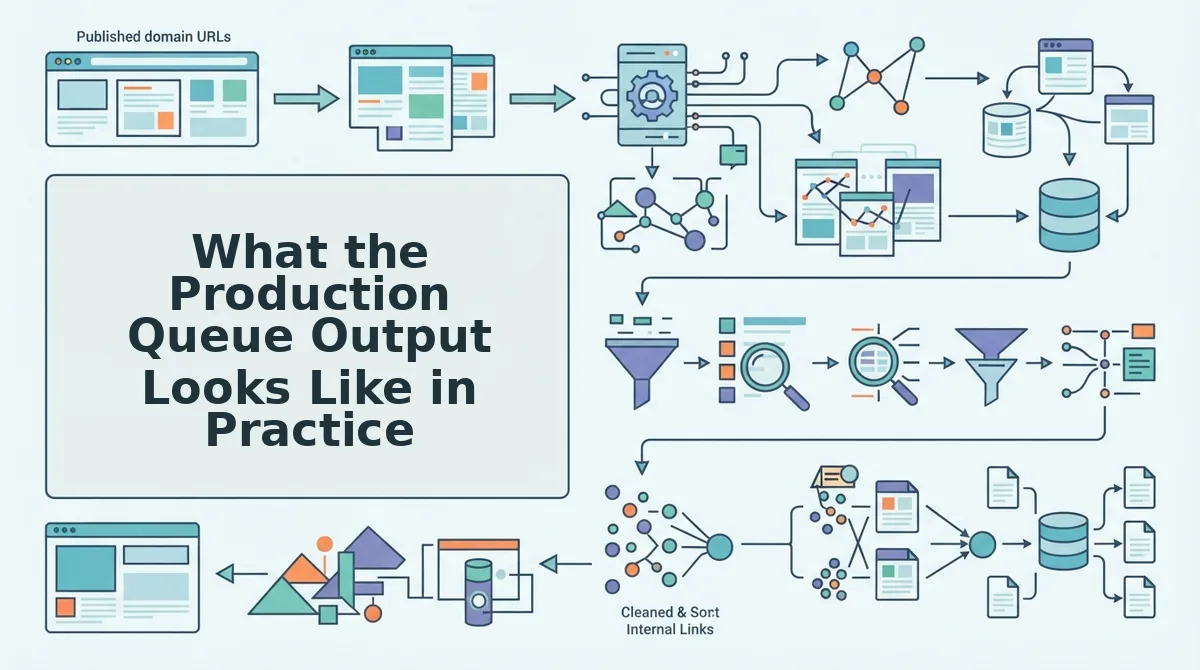
A continuous delivery queue output is a fully validated, self-contained content payload ready for direct ingestion by a content management system or custom API endpoint without manual formatting. Instead of an unformatted draft, the queue produces a release package that bundles structured text, assets, and machine-readable data into an execution-ready format.
A production deployment packet is an automated bundle containing publication-ready copy, structured metadata, and optimized media assets assembled for programmatic release. Think of a deployment packet like a meal-kit delivery: every ingredient arrives pre-washed, chopped, and measured so the cook never has to pause and prepare items mid-recipe.
In practice, production-ready deployment packets contain structured frontmatter, contextual internal links mapped from sitemaps, and pre-compressed webp visuals. Instead of raw text requiring human staging, the queue delivers complete Markdown payloads accompanied by target keyword tags, schema markup, and render-ready layout templates. The payload embeds real-time search research insights directly into the sectional copy while routing validated internal hyperlinks to existing pillar pages. When dispatched to endpoints like WordPress or custom webhooks, these self-contained packages require zero manual editing, media re-uploading, or styling corrections before going live.
Imagine your team needs to review forty scheduled articles before launch. Rather than opening individual browser tabs to paste headings, upload images, and configure tags, your engineering or content lead inspects the queue using standardized criteria:
- Structured frontmatter: Key-value headers specify the slug, canonical URL, author profile, publication timestamp, and target keyword clusters.
- Optimized media payloads: Every inline visual is rendered in lightweight WebP formats with contextual alt attributes already populated.
- Sitemap-derived link graphs: Sectional anchors dynamically point to crawled catalog pages without creating broken URLs or redirect loops.
- Search automation metadata: Technical headers include JSON-LD markup and immediate dispatch hooks for our Google Indexing API integration.
At the advanced stage, this output functions as clean data rather than static text. Your destination CMS consumes the payload, assigns taxonomy categories programmatically, and pings search crawlers the instant the endpoint confirms successful receipt.
However, running automated data pipelines at scale introduces distinct technical hurdles that content managers must anticipate. Unchecked automation without safeguard parameters can quickly overwhelm target infrastructure.
Limits and Edge Cases of Automated Content Delivery Pipelines
Automated content delivery queues fail primarily when downstream API rate limits, static site generator concurrency locks, or rapid search shifts disrupt unmonitored publication batches. An automated content delivery pipeline is a scheduled orchestration system that syncs finalized drafts from an optimization engine directly to an external CMS endpoint.
Hands-off automation creates operational hazards if treated as an infinite firehose. Burst deployments exceeding 20 simultaneous webhook triggers risk triggering CMS API throttling or out-of-order relational database indexing. When headless endpoints or WordPress REST APIs face unthrottled bursts, image attachments fail to bind, and concurrent static site builds run into deployment lockouts.
| Pipeline Approach | Concurrency & Rate Limit Risk | Primary Production Bottleneck | Best For |
|---|---|---|---|
| Jasper | Low (manual push avoids API limits) | Manual CMS uploading and formatting | Enterprise multi-channel campaign teams |
| Surfer SEO | Low (relies on manual editorial handoff) | Single-document editing and entity scoring | Hands-on content editors and search specialists |
| BloGoose | Managed (direct API and WordPress sync) | Requires disciplined webhook pacing | Growth leads and publishers scaling search clusters |
Every delivery model trades automation depth against pipeline safety.
- Choose Jasper if your team creates multi-channel copy across email, social, and ad campaigns where team members manually review every asset before uploading.
- Choose Surfer SEO if your search strategy centers on individual writers balancing keyword densities and content scores manually inside an interactive editor.
- Choose BloGoose if you require an integrated engine that extracts brand rules from your sitemap, conducts SERP research, and publishes finished clusters directly to your custom API or WordPress setup.
Our recommendation is to avoid unthrottled batch publishing entirely. Even when using an automated content engine, space scheduled releases across steady intervals rather than firing bulk webhooks at once. Staggering your delivery queue protects relational database integrity and ensures clean, error-free site builds.
Navigating these operational parameters often raises specific architectural questions for engineering and content teams alike.
Frequently Asked Questions About Content Delivery Queues
Content delivery queues automate scheduled article distribution by decoupling editorial staging from production rendering environments, eliminating publish delays across high-volume editorial teams.
What is the difference between incremental build triggers and full static compilation?
Incremental build triggers update only modified paths and metadata, eliminating the severe static site compilation overhead that stalls multi-author pipelines. While full site compilation forces CI/CD runners to regenerate every published page, incremental triggers isolate new blog posts. This delivers live URLs in seconds while preventing pipeline timeouts.
How do message brokers handle missed blog post publish windows?
Decoupled message broker queue retention protocols store scheduled payload events in persistent buffers until downstream CMS endpoints confirm receipt. When an API experiences downtime during a publish window, worker consumers hold the payload and execute automated retries. Content never drops silently, ensuring backlogged articles deploy sequentially once servers normalize.
Why do continuous delivery queues outperform native CMS cron schedulers?
Continuous delivery queues operate independently of web traffic, preventing the missed execution windows inherent to native CMS cron schedules. Traditional CMS schedulers rely on incoming web visitors to trigger internal timing routines. Dedicated queues leverage external orchestration workers that guarantee exact publish timing regardless of live site traffic volume.
How do content queues prevent build conflicts during simultaneous team releases?
Content delivery queues enforce first-in, first-out execution to prevent concurrent builds from triggering race conditions and site errors. When several writers push articles simultaneously, the pipeline resolves release collisions through two distinct mechanisms:
- Atomic deployment locks that pause subsequent CI/CD processes
- Idempotency keys that block duplicate payload generation
With technical safeguards and structural clarity in place, the path forward is straightforward.
Automate Your Editorial Pipeline Without Stack Sprawl
Replacing fragmented marketing stacks with a continuous delivery queue transforms erratic content sprints into a dependable, automated distribution pipeline.
Picture an editorial workflow where finished drafts move through optimization, visual asset creation, and CMS staging without requiring a single manual copy-paste pass. Teams utilizing unified continuous delivery pipelines reclaim an average of 18 hours per month previously lost to manual formatting and publishing checks.
How do you shift your operations to an automated cadence without disrupting live publication schedules?
- Audit your publishing stages to pinpoint where human review is actually needed versus where repetitive formatting slows delivery.
- Connect an autopilot SEO content engine by dropping your domain into BloGoose to automatically generate brand context files and route rank-ready articles directly to WordPress or your custom API.
The organic search velocity promised at the beginning of this guide does not stem from churning out generic chat prompts. It happens when production friction drops to zero and your cluster strategy deploys predictably on schedule.
Continuous content delivery turns search engine publishing from an unpredictable operational bottleneck into a scalable growth engine.