
Direct CMS Publishing vs Jasper for Blog Teams
Your blog team just spent three hours prompting an AI writer, and now the drafts are sitting in a Google Doc, unpublished, unformatted, and already falling behind your content calendar. If that scenario sounds familiar, the real question isn't whether AI can write. It's whether your tool finishes the job. The choice between direct CMS publishing vs Jasper for blog teams comes down to one question: does your AI tool stop at the draft, or does it ship the post live?
You're right to be frustrated. Jasper produces polished drafts, but it still requires manual export and upload to publish, a hidden handoff that eats hours every week. Here's what we'll cover: exactly where Jasper stops, how direct CMS publishing works step by step, and a side-by-side workflow comparison. Along the way, you'll see why an AI SEO content engine that publishes directly to WordPress changes the math entirely.
And here's the open loop: the gap between a finished draft and a live post isn't one step. It's five or six, and most comparisons never count them.
The Draft-to-Publish Gap: Where Jasper Stops
The draft-to-publish gap is the sequence of manual steps between an AI tool's text output and a live, indexed blog post. Jasper closes the writing loop but leaves the publishing loop entirely to your team.
Think of Jasper like a ghostwriter who hands you a typed manuscript and walks away. The manuscript is excellent, but someone still has to format it, design the cover, register the ISBN, and ship it to bookstores. That's the gap.
The Hidden 5-Step Handoff
Here's where most comparisons miss the point. When a blog team uses Jasper, the draft-to-publish workflow breaks into five or six manual steps that no competitor's marketing page itemizes:
- Export the draft, copy text out of Jasper's editor or export a document file.
- Reformat for WordPress, rebuild headings, lists, and block structure in the CMS editor.
- Upload images and media, download generated or stock images, then re-upload them to the WordPress media library.
- Set metadata manually, write the SEO title, meta description, slug, and category tags by hand.
- Schedule or publish, click through WordPress publishing settings, assign an author, and hit publish.
Each step takes two to ten minutes. Across a five-post week, that's one to three hours of non-writing labor, per writer, per week. Multiply that across a content team of three, and the hidden handoff consumes a full workday every single week.
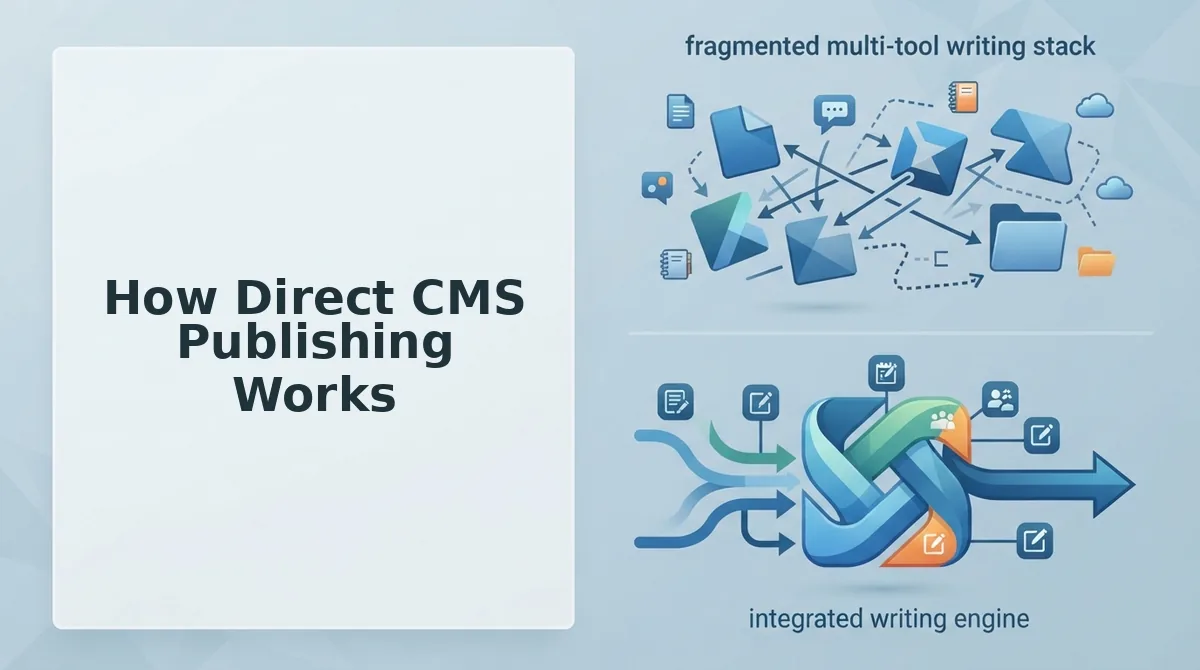
A direct CMS publishing tool eliminates all five steps by treating the CMS as the destination, not an afterthought. The AI writes, formats, sets metadata, uploads media, and publishes in one continuous pipeline. The draft and the live post are the same artifact.
How Direct CMS Publishing Works
Direct CMS publishing is a pipeline where the AI content engine writes, formats, optimizes, and publishes a finished article to your content management system without manual export or upload. Here's the exact workflow, using an AI SEO content engine as the reference implementation.
Prerequisites: You need a live website with an XML sitemap, admin access to your WordPress site (or a custom API endpoint), and a connected publishing destination in your AI tool's settings.
- Connect your website domain. Enter your site URL in the setup wizard. The engine crawls your existing pages, locates the XML sitemap, and inspects your published content structure. You should see a confirmation that your site has been scanned and indexed.
- Review the extracted brand context. The engine detects your brand voice rules, tone, terminology, formatting preferences, from your existing pages. Confirm or adjust these rules. You should see a brand voice summary that matches how your team actually writes.
- Approve the generated content calendar. The engine builds a pillar-focused calendar based on your site structure and keyword gaps. Select the topics you want to publish. You should see a queue of articles mapped to your existing pages and target keywords.
- Trigger the draft generation. The engine writes each article using your brand voice rules and SEO targets. No prompt engineering required. You should see a complete draft with headings, internal links, and metadata pre-filled.
- Click Publish. The finished article ships directly to WordPress or your custom API, formatted, with images, metadata, and internal links intact. You should see the live post on your site within seconds, no manual upload needed.
This pipeline is what an AI blog generator with direct WordPress publishing automates end to end. The calendar, the crawl, the voice extraction, and the publish step all happen inside one tool, no spreadsheet coordination, no copy-paste loop. That workflow contrast sets up the next section.
Jasper vs BloGoose: Workflow Comparison
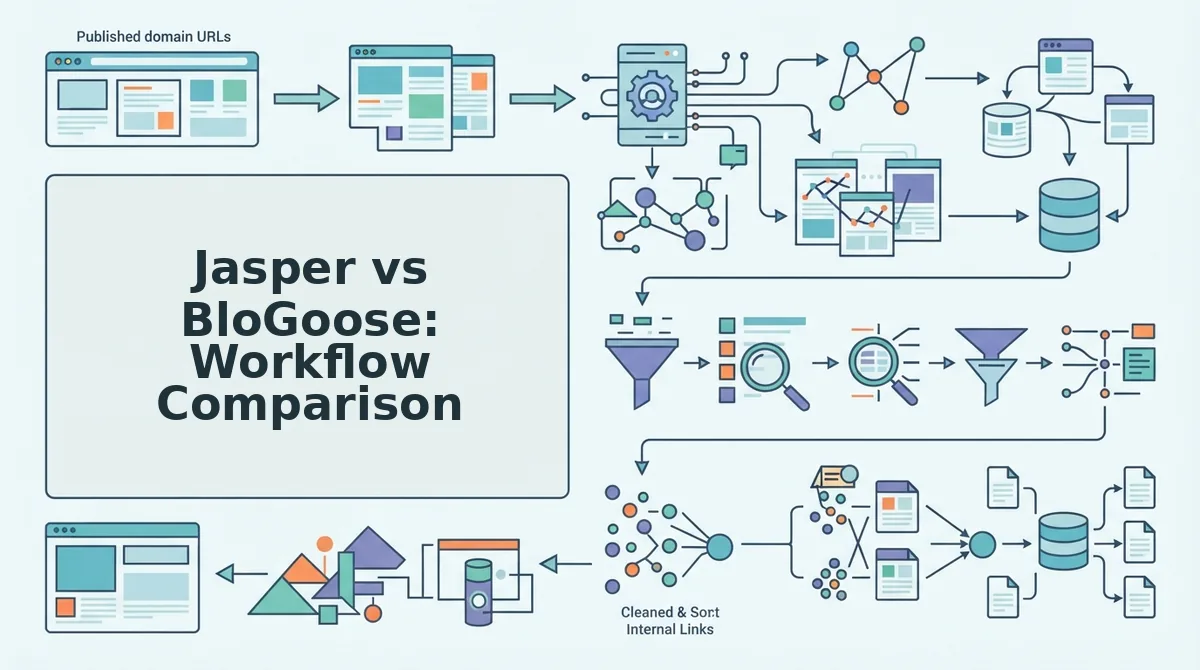
Jasper excels at fast, high-quality AI drafting from a chat window or template; BloGoose compresses the entire draft-to-published pipeline into one or two steps. The right choice depends on whether your bottleneck is writing speed or shipping speed.
Jasper's strength is undeniable: it produces polished long-form drafts quickly, supports brand voice training, and gives writers granular control over tone and structure. For teams that already have a mature editorial workflow and a dedicated CMS manager, Jasper's drafting speed is a genuine asset. The platform is a writing tool first, and it does that job well.
But the real question isn't which tool writes better, it's which tool ships. A draft sitting in a Google Doc or an export folder generates zero organic traffic. Jasper's workflow ends at the draft; BloGoose's workflow ends at the published, indexed post.
The step-count difference is stark. Jasper requires roughly six manual steps from finished draft to live post: export the document, reformat for your CMS, upload media, paste content into the editor, set metadata and categories, then hit publish. BloGoose reduces this to one or two steps: review the draft, approve it, and the platform publishes directly to WordPress or your custom API with metadata and internal links already configured.
| Workflow Stage | Jasper | BloGoose |
|---|---|---|
| Draft generation | Fast, template-driven, strong brand voice controls | Automated from site crawl and keyword calendar |
| Export / transfer | Manual export to doc or clipboard | None required, draft stays in platform |
| Formatting for CMS | Manual reformatting, image re-upload | Auto-formatted for WordPress or API schema |
| Metadata & SEO fields | Manual entry in CMS | Auto-generated from target keyword and page context |
| Publishing | Manual upload and publish | One-click approve to auto-publish |
| Total steps: draft to live | 6 | 1-2 |
Jasper saves time on drafting speed; BloGoose saves time on the entire pipeline. For a solo operator publishing three posts a week, the six-step handoff consumes hours that could go toward strategy or promotion. For a multi-writer team, those steps multiply across every author and every post.
Best for solo content operators and lean growth teams: BloGoose, because the publishing loop is automated end-to-end and requires no CMS babysitting. Best for large editorial teams with dedicated CMS managers and custom publishing workflows: Jasper, because its drafting flexibility and brand voice depth justify the manual handoff when you already have people paid to handle it.
If you're weighing a chat-window drafting tool against a full pipeline engine, the deeper comparison is covered in our breakdown of AI content engine vs chat window workflows. And once a post goes live, speed to index matters, see how to ask Google to crawl new posts so your shipped content starts ranking sooner.
What Blog Teams Actually Need
Blog teams don't need more drafting tools, they need fewer handoffs between draft and published post. The requirements below are ordered by how directly each one affects publishing volume and organic traffic.
- Hands-off delivery for solo operators. A solo founder or content lead has no CMS manager to delegate formatting, metadata, and uploads to. Every manual step is time stolen from strategy, promotion, or the next draft. Direct CMS publishing turns approval into the only required action, so a solo operator can ship a week of posts in one sitting.
- Workflow automation for multi-writer teams. When three or more writers produce drafts, inconsistent formatting, missing metadata, and publishing bottlenecks compound fast. Automated publishing pipelines enforce the same structure, internal linking rules, and SEO fields across every author without a style-guide policing meeting.
- Brand voice consistency at scale. A brand voice guide only works if every writer follows it, and most don't, especially under deadline pressure. Tools that extract voice rules from your existing published content and apply them automatically to every draft remove the single biggest quality variable in multi-writer teams.
- Zero unpublished-draft waste. Every AI-generated draft that never goes live represents wasted generation cost and a lost ranking opportunity. If your team drafts 20 posts a month but only publishes 12, the manual handoff is the leak. Closing that gap is the fastest ROI lever most blog teams never measure.
- A publishing cadence that compounds. Search engines reward consistency, not bursts. A pipeline that ships on schedule without heroic effort keeps the cadence alive through vacations, hiring gaps, and busy product sprints. Teams that rely on manual publishing inevitably miss weeks, and rankings slip.
- Indexing speed after publish. A published post that Google hasn't crawled is invisible. Teams need a workflow that triggers crawl requests automatically or makes them one click away, not a separate tab in a separate tool that someone forgets to check.
- A calendar that plans itself. Topic selection eats more time than writing for many teams. An autopilot 30-day content calendar generator removes the "what do we write next" meeting entirely, feeding the pipeline with keyword-mapped topics ready for drafting.
The cost of the manual handoff compounds with every additional team member. A solo operator loses an hour per post; a five-person team loses five hours per post across formatting, metadata, and upload coordination. That's the difference between a content engine and a content bottleneck.
Direct CMS Publishing vs Jasper: FAQ
Direct CMS publishing sends finished AI-generated articles straight to WordPress or a custom API without manual export, reformatting, or upload. It removes the four to five handoff steps that sit between a finished draft and a live, indexed post.
Does Jasper publish directly to WordPress?
No. Jasper generates drafts but does not publish them directly to WordPress. You must export the content, reformat it for your CMS, upload images, set metadata, and publish manually, or connect a third-party integration to bridge part of that gap.
What's the fastest way to get AI content live?
The fastest path is a platform that drafts and publishes in the same workflow. BloGoose crawls your site, generates keyword-mapped drafts, and publishes approved posts directly to WordPress or your custom API, reducing the draft-to-live process from roughly six manual steps to one or two.
Is direct CMS publishing worth switching tools for?
If you publish more than two posts per week, yes. Direct publishing saves four to five manual steps per post, which compounds across a content calendar. For solo operators and lean teams, that recovered time often exceeds the time spent drafting in the first place.
Why do unpublished drafts hurt blog growth?
Unpublished drafts represent wasted AI generation cost and zero organic traffic. Every draft that stalls in the handoff pipeline is a ranking opportunity your competitors can claim. Teams that measure draft-to-publish conversion rates typically find the manual handoff, not writing quality, is the bottleneck.
How does direct publishing affect AI answer citations?
AI chatbots cite content that is live, crawlable, and clearly structured. Faster publishing means your content enters the citation pool sooner. For a deeper look at how structure and speed influence chatbot visibility, see our guide on how to get cited in AI answers.
If your drafts are piling up faster than they're going live, the tool isn't the problem, the pipeline is. Stop collecting drafts. Start shipping posts.
Stop Collecting Drafts. Start Shipping Posts.
Every draft sitting in a Jasper folder is a published post your competitor already shipped. That's not hyperbole, it's the compounding cost of a drafting engine in a publishing world.
Jasper gets you to the draft. BloGoose gets you to the live URL. The difference isn't a feature checkbox. It's the entire workflow from topic selection to indexed article, and it's the reason blog teams that measure output in published posts, not drafts have already made the switch.
Here's the framework that matters:
- Count your steps. Jasper requires drafting, exporting, formatting, uploading, and publishing, five manual handoffs. Direct CMS publishing collapses that to one automated pipeline.
- Audit your draft folder. If more than 20% of your Jasper drafts never go live, you're paying for content that can't rank.
- Switch to a pipeline. The AI SEO content engine that ships directly to WordPress eliminates the gap between writing and ranking.
Your next action is one sentence: connect your site to BloGoose and let the next article publish itself while you review the one after it.
A blog post that never publishes is just an expensive thought.