
How to draft blog posts section by section with AI agents

You paste a comprehensive 2,500-word prompt into a chatbot, hit enter, and receive generic, repetitive fluff that loses the narrative thread halfway through. When you need depth, precision, and verified facts, learning how to draft blog posts section by section with dedicated AI agents ensures each heading gets the computational focus it deserves. You will master the exact multi-agent architecture required to orchestrate research, drafting, and contextual linking across modular publishing workflows.
This guide covers how to route distinct prompts to specialized agents using your site architecture, while acknowledging that manual review remains necessary for highly regulated niches. We will preview the agent handoff process, context file structuring, and direct CMS delivery without tool sprawl.
Consider this standard workflow for automated SEO content:
- Situation: A site owner needs an in-depth guide covering technical integration steps without hallucinated settings.
- Action: Instead of requesting a full post at once, an outline agent generates the subheadings, and a drafting agent processes each section sequentially against extracted brand guidelines.
- Outcome: Every section maintains exact terminology, avoids thesis drift, and matches the target voice before export.
Single-prompt long-form outputs frequently suffer from token context dilution after 800 words, causing prompt amnesia and thesis repetition. Later in this guide, you will discover the counterintuitive prompting limit that actually prevents AI agents from duplicating arguments across subheadings.
Examining the mechanics of single-prompt degradation reveals why modular workflows are essential.
Why Monolithic Prompts Fail Long-Form Content Production
Monolithic prompts fail long-form content production because single-pass language model requests degrade contextual memory, dilute editorial voice, and trigger hallucinations across extended outputs. A monolithic prompt is a single, all-in-one instruction set sent to an LLM to generate an entire article from introduction to conclusion in one execution. When an algorithm attempts to plan, draft, and self-edit simultaneously, it exhausts its immediate attention budget and defaults to generic summaries. This process strips out technical specifics, leaving site owners with robotic filler that fails to satisfy search intent or earn citations in AI answer engines.
Expanding model context windows does not solve this structural defect. More memory capacity cannot replace sequential editorial rigor.
Human writers have long relied on multi-pass frameworks like Amruta's Four-Drafts technique, separating the raw brain dump from structural editing, line polishing, and final proofing. Monolithic AI prompts collapse these essential phases into a single unmonitored pass, while modular pipelines restore that discipline through autonomous orchestration.
| Drafting Approach | Depth & Fact Density | Hallucination Risk | Editing Overhead | Best For |
|---|---|---|---|---|
| Monolithic LLM Prompts | Low; relies on broad generalities and repetitive phrasing | High; fabricates details when context degrades | Heavy; requires substantial human rewriting and fact-checking | Solo operators drafting short internal notes or simple social copy |
| Human Multi-Pass Drafting | High; preserves nuanced domain expertise and unique perspective | Extremely low; manually verified by the author | Intense; demands hours of manual writing and revision across stages | Journalists, essayists, and narrative-first thought leaders |
| Modular Agent Orchestration | High; injects fresh SERP research into each subtopic | Low; validates facts and brand guidelines per section | Minimal; delivers ready-to-publish drafts directly to CMS endpoints | Growth leads, publishers, and agencies scaling organic search |
Choose human drafting if your primary asset is personal memoir or unreleased investigative reporting. Choose monolithic prompts if you need a quick 300-word summary where structural depth is irrelevant. For competitive organic search, our recommendation is modular agent orchestration. Deploying a dedicated AI SEO content engine enables you to crawl existing sitemaps, establish grounded Markdown voice rules, and generate section-level drafts backed by live SERP data without stacking manual prompts.
Executing this modular approach requires an architectural blueprint that coordinates individual agents through distinct drafting cycles.

How AI Agents Draft Blog Posts Section by Section
Can autonomous software draft complex, multi-thousand-word guides without drifting off-topic or hallucinating details? AI agents draft blog posts section by section by breaking outlines into sequential execution blocks, generating each heading through dedicated contextual states rather than one continuous prompt.
Section-by-section AI drafting is an automated content generation method that writes an article sequentially by isolating individual headings into dedicated agent tasks. Instead of asking one model to generate an entire 2,000-word guide at once, the system deploys targeted agents for each heading while maintaining state across the draft. Each sub-agent receives its immediate subtopic, localized search engine retrieval data, and the accumulated context of prior headings. This modular approach preserves topical depth, enforces strict structural guidelines, and prevents the repetition and hallucination common in unmanaged long-form generation.
Think of this architecture like an assembly line in a vehicle manufacturing plant. Rather than expecting a single technician to bolt down the frame, install the engine, and wire the dashboard simultaneously, specialized stations execute defined tasks in an exact sequence. Each station receives the vehicle with completed prior modifications and clear technical schematics for its own step.
The core engine behind this handoff is rolling context management. When an agent starts drafting a specific heading, it avoids ingesting the entire raw text of earlier sections. Feeding full transcripts forward rapidly bloats the model context window, degrading instruction adherence and diluting core topical focus.
Instead, the pipeline injects a precise three-part operational payload into the active section agent:
- Preceding state summary: A concise 50-word preceding summary capturing the core arguments and narrative transitions of the previous section.
- Global style parameters: Persistent voice directives, formatting limits, and brand tone rules extracted from baseline configuration files.
- Target entity list: A localized collection of search terms, factual entities, and localized SERP signals required specifically for that heading.
Localized SERP retrieval further sharpens this process. Instead of querying search results once for the broad primary keyword, the orchestrator pulls live ranking results for each individual subheading. This ensures the agent populates each section with distinct, intent-specific entities rather than recycling general talking points throughout the draft.
Analyzing an AI content engine vs chat window workflows reveals why this state separation matters. Monolithic chat windows treat every paragraph as an undifferentiated stream, whereas modular execution isolates every section against its own search intent.
Setting up this chained generation architecture requires specific operational assets before the first prompt ever runs.
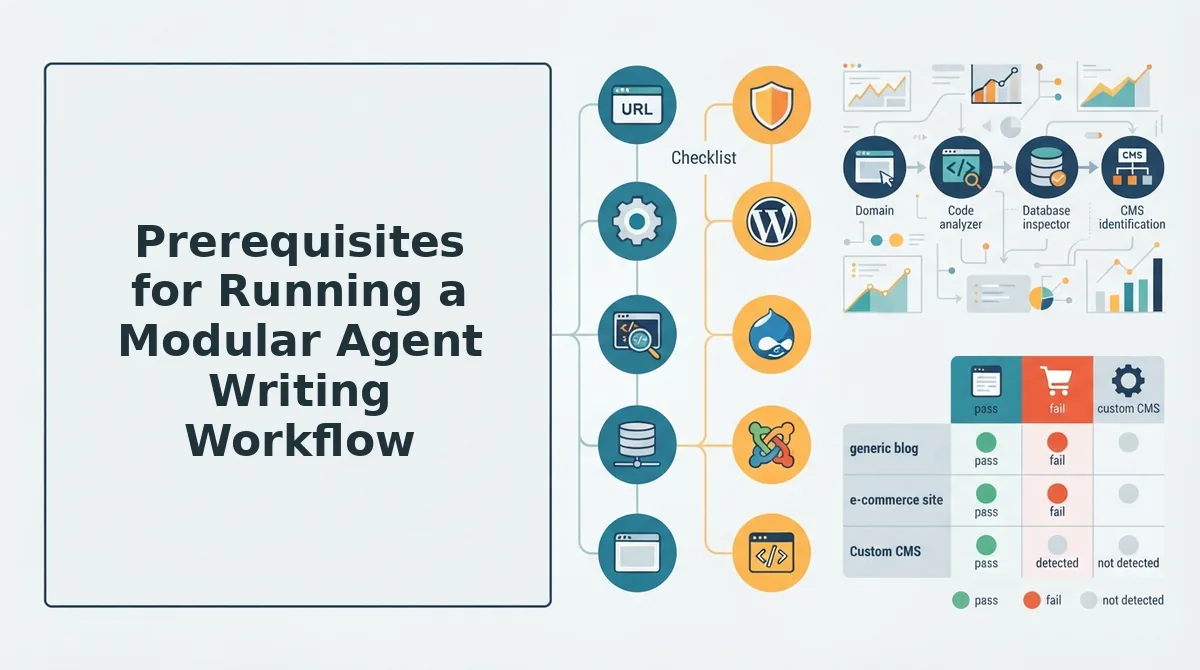
Prerequisites for Running a Modular Agent Writing Workflow
A modular agent writing workflow requires deterministic input files, structured data schemas, and section-level parameter limits rather than freeform conversational prompts. Without upfront grounding documents, autonomous drafting agents default to generic filler, repeated topic transitions, and conflicting stylistic assertions across subheadings.
A modular agent writing workflow is an automated architecture where discrete AI tasks draft individual content headings sequentially against strict contextual boundaries. Picture handing five freelance writers one chapter each without sharing an editorial guide or structural hierarchy. The resulting manuscript instantly disintegrates into fragmented prose. AI agents experience this exact structural breakdown without rigorous technical constraints.
Why do multi-agent publishing experiments collapse so quickly?
- Deterministic Brand Voice Blueprint (brand-voice.md): This core document sets tone rules, vocabulary constraints, and sentence rhythm targets in plain markdown format. It prevents autonomous agents from defaulting to corporate buzzwords and keeps technical terminology consistent across every heading. Place your style rules inside markdown brand context files so agents ingest formatting boundaries directly through system prompts before generating tokens.
- Structured JSON Outline Schema: This machine-readable file maps every heading, target search intent, section word count, and required entities before drafting begins. It eliminates structural ambiguity by giving each modular agent explicit start and end criteria for its assigned block. Build this blueprint using a strict JSON format with dedicated attributes for primary questions, target keywords, and visual asset placements.
- Section-Specific Search Constraints: These live data inputs deliver factual search engine result page signals and entity parameters relevant solely to a single subheading. Restricting research inputs to one section stops agents from prematurely answering downstream concepts in your introduction. Query your search API to pull top-ranking passages specifically for the immediate section query rather than the entire target keyword cluster.
- Negative Constraint Filter List: This explicit boundary catalog bans banned jargon, forbidden analogies, cliché transition sentences, and unverified data claims. It cuts robotic AI patterns by forcing the model to explain complex mechanisms using direct verbs rather than passive filler phrases. Maintain a plain-text negative blacklist file and inject it directly into the temperature parameter payload of every drafting call.
- Isolated Upstream Context Buffer: This localized memory cache feeds the agent only the concluding paragraph of the preceding section alongside the master outline. Passing entire monolithic transcripts causes context pollution and repetitive summaries across consecutive headings. Configure your runner script to prune historical conversational memory, forwarding only the final three sentences of the previous module as a transitional bridge.
With these foundational assets established, you can assemble the sequential engine that converts raw headings into finished prose.

How to Turn a Blog Outline into Modular Drafts Step by Step
To turn a blog outline into modular drafts, an AI system isolates each outline heading into a distinct generation prompt, enriches each node with localized research, and passes a rolling state buffer between steps to preserve continuity across seams. This sequential execution model eliminates context degradation, ensuring every subtopic receives dedicated model compute.
Picture this scenario: your agent has just drafted a 400-word technical section on crawl budgets, but the subsequent section on indexation limits re-explains the exact same crawl concepts from scratch. This context drift happens when agents generate sections in pure isolation without state handoffs.
A rolling state buffer is a persistent data packet that carries recent entity definitions, prior section summaries, and active keyword counts across generation cycles.
Before beginning, ensure you have an approved outline with defined H2 and H3 elements, your target keyword list, and your established voice parameters. To align these parameters automatically, you can automate brand voice in AI blog posts using structured context files.
- Decompose the master outline into isolated heading prompts (Time estimate: 2 minutes). Parse your document tree so each H2 heading and its nested H3 subheadings form an independent agent job ticket. You should see separate queue items for every section rather than a single generation prompt.
- Inject localized SERP research into each specific section payload (Time estimate: 3 minutes). Attach verified facts, relevant statistics, and target search intents directly to the assigned heading prompt instead of flooding the model with the entire document research brief. You should see each section prompt paired exclusively with its immediate subtopic citations.
- Pass the rolling state buffer from the completed section into the downstream prompt (Time estimate: 1 minute). When Section 2 finishes drafting, extract its concluding sentence, its key entities, and an 80-word summary, then append that payload to the input parameters of Section 3. You should see the subsequent draft acknowledge previous talking points without repeating their definitions.
- Run a cohesion stitching pass across section boundaries (Time estimate: 2 minutes). Scan the boundary text where the previous section ends and the new section begins, stripping redundant throat-clearing sentences and aligning transition vocabulary. You should see smooth structural bridges across every heading junction.
Consider this state handoff payload from Section 2 to Section 3:
Input Buffer: Previous H2: "Monolithic Prompts". Key entities declared: prompt window limits, hallucination rate. Last sentence: "These token limits force early assertions out of context."
Output Direction: Begin Section 3 ("Modular Drafting Agents") by referencing the token degradation established in Section 2, but prohibit re-defining token limits.
Instead of manually wiring sequential buffers and API calls, BloGoose handles this modular architecture automatically. The AI SEO content engine crawls your domain, drafts sectional content enriched by live SERP research, and publishes finished articles directly to your CMS.
Once your modular draft completes its initial pass, you must verify that tone and terminology remain steady across each seams.
How to Verify Cohesion and Troubleshoot Modular Drafting Drift
To verify cohesion and troubleshoot modular drafting drift, audit heading boundary sentences against your brand context rules, check entity consistency across subsections, and prune repetitive introductory recaps. How do you prevent independently generated content modules from feeling disjointed once stitched together?
Modular drafting drift is the gradual loss of narrative tone, logical continuity, or entity density that happens when AI agents generate content sections in isolation. Catching it requires a rapid verification protocol before publishing.
Prerequisites: A compiled draft assembled from your section runs, access to your brand context files (such as style-guide.md or entity lists), and your CMS preview interface.
- Open the full stitched preview to execute a 4-minute boundary transition audit. Read the final sentence of each section and the first sentence of the following header consecutively. You should see smooth conceptual bridges rather than abrupt resets or re-introductions of the primary topic.
- Scan the copy against your target keyword and entity list for 3 minutes. Verify that technical terminology and primary entities appear consistently across subheadings rather than alternating between mismatched synonyms. You should confirm identical entity usage across all modules.
- Select and isolate the opening paragraph of each modular subhead. Delete repetitive thesis statements, transitional filler, or generic setup clauses. You should see direct-answer leads immediately following every H2 tag.
Modular Drift Troubleshooting Matrix
- Boundary Intro Repetition: Caused by an unpruned system prompt passing entire article goals into localized workers. Fix this by injecting negative constraints that explicitly ban article-level thesis statements, introductory throat-clearing, and topic summaries in downstream sections.
- Tone Fluctuations: Caused by context window resetting between runs. Fix this by passing rigid tone exemplars directly into the module prompt so pragmatic, direct voice traits stay static across every subhead.
- Entity Gaps: Caused by missing upstream context. Fix this by feeding the previous section's concluding entity state into the current section worker to maintain topical continuity.
With your verification protocol active, specific procedural questions often arise about scaling modular generation across broader site structures.
Frequently Asked Questions About Section-by-Section AI Drafting
Section-by-section AI drafting isolates individual outline headings into separate agent runs, eliminating tone drift and structural collapse across long articles.
How long does section-by-section AI drafting take compared to monolithic prompts?
Running discrete prompts forces the model to verify style guidelines per heading, eliminating the heavy manual rewrites typical of single-prompt outputs.
How do AI agents maintain voice consistency across separate sections?
AI agents preserve voice consistency by ingesting brand context rules alongside dynamic summaries of preceding sections. Passing prior context prevents repetitive transitional phrases, enforces strict vocabulary constraints, and stops the model from regressing into generic filler across long guides.
Why does single-prompt AI generation fail to meet target section lengths?
Single-prompt generation fails because frontier models compress token budgets when generating entire outlines at once. Tasked with thousands of words simultaneously, the engine truncates technical explanations into shallow summaries. Drafting sections independently forces the AI to satisfy exact, paragraph-level depth requirements.
What inputs are required to run an automated modular drafting workflow?
Modular drafting requires three structured inputs configured before generation starts:
- A locked outline defining specific section targets and subtopics.
- A brand context document specifying formatting rules and voice constraints.
- A rolling memory buffer containing summaries of preceding sections to prevent overlap.
How does modular drafting improve search rankings and AI chatbot citations?
Modular drafting improves search performance by placing direct-answer definitions in the first sentence beneath every heading. AI answer engines reward isolated, factual statements that resolve search intent immediately without forcing systems to parse conversational preamble.
Connecting these isolated section prompts into an automated pipeline transforms individual drafts into a scalable production engine.
Scaling Your Blog Production with Autonomous Modular Pipelines
Autonomous modular pipelines scale organic search output by treating each heading as an isolated execution task rather than expecting monolithic prompts to sustain depth across an entire article. Most teams blame prompt phrasing for shallow output when the root cause is structural: single-pass generation inherently dilutes factual focus, producing repetitive filler that fails search intent.
Modular agents resolve this breakdown by maintaining strict context per section. This eliminates tedious prompt chaining and context drift, producing rank-ready articles built for Google rankings and answer-engine citations.
To transition from manual drafting loops into an autonomous pipeline, implement three practical steps:
- Extract brand voice rules and internal linking maps directly from your published sitemap.
- Isolate live research and drafting into bounded stages to prevent hallucinations.
- Route verified section outputs straight to your CMS via automated publishing endpoints.
BloGoose operationalizes this framework by crawling your website, establishing custom brand context files, and shipping citation-optimized content directly to WordPress or your custom API. Submit your domain into BloGoose to turn your site structure into a fully automated publishing engine.
Sustainable organic growth comes from enforcing strict context boundaries across modular pipelines, not from engineering longer prompts.