
Editorial queue pacing checklist for high volume blog cadence
An operations lead schedules 50 articles in a single morning, only to watch the publishing pipeline freeze under dozens of unreviewed drafts yielding zero search traffic. Generating draft volume is simple, but without structured pacing, editorial staging queues quickly collapse into gridlock.
Managing an AI SEO content engine requires operational checkpoints rather than unthrottled generation. This editorial queue pacing checklist outlines the exact pacing rules needed to balance review throughput, enforce voice rules, and maintain steady publishing velocity.
You will also discover why releasing drafts in synchronized topical clusters outperforms standard drip schedules, even when total monthly output remains identical. Note that this framework governs queue management for automated CMS workflows and does not replace human domain expertise.
Consider a publishing team integrating an autopilot content engine directly into WordPress:
- Situation: Automated drafting generates 30 queued posts weekly, creating an editorial backlog that stalls publishing for weeks.
- Action: The operator caps the active queue at five articles per batch, matching drafting triggers directly to completed review approvals.
- Outcome: Editors review every draft within 24 hours, brand guidelines stay enforced, and verified articles ship consistently to the CMS API.
To implement this level of operational control, teams must first dismantle the traditional scheduling assumptions that cause bottlenecks in the first place.
Why Content Calendars Fail and Editorial Queues Succeed
Content calendars fail during high-volume cadences because they enforce arbitrary calendar deadlines that push drafts forward regardless of editorial bandwidth. An editorial queue is a pull-based production system that advances content items across sequential workflow stages only when downstream review capacity becomes available.
Setting rigid calendar dates for automated drafting pipelines is the fastest route to editorial burnout. When high-volume generation runs into manual review limits, a static calendar creates an ever-growing backlog of overdue assignments. Think of a static calendar like an unthrottled factory conveyor belt dumping parts onto a workbench; the moment an inspector pauses to verify a complex assembly, unfinished inventory spills onto the floor.
An editorial queue solves this breakdown by enforcing dynamic pull-based queue mechanics that respect Work-In-Progress (WIP) limits across draft, edit, stage, and publish states. Under this model, an article only advances into review when an active slot opens. If the editing buffer reaches its strict capacity limit, upstream generation pauses automatically until the bottleneck clears. This operational guardrail protects human reviewers from volume spikes, eliminates deadline anxiety, and ensures every piece meets rigorous search standards before distribution.
Why does this workflow outperform date-based scheduling?
- Draft: Generates structured, search-optimized copy strictly up to the intake buffer limit.
- Edit: Subject-matter experts verify facts, style rules, and entity citations within a protected WIP ceiling.
- Stage: Formats ready drafts, populates structured metadata, and maps internal links for CMS integration.
- Publish: Releases staged articles into live production at a measured cadence without manual intervention.
Governing content delivery through operational capacity rather than calendar deadlines guarantees consistent output while preventing the quality degradation typical of high-volume publishing.
Once you transition from static deadlines to a capacity-driven queue, the next step is establishing your team's exact operational thresholds.
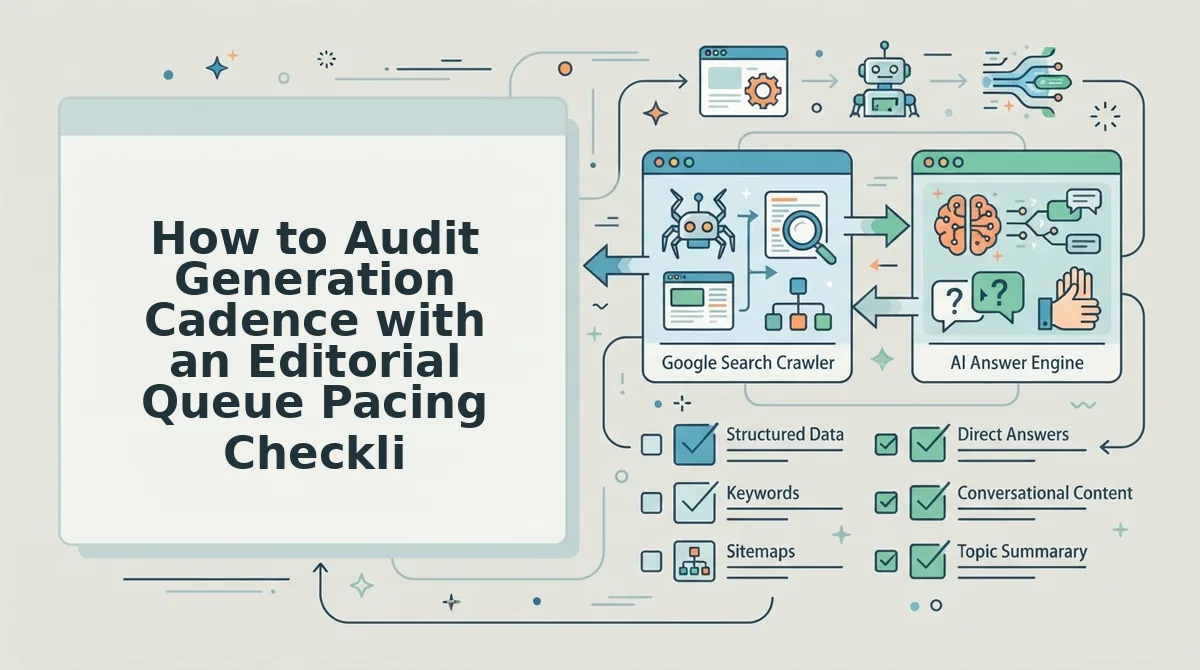
How to Audit Generation Cadence with an Editorial Queue Pacing Checklist
Auditing generation cadence against editorial capacity requires calculating your human review ceiling and throttling automated output to match that threshold before drafts back up. Aligning these two speeds prevents backlogs and stops unvetted AI copy from slipping straight to production.
What happens to editorial quality when automated drafting generates four times what your lead editor can read in a week? The queue breaks, spot-checks replace comprehensive line reviews, and hallucinated claims reach indexing queues.
An editorial QA ceiling is the maximum number of drafted posts an editor can verify for tone, entity precision, and internal linking structure without lowering review standards. A single full-time editor maintains a realistic review benchmark of 12-15 long-form articles per week before quality degradation occurs. Exceeding this benchmark guarantees editorial fatigue.
Before beginning this audit, gather your team's weekly production metrics, assign an editor to log review intervals, and define your weekly publishing target.
- Calculate your team's baseline review throughput (Time estimate: 20 minutes). Open your task tracker, select the past four weeks of review logs, and divide the total number of approved articles by the number of active editors. You should see an accurate weekly baseline, typically landing near the standard 12-15 articles per editor.
- Audit the automated drafting frequency in your engine settings (Time estimate: 10 minutes). Navigate to your content engine dashboard, click Schedule Settings, and check the automated draft generation rate across all connected pillars. If your platform generates 30 weekly drafts while your editing staff caps out at 15, mark that 15-post surplus as an immediate bottleneck.
- Throttle generation velocity to create an editorial buffer (Time estimate: 15 minutes). Select Cadence Controls, lower scheduled drafting runs to match your audited weekly ceiling, and toggle draft batching to release items in staggered groups. You should see an updated queue projection that never exceeds your team's 12-15 article capacity per review cycle.
- Establish a sandbox trial to measure throughput stress (Time estimate: 30 minutes). Queue a test run of drafts to monitor editorial turnaround under real publishing conditions. You can test 3 free articles to observe how quickly your reviewer clears fact-checking, styling adjustments, and layout previews. Success appears as clean approvals logged in under 45 minutes per piece.
Lock your automated pipeline to human review bandwidth. Sustainable publishing cadences protect indexing velocity without sacrificing editorial standards.
However, pacing drafting volume alone will not safeguard your organic performance if every approved piece targets the same transactional keyword.
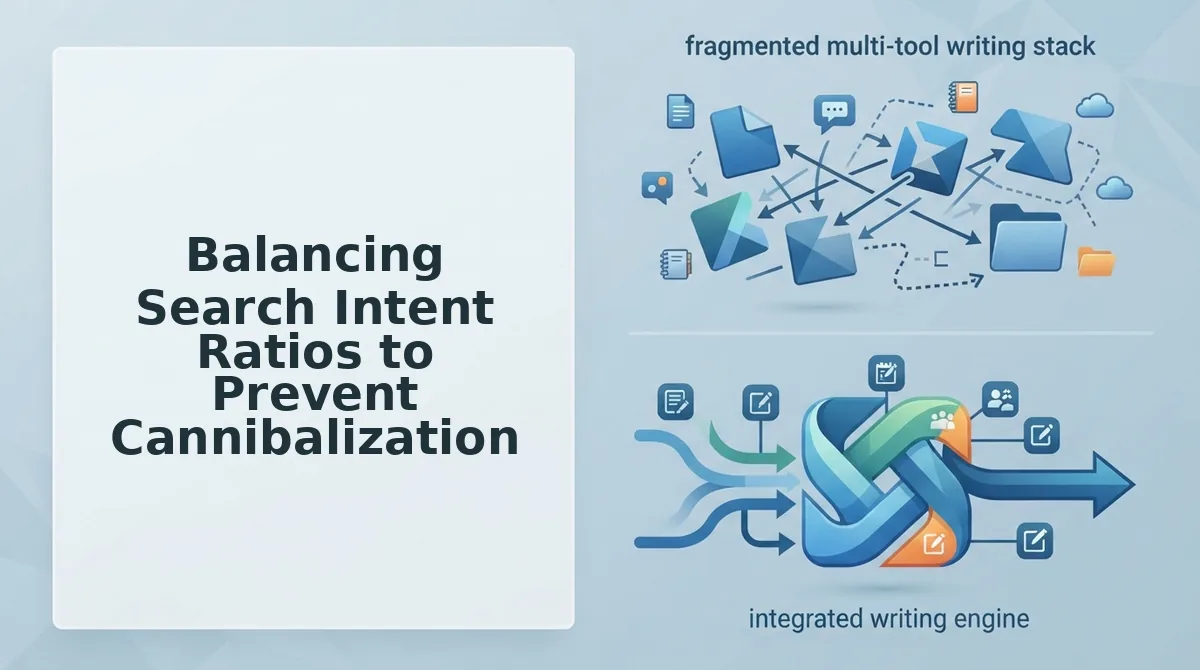
Balancing Search Intent Ratios to Prevent Cannibalization
Balancing search intent ratios in a high-volume blog queue requires distributing production across informational, commercial, and technical search queries rather than publishing repetitive variations of the same topic. Publishing five informational explainers on the identical subject in one week triggers algorithmic spam filters rather than topical authority. Keyword cannibalization is an organic search issue where multiple URLs on the same domain compete for identical search queries and split ranking equity. To prevent indexing penalties and ranking dilution, high-cadence queues must apply an explicit intent ratio framework across every batch.
Does accelerating publishing velocity automatically increase your organic visibility? Not when your queue floods search engines with duplicate intent.
- Allocate 60% of drafts to informational problem-solving: This tier focuses on foundational educational guides, conceptual overviews, and early-stage problem queries. It establishes comprehensive topical depth and captures high search volumes without exhausting commercial search queries. Schedule three informational assets for every two conversion-focused pieces when building new topic clusters.
- Assign 25% of drafts to commercial comparison: This category targets commercial investigation terms such as alternative audits, solution comparisons, and direct software evaluations. It captures high-intent buyers evaluating their final options and defends your category against competitor alternatives. Release these comparison assets sequentially only after the foundational educational guides are already live in your CMS.
- Reserve 15% of drafts to technical execution: This tier delivers precise workflows, API configurations, and step-by-step technical procedures. It provides the exact factual steps that AI answer engines extract for direct citations while capturing developer and operator search queries. Deploy these execution blueprints as authoritative technical endpoints that connect back to your broader strategic posts.
- Enforce semantic gap intervals between adjacent sprints: This counterintuitive safeguard mandates a strict multi-day buffer between articles that share closely related semantic entities. Releasing near-duplicate variations across consecutive days dilutes backlink authority, confuses crawl priority, and cannibalizes primary keywords. Audit your target keywords map before scheduling batch generation to space semantically similar drafts at least seven days apart.
Maintaining strict intent ratios across a high-cadence pipeline becomes unmanageable when coordinated through disconnected spreadsheets. BloGoose eliminates this friction as an autopilot SEO content engine, extracting brand rules from your XML sitemap, building balanced pillar calendars, and publishing rank-ready articles directly to WordPress or your custom API.
Even a perfectly balanced content mix will stall if your staged articles fail to register with search crawlers upon publication.
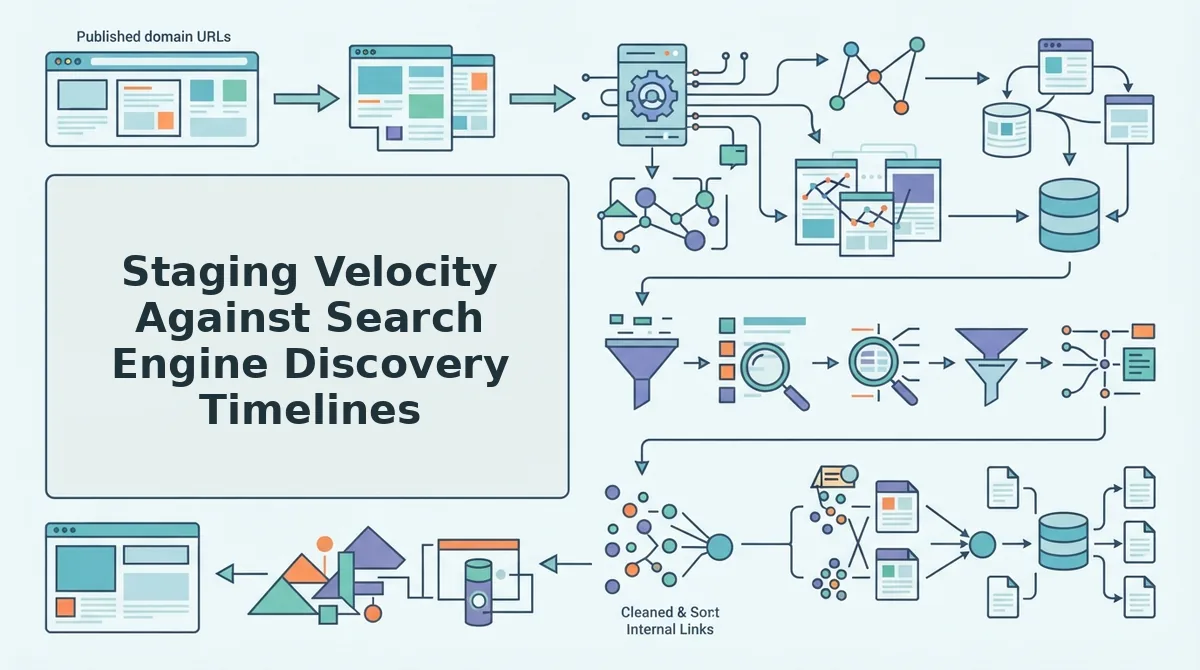
Staging Velocity Against Search Engine Discovery Timelines
Staging velocity must align directly with search discovery limits to prevent high-volume content queues from lingering unindexed. Without active discovery triggers, search engines rely solely on standard XML sitemap recrawls, which leaves recently published assets invisible for extended cycles.
Consider Gate 3 of your editorial pacing checklist: solving the ghost backlog. Pushing 100 posts to WordPress draft or scheduled status without webhook pings creates a false sense of output, as pages sit undetected by search crawlers for weeks.
A crawl budget is the total number of URLs search engine bots allocate to crawl on a domain before exiting. When editorial queues outpace crawler attention, bot visits are wasted on outdated files rather than fresh topical clusters.
Gate 3 requires synchronizing CMS publication with automated crawl requests. When you stage large topic clusters, passive XML sitemaps often take weeks to process. Using direct API endpoints to ask Google to crawl new posts instantly notifies search bots that fresh content is ready for evaluation. This process eliminates the ghost backlog where finished drafts sit dormant on your server, ensuring high-volume cadences translate directly into rapid indexation and timely organic ranking signals.
| Staging Method | Discovery Speed | Crawl Budget Impact | Best For |
|---|---|---|---|
| Immediate Webhook Indexing | Real-time bot requests within hours | High efficiency; directs crawlers strictly to new URLs | Best for rapid content clusters and solo operators |
| Scheduled Pacing | Batched bot visits distributed across days | Moderate; prevents server spikes by metering bot hits | Best for high-traffic enterprise portals |
| Manual Ping Intervals | Variable discovery lagging by several weeks | Low efficiency; relies on sporadic manual submission loops | Best for low-volume hobby sites under 2 posts monthly |
How should you decide which discovery path fits your pipeline?
- Choose Immediate Webhooks if you ship multi-article topic clusters and require immediate indexation without manual Search Console checks.
- Choose Scheduled Pacing if your hosting environment experiences performance drops under simultaneous bot and reader traffic.
- Choose Manual Pings if you publish on irregular schedules and lack automated CMS webhooks.
Our recommendation: Implement scheduled staging coupled with automated webhook pings. This combination maintains consistent reader-facing publishing intervals while ensuring search engines register every new live URL the moment it transitions from draft to published.
With discovery mechanisms active, you need a quantifiable formula to monitor pipeline health and anticipate clearance horizons before bottlenecks re-emerge.
How to Calculate Pipeline Velocity and Clear Editorial Backlogs
To calculate pipeline velocity and clear editorial backlogs, divide the total volume of pending drafts by your weekly editorial review capacity and multiply the result by seven. Pipeline velocity is the operational speed at which queued content moves from initial generation to scheduled publication. Calculating this metric prevents production stalls where unreviewed drafts accumulate faster than editors can verify factual accuracy. By converting raw draft inventory into an exact clearance timeline, teams can pause generation before staging queues decay.
Queue Velocity (Days) = (Total Backlog in Draft / Weekly Editorial QA Capacity) * 7
Before running the calculation, gather two required data points: your exact count of unpublished drafts in staging and your verified weekly review capacity.
- Open your CMS dashboard or staging repository to record every article currently awaiting review. Count all completed drafts that lack final editorial sign-off. You should see a single, verified draft tally representing your active queue (Time: 30 seconds).
- Type your team's tested editorial review capacity into your tracking spreadsheet. Record the realistic number of articles a reviewer can audit for voice, citations, and layout each week without lowering standards. You should see a stable throughput baseline (Time: 30 seconds).
- Calculate the clearance horizon using the queue velocity formula. Divide your draft backlog by your weekly review ceiling, then multiply by seven. You should see the exact number of days required to drain inventory before scheduling new generation runs (Time: 30 seconds).
- Select your CMS integration controls to configure your WordPress publishing setup. Connect verified drafts directly into automated scheduling slots to eliminate manual copy-paste handling. You should see approved articles move directly to scheduled status.
Consider an agency holding 42 stalled drafts in staging with a confirmed editorial QA capacity of 14 articles per week. Applying the formula, (42 / 14) * 7, reveals an exact 21-day backlog horizon. Recognizing that review bandwidth is committed for three weeks, the operator halts new generation runs to focus resources exclusively on processing the queued articles. By routing cleared pieces through automated CMS scheduling, the team eliminates the 42-post backlog in 21 days without editorial burnout or missed indexing cycles.
Understanding these mathematical thresholds helps teams resolve the most common operational questions that arise during high-volume production.
Frequently Asked Questions About Editorial Queue Pacing
Editorial queue pacing balances raw drafting volume with editorial review capacity and search crawl thresholds. A team generating 50 drafts weekly often publishes only 10. Why? Review bottlenecks choke unpaced pipelines.
How many articles can an editor review each week without quality dipping?
A solo editor can thoroughly review 15 to 25 articles per week before quality drops. Exceeding this limit causes hallucinated facts, missed internal links, and voice drift. High-output teams protect quality by automating technical checks and structural formatting before human QA begins.
How does publishing velocity impact crawl budget?
Rapid publishing spikes force search engines to spend crawl budget on URL discovery rather than page rendering. When publishing velocity outpaces domain authority, indexing delays accumulate. Consistent pacing ensures search engine bots crawl, render, and index new content clusters predictably without exhausting server resources.
Why does an editorial queue develop a production backlog?
Production backlogs occur when draft creation outpaces manual editorial review and CMS staging capacity. Generating text takes seconds, but factual verification, schema validation, and layout checks require human oversight. Backlogs expand rapidly unless teams enforce strict work-in-progress limits across their review stages.
How do publishers safely clear an editorial backlog?
Publishers clear backlogs by releasing staged drafts in scheduled daily tranches instead of bulk publishing. Dumping hundreds of URLs at once triggers crawler throttling. Stagger releases across predictable daily intervals, publish clustered topic sets together, and archive stale drafts that no longer match search intent.
What is the ideal buffer size for an editorial queue?
The ideal buffer size is a two-week reserve of fully approved, scheduled articles. A two-week queue provides adequate protection against operational disruptions without letting staged drafts turn obsolete. Larger buffers create maintenance waste when search intent or product positioning changes before publication.
Equipped with clear operational benchmarks, you can now automate the entire progression from drafting to indexing.
Put Your High-Volume Publishing Queue on Autopilot
Maintaining a high-volume publishing cadence requires synchronizing production throughput directly with editorial verification thresholds rather than relying on arbitrary calendar deadlines. When drafting outpaces review capacity, unvetted backlogs accumulate and internal linking integrity deteriorates.
Are you ready to scale publishing without your content review pipeline collapsing under its own weight?
Resolving queue congestion requires three operational controls to keep content flowing from research to indexation:
- Enforce strict generation caps: Cap draft creation at your team's documented QA ceiling to keep editorial review buffers stable.
- Balance search intent ratios: Audit topic batches across informational, commercial, and comparison intents to prevent keyword cannibalization across concurrent clusters.
- Automate CMS staging: Eliminate manual formatting loops by pushing fully structured, citation-ready posts straight to WordPress or your custom API.
To remove operational bottlenecks, submit your website domain to BloGoose's AI-powered SEO content engine to extract brand context directly from your XML sitemap and ship publish-ready articles directly to your CMS.
Sustainable publishing velocity is determined by the speed of your editorial validation pipeline, not the raw volume of drafts your tools generate.