
How do you extract brand tone from blog archives easily
Your blog's voice is drifting, and you can feel it. One post reads like a sharp, opinionated founder; the next sounds like a cautious corporate memo. As one workshop insight put it, website copy "starts strong in one place and slowly drifts everywhere else." You're not imagining it: most teams never systematically extract brand tone from blog archives, so every new writer or AI tool adds another layer of drift.
You're right to want a fix. Here's the promise: by the end of this article, you'll have a repeatable 5-step protocol for extracting tone from your existing posts, no vague "just read your content" advice. We'll cover collecting a representative sample, normalizing text, tagging measurable tone features, building a tone profile, and applying it to new drafts.
Along the way, you'll discover why a publisher with 200 posts saw tone patterns stabilize only after roughly 18 posts, a finding that changes how you sample. And if you'd rather skip the manual work entirely, an AI SEO content engine can crawl your site and extract brand voice rules automatically.
Step 1: Collect a Representative Archive Sample
You need at least 15 - 20 posts or 8,000 - 10,000 words before tone patterns become statistically stable, smaller samples produce misleading results. One publisher with 200 posts found tone patterns only stabilized after roughly 18 posts, so don't shortcut this step.
Prerequisites: Access to your blog's CMS export tool or sitemap, a spreadsheet, and 20 - 30 minutes.
- Open your CMS export panel (WordPress: Tools to Export; Ghost: Labs to Export). Select "All content" and download the JSON or CSV file. You should see a file appear in your downloads folder within seconds.
- Filter to published posts only, exclude drafts, pages, and landing pages. Sort by publication date, newest first. This removes non-blog content that would contaminate your sample.
- Select every third post from the date-sorted list until you reach 15 - 20 posts. Skipping every other post prevents recency bias and captures tone across different writers, topics, and periods.
- Copy the post body text into a plain-text file, one post per section, labeled with its date and author. You should end with a single .txt file containing 8,000 - 10,000 words.
- Verify the word count using your text editor's word counter. If you're under 8,000 words, add more posts until you cross the threshold, tone features like sentence rhythm and transition habits need volume to surface.
This sample-size question is the one most tone guides skip: 15 - 20 posts or 8,000 - 10,000 words is the minimum threshold where recurring tone features stop looking like one-off author quirks and start looking like brand patterns.
Step 2: Normalize the Text for Analysis
Normalization strips non-voice elements from your sample so tone features aren't contaminated by formatting artifacts. Skip this step and your tone profile will describe your CTA buttons, not your writing voice.
Prerequisites: Your plain-text sample from Step 1 and a text editor with find-and-replace.
- Open your sample file in any plain-text editor (VS Code, Notepad++, or TextEdit in plain-text mode). You should see only raw post text with no HTML tags.
- Delete all headers and subheaders. H1s, H2s, H3s. Headers are structural, not tonal, and they skew your analysis toward title-case phrasing.
- Strip every CTA block, "Subscribe now," "Book a demo," "Download the guide." CTAs use conversion language that rarely reflects your editorial voice.
- Remove image captions and alt text. Captions are written for search engines and skimmers, not for tone consistency.
- Delete boilerplate, author bios, disclosure statements, "Originally published on" lines, and footer text. These repeat verbatim across posts and inflate word-frequency counts.
- Run a find-and-replace for double spaces, smart quotes, and em-dashes to standardize punctuation. You should see a clean, continuous block of prose with no structural elements remaining.
Here's where most tone audits go wrong: they feed raw HTML exports into analysis tools and end up tagging "Click here" and "Written by" as brand voice features. Normalization removes that noise before you measure anything.
With clean text in hand, you're ready to move to Step 3: Tag Measurable Tone Features.
Step 3: Tag Measurable Tone Features
Tone features are the countable linguistic signals in your writing, sentence length, punctuation habits, pronoun choices, and word-class ratios, that together form a measurable fingerprint of your brand voice. Tagging them turns vague impressions like "we sound friendly" into data you can replicate, audit, and hand to any writer or AI tool.
Think of tone features like the ingredients on a nutrition label. You can't taste "12 grams of sugar" in a granola bar, but once the label exists, you can compare products, spot drift, and reproduce the recipe. The same applies to voice: individual word choices feel intuitive, but their aggregate patterns are what make your content recognizable.
Start with a simple pass over your normalized archive sample. Read 10 - 15 posts and mark anything that repeats: sentence fragments, em-dashes, first-person plural, rhetorical questions. Then move to an intermediate pass where you count features per 100 words. Finally, run an advanced pass using a spreadsheet or a tool like BloGoose's brand context extraction, which automates feature detection across your full archive.
The 7-Feature Tone Checklist
| Feature | Example Value | What It Reveals |
|---|---|---|
| Sentence length | 14 words average | Short = punchy, direct; long = analytical, formal |
| Punctuation density | 2.1 marks per sentence | High em-dash/colon use = conversational asides; low = clipped, declarative |
| Pronoun stance | "We" 3x more than "I" | First-person plural = team voice; second-person "you" = reader-focused |
| Modal verbs | "Can" and "will" dominant; rare "must" | Permissive modals = approachable; obligatory modals = authoritative, strict |
| Adjective-to-verb ratio | 0.6 adjectives per verb | Verb-heavy = action-oriented; adjective-heavy = descriptive, sensory |
| Contraction rate | 78% of possible contractions used | High = casual, spoken; low = formal, institutional |
| Sentence opener variety | Under 20% start with "The" or "It" | Varied openers = rhythm and engagement; repetitive = flat, templated |
Each feature answers a specific diagnostic question. Contraction rate, for example, tells you whether your archive reads like a conversation or a white paper. Modal verbs work the same way: a brand that says "you can export your data" positions itself as permissive and helpful, while one that says "you must configure the API key" signals strict procedural authority. Adjective-to-verb ratio reveals whether your content describes states or drives action. A ratio under 0.7 means verbs dominate, your archive is doing things, not decorating them. Above 1.2, and your voice leans descriptive and atmospheric, which suits lifestyle content but slows down technical writing.
Record one example value per feature for your archive. These numbers become the thresholds you codify in the next step, and the guardrails that keep future posts sounding like you, not like a generic AI default.
Step 4: Cluster Patterns into Tone Rules
Clustering converts your tagged feature data into codified voice rules, explicit "we do this, never that" statements any writer or AI can follow. Observation is useless without codification: a spreadsheet full of counts means nothing until you translate the patterns into prescriptive language.
Prerequisites: your completed 7-feature checklist from Step 3, plus a text editor or style-guide document.
- Group your feature values by similarity. Sort the 7 features into clusters, casual signals (contraction rate, pronoun stance, sentence length) versus structural signals (punctuation density, opener variety, adjective-to-verb ratio). You should see 2 - 3 natural groupings emerge in about 10 minutes.
- Write one rule per cluster using the "We use X, never Y" template. For example: "We use contractions in 70%+ of possible cases, never formal expansions like 'do not' or 'cannot.'" Each rule takes 2 - 3 minutes to draft.
- Test each rule against 5 random archive posts. Read the posts and check whether the rule holds. If a rule fails on 2 or more posts, split it into two narrower rules. Expect this pass to take 15 minutes.
- Add a rationale line under each rule. State why the pattern exists, "short sentences keep setup steps scannable", so future editors can judge edge cases. You should end with 5 - 8 rules total.
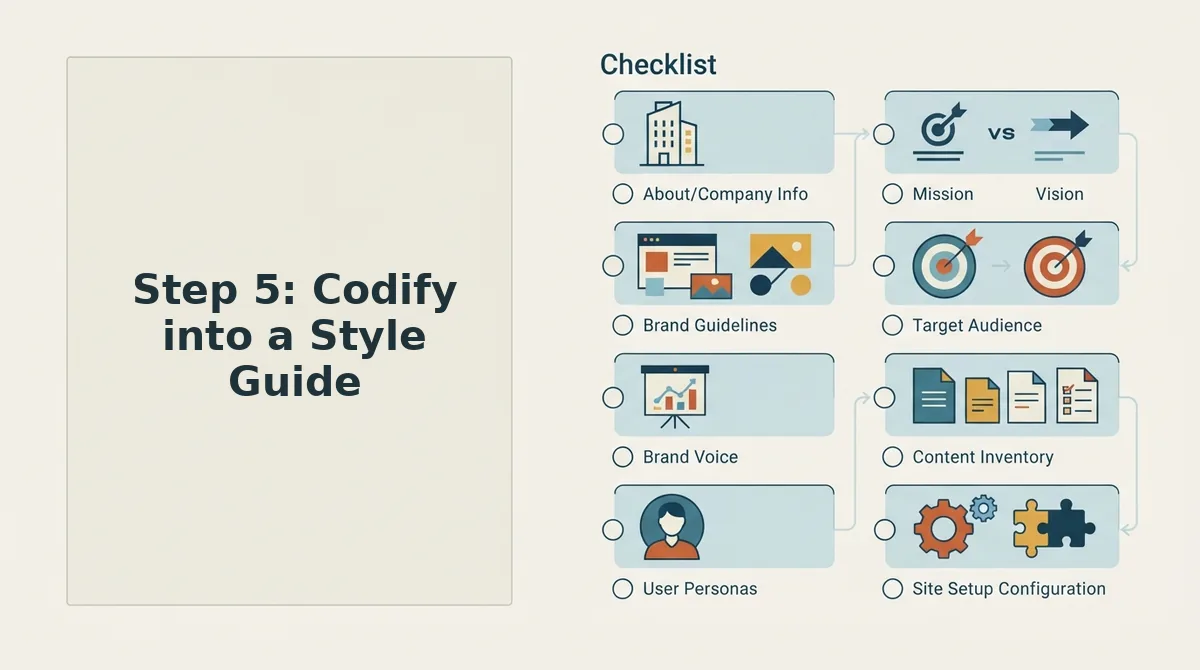
Step 5: Codify into a Style Guide
Codifying means writing your clustered tone rules into a reusable style guide document, a single reference that keeps every future post, writer, and AI prompt aligned to your archive's voice. Without this step, tone extraction stays trapped in your head.
Prerequisites: your clustered rules from Step 4, plus a shared document tool (Google Docs, Notion, or a CMS page).
- Create a "Voice Principles" section. Write 3 - 5 short sentences summarizing the personality your archive projects, for example, "Direct but warm: we explain before we persuade." This takes 10 minutes and anchors every rule that follows.
- Add a "Do / Don't" examples table. For each rule, paste one real sentence from your archive as the "Do" and rewrite it against the rule as the "Don't." You should have 5 - 8 paired examples in 20 minutes.
- List feature thresholds as numbers. Record the target ranges from Step 3, sentence length, contraction rate, adjective-to-verb ratio, so the guide is checkable, not just descriptive. A 5-minute copy-paste from your checklist.
- Publish the guide where your publishing workflow can reach it. If you use an automated pipeline, connect the guide as the voice reference. BloGoose can generate a markdown style guide from your website and apply it to every drafted article automatically. You should see consistent tone across new posts within one publishing cycle.
With your style guide live, every new article inherits the archive's voice instead of guessing at it. But archives are rarely uniform, next, handle the posts that break your own rules.
What to Do When Your Archive Has Tone Drift
Tone drift happens when early posts and recent posts score differently on your measurable features. You need a detection checklist and a normalization strategy before you codify rules.
Prerequisites: A normalized archive from Step 2, your tagged feature scores from Step 3, and a spreadsheet or the BloGoose brand context extractor.
- Split your archive into two halves by publish date. Open your spreadsheet and label the earliest 50% of posts "Early" and the latest 50% "Recent." You should see two clearly separated date ranges.
- Compare the 7 measurable tone features across both halves. Select each feature column and calculate the average score for Early vs. Recent. Flag any feature where the difference exceeds 15%. You should see a drift scorecard with highlighted cells.
- Identify the dominant cluster as your baseline. Click the cluster with the highest post count across the full archive. This is the tone your brand actually uses most. You should see one cluster covering at least 60% of posts.
- Document exceptions instead of averaging them. Type a short note for each drifted feature: "Recent posts use 40% more contractions, keep contractions, drop the 2019 formal phrasing." You should have a one-page exception list.
- Re-run your clustering with the baseline locked. Upload the exception list to your style guide draft. Future posts should match the baseline cluster, not the drifted outliers. You should see consistent tone scores on your next three drafts.
FAQ: Extracting Brand Tone from Blog Archives
Direct answers to the most common questions about pulling brand voice from existing content.
How do I analyze writing style from blog posts?
Tag measurable features across a sample of posts: sentence length, contraction rate, pronoun usage, emotional valence, jargon density, and punctuation patterns. Cluster the tagged posts into groups with similar feature scores. The dominant cluster is your writing style. This takes roughly 2 - 3 hours for a 20-post sample.
Why does brand voice consistency matter for SEO?
Consistent tone signals topical authority and improves reader trust, which correlates with longer dwell time and lower bounce rates. AI answer engines also cite content with stable, recognizable voice patterns more reliably than erratic tone. Consistency makes your brand quotable.
Can you automate brand tone extraction?
Yes. Tools like BloGoose crawl your sitemap, extract brand voice rules from published pages, and apply those rules to new drafts automatically. Manual tagging works for small archives, but automation removes the spreadsheet step and scales to hundreds of posts without drift.
How many blog posts do you need to extract brand tone?
A minimum of 20 posts is enough to detect stable patterns. Fewer than 10 posts produces unreliable clusters because outliers dominate the averages. For archives over 100 posts, sample 20 - 30 posts evenly spaced across the publish timeline to capture drift.
What if my blog has multiple authors with different tones?
Cluster posts by author first, then extract tone rules per author. Identify the shared features across all authors as the brand baseline. Document author-specific exceptions separately so each voice stays recognizable without breaking the overall brand.
Start Extracting Your Brand Tone Today
The five-step protocol, collect, normalize, tag, cluster, codify, turns any blog archive into a repeatable brand voice system in about half a day. The real payoff is not the style guide; it is the compounding consistency that makes your content quotable in AI answers and trusted by readers.
Start with a 20-post sample from your archive and run the drift-detection checklist before you write a single rule. Once your manual protocol works, scale it by connecting your site to the AI SEO content engine at BloGoose, which crawls your sitemap and extracts brand context automatically for every new article.
Your archive already contains the voice your audience recognizes. Extract it once, codify it, and let every future post sound unmistakably like you.