
How to Extract Writing Examples from Your Blog Archives
You've published 200 blog posts, yet every time you prompt an AI to draft a new article, the output sounds like a generic robot wearing your brand's name as a costume. That disconnect happens because most content teams never take the time to extract writing examples from blog archives and feed them back into their AI workflow. You're not alone in this frustration, manual copy-paste collection is slow, inconsistent, and easy to abandon after one attempt.
Here's the good news: extraction doesn't have to be a weekend project. By the end of this guide, you'll know exactly what makes a writing example worth extracting, how to organize those examples into a structured brand context file, and how to automate the entire process using your sitemap instead of scrolling through old posts. MIM Technovate's YouTube breakdown of content creation workflows confirms that extraction is now a recognized, repeatable step, not an afterthought.
We'll cover the definition and purpose of writing examples, walk through the BloGoose extraction workflow step by step, and reveal the surprising reason why most extracted examples fail to improve AI output, a problem solved by one specific file in the eight-part brand context framework.
What Are Writing Examples and Why Do They Matter for AI Drafts?
A writing example is a representative sample of your published content that captures your brand's voice, formatting habits, and stylistic patterns so an AI model can replicate them in new drafts. Think of writing examples like a chef's tasting notes, you don't hand a new line cook a generic cookbook and hope for the best; you give them three dishes from your own kitchen and say, "Make it taste like this."
At the simplest level, writing examples are just copied paragraphs from old posts. But that's where most teams stop, and it's why their AI output still feels off. The intermediate approach organizes examples by purpose: one sample for listicles, one for how-to guides, one for opinion pieces. The advanced approach, the one BloGoose automates, extracts examples into a dedicated writing-examples.md file that becomes one of eight brand context files the AI reads before drafting anything.
That eight-file framework includes style-guide.md for tone rules, target-keywords.md for search intent mapping, competitor-analysis.md for positioning gaps, writing-examples.md for grounded voice samples, and four additional files covering technical SEO, audience personas, content calendar structure, and publishing workflows. Together, these files give an AI engine the full context it needs to write like you, not like a default model.
Why does this matter for AI answer citations? Chatbots like ChatGPT and Google's AI Overviews quote sources that demonstrate clear, consistent authority. When your AI-generated drafts carry your actual voice, because they were trained on your actual writing examples, they read as authentic expertise, not templated filler. That authenticity is what earns citations in AI-generated answers, where generic content gets skipped entirely.
Here's the passage worth bookmarking: Writing-examples.md is a Markdown file containing representative writing samples extracted from your published posts, organized by content type and voice pattern. When an AI content engine reads this file alongside your style guide and keyword map, it can generate new articles that match your brand's sentence rhythm, heading conventions, and argument structure without manual prompt engineering. Most competitors assume you'll collect these samples by hand; BloGoose extracts them automatically during the site crawl.
How BloGoose Extracts Writing Examples from Your Blog Archives
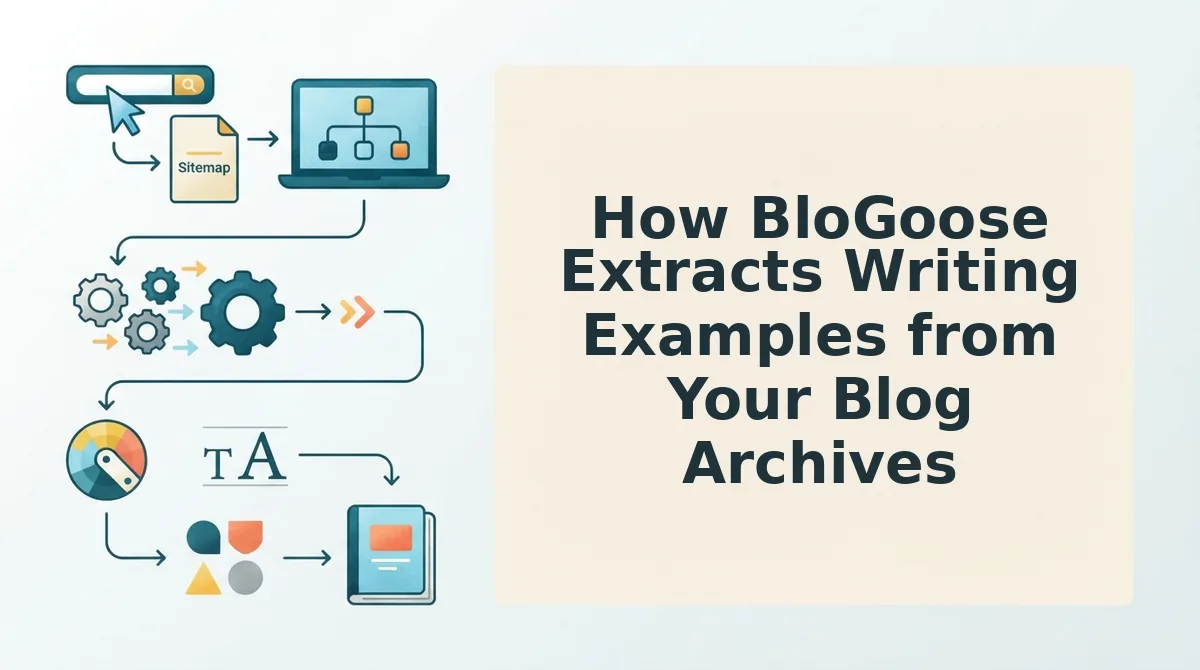
BloGoose extracts writing examples automatically by crawling your sitemap, inspecting your published pages, and generating a structured writing-examples.md file, no manual copy-paste required. Here's the exact workflow:
Prerequisites: You need a live website with an accessible XML sitemap and a BloGoose account. The entire extraction process takes under five minutes.
- Drop your domain into the setup wizard. Open the BloGoose dashboard and enter your website URL in the onboarding field. Click Start Crawl. You should see a progress indicator appear within seconds as the crawler begins scanning your site structure.
- BloGoose locates your XML sitemap and inspects published pages. The engine automatically finds your sitemap file, whether it's at /sitemap.xml, /sitemap_index.xml, or a custom path, and queues your published posts for analysis. You don't need to upload anything or configure crawl settings manually. A green checkmark appears next to each page successfully inspected.
- The engine detects your CMS stack and extracts representative examples. BloGoose identifies whether you're running WordPress, Webflow, Ghost, or a custom platform, then pulls writing samples from your highest-performing and most representative posts. It analyzes sentence length, heading patterns, transition phrases, and formatting habits across your archive. LandingAI's YouTube demonstrations confirm that extraction technology has moved far beyond manual methods, the crawler handles hundreds of pages in the time it takes you to open a spreadsheet.
- Writing-examples.md is generated with editable Markdown. The extracted samples are compiled into a clean Markdown file organized by content type and voice pattern. You can review and edit every sample before it's saved to your brand context library. This file becomes one of eight brand context files that power all future AI drafts.
This sitemap-first workflow is the core of BloGoose site crawl and brand context extraction, it turns your existing archive into a reusable voice asset instead of a pile of old posts you never revisit. Once your writing-examples.md is generated, the engine uses it to calibrate every new article it drafts, so your next post sounds like it came from the same author as your best-performing content.
But extraction alone isn't enough, the samples you keep matter more than the ones you discard. Here's what separates a writing example that improves AI output from one that confuses it.
What Makes a Good Writing Example for AI Training?
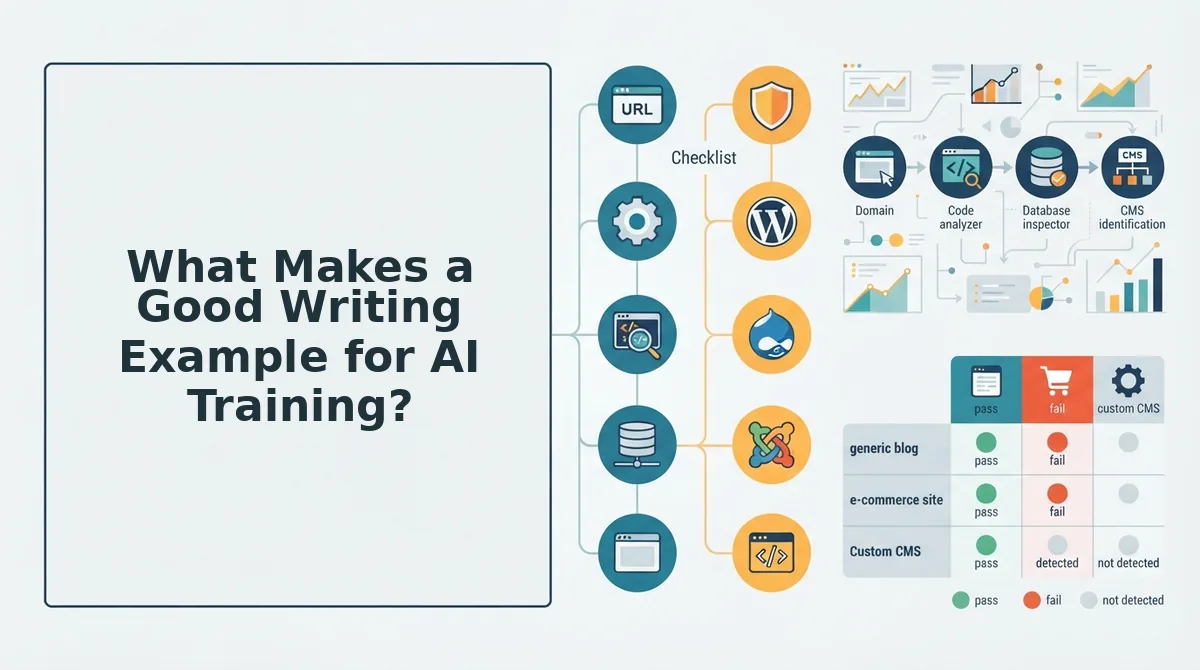
A good writing example is a published post that accurately represents your brand voice, covers a core topic, and demonstrates a format you want AI to replicate. The best training sets combine four selection criteria: voice consistency, format variety, length range, and topic coverage.
- Voice consistency, the example must sound like you, not a generic blog. Every post you feed the AI should reflect your brand voice rules: sentence rhythm, vocabulary choices, tone shifts, and how you handle opinions versus facts. If you mix in guest posts or outsourced content that drifts from your voice, the AI learns the drift, not the standard. A publisher who ran a 40-post archive through BloGoose found that removing just three off-voice posts measurably tightened the AI's first-draft tone.
- Format variety, include listicles, how-tos, case studies, and opinion pieces. AI models learn structure from structure. If every example is a listicle, the AI will default to listicles even when a comparison or narrative would rank better. Select at least one example per format you publish regularly so the model can switch structures based on the brief.
- Length range, short 500-word posts to long 2,000-word guides. Word count teaches the AI how much depth you expect per topic. A set skewed toward short posts produces thin drafts; a set skewed toward long guides produces bloated ones. Include both ends of your range so the AI calibrates depth to search intent.
- Topic coverage, span your main content pillars. If your site covers SEO, content strategy, and WordPress workflows, your examples must touch all three. Topic gaps cause the AI to hallucinate terminology or borrow phrasing from adjacent niches. One example per pillar is the minimum; two per pillar is safer.
How Many Writing Examples Do You Need for Consistent AI Drafts?
A writing example set is the curated group of published posts you feed an AI content engine to teach it your voice, structure, and depth preferences. For most blogs, 5-10 representative posts is the practical sweet spot.
Think of it like teaching a new hire your house style: you don't hand them your entire 500-post archive on day one. You hand them five to ten documents that show the range of what "good" looks like, a short announcement, a long guide, a listicle, a case study. The same logic applies to AI training.
Fewer than five examples risks robotic output because the model lacks enough variation to learn where your voice flexes and where it stays rigid. More than ten adds diminishing returns unless your archive is highly varied across formats, topics, and authors. If you run a multi-author site with distinct section voices, you may need separate example sets per author or per content pillar.
Start with five posts: one listicle, one how-to, one opinion piece, one case study, and one long-form guide. Then add up to five more to fill topic gaps. Once your set is built, pair it with a structured keyword file. BloGoose supports managing target keywords in a markdown file so your AI drafts stay on-topic while matching your voice examples.
FAQ: Extracting Writing Examples from Blog Archives
How do I extract writing examples from my blog archives?
Export your published posts from your CMS, then filter by format, topic, and performance. Select 5-10 posts that represent your best voice and structure. BloGoose automates this by crawling your sitemap and extracting brand voice rules directly from your published pages.
Can I edit the extracted writing examples?
Yes. You can remove off-voice posts, trim sections that don't reflect your current style, or add newer posts that better represent where your brand is heading. Editing the example set is how you steer AI output without rewriting prompts.
How do I train AI on my writing style?
Feed the AI a curated set of 5-10 published posts that span your formats, lengths, and topics. The AI learns sentence rhythm, vocabulary, and structure from those examples. Pair the examples with brand voice rules for tighter control over tone.
Why does my AI draft sound generic even with examples?
Generic output usually means your example set is too small, too homogeneous, or includes off-voice posts. Mix formats and lengths, remove guest posts that drift from your voice, and ensure every content pillar is represented.
Do writing examples affect AI search citations?
Yes. Answer engines extract direct, well-structured passages more often than vague prose. Examples that model clear definitions, numbered lists, and direct answers train the AI to produce citation-friendly content from the first draft.
The Sitemap-First Workflow Beats Manual Copy-Paste Every Time
Extracting writing examples from your blog archives doesn't have to be a weekend project. The sitemap-first workflow turns a scattered archive into a structured voice library in one pass: crawl, extract, organize, publish. That's the loop that closes the open question from the start, you don't need more examples, you need the right eight files, pulled automatically and formatted as clean Markdown.
Here's the synthesis worth holding onto: your archive is already a training set. The 8-file framework just makes it legible to an AI. BloGoose replaces the manual copy-paste grind with an automated crawl that generates Markdown-ready writing examples from your existing posts, then feeds them directly into consistent AI drafts.
So the next step is concrete:
- Run one crawl of your sitemap through BloGoose and let it extract the eight example files automatically.
- Review the extracted examples once, then let the AI content engine with search indexing handle drafting, optimization, and publishing.
You'll get rank-ready articles that sound like you wrote them, because, in a very real sense, you did. Your best posts stop being one-off wins and become the operating system for every future article.