
How to Find Content Gaps from Live SERP Analysis
You've spent hours staring at page-one results, cross-referencing competitor URLs, and still can't articulate why your content refuses to move past position 12. That's the reality for most publishers trying to find content gaps from live SERP analysis without a repeatable framework, and it's exactly why a Rank Math video on the topic pulls 9,453 views yet leaves viewers without a single gap-specific method.
You're not wrong to feel stuck. Most gap-analysis advice assumes you already pay for Ahrefs, Semrush, or another premium suite. This article doesn't. You'll learn a manual, free, five-signal checklist you can run against any live SERP in under 20 minutes, no paid tool access required.
Here's the roadmap: first, we'll define what a content gap actually is (and isn't), then break down the five signals that expose it, and finally show you how to read a live SERP manually. One of those signals reveals a gap type almost every competitor overlooks, and it's hiding in plain sight on every results page you've already analyzed. Platforms like BloGoose automate this detection at scale, but understanding the manual method first makes any tool output sharper.
What Is a Content Gap (and What It Isn't)?
A content gap is any question, angle, subtopic, or evidence type that the current top-ranking SERP fails to adequately answer, despite clear searcher demand for it. It is not simply a keyword you haven't targeted yet.
Think of a SERP like a restaurant menu. A keyword gap is a dish missing from your menu that competitors serve. A content gap is a dish every restaurant on the street serves poorly, undercooked, missing ingredients, or mislabeled, leaving hungry customers unsatisfied no matter where they sit down. You win not by adding another mediocre version, but by serving the dish correctly.
This distinction matters because most tools conflate the two. Ahrefs, for example, covers keyword gaps and page-level gaps in separate videos but never contrasts them side by side. That leaves practitioners treating "we don't rank for X" and "nobody answers X well" as the same problem. They aren't. The first is a targeting issue solved with new pages. The second is a quality issue solved with better pages, and it's where live SERP analysis delivers its highest return.
At the intermediate level, you should evaluate gaps across three dimensions: intent coverage (does the SERP serve the searcher's actual goal?), depth coverage (are required subtopics present?), and trust coverage (do results demonstrate first-hand experience or primary sources?). A gap exists when any dimension fails while demand persists.
Advanced practitioners add a fourth dimension: freshness coverage. A SERP can rank pages that were comprehensive in 2024 but now cite outdated statistics, deprecated features, or superseded guidance. That staleness is itself a content gap, searchers need current answers, and the SERP isn't providing them.
Here's a self-contained answer to a query you'll likely type next: What is the difference between a content gap and a keyword gap? A keyword gap is a search term your site doesn't target but competitors do, it's about missing pages. A content gap is a question, angle, or evidence type the current top-ranking results collectively fail to answer well, it's about missing substance. You can close a keyword gap by publishing any page targeting that term. You can only close a content gap by publishing a page that answers something the existing SERP leaves unresolved, which is why live SERP analysis is the prerequisite for finding it.
The 5-Signal SERP Gap Checklist
Run every live SERP through these five signals in order. Each one exposes a different type of gap, and together they form a complete audit you can complete manually in under 20 minutes.
- Intent mismatch, the SERP serves one goal, searchers want another. Open the top five results and identify the dominant intent they target (informational, commercial, transactional, navigational). Then check the People Also Ask box and related searches. If PAA questions skew toward a different intent than the ranking pages address, you've found a gap. For example, a SERP for "best project management software" might rank five listicles targeting commercial comparison intent, while PAA reveals searchers asking "how do I migrate from Trello without losing data", a post-purchase implementation question no result answers. Target the underserved intent with a dedicated page.
- Thin or missing sections, competitors skip a required subtopic. List the subtopics a searcher reasonably needs to act on the query. Then scan each top-ranking page's H2 and H3 structure. Any required subtopic absent from all or most results is a structural gap. Why it matters: Google rewards pages that resolve the full query journey, not just the headline question. How to use it: build your outline around the missing subtopic as a primary section, then cover the common subtopics more concisely than competitors do.
- Unanswered PAA questions, People Also Ask reveals demand no result addresses. Expand the PAA box three to four levels deep and collect every question. Then check whether any top-10 result answers each question in a dedicated section. PAA questions that appear repeatedly but lack a clear answer anywhere on page one represent direct, low-competition content opportunities. These questions are Google telling you exactly what searchers want next, and what the current SERP fails to deliver.
- Weak E-E-A-T, no first-hand experience or primary sources. Review each ranking page for evidence of Experience, Expertise, Authoritativeness, and Trust. Look for author bylines with relevant credentials, screenshots, original data, case studies, or citations to primary sources. If the top results all cite each other or reference the same secondary statistics without original testing, the SERP has a trust gap. A page with genuine first-hand experience, even from a smaller site, can outrank established domains that lack it.
- Stale data or outdated claims, freshness gap. Check publication dates, cited statistics, and referenced features or pricing. If the average top-10 result is over 18 months old or cites data from two or more years ago, searchers are being served outdated information. This is the easiest gap to close: publish a current, accurately dated page that updates every outdated claim. Google's freshness algorithms will often reward the newer page even against higher-authority incumbents.
Here's a self-contained answer to a query you'll likely type next: How do I find content gaps manually without paid tools? Run the five-signal checklist against any live SERP: check for intent mismatch between ranking pages and PAA questions, list required subtopics and scan competitor H2s for missing sections, expand PAA three levels deep to find unanswered questions, evaluate each result for first-hand experience and primary sources, and check publication dates for stale data. Each signal exposes a gap type you can target with a new or updated page, no paid SEO suite required.
Once you can spot these five signals by hand, you'll read any SERP differently, and the next step is turning that reading skill into a repeatable walkthrough.
How to Read a SERP for Gaps (Manual Walkthrough)
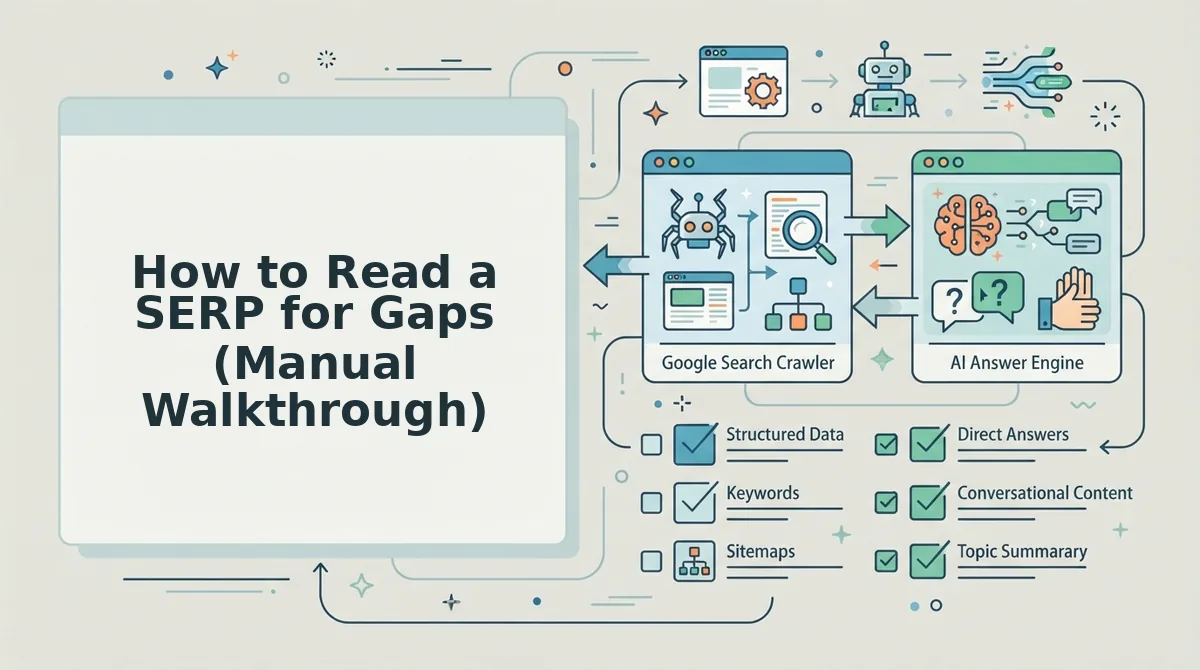
Reading a SERP manually takes about 15 minutes per keyword once you know the five signals to check. You need a browser in private or incognito mode, a spreadsheet or note app, and the target keyword, we'll use "best dog food for sensitive stomachs" as our working example.
- Open a private browser window and search the keyword. Type the query into Google, Bing, or your target engine. Private mode strips your search history and location bias, so you see a cleaner baseline SERP. You should see roughly 10 organic results, a People Also Ask box, and possibly a featured snippet.
- Scan all 10 titles and note the angle each one takes. For our example, you'll likely see titles like "10 Best Dog Foods for Sensitive Stomachs (Vet Approved)" and "The 7 Best Dog Foods for Sensitive Stomachs in 2026." Write down the dominant angle, most results are listicles targeting pet owners, not veterinary professionals. You should now have a clear picture of the content type Google rewards here.
- Click the top 3 results and list their H2 subheadings. Open each page and copy every H2 into your notes. Look for repeated subheadings like "What Causes Sensitive Stomachs?" or "Ingredients to Avoid." Repeated H2s across competitors signal table-stakes coverage. Missing H2s, like "How to Transition Foods Without Upsetting Your Dog's Stomach", are your first gap candidates.
- Expand every People Also Ask question on the SERP. Click each PAA dropdown and record the questions. You should see queries like "What ingredient in dog food causes stomach sensitivity?" and "Is grain-free better for sensitive stomachs?" These are real user questions that the top-ranking pages often answer only in passing, a direct gap you can target with a dedicated section or standalone article.
- Check the publish or update date on every result on page one. Look at the byline or schema date. If six of ten results are from 2024 or earlier and the topic moves fast, pet nutrition guidelines change, you've found a freshness gap. You should see at least one or two results that are clearly outdated, which means Google is starving for a current, well-researched answer.
Here's where most people stop, and where the real gaps hide. After you've logged titles, H2s, PAA, and dates, go back and look for intent mismatches. If the SERP is full of listicles but PAA questions are all "how to" queries, there's a gap for a step-by-step guide. If every result targets beginners but the PAA shows advanced questions about elimination diets, there's a gap for expert-level content. This is the core of live SERP analysis: the gap is rarely a missing keyword, it's a missing angle, depth level, or freshness signal that the current results fail to satisfy.
Qualifying a Gap Before You Write
Not every gap deserves a post. Run every candidate through this three-question go/no-go test before you invest writing time, it takes five minutes and prevents the most common content waste: publishing into a gap nobody searches or nobody can rank for.
- Does the gap match the dominant intent? Check whether the SERP's top results are informational, transactional, or navigational. If you found a "how to transition dog foods" gap inside a commercial listicle SERP, the intent is mixed, but if the PAA questions all skew informational, the gap is real. Only proceed when your content type matches what searchers demonstrably want, not what you assume they want.
- Can you beat the weakest current result? Open the lowest-ranking page that still addresses the gap and audit its depth, freshness, and authority. If the weakest result is a 400-word forum post from 2023 with no sources, you can beat it with a 1,500-word, citation-backed article. If the weakest result is already a comprehensive guide from a domain with 90+ DR, the gap is not a gap, it's a moat.
- Does it fit your topical cluster? A gap is only worth filling if it strengthens an existing pillar page or supports a cluster you're already building. A standalone gap with no internal linking path will struggle to rank and won't compound authority. If the gap doesn't connect to at least two existing or planned pages, skip it.
If a gap passes all three questions, it's a go. BloGoose automates this qualification step by crawling your existing site structure and flagging SERP gaps that match your established clusters, so you spend writing time on gaps that actually move rankings, not on hunches.
FAQ
What's the difference between a keyword gap and a content gap?
A keyword gap is a query your competitors rank for that you don't target at all. A content gap is a query, angle, depth level, or freshness signal that no current result satisfies well, including queries where you already rank but underdeliver. Keyword gaps are found in tools; content gaps are found by reading the SERP itself.
How do I spot a content gap without paying for a tool?
Search your target keyword in a private browser window, then manually log the titles, H2 subheadings, People Also Ask questions, and publish dates of the top 10 results. Repeated H2s show table stakes; missing H2s, unanswered PAA questions, and outdated dates reveal gaps. A spreadsheet is the only tool required.
What does a content gap actually look like on a SERP?
It looks like a mismatch between what searchers ask and what results answer. For example, a SERP full of listicles where every PAA question is a "how to" query signals a missing step-by-step guide. Or six of ten results from 2024 on a fast-moving topic signals a freshness gap.
How do I know if a content gap is worth filling?
Run a three-question test: does the gap match the dominant search intent, can you beat the weakest current result on depth and freshness, and does it fit your topical cluster? If all three pass, the gap is worth writing for. If any fails, skip it, the effort won't compound into rankings or answer engine optimization citations.
From SERP Signals to a Published Gap-Filler
Live SERP analysis stops being a manual chore the moment you treat it as a repeatable checklist, not a research project. The 5-signal scan tells you where the gap is. The 3-question test tells you whether it's worth your time. What most teams miss is the third step: acting before the SERP shifts.
That's where the real leverage lives. BloGoose runs live SERP queries during topic research and checks the exact signals described in this article, weak title alignment, thin answer depth, missing schema, stale dates, and unaddressed long-tail modifiers, then drafts and ships the gap-filler to WordPress without a manual handoff. You don't research gaps and then write about them. You close them in the same workflow.
Your next step: pick one underperforming page, run the 5-signal scan against its target query, and qualify the strongest gap with the 3-question test. If it passes, get indexed faster by publishing through a pipeline that pings search engines on publish, not days later.
The sites winning in 2026 aren't publishing more. They're publishing into the holes their competitors left open, and doing it before those competitors notice.