
What to Fix Before You Extract Brand Voice From a Website
Most teams don't realize their AI content sounds robotic because their website is the problem, not the prompt. If you skip the fix before extracting brand voice from website step, you're feeding a crawler broken sitemaps, thin pages, and tone drift, then wondering why every draft reads like a template. That's the exact scenario BloGoose was built to solve: it crawls your sitemap and generates a brand context file before a single word is drafted.
You're not bad at prompting. You're extracting voice from a site that hasn't been cleaned up first. This article walks you through the site-hygiene fixes that determine whether your AI-powered SEO content engine produces rank-ready articles or generic filler, and one of the seven audit points will surprise you.
Here's the roadmap: why extraction fails, the 7-point pre-extraction audit, and the sitemap foundation every tool depends on.
Why Brand Voice Extraction Fails (And It's Not the AI's Fault)
Brand voice extraction is the process of crawling a website's published pages to identify recurring tone, vocabulary, sentence structure, and positioning patterns that an AI can replicate in new content. It fails when the source site has inconsistent content, broken sitemaps, or thin pages, the AI can only learn what the site actually publishes.
Think of it like teaching a chef from a recipe box where half the cards are blank, three are duplicates, and two are written in a different language. The chef isn't incompetent; the source material is unusable. Extraction accuracy is a function of site hygiene, not prompt quality.
Five failure modes dominate. A broken XML sitemap means the crawler misses pages entirely or wastes requests on 404s. Thin pages under 300 words give the model too little signal to detect voice patterns. Mixed CMS templates create structural noise that reads as inconsistency. Tone drift happens when old posts and new posts were written by different teams with no style guide. Duplicate content dilutes frequency signals, making the model hedge toward generic phrasing.
Before you fix prompts, fix the source. A self-contained check: run your sitemap through any crawler, count pages under 300 words, and compare the first 10 posts against the last 10 for tone consistency. If more than 20% fail, extraction will underperform regardless of which AI model you use. This is also why live SERP analysis matters, it reveals what your site actually competes against, not what you assume it does.
The 7-Point Pre-Extraction Audit
Run these seven checks in order before any brand voice extraction. Each item is a pass/fail gate: if it fails, fix it before moving on.
- XML sitemap is crawlable and current. A sitemap listing deleted URLs or missing new posts forces the crawler to waste requests and learn from incomplete data. Verify it returns 200, includes all live pages, and excludes noindexed URLs.
- No thin or placeholder pages. Pages under 300 words provide too little linguistic signal for voice detection. Audit for "lorem ipsum" remnants, stub posts, and category pages with one-sentence intros, delete, merge, or expand them.
- Consistent page templates. When blog posts, landing pages, and product pages share structural patterns, the crawler isolates voice from layout noise. Mixed templates create false variation that reads as tone inconsistency.
- Author voice is uniform. If three writers produce content with no shared style guide, extraction averages their voices into a bland composite. Create a one-page style guide covering sentence length, contractions, humor tolerance, and banned phrases, then enforce it across the last 20 posts.
- No duplicate or near-duplicate content. Duplicate pages dilute frequency signals for distinctive phrases, pushing the model toward generic wording. Canonicalize or consolidate anything above 85% similarity.
- Clear topic boundaries. When one page covers three unrelated topics, the model can't map vocabulary to intent. Each URL should answer one primary query with one clear angle.
- Conversion pages don't dominate. If 70% of your crawlable pages are pricing, features, and demo CTAs, the extracted voice skews salesy. Ensure editorial content outnumbers conversion pages at least 2:1.
Item four is the one most teams skip, and it's the silent killer of voice extraction. Uniform author voice matters more than any prompt tweak because the model learns frequency patterns, not intentions.
Once these seven pass, you're ready for the foundation layer: sitemap hygiene.
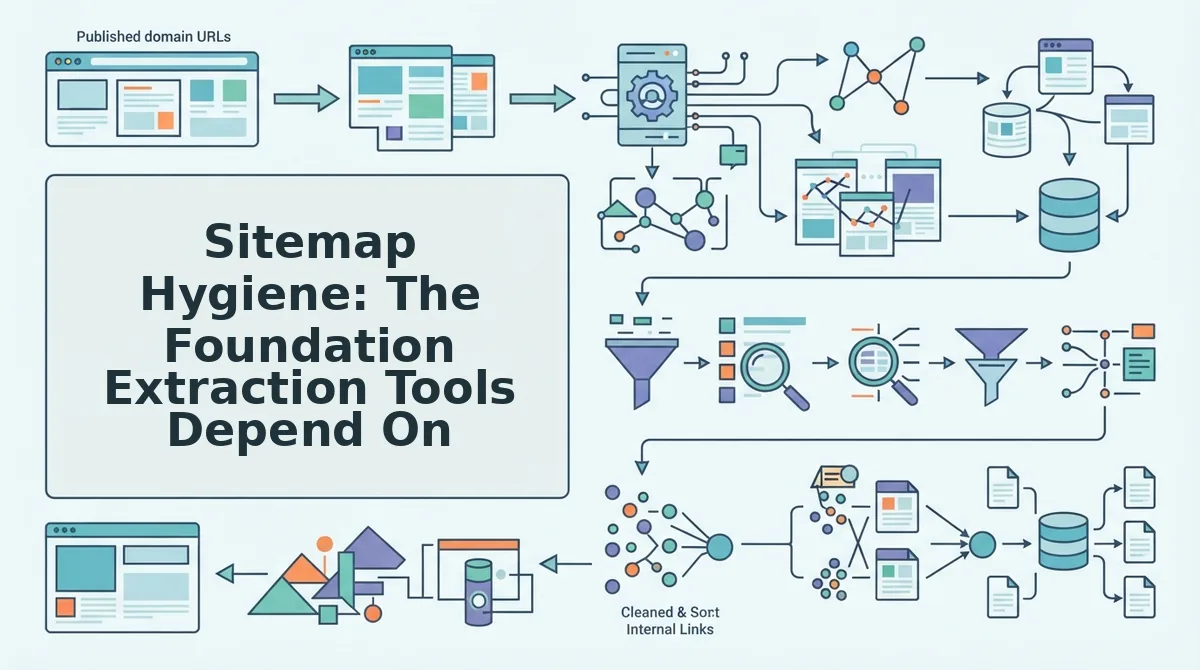
Sitemap Hygiene: The Foundation Extraction Tools Depend On
A clean, accurate XML sitemap determines whether your extraction tool reads your best content or drowns in boilerplate. Before running any brand voice extraction, you need a sitemap that reflects only the pages whose voice you want the AI to learn.
Prerequisites: Access to your CMS admin (WordPress, Shopify, Webflow, or similar), your domain's robots.txt file, and a sitemap validator such as Google Search Console's Sitemaps report.
- Locate your XML sitemap. Type
yoursite.com/sitemap.xmlinto a browser. If you see a structured list of URLs, you have a standard sitemap. If you get a 404, checkyoursite.com/sitemap_index.xmlor your CMS's SEO plugin settings (Yoast, Rank Math, or All in One SEO under Settings to XML Sitemap). You should see a list of sub-sitemaps organized by content type. - Open your CMS's sitemap settings. Click Settings, then XML Sitemap (or the equivalent in your SEO plugin). Look for the content types included in the sitemap. You should see checkboxes for posts, pages, categories, tags, and author archives.
- Exclude tag and author archive pages. Uncheck Tags and Author Archives from the sitemap. These pages are thin, boilerplate-heavy, and pollute extraction with repeated navigation text instead of brand voice. You should see the sitemap URL count drop immediately in the preview.
- Audit the remaining URLs for lastmod accuracy. Open your sitemap in a validator and sort by Last Modified. Flag any URL with a lastmod older than 24 months that still ranks for a target keyword. You should see a clean list where every included URL corresponds to a page you actually want the AI to read.
- Submit the cleaned sitemap to Google Search Console. Click Sitemaps in the left sidebar, paste your sitemap URL, and click Submit. You should see a green "Success" status within a few minutes. This step takes under 5 minutes and confirms search engines and extraction tools are reading the same clean index.
One publisher ran extraction on a sitemap with hundreds of tag pages. The resulting voice rules were polluted by boilerplate navigation text and category labels, not actual editorial voice. Excluding tag and author archives before extraction fixed the output in a single re-run.
Pre-extraction sitemap checklist:
- XML sitemap location confirmed and accessible
- Tag and author archives excluded
- Lastmod dates accurate for all included URLs
- CMS detected and sitemap settings match the live site
- No redirect chains or orphaned URLs in the sitemap
BloGoose's crawler reads your sitemap as the entry point for sitemap context extraction, so a clean sitemap means the voice rules it generates come from your actual content, not your archive scaffolding. Run this audit once before your first extraction, then re-check quarterly or after any major site migration.
Content Consistency: What Your Pages Teach the AI About Your Voice
Extraction tools learn patterns from repetition. If your pages use five different intro formats, three different tones, and inconsistent heading structures, the AI has no stable signal to extract, it averages the noise and produces a generic voice.
Competitors in the AI content space often assume source content is already clean. That assumption is wrong for most real sites, which is why BloGoose's crawl step inspects page structure before voice rules are generated. The table below shows what extraction tools actually read from your pages.
| Signal | Inconsistent Pages (Weak Extraction) | Consistent Pages (Strong Extraction) |
|---|---|---|
| Intro format | Some pages open with a question, others with a stat, others with a story | Every page opens with a direct answer sentence followed by context |
| Tone | Formal in blog posts, casual in case studies, promotional in landing pages | One defined tone across all content types, with minor variation by format |
| Heading structure | H2s vary between questions, statements, and keyword phrases | H2s follow a predictable pattern (e.g., direct-answer statement) |
| Off-brand pages | Old guest posts, pre-rebrand articles, and test pages mixed in | All indexed pages reflect the current brand voice |
Best for established publishers with legacy content: Run a consistency audit before extraction. Identify your top 20 performing pages and check whether they share a common intro pattern, tone, and heading style. If they don't, pick the pattern from your best-converting pages and apply it to new content going forward.
Best for teams scaling content production: Document your voice rules in a one-page style guide before extraction. HubSpot Academy's content marketing training emphasizes that brand voice consistency at scale requires explicit documentation, not implicit team knowledge.
Best for solo operators with a small site: Fix inconsistency manually. Rewrite your five most-trafficked pages to match one template, then let extraction learn from that clean core.
The fix is not to delete everything, it's to make the signal louder than the noise. BloGoose's brand context extraction reads page structure, tone markers, and formatting patterns across your sitemap, so a consistent core of 20-30 pages teaches the AI more than 200 mixed-signal pages ever will.
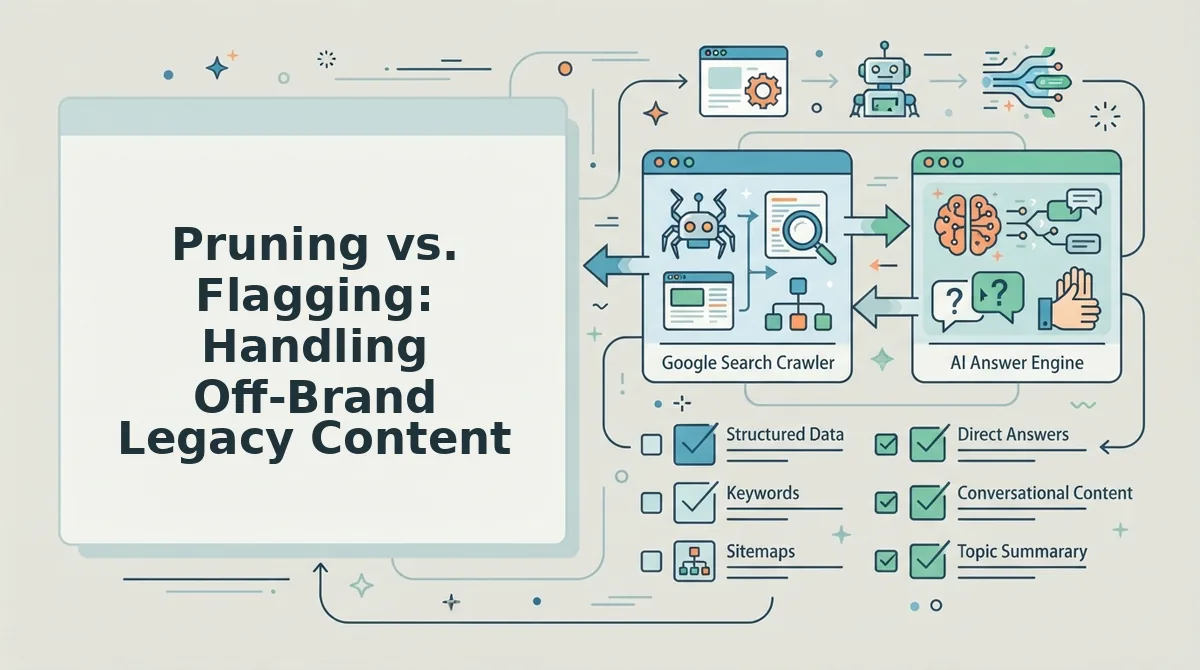
Pruning vs. Flagging: Handling Off-Brand Legacy Content
Off-brand legacy content is any published page whose tone, structure, or topic no longer matches your current brand voice. You don't need a content funeral. You need a filter.
Think of brand voice extraction like training a new hire. If you hand them a folder of old memos, half-written drafts, and a few polished reports, they'll learn a muddled version of how you communicate. Hand them only the polished reports, and they'll learn the voice you actually want.
Simple: Delete thin content. If a page is under 300 words, has no backlinks, no organic traffic, and no unique information, delete it or set it to noindex. Thin pages teach extraction tools filler patterns, not voice.
Intermediate: Flag off-brand but valuable content. If a page drives traffic or has backlinks but uses an outdated tone, flag it for a rewrite rather than deletion. Exclude it from the extraction crawl until the rewrite is live. This keeps your voice rules clean without losing SEO equity.
Advanced: Exclude irrelevant content types. If your site has a news section, a changelog, or a legal hub that serves a functional purpose but doesn't reflect your editorial voice, exclude those URL patterns from the extraction crawl entirely. BloGoose's crawl settings let you define which sitemap sections feed the voice model and which are ignored.
Decision logic:
- Delete if the page is thin, off-brand, and has no traffic or backlinks.
- Flag if the page is off-brand but has traffic, backlinks, or conversion value.
- Exclude if the page is on-brand but irrelevant to voice (legal pages, changelogs, support docs).
How many pages does extraction actually need? The answer depends on how clean those pages are.
How Many Pages Does Extraction Actually Need?
Brand voice extraction is the process of analyzing multiple published pages to identify recurring patterns in tone, vocabulary, sentence structure, and formatting that define how your site communicates. The practical range is 10-30 consistent pages for reliable voice rules; fewer works but with lower confidence.
Think of extraction like learning a person's handwriting. One note tells you almost nothing. Ten letters reveal consistent loops and slants. Thirty letters let you forge it convincingly. The same logic applies to your site's voice.
Start simple: feed the extractor 10 pages from your core content, your homepage, three pillar articles, and six supporting posts. At this level, the tool detects obvious patterns like sentence length, headline style, and recurring phrases. Confidence is moderate, enough for a rough voice draft.
Move to intermediate: add 10 more pages spanning different content types, such as case studies, product pages, and category descriptions. This teaches the extractor how your voice flexes across formats without breaking. Patterns like transition preferences, em-dash usage, and first-person versus third-person choices emerge clearly.
For advanced extraction, cap the input at 30 pages that represent your best-performing, on-brand content. Beyond 30, you introduce noise, outdated posts, experimental tones, and legacy phrasing dilute the signal. Fewer than 10 pages leaves the extractor guessing, producing generic output that sounds like every other AI draft.
Small sites with only 5-8 published pages can still extract voice, but expect lower confidence. In that case, supplement the crawl with a manually written brand style brief that states your tone rules explicitly. The extractor uses the brief as a constraint layer, reducing guesswork on thin content.
A self-contained answer for anyone asking "how many pages does AI need to learn my brand voice": Aim for 10-30 consistent, on-brand pages. Ten pages establish baseline patterns like sentence rhythm and vocabulary. Twenty pages reveal how the voice adapts across formats. Thirty pages is the ceiling for signal quality, beyond that, legacy or off-brand content starts diluting the model. Sites with fewer than 10 pages can compensate by providing an explicit style brief alongside the crawl.
FAQ
What should I fix before extracting brand voice from my website?
Fix your sitemap, remove or flag off-brand legacy content, and ensure 10-30 consistent pages represent your current voice. A clean sitemap tells the extractor which pages matter, while pruning prevents outdated tones from contaminating the voice model.
Do I need to delete old posts first?
No, deletion is optional. Flagging off-brand posts as excluded from extraction works just as well and preserves your URL equity. Only delete pages that are factually wrong, duplicate, or actively harmful to your current positioning.
How long does brand voice extraction take?
Most extraction tools complete a crawl and voice analysis in under 10 minutes for a 30-page site. The bottleneck is preparation, auditing your sitemap and pruning off-brand content takes longer than the extraction itself.
Can I extract brand voice from a small site?
Yes, but with lower confidence. Sites with 5-8 pages can still yield basic voice patterns, especially when you supplement the crawl with a written style brief that states tone rules explicitly. For stronger results, publish 10 or more consistent pages first.
Why does my extracted brand voice sound generic?
Generic output usually means the extractor had too few pages, too much off-brand content, or no style constraints. Fix it by feeding 10-30 consistent pages and pairing the crawl with AEO content optimization rules that define how your brand answers questions.
Extraction Is Only as Good as the Site You Feed It
Every fix in this article traces back to one principle: garbage in, garbage out. The extractor does not judge your content, it mirrors it. A messy sitemap, inconsistent tone, and unflagged legacy posts produce a voice model that sounds like a confused average of everything you have ever published, not the brand you are building now.
The payoff is this: preparation is the real work. The extraction itself is mechanical. Your competitive edge comes from the 7-point audit, the sitemap cleanup, and the pruning decisions you make before the crawl begins. Do that work once, and every future article inherits a voice model worth trusting.
Your next step is to run the 7-point pre-extraction audit on your own site today, it takes under an hour and reveals exactly where your voice signal is leaking. When the audit is clean, let BloGoose's AI-powered SEO content engine crawl your site and generate brand context files automatically, so every article ships with your voice baked in from the first draft. The engine is ready when your site is.