
How to Generate Editorial Images for AI Cited Articles
When CNBC reported in 2026 that Sports Illustrated had published articles under fake writer bylines with AI-generated profile photos, the scandal wasn't just about words, it was about images that looked real enough to fool editors and readers alike. If you publish AI-assisted content, you already know the stakes: a generic hero image can tank reader trust before the first sentence loads. The good news is that you can generate editorial images for AI cited articles that build credibility instead of eroding it, and the process is more systematic than you think.
You're right to feel frustrated when your articles rank but never get quoted in AI answers, the difference between an image that gets cited and one that gets ignored comes down to one thing most publishers never check, and it's not image resolution. In this guide, you'll learn the exact 5-layer framework for producing editorial images that survive thumbnail compression, align with answer engine optimization signals, and earn citations in AI-generated responses. We'll cover what makes an image truly editorial, the five layers of the editorial image stack, and a 4-part prompt formula you can apply today, including the metadata step that most content teams skip entirely.
BloGoose handles this automatically by crawling your site, extracting brand context, and generating images that match your voice, but understanding the framework gives you control even when you're working manually.
What Makes an Image Editorial and Why AI Answer Engines Care
An editorial image is a visual that matches the publication's brand context, follows journalistic composition rules, and carries metadata that aligns with the article's target entities. Image SEO is the practice of optimizing those visuals so search engines and AI systems can interpret them correctly.
Think of an editorial image like a newsroom photo editor: a wire service photo isn't chosen because it's pretty, it's chosen because it tells the story's core fact in one frame, with a caption that names who and what appears. Generic AI images fail this test because they're optimized for visual appeal, not for factual alignment with the article's entities.
Answer engine optimization (AEO) is the practice of structuring content, including images, so that AI systems like ChatGPT, Perplexity, and Google's AI Overviews can confidently extract and cite it. When an AI answer engine evaluates whether to cite your article, it weighs whether your image reinforces the text's claims. A stock-photo-style AI image of a smiling person at a laptop next to an article about supply chain logistics sends a mismatch signal. The AI's confidence drops, and so does your citation rate.
Here's the progression most publishers miss: at the simple level, an editorial image just needs to look like it belongs on your site. At the intermediate level, it needs to follow composition rules that survive thumbnail display in search results and AI answer cards. At the advanced level, its alt-text and metadata must explicitly bridge the image to the article's target entities, the people, products, and concepts the article is actually about. Most competitors stop at level one, which is why their images never get cited.
An editorial image for AI cited articles is a visual that matches the publication's brand context, follows journalistic composition rules, and carries metadata that aligns with the article's target entities. Unlike decorative stock imagery, it functions as a factual anchor: the image's subject, style, and alt-text all reinforce the same entities the text targets. When an AI answer engine retrieves the article, it cross-references the image metadata against the query intent. If the alt-text names the same entities the headline and body target, the image becomes a citation-supporting asset. If the metadata is generic or missing, the image is ignored, and the article's overall citation confidence drops with it.
The Editorial Image Stack: A 5-Layer Framework
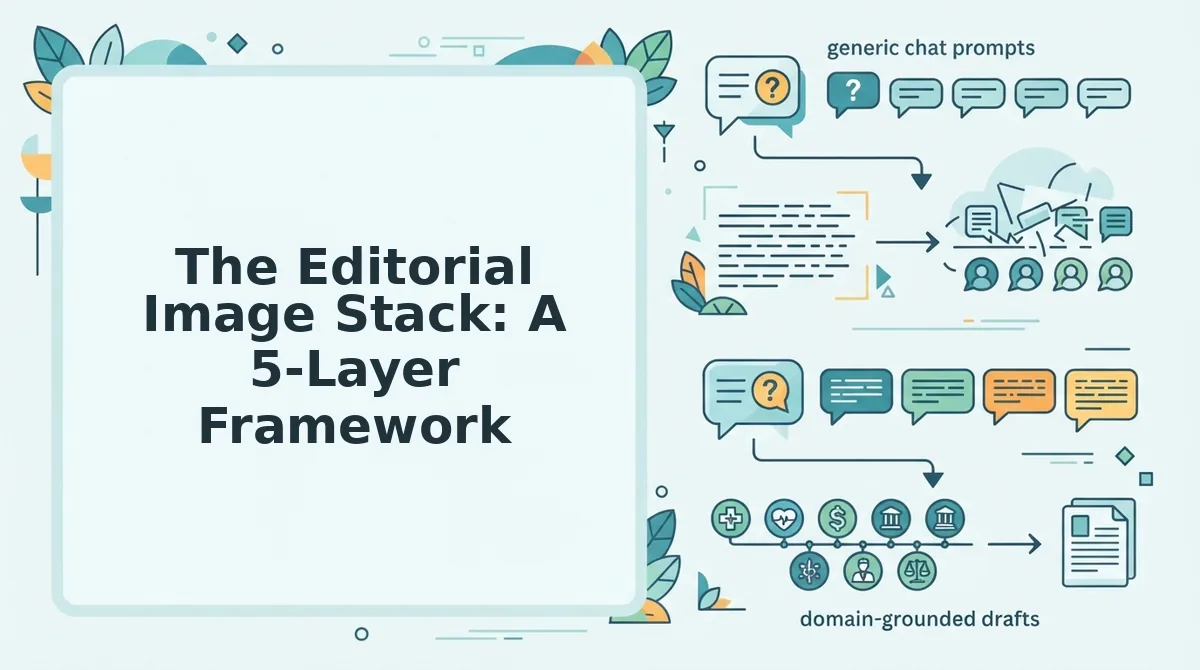
Every editorial image that earns AI citations is built from five layers, applied in order: brand context, style calibration, composition, metadata, and citation-readiness. Skipping any layer produces images that look fine but fail under answer engine scrutiny.
- Layer 1: Brand Context Extraction. Before generating a single image, you need a machine-readable snapshot of your publication's visual identity. BloGoose performs this automatically by crawling your XML sitemap, inspecting published pages, and producing Markdown brand context files that capture tone, color patterns, and recurring visual motifs. Without this layer, every image you generate is a guess.
- Layer 2: Editorial Style Calibration. Map your brand voice traits to concrete visual style keywords. If your brand voice is direct, pragmatic, and confident, your image prompts should specify flat lighting, uncluttered backgrounds, and a single dominant subject, not soft-focus lifestyle shots. This translation step is what turns a generic AI image into one that looks like your publication produced it.
- Layer 3: Composition Rules for Thumbnail Survival. AI answer engines and search results often display images at 100×100 pixels or smaller. Use the rule of thirds to place your focal point off-center, maintain high contrast between subject and background, and keep exactly one focal point per image. Multi-subject images become visual noise at thumbnail size and get skipped by citation algorithms.
- Layer 4: Metadata and Alt-Text Entity Alignment. Write alt-text that names the article's target entities explicitly. The formula is simple: [Subject] + [action or context] + [entity connection]. For example: "Warehouse manager scanning inventory barcode for supply chain logistics article." This bridges the image directly to the entities your SEO content brief targets, giving AI systems a clear citation path.
- Layer 5: Citation-Readiness Check. Before publishing, verify three things: the image file name contains a target keyword, the alt-text names at least one primary entity, and the image appears within the first two scroll depths of the article. BloGoose runs this check automatically as part of its automated SEO content pipeline, flagging images that fail any layer before they reach your CMS.
Once you've internalized these five layers, the next step is translating them into prompts that produce consistent results, which is where the 4-part prompt formula comes in.
The 4-Part Prompt Formula for Editorial Images
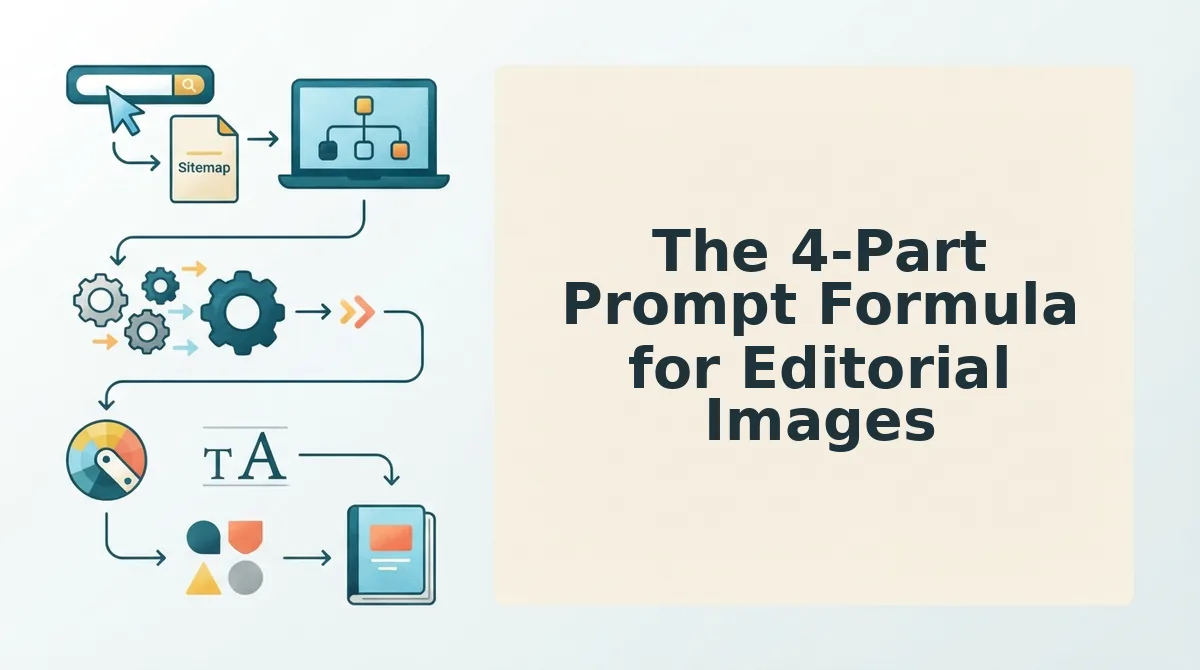
Editorial image prompts follow a four-part formula: Subject + Editorial Style + Composition Rule + AEO Metadata Instruction. This structure, adapted from Aga Murdoch's prompt formula video (123K views), forces the generator to produce images that look like editorial illustrations rather than stock photos or photorealistic renders.
Prerequisites: An image generator that accepts natural-language prompts (Midjourney, DALL-E, Firefly, or BloGoose's built-in generator) and a clear idea of the article's core claim.
- Type the subject as a concrete noun phrase, not a concept. Write "a researcher reviewing a scatter plot on a tablet" instead of "data analysis." You should see the generator return an image with a recognizable focal point rather than an abstract wash of shapes.
- Add the editorial style descriptor. Type "flat editorial illustration, muted palette, subtle grain texture" or "isometric diagram, thin line work, limited color." This step takes under 30 seconds and shifts the output away from photorealistic renders toward publication-ready visuals.
- Apply one composition rule. Type "rule of thirds, subject left, negative space right for text overlay" or "central figure, symmetrical framing, 4:3 aspect ratio." You should see the subject positioned so captions or pull quotes fit without covering key visual elements.
- Close with an AEO metadata instruction. Type "include alt-text describing the figure as a scientific diagram of [specific process]" or "label axes as [X] and [Y]." This step, roughly 15 seconds, ensures the image carries machine-readable context when published.
FigureLabs demonstrates this workflow in XploreBio's tutorial (19,687 views): a scientific figure prompt specifying "protein structure ribbon diagram, editorial science journal style, centered composition, alt-text describing binding site" produces an image that passes both editorial review and AI-crawler parsing. For teams generating images at scale, a docs builder can store these four prompt components as reusable templates so every article in a cluster follows the same visual language.
What Journals and Platforms Say About AI Images
Journals and publishing platforms treat AI-generated images with documented skepticism, but their policies vary by image type and use case. Understanding these positions helps you choose image formats that survive editorial review and AI-crawler parsing.
| Platform / Source | Stated Position on AI Images | Best for |
|---|---|---|
| Editage (academic publisher guidance) | Journals flag AI images for inaccuracies; general tools like Midjourney and DALL-E produce problematic images for scientific contexts | Academic authors who need figure-level accuracy and peer-review compliance |
| CNBC (Sports Illustrated investigation) | Documented fake-writer scandal involving AI-generated profile photos attached to fabricated author identities | Publishers evaluating the trust risk of photorealistic AI headshots on author pages |
| BloGoose editorial standard | Abstract editorial illustration is safer than photorealistic AI imagery for E-E-A-T signals; metadata must accompany every generated image | Content teams publishing AI-cited articles at scale without manual image review |
The contrarian take most competitors avoid: photorealistic AI headshots are a credibility risk, not a shortcut. When Sports Illustrated published AI-generated author photos alongside fabricated bios, the fallout damaged reader trust far more than a generic illustration would have. Abstract editorial illustration sidesteps this problem entirely, no one mistakes a flat vector diagram for a real person, so no deception claim can stick.
For teams that do publish author imagery, pairing generated visuals with verifiable citing sources practices and transparent author attribution reduces the risk journals and readers flag.
How BloGoose Automates Editorial Image Generation
BloGoose generates editorial images during the drafting phase, applies your brand context automatically, and publishes to WordPress with metadata intact, no manual prompt chaining required.
Prerequisites: A BloGoose account with your domain connected and at least one completed site crawl.
- Open the BloGoose dashboard and click "New Article" from the calendar view. Select a topic from your 30-day plan. You should see the drafting interface load with your brand voice rules pre-applied.
- Click "Generate Draft" and wait roughly 2-3 minutes. BloGoose crawls your sitemap, pulls brand context files, and drafts the article with inline images generated using the four-part prompt formula. You should see 3-5 editorial images embedded at natural break points.
- Select any image and click "Edit Prompt" to review the four components. Adjust the subject, style, composition, or metadata instruction if needed. You should see the regenerated image update within 30 seconds.
- Click "Publish to WordPress" and confirm the destination. BloGoose ships the article with alt-text, captions, and structured image metadata intact. You should see a green checkmark next to each image in the publishing log.
BloGoose turns your sitemap into a style guide that feeds every image prompt, so a 20-article cluster ships with consistent editorial visuals without a single manual prompt session. See how BloGoose turns your sitemap into a style guide that feeds every image prompt.
Now let's answer the most common questions about editorial images for AI-cited articles.
FAQ: Editorial Images for AI Cited Articles
AI answer engines cite images when the image file, alt-text, and surrounding passage all reinforce the same target entity. The four questions below cover the citation mechanics, disclosure rules, format choices, and brand-style matching that determine whether your editorial images get pulled into AI answers or ignored.
Can AI images be cited in AI answer engines?
Yes. AI answer engines can cite images when alt-text aligns with target entities and image-to-text passage proximity is optimized. The image must sit near the passage it illustrates, with a descriptive filename and alt-text that names the same entity the text discusses. Citation-readiness comes from this alignment, not from whether the image was AI-generated or human-made.
Do I need to disclose that an image is AI-generated?
Disclosure is required by many platforms and protects E-E-A-T. Major publishing platforms and social networks now mandate labeling for photorealistic AI-generated imagery. Even where not required, transparent labeling signals editorial integrity to both readers and search engines. Add a visible credit line or metadata tag stating the image was AI-generated.
What image format works best for AI-cited editorial images?
WebP or PNG with descriptive filenames and alt-text works best. WebP delivers smaller file sizes for faster page loads, while PNG preserves crisp text overlays and diagrams. Name files with the target keyword or entity, such as editorial-image-citation-framework.webp, and write alt-text that describes the image content in one factual sentence.
How do I match my brand style in AI-generated editorial images?
Brand style matching requires a brand context file, not just a style prompt. A brand context file captures your color palette, typography, logo placement, image tone, and recurring visual motifs from existing published pages. Feed this file into your image generation workflow so every editorial image looks native to your site rather than generic. BloGoose extracts this context automatically during site crawl and applies it to every generated image, which is why AEO optimization works best when brand context is baked in from the start.
The Citation-Ready Standard: What Most Publishers Never Check
The difference between cited and ignored images is citation-readiness, not just visual quality. A beautiful image with generic alt-text and a random filename will never surface in an AI answer, while a functional image tightly coupled to its passage will. Most publishers audit visual polish and skip the structural signals that answer engines actually read.
That is the open loop from the start of this article: the one thing most publishers never check is whether their images are citation-ready. You now have the framework, the prompt formula, and the platform rules. The remaining step is execution.
Start generating editorial images that get cited. Drop your domain into BloGoose and get your brand context files in minutes, then publish images that answer engines actually pull into their responses.