How many published posts does a site crawl need to learn a voice

The draft came back competent, on brief, and completely voiceless â six posts pasted in as examples, and the same smooth, interchangeable paragraphs came out the other side. That is the frustration behind AI writing that sounds generic after examples, and the culprit is usually not the model.
Ask how many posts to learn a writing voice and there is a usable number: eight to 12 of your own, unedited articles, roughly 6,000 to 10,000 words. Not twelve 300-word news blurbs.
You probably supplied far less than that and blamed the output. Here is the fix â the word floor, the mix that makes a corpus usable, and a ten-minute test for whether yours is complete.
Three things decide it, in this order:
- Total word count, not page count.
- Spread across formats, funnel stages, and audience segments.
- Whether the samples are actually yours.
Run the crawl. Drop your domain into setup; the automated SEO content pipeline locates the XML sitemap, inspects published pages, and extracts brand voice rules before drafting anything. Audit that rule set against your own reading of the site first â the crawl only reflects the pages you gave it.
One counterintuitive finding sits later in this piece: past a certain size, adding more posts can lower fidelity.
The math behind that 8-to-12 range is where the real answer lives.
The short answer is 8 to 12 posts, and here is the math
Eight to 12 posts â roughly 6,000 to 10,000 words of your own unedited prose at a typical 800-word post length â is where a site crawl stops copying your sentence rhythm and starts reproducing your vocabulary and structural templates. Below five posts you get a mimic. Past 30, the returns flatten.
A voice corpus is the set of your own published writing a system samples to build a style profile. Corpus size doesn't just change confidence â it changes what the model is capable of reproducing at all.
| Corpus size | Approx. words | What it reproduces | Best for |
|---|---|---|---|
| Under 5 posts | 2,000â4,000 | Sentence rhythm and punctuation habits only | Solo operators testing a new domain before investing |
| 8â12 posts | 6,000â10,000 | Vocabulary, structural templates, opening moves | Founders publishing weekly on one site |
| 15â25 posts | 12,000â20,000 | Editorial judgment across formats â how you argue in a comparison versus a how-to | Agencies and DTC teams running multi-format clusters |
| 30+ posts | 24,000+ | Marginal gains; rising risk of averaging toward generic | Large publishers auditing an existing archive |
DEV Community's November 2026 guidance of 10 to 30 pieces is the only publicly stated range, and as an outer bracket it holds up reasonably well. It simply never says what changes between the two ends â which is the part that decides your output quality.
One long piece can do more than several short ones. A single 2,000-word essay outperforms six 300-word news blurbs as voice training data, because the essay exposes how you build an argument rather than how you compress a headline.
Choose by where your corpus already sits
- Choose under 5 posts if you're validating whether automated drafting fits at all.
- Choose 8â12 posts if you want a usable voice profile this month.
- Choose 15â25 posts if you publish comparisons, opinion, and how-tos and need all three to sound like you.
What we'd choose: start at 8â12, test whether every format you publish is covered at least twice, and only extend toward 25 where a format gap shows up. Adding posts for the sake of a number mostly adds noise.
BloGoose handles that sampling from your sitemap rather than a paste window â it locates the XML sitemap, inspects published pages, and extracts voice rules from what's already live. Pair that with AEO content optimization if the goal is also being quoted in AI answers.
But post count is only a proxy â coverage is the variable that actually matters.
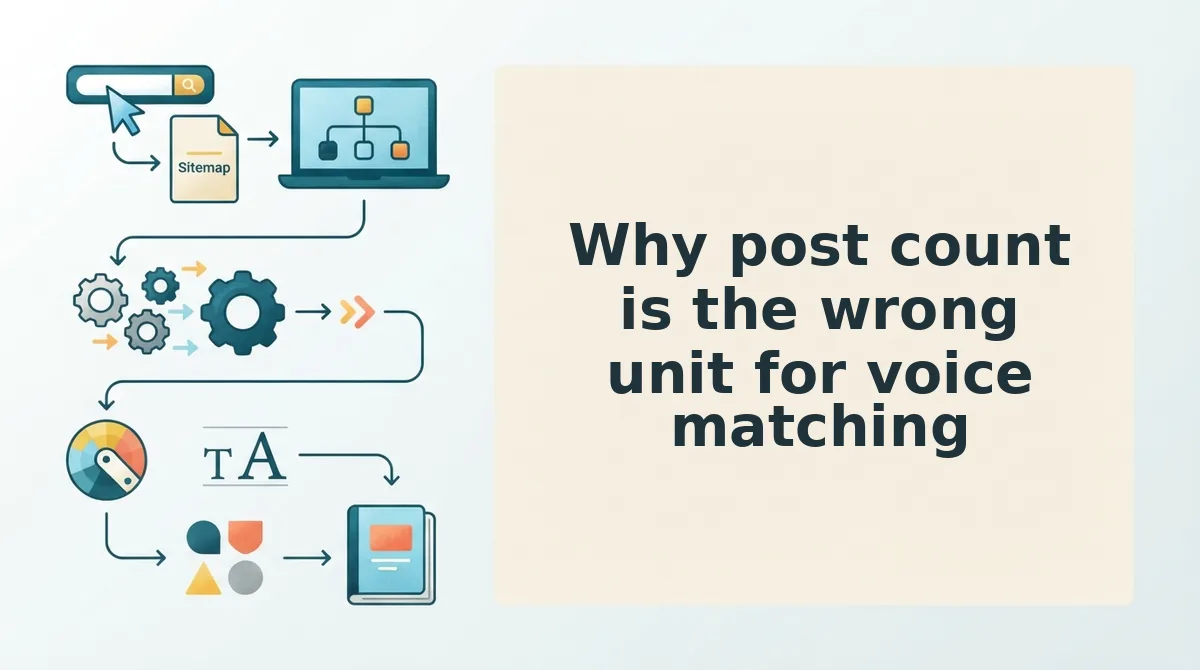
Why post count is the wrong unit for voice matching
A voice model learns from word volume and stylistic range, not from URLs, so two archives of twelve posts can hand a crawl very different amounts of signal.
Here is where the count stops mattering.
Coverage Matrix is a diagnostic that scores an archive along four axes â format, funnel stage, audience segment, recency â and calls a corpus complete when every axis holds two or more samples. A round post count never tells you that; two samples per axis does.
- Word floor first: 6,000â10,000 words of your own unedited prose. That equals 8â12 posts at typical 800-word length, and one long essay supplies more signal than six 300-word news blurbs. Sum word counts, not URLs, before counting anything else.
- Format: two samples each of how-to, opinion, comparison, and narrative. A how-to rhythm never teaches a model how you argue, so each format has to be sampled on its own. Tag every post with a single format label, then count the tags.
- Funnel stage, audience segment, recency: two samples per bucket. Explainer and comparison posts hedge differently, and old posts teach a register you may have abandoned. Sort your tagged posts down each axis and mark the empty cells.
- Exclusions: ghostwritten, heavily edited, AI-drafted, pre-rebrand. Each carries someone else's rhythm â a writer's, an editor's, a model's default register, or your discarded voice. DEV Community's November 2026 advice to skip ghostwritten work holds for this reason: the model averages whatever you feed it, so weak posts can lower fidelity rather than raise it.
Worked example. A publisher scores the matrix after a crawl and finds format thin on comparison posts, funnel stage almost entirely top-of-funnel, recency fine. The instinct is twelve more posts. The better move is two â one long comparison essay, one opinion piece â then a re-crawl. Coverage reaches two samples per axis with two new pieces instead of twelve, and the result slots straight into existing topic clusters.
What a crawl reads when it pulls those posts is the next question.

What a site crawl actually extracts from your posts
A site crawl is an automated read of your published pages that converts prose into a structured voice file. It does not save your posts into a folder for later rereading â it measures them.
Think of it like a music producer listening to six of your tracks before a session. The producer is not memorizing your lyrics; they are clocking your tempo, your key changes, and the drum sound you always come back to. The output is a spec sheet, not a mixtape.
The first pass: deciding which URLs earn a read
A crawl starts at your XML sitemap and then filters. It keeps published, bylined posts â the ones with a human name attached and a live URL. When the site has been rebranded, it favors pages published after that shift, since pre-rebrand pages describe a voice you no longer use.
It also wants range, so it pulls roughly one page per format: a how-to, an opinion piece, a comparison, a narrative. Then it drops the rest. Drafts stay out, because unpublished work hasn't been edited by you yet. Guest posts stay out â that's someone else's rhythm. Ghostwritten pages stay out, because the byline is a costume. Listicles with no author line are skipped for the same reason.
Crawl depth is bounded by the same logic that governs crawl budget: every fetched URL costs time, so the goal is coverage, not volume.
The second pass: the eight signals it records
Voice extraction happens at the sentence and paragraph level, not the topic level. From the surviving pages, eight signals get captured:
- Sentence length distribution â the spread, not the average. A writer who alternates 4-word punches with 30-word runs sounds different from one who writes flat 18s.
- Opener patterns â how paragraphs begin. With a claim, a question, a scene, a name?
- Contraction rate â how often "do not" becomes "don't." This single ratio separates formal from conversational faster than any adjective list.
- Punctuation habits â em dashes versus parentheses, colons before lists, whether semicolons ever appear.
- Recurring framings â the metaphors and comparisons you return to without noticing.
- Banned vocabulary â words that never appear in your corpus, which function as a negative constraint during drafting.
- Paragraph density â lines per block, which controls page rhythm visually as much as verbally.
- Closing moves â how you end a section. A verdict, a caveat, a handoff?
The third pass: how the file feeds drafting
The result is a compact set of rules â often called writing-examples.md in prompt-based workflows â that constrains every draft before a sentence is generated. Here is the self-contained version for anyone searching this directly:
What does a site crawl extract to learn a writing voice? It extracts measurable style signals â sentence length distribution, paragraph openers, contraction rate, punctuation habits, recurring framings, banned vocabulary, paragraph density, and closing moves â from published, bylined pages. Those signals become a constraint file that governs drafting, so new posts inherit rhythm and structure rather than topics or phrasing.
That distinction matters for citation. Answer engines quote passages that read as a coherent authorial voice across a site, and a constraint file keeps tone stable from post to post. The BloGoose docs walk through the full extraction-to-publish handoff if you want to see the file shape itself.
Voice extraction is the step most prompt kits skip. They hand you a template and hope the model infers the rest â which is the mechanism behind the generic output everyone complains about.
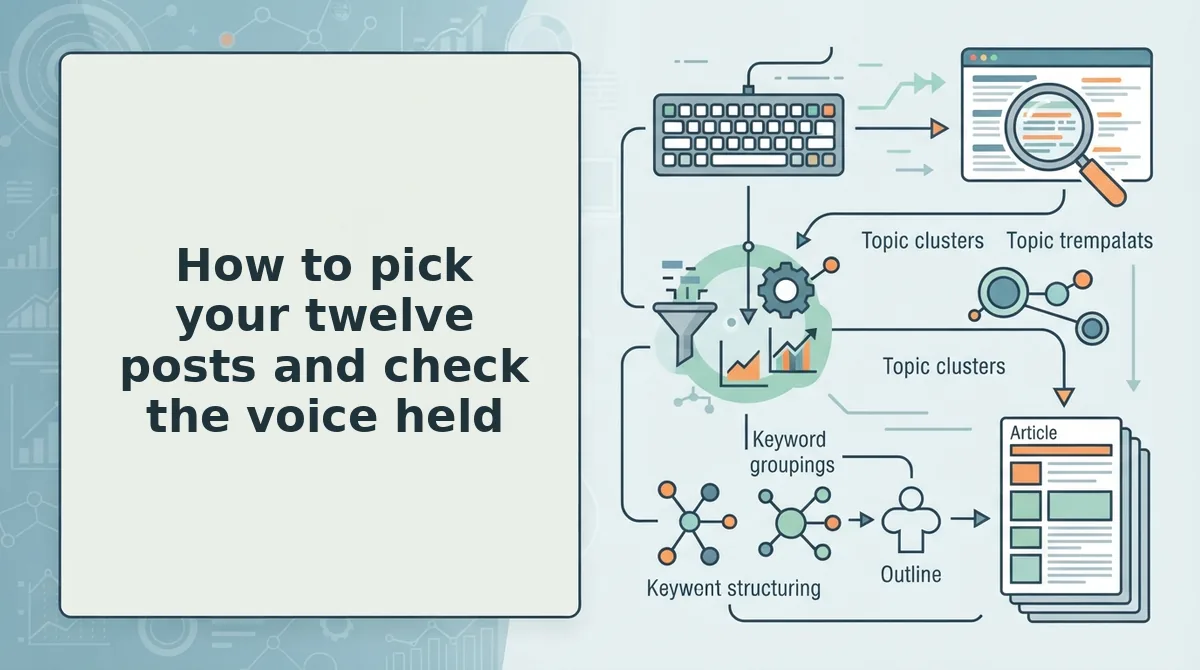
How to pick your twelve posts and check the voice held
You need access to your post archive, your publish dates, and about 45 minutes. A spreadsheet helps; the Coverage Matrix from earlier is the scoring sheet. Do the selection in one sitting so the criteria stay consistent, then run both checks against the same fresh draft.
- Open your post list and filter to bylined posts only (5 minutes). Export titles, URLs, author names, and word counts. Delete every row without a human author line. You should see your archive shrink by the guest and ghostwritten tail.
- Cut anything published before your last rebrand (3 minutes). Sort by date and draw the line at the rebrand. Keep older posts only if nothing newer exists in that format. You should now be looking at a list that sounds like the site you run today.
- Score the remainder against the Coverage Matrix (15 minutes). Tag each post by format, funnel stage, audience segment, and recency. Stop when every axis holds at least two samples. You should see gaps â usually opinion and comparison â marked in the grid.
- Confirm the word count clears 6,000 (2 minutes). Sum the word counts of the selected posts. If you land under 6,000, add the longest unedited essays you have rather than more short posts. You should see a total between 6,000 and 10,000 words.
- Type those URLs into the crawler and run extraction (10 minutes). In BloGoose, paste the domain in the setup wizard; the crawl reads the sitemap and applies the same filters automatically. You should see a generated voice file listing the eight captured signals.
- Draft 150 words on an unfamiliar topic and compare (10 minutes). Check three things against the corpus: your opener pattern, your average sentence length, and your punctuation habits. You should see the draft open the way your posts open, not the way a chatbot opens.
- Run the discrimination test (2 minutes). Show a colleague one paragraph from an old post and one from the new draft, unlabeled. Ask which came from the site. If they guess wrong or hesitate, the voice held.
That last check is not paranoia. A DEV Community post from April 2026 described a corpus of roughly 100 posts that still needed vocabulary distribution, sentence-length entropy, and structural templates layered on top before the voice held. If a hundred posts need that scaffolding, twelve need the verification step more, not less.
Start with twelve good posts, not a hundred
Twelve bylined posts, 6,000 to 10,000 words of your own unedited prose, is the working floor. Not a hundred. The corpus is a sample, and a tight sample beats a wide one that averages you into the middle.
The honest limitation: a voice file ages. It describes who wrote those twelve posts on the day they were crawled, not who writes for you now. Re-run extraction after a rebrand, and again whenever a new writer joins the byline â otherwise you are drafting in a voice nobody on the team currently uses.
Two next steps. If your archive is thin, pull your three longest essays and start there; word count rescues a small sample. If your corpus is ready, run the extraction in BloGoose and let the crawl do the filtering â the docs cover the setup path from domain to voice file.
Once the voice holds, the constraint stops being the interesting problem and the real work begins: choosing which clusters to own and which queries deserve a citation. Twelve posts get you a voice worth quoting. The next question is what you want it to say.