Jasper for SEO blogging vs a live SERP research workflow
You type a topic into Jasper's One-Shot Blog Post template, press generate, and a clean draft arrives in seconds. What did that draft know about the pages ranking for your keyword this morning? That question sits at the center of using Jasper for SEO blogging.
Jasper earns its reputation. It writes fluent, readable copy fast, and for many content teams that speed alone justified adopting it.
Speed and ranking are separate problems, though. A draft can read well and still miss the search intent, the People Also Ask questions, and the angles that currently win the results page.
This article compares Jasper's prompt-first workflow with a live SERP research workflow and gives both a fair hearing. It includes a six-job matrix showing who does the work at each stage, from research to publishing, and a checklist to run before any draft goes live.
It also covers the step every Jasper tutorial skips. That step causes more ranking misses than writing quality does, and the comparison below shows why.
Is Jasper Good for SEO Blogging?
Jasper is a strong writer, but its prompt-first workflow starts from what you type, not from what currently ranks. It works for SEO blogging when you feed it a validated brief built from live search results. Without that brief, it produces polished copy aimed at a guess.
A prompt-first workflow is a content process in which the brief comes from the writer's own input rather than from data about the current search results page. The real difference between the two approaches is where the brief comes from, not how well either one writes.
What a Prompt Cannot Know
A prompt works like a paper road map. It shows the roads that existed when it was printed, but it can't show today's traffic, closures, or detours. Live SERP research works like a GPS that reroutes in real time.
- Current ranking pages: which URLs hold the top positions and which subtopics they cover.
- People Also Ask: the related questions Google displays, which show the subtopics searchers expect you to answer.
- Intent shifts: when a query moves from "what is" to "best" intent, the winning format changes with it.
- AI Overview patterns: AI Overviews are Google's generated summaries at the top of results. The sources they quote show which structures get cited.
Does Jasper check what ranks before it writes? In the workflow most people learn, no. Templates like One-Shot Blog Post generate a draft from the topic, tone, and keywords you enter, so the output reflects your assumptions about the search results rather than the results themselves. If your keyword's intent has shifted, the draft won't know. If new People Also Ask questions have appeared, it won't cover them. Check jasper.ai directly to see whether your plan includes any SEO research features. Either way, someone has to validate the brief before generation, or the draft ends up competing against pages it has never seen.
The top results on YouTube show the same pattern. All five top YouTube results for this topic are step-by-step prompting tutorials, with view counts ranging from 7 to 2,241. None of them checks whether the published output actually ranks. That doesn't prove anything, but it does show that the tutorials focus on prompting and skip verification.
Ranking depends on helpful content that matches real intent. That is why BloGoose crawls your site and learns your brand voice before it plans a single article.
Writing From a Prompt vs Writing From Live SERP Research
A prompt-first workflow leaves most SEO jobs to the user. A live SERP research engine automates them. SEO blogging comes down to six jobs:
- Research
- Brief
- Draft
- Optimize
- Images
- Publish
The Prompt-to-Publish Gap Matrix
Each cell names who does the work. Anything not confirmed in the research is marked for you to verify.
| Job | Prompt-first workflow (Jasper) | Live SERP research engine |
|---|---|---|
| Research | User: pulls ranking pages and People Also Ask questions by hand | Tool: reads current results before planning |
| Brief | User: writes it into the prompt | Tool: builds it from SERP data and site context |
| Draft | Prompt tool: Jasper's core strength | Tool: drafts in your extracted brand voice |
| Optimize | User-handled, or verify in Jasper docs | Tool: SEO and AEO built into the draft |
| Images | User-handled, or verify in Jasper docs | Tool: creates article images |
| Publish | User-handled, or verify in Jasper docs | Tool: publishes to WordPress or a custom API |
Jasper's strength is real. It drafts quickly and handles many kinds of copy beyond blog posts. Its gap sits upstream of the draft, in the research and brief jobs.
Does a Longer Post Rank Better?
Length is not a ranking signal on its own. A long draft built on an unvalidated brief is padding: more words answering questions searchers didn't ask.
Some guides treat long-form output as the goal of AI blogging. In practice, a 1,200-word post that matches current intent can outperform a far longer one that guesses at it.
Best for
- Jasper is best for experienced SEO leads who already build validated briefs and want a fast drafting partner.
- A live SERP research engine is best for founders, solo operators, and lean content teams who want automated SEO content without stitching research, drafting, and publishing together by hand.
Jasper still has a clear place, however.
When Is Jasper Still the Right Choice?
Jasper is still the right choice when speed and brand voice matter more than search fit, such as ad variants, multi-channel campaigns, or fast drafts from a brief you already trust. Jasper is an AI writing assistant that generates marketing copy from prompts and templates, guided by the brand voice settings you give it.
Simple: Short-form and ad variants
If you need 15 headline variations for a paid social test, Jasper fits well. Ad copy is judged by click-through and conversion, not by whether it matches what ranks on Google. No SERP (search engine results page) research is required.
Intermediate: Multi-channel campaign workflows
A product launch might need an email, three social posts, a landing page hero, and ad copy, all in one voice. Jasper's templated approach lets a marketer produce that set in one session. Consistent tone across channels is the main goal.
Advanced: The One-Shot Blog Post with a validated brief
Jasper's One-Shot Blog Post template works best when a team already has a researched brief. That brief should list target headings, user questions, and search intent, which is the reason behind a query, such as learning versus buying. With those inputs, Jasper turns the brief into a fast first draft.
Think of Jasper like a skilled typist taking dictation. The output is only as accurate as what you read aloud. Give it a vague topic and you get a fluent but generic article. Give it a validated outline and you get a usable draft.
Publishing then stays manual: you copy the draft into your CMS, format it, and add images yourself.
The limit for SEO: Jasper drafts what you give it. It does not decide which headings, gaps, or questions the article needs to compete in search.
How a Live SERP Research Workflow Builds a Validated Brief
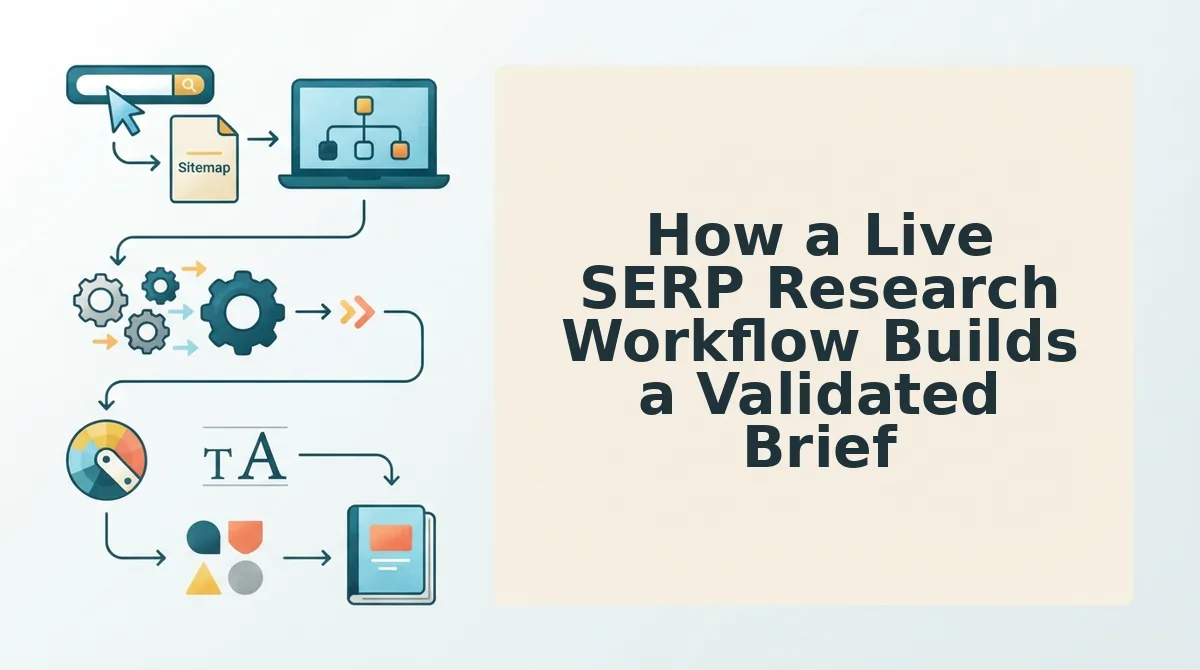
A live SERP research workflow builds a validated brief by studying what currently ranks, what users still ask, and what competitors miss, before any drafting starts. This brief validation step is what prompt-first tools skip.
Prerequisites: a target keyword, a browser with access to search results and community threads, a list of your existing site URLs (your sitemap works), and a document for your SEO content brief.
The 5-point "Is this brief validated?" checklist
- Collect consensus H2s from 3+ ranking pages. Open the top results and note headings that appear on at least three of them. Expect 15â20 minutes. You should end with 5â8 must-cover topics.
- List unanswered user questions. Search forums and social threads for the keyword and copy questions the ranking pages ignore. Expect 10â15 minutes. Success means 3â5 real questions written in users' own words.
- Classify the intent. Label the query as informational, comparison, or transactional based on what page types rank. Expect 5 minutes. You should have one intent label that dictates format, such as a guide or comparison table.
- Define your gap angles. Write 1â2 angles no ranking page covers well. Expect 10 minutes. Success is a sentence that explains why your article deserves to exist.
- Map internal links. Match 2â4 pages from your sitemap to sections of the brief. Expect 5 minutes. Each link should support a specific heading.
This checklist works with any tool, including Jasper. Paste the finished brief into the One-Shot Blog Post template and the draft improves immediately.
Worked example: the same topic, run end to end
How does BloGoose turn a niche topic into a published article? Take the topic from this article's introduction, Jasper for SEO blogging. BloGoose runs SERP and social queries on that topic, then extracts competitive gaps and intent patterns from the results. It outputs a validated brief and drafts the article with SEO and AEO content optimization built in, so the piece targets both Google rankings and AI answer citations. Sitemap context supplies internal links, and Markdown brand context files keep the voice accurate. BloGoose then creates images and publishes directly to WordPress or a custom API, removing the copy-paste step.
If your team spends more time assembling briefs than publishing, try BloGoose to run the research, brief, draft, and publish steps as one workflow.
Where BloGoose Falls Short
BloGoose has clear limits: it is built for SEO articles, it depends on current brand context, and its drafts still need human review.
- Not built for ad copy or campaigns. BloGoose focuses on search-ready articles, not ad variants or multi-channel campaign copy. That is Jasper's strength, so teams running paid social tests may still need a dedicated copy tool.
- Brand context files need upkeep. Voice accuracy depends on Markdown brand context files that reflect your current site. After a redesign or repositioning, update brand context files so the tone does not drift.
- Drafts still benefit from human review. Automated research and drafting cut the busywork, but they do not replace editorial judgment. A quick read for facts, nuance, and product claims before publishing protects your credibility.
With both tools' limits on the table, the choice comes down to your team's workflow.
Which Workflow Should Your Team Use?
Pick the workflow that matches where your research already happens. The writing tool matters less than whether the brief is validated before drafting starts.
- Choose Jasper if your team writes multi-channel or campaign copy and already has researched briefs.
- Choose a live SERP research engine if your team publishes regular SEO clusters that need to rank on Google and get cited in AI answers.
This is the finding the intro promised. Jasper writes well, but it starts after the research. SEO teams that use it end up doing the SERP research by hand.
Your next step is to run the 5-point checklist on your next brief. Any gap it exposes is a ranking risk that a better prompt cannot fix.
To skip the manual research loop, drop your domain into the AI SEO content engine setup wizard. BloGoose will crawl your site and build your first pillar-focused calendar.
Rankings and AI citations go to the article built on the live SERP, not the one built on the cleverest prompt.