
Live SERP Topic Research vs Manual Keyword Spreadsheets

Your keyword spreadsheet is a snapshot. The SERP is a live feed. The gap between them is where rankings are won or lost, and most content teams don't realize how wide that gap has become until a freshly published article lands on page four for a keyword that looked winnable two weeks ago.
If you've ever built a content calendar from export files, volume estimates, and difficulty scores only to watch the results underperform, you're not alone. The disconnect between live SERP topic research vs manual keyword spreadsheets is the single biggest hidden leak in modern SEO workflows.
This article will show you exactly what manual research still does well, where it silently breaks down, and how live SERP analysis closes the gap. Along the way, you'll learn a framework called SERP Drift, the measurable gap between what a spreadsheet snapshot says and what the live SERP shows at publish time, and why it explains most "mystery" ranking failures. One finding in particular will change how you schedule every future content brief.
Platforms like BloGoose now automate live SERP topic research directly into the drafting pipeline, but understanding the underlying mechanics matters before you hand off the work.
What Manual Keyword Spreadsheets Actually Do Well
A manual keyword spreadsheet is a structured research document where you record seed keywords, search volume, keyword difficulty, and SERP observations before writing content. It works, up to a point.
Think of a manual spreadsheet like a paper map. It gives you a reliable overview of the terrain, marks the major routes, and helps you plan a journey. But it doesn't tell you about the road closure that happened this morning. For that, you need live traffic data.
The standard manual workflow follows a predictable sequence: seed list to volume check to difficulty scoring to SERP review to content brief. You start with a list of topic ideas, pull volume and difficulty metrics from a tool, manually open the top ten results for each keyword, note what Google is ranking, and compile your observations into an SEO content brief.
This process has genuine strengths. Manual SERP review forces you to see exactly what content type Google rewards for a given query, whether that's a listicle, a comparison page, or a long-form guide. SEO educator Brie E Anderson emphasizes that Google's SERP shows the exact content type it wants, and manual SERP analysis is a required step in keyword research precisely because no volume metric can substitute for looking at the results yourself.
For a small set of high-priority keywords, say, ten to twenty, this hands-on approach produces genuinely useful briefs. You catch intent mismatches, spot content gaps, and internalize the competitive landscape. The problem isn't the quality of the output. It's the scalability of the process.
Manual live SERP analysis works beautifully as a bottleneck. Every additional keyword adds another round of opening tabs, scanning results, and updating cells. By the time you finish reviewing keyword forty, the SERP for keyword one has already shifted. BloGoose automates this entire research loop, but the manual method remains a useful baseline for understanding what the automation replaces.
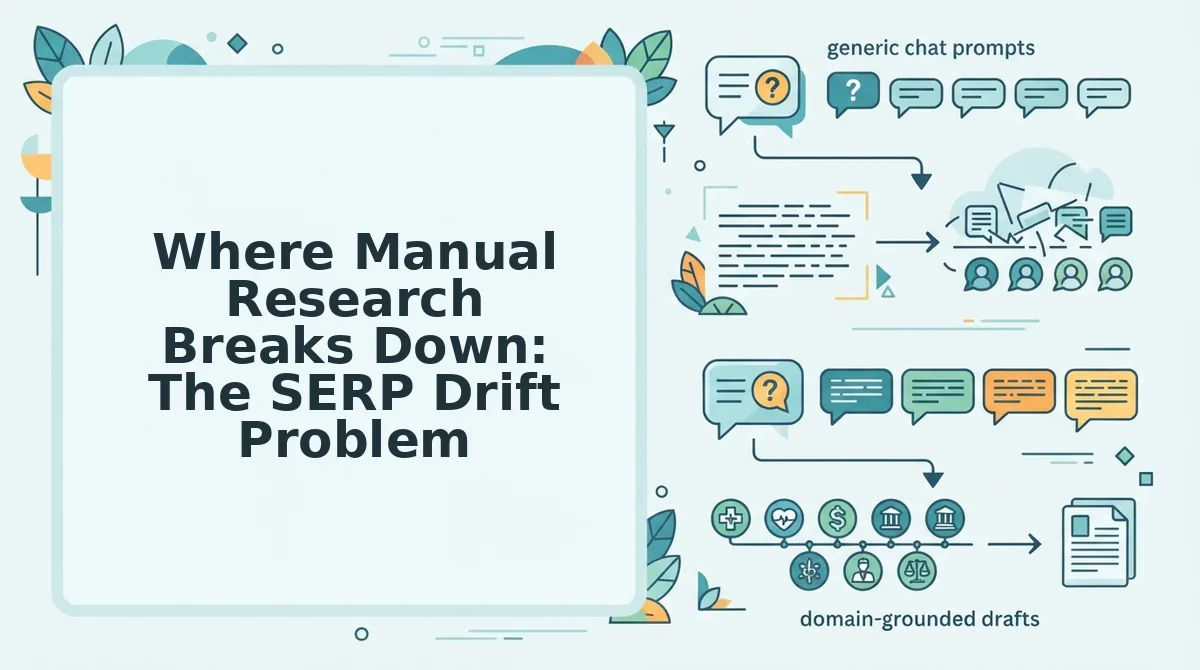
Where Manual Research Breaks Down: The SERP Drift Problem
SERP Drift is the measurable gap between what a spreadsheet snapshot says and what the live SERP shows at publish time. It is the primary reason manual keyword research produces content that misses its target.
Think of SERP Drift like checking a weather forecast on Monday and packing for a Saturday hike without looking again. The forecast was accurate when you saved it. But by Saturday, the conditions have changed, and you're standing on a trail in the wrong gear.
Five things drift between research and publish. Rankings shift as competitors publish new content or update old pages. Search intent migrates when Google reinterprets what users actually want from a query. People Also Ask questions change as Google's understanding of the topic evolves. Featured snippet formats flip between paragraphs, lists, and tables. And new competitors enter the SERP with content that resets the quality bar.
The hidden cost is time. Manual SERP review scales poorly beyond roughly twenty keywords. Each keyword requires opening the SERP, scanning the top results, noting content types and formats, and recording observations. At a conservative five to seven minutes per keyword, a fifty-keyword research sprint consumes four to six hours of pure SERP review, before any brief writing begins. By the time the brief is done, the earliest-reviewed keywords have already drifted.
This is why teams that rely on manual spreadsheets often publish content optimized for a SERP that no longer exists. The spreadsheet was accurate. The SERP moved. The gap between them is where rankings are lost.
Live SERP topic research closes that gap by querying the SERP at the moment of drafting, not days or weeks earlier. Here's what that actually looks like in practice.
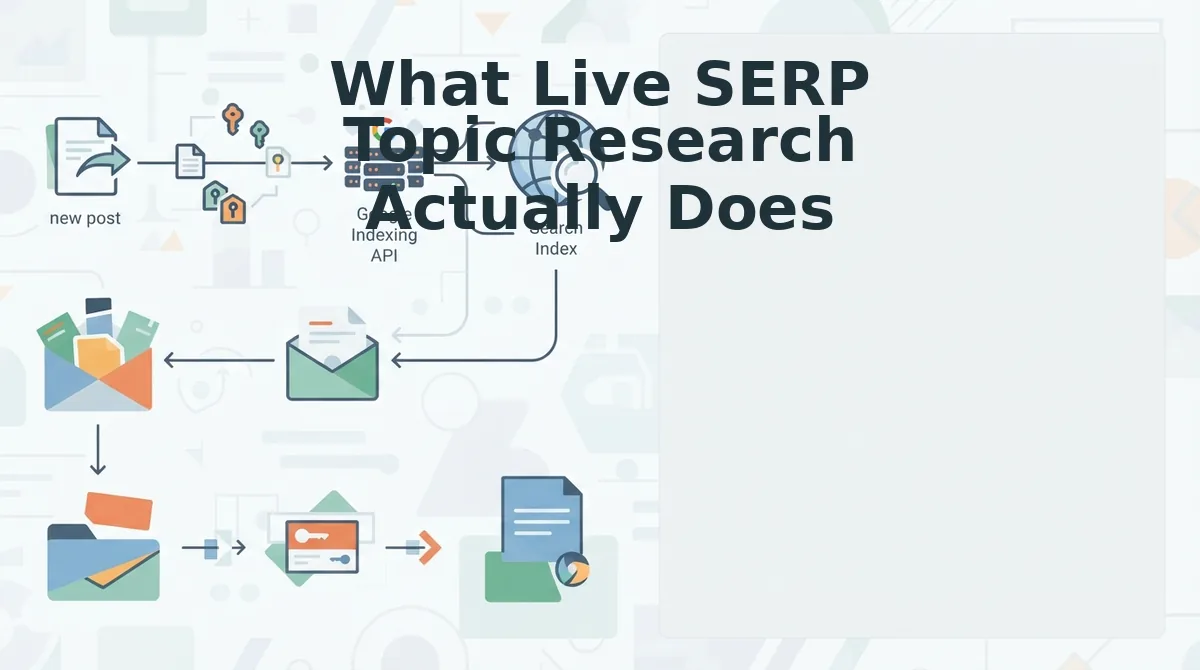
What Live SERP Topic Research Actually Does
Live SERP topic research replaces the manual export-and-review loop with an automated pipeline: a tool crawls your site, extracts your brand context, queries current search results, and generates a content calendar from what is actually ranking right now. You need a domain with a crawlable sitemap and an automated SEO content tool that can query SERPs programmatically.
- Open your content engine and enter your domain. In BloGoose, paste your site URL into the setup wizard. The crawler locates your XML sitemap and inspects your published pages. You should see a crawl summary listing page count, detected topics, and any broken URLs.
- Select Brand Context from the sidebar, then review the extracted voice rules. The tool pulls tone, terminology, and formatting patterns from your existing content. Confirm or edit the rules. You should see a green checkmark next to each extracted rule that matches your editorial standards.
- Click Query Live SERPs. The engine sends your seed topics and detected site themes to the search results in real time. It captures current ranking pages, SERP features like People Also Ask and featured snippets, and competitor gaps. Expect this to take 2-5 minutes depending on topic count.
- Open the Content Calendar tab. BloGoose groups the live SERP findings into pillar-and-cluster topic clusters. Each suggested article shows the target query, detected intent, and a gap note explaining why the topic earned a slot. You should see a dated publishing sequence you can reorder by drag and drop.
- Click Generate Draft on any calendar item. The engine drafts the article using your brand voice rules and the live SERP data as the optimization layer. You should see a full draft with headings, internal link suggestions, and AEO-friendly answer blocks within 60-90 seconds.
- Select Publish, then choose WordPress or API. BloGoose ships the finished article directly to your CMS. You should see a success confirmation with the live URL once the post is live.
Live SERP data catches three things manual spreadsheets routinely miss: intent shifts where a keyword now means something different than it did last quarter, new SERP features that change what content format wins, and competitor content gaps that only appear when you compare current ranking pages side by side. BloGoose replaces fragmented multi-tool writing stacks by automating research, drafting, optimization, and publishing in one workflow, so the calendar you build from live data is also the calendar you publish from. For teams that want the calendar built automatically from live search results rather than assembled by hand, an autopilot content calendar removes the manual step entirely.
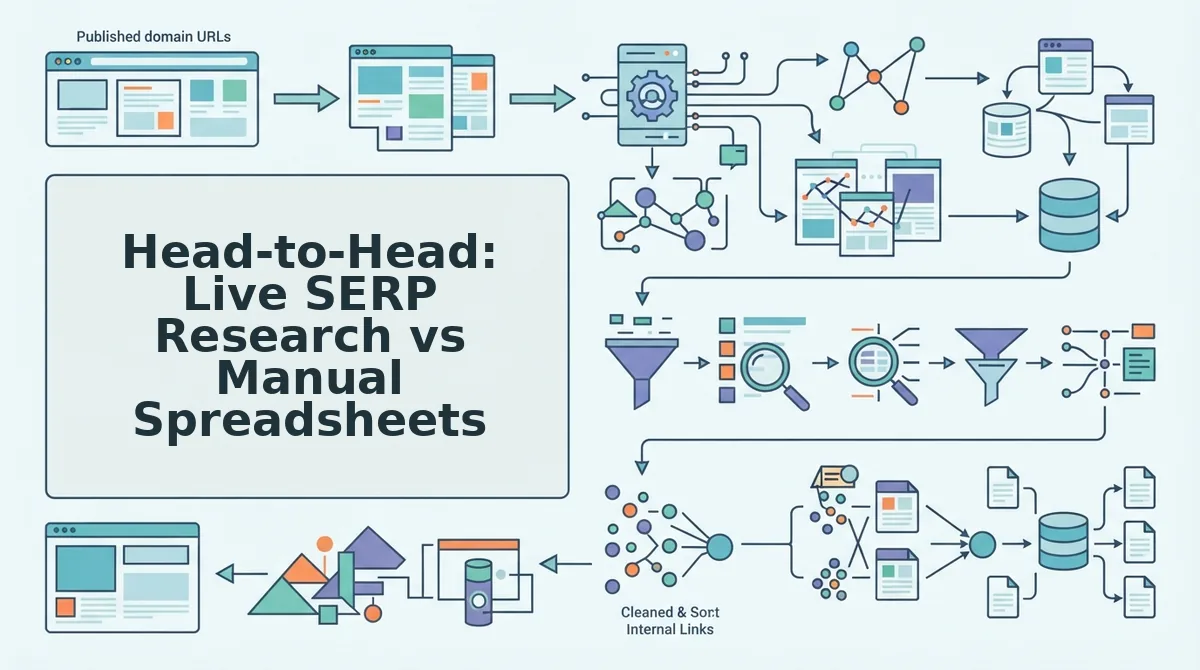
Head-to-Head: Live SERP Research vs Manual Spreadsheets
Live SERP research and manual keyword spreadsheets solve different problems, and the honest answer is that most teams need both at different stages. Manual spreadsheets remain the best tool for seed keyword curation, stakeholder review, and small keyword sets where human judgment matters more than scale. Live SERP research wins when you need content at scale, competitive niche coverage, or fast-moving industries where rankings change weekly.
| Comparison Factor | Manual Keyword Spreadsheets | Live SERP Topic Research | Hybrid Workflow |
|---|---|---|---|
| Data freshness | Snapshot at export time; decays as SERPs shift | Queries current results on every run | Seed data refreshed by live queries before drafting |
| Setup time | Hours to days for a full keyword matrix | Minutes: domain crawl plus automated SERP query | Moderate: manual seed list, then automated expansion |
| Scale ceiling | Practical limit around 100-300 keywords per person | Thousands of topics across pillar-and-cluster maps | Manual curation at the top, automated scale below |
| Stakeholder review | Excellent: rows are easy to annotate and approve | Weaker: generated calendars need a review layer | Strong: humans approve seeds, engine expands them |
| SERP feature detection | Manual and error-prone | Automated: PAA, featured snippets, video carousels | Automated detection with human prioritization |
| Best for | Solo consultants and small teams validating a niche | Publishers and agencies running content at scale | Most growth teams with an editorial review step |
Manual spreadsheets deserve credit where they excel: they force deliberate keyword selection, they are easy to share with a client or editor, and they keep a permanent audit trail of why a keyword was chosen. No automated tool replaces the judgment call of deciding a keyword is off-brand or too competitive for your current domain authority. If you manage a small set of high-intent keywords and publish slowly, a spreadsheet is genuinely sufficient.
Live SERP research earns its place the moment publishing volume increases or the niche gets competitive. When rankings shift weekly, a spreadsheet exported last month is already wrong. Live research also catches SERP features that change the required content format, something a static keyword list cannot signal. For teams that want to keep their manual process but remove the drift, a hybrid workflow works best: curate seed keywords manually, then let live SERP research expand and validate them. If you already manage target keywords in a structured file, that seed list becomes the input for automated expansion rather than the final output. The broader question of whether to run this inside a dedicated engine or a chat window is covered in our breakdown of AI content engine vs chat window workflows.
FAQ: Live SERP Research vs Manual Spreadsheets
Live SERP research queries current search results programmatically and turns them into a content calendar, while manual spreadsheets capture a static snapshot of keyword data at export time. The core difference is freshness: live research reflects today's rankings, spreadsheets reflect the day you built them.
How does live SERP topic research compare to manual keyword spreadsheets?
Live SERP research queries current search results automatically and generates a content calendar from what ranks now. Manual spreadsheets capture a static snapshot at export time. Live research scales to thousands of topics and detects SERP features; spreadsheets cap around a few hundred keywords per person but offer better stakeholder review.
What does live SERP research catch that manual research misses?
Live research catches intent shifts where a keyword's meaning changed since your last export, new SERP features like People Also Ask or video carousels that change the winning content format, and competitor content gaps visible only when current ranking pages are compared side by side. A static spreadsheet cannot surface any of these.
Can I combine live SERP research with manual spreadsheets?
Yes, and most teams should. Use manual spreadsheets for seed keyword curation and stakeholder approval, then feed those seeds into a live SERP tool for expansion and validation. The hybrid workflow keeps human judgment on keyword selection while automating the scale and freshness layers.
How much time does manual SERP research actually take?
Manual SERP research typically takes hours to days for a full keyword matrix: exporting data, reviewing each SERP by hand, noting features and competitors, and building a calendar. Live SERP research completes the same crawl, query, and calendar generation in minutes, though human review of the output still adds time.
The SERP Drift decision: stop choosing between speed and accuracy
Manual spreadsheets win for seed keyword curation and stakeholder review. Live SERP research wins for catching intent shifts, new competitors, and featured snippet changes that spreadsheets miss. The highest-performing teams use both: manual for strategy, live for execution.
That's the resolution to the tension this article opened with. The spreadsheet isn't obsolete, it's just the wrong tool for the wrong phase. Your keyword strategy belongs in a document humans can debate. Your topic execution belongs in a system that watches the SERP while you sleep.
Here's the pattern interrupt: teams that insist on one approach exclusively lose either speed or accuracy. Teams that sequence both gain a compounding advantage, every crawl cycle feeds better manual decisions, and every manual decision sharpens what live research should track.
Three concrete next steps:
- Keep your seed keyword spreadsheet for quarterly strategy reviews and stakeholder sign-off.
- Move topic expansion and content brief generation to a live SERP research workflow that re-checks rankings, competitors, and snippet formats before every publish.
- Automate the execution layer with automated SEO content that pulls live SERP data into every draft, so your manual strategy actually reaches the page without drift.
BloGoose is built for exactly this handoff: crawl your site, extract your brand voice, then generate and publish rank-ready articles that reflect what the SERP rewards today, not what your spreadsheet captured last quarter. See how the engine sequences manual strategy with live execution on BloGoose pricing.
Spreadsheets set the direction; live SERP research keeps you on the road while the map redraws itself.