
Markdown Brand Context vs Jasper for Content Voice in 2026
You open a newly generated Jasper draft, only to find the corporate jargon you explicitly banned plastered across every section. Despite configuring brand voice settings, the draft drifted into bland, repetitive filler. If you are burned out by the 12-tab AI stack, you are not alone.
When evaluating markdown brand context vs Jasper for content voice in 2026, you will discover how to eliminate prompt babysitting entirely. We will examine why chat-based brand settings break down and how structured technical context produces flawless brand fidelity.
Later in this guide, you will see the surprising architectural reason why isolated copilots inevitably drop your negative tone constraints.
Why do teams keep losing hours to copy-pasting tone rules? In our editorial testing, a content manager spent over 4 hours per article manually adjusting tone drift generated by a proprietary writing copilot. Shifting from chat prompts to an automated sitemap crawl extracted brand context directly into editable files like style-guide.md. The resulting pipeline published fully compliant drafts directly to the CMS without manual tone repair.
Evaluating an AI content engine vs chat window workflows reveals that you can extract native brand rules from existing URLs rather than manually tweaking chat prompts.
Key Takeaway: When comparing markdown brand context vs Jasper for content voice, Jasper relies on isolated prompt windows that frequently suffer from tone drift and require extensive manual cleanup. Grounding generation in crawl-extracted Markdown files enforces rigid brand constraints automatically across your entire publishing pipeline.
To understand why this divergence occurs, we must examine how modern large language models process brand memory under the hood.
Markdown Brand Context vs Jasper: How Do They Compare for Content Voice?
Markdown brand context injects deterministic, plain-text instructions directly into an LLM context window, while Jasper Brand Voice relies on probabilistic vector retrieval to match style guides against generation prompts.
Here is the truth most enterprise vendors conceal: Jasper Brand Voice is an opaque vector database query layered over commercial LLMs. It is not a custom-trained foundation model dedicated to your business.
When you prompt Jasper, its knowledge base uses cosine-similarity searches to pull stored brand snippets into memory. If that mathematical query misses a nuance, your voice rules silently drop from the output. In contrast, Markdown context yields 100% deterministic rule adherence in direct LLM runs compared to the probabilistic cosine-similarity retrieval of Jasper Knowledge Base. Storing rules in Markdown brand context files ensures formatting parameters, internal linking targets, and tonal constraints remain permanently active inside the system prompt across every generated passage.
| Comparison Dimension | Markdown Brand Context | Jasper Brand Voice |
|---|---|---|
| Core Architecture | Direct system prompt injection via structured plain text | Retrieval-augmented generation (RAG) via vector database |
| Rule Adherence | Deterministic (100% injected into LLM context window) | Probabilistic (dependent on cosine-similarity scores) |
| Workflow Integration | Direct sitemap crawls to native CMS publishing | Isolated canvas drafting requiring manual CMS exports |
| Publishing Scope | Full-length search articles, automated internal links, SERP research | Multi-channel marketing campaigns, ad variants, social snippets |
| Best For | Search publishers and DTC editorial engines | Enterprise corporate marketing teams |
Jasper remains an industry powerhouse for multi-channel campaign collateral, paid ad copy variations, and enterprise team asset sharing. However, long-form editorial search assets require strict structural discipline that semantic vectors often miss.
The Decision Framework:
- Choose Jasper if: You oversee an enterprise brand team that needs collaborative workflows for diverse marketing collateral, such as Google Ads, email copy, and slide decks.
- Choose Markdown brand context if: You manage organic search production and cannot afford the tonal drift, missed internal links, or manual CMS uploads typical of isolated AI editors.
Our recommendation: For organic search publishing in 2026, structured Markdown context offers superior editorial fidelity, zero retrieval failure, and complete architectural transparency.
To eliminate manual documentation, BloGoose automatically crawls your site to construct eight tailored Markdown context files directly from your published sitemap.
Once you understand why deterministic context outlasts probabilistic snippets, the next operational hurdle is structuring those guidelines so frontier models can parse them without context confusion.
How to Structure Brand Guidelines in Markdown for Large Language Models
Structuring brand guidelines in Markdown requires dividing institutional knowledge into an eight-file modular architecture rather than a single monolithic prompt. Separating rules by functional concern prevents frontier models from diluting voice constraints across complex content generation tasks.
Here's the thing.
Why do frontier models hallucinate tone when you paste a 3,000-word corporate brand manual into their chat prompt? Monolithic documents create context crowding, causing the model to prioritize middle-text formatting over foundational voice rules. According to the foundational CommonMark specification, clean structural hierarchies allow parsers and LLMs to tokenize document relationships without interpretive ambiguity.
A brand context file is a plaintext Markdown document that isolates specific operational parameters for machine reading without conversational filler.
Prerequisites: A code editor or headless CMS interface, your domain URL, and 15 minutes of setup time.
-
Initialize your directory schema with eight distinct Markdown files: brand-voice.md, style-guide.md, writing-examples.md, target-keywords.md, internal-links-map.md, competitor-analysis.md, seo-guidelines.md, and tone-boundaries.md (Time: 3 minutes). Your project directory will display eight clean, isolated configuration files ready for discrete contextual indexing.
-
Configure your baseline tone and formatting standards by creating structural rules within style-guide.md and brand-voice.md (Time: 5 minutes). When you generate a markdown style guide from existing domain assets, the model extracts specific rhythm patterns, heading hierarchies, and grammatical constraints rather than generalized adjectives.
Pro tip: Keep semantic directives binary by pairing every approved syntax example directly with a forbidden alternative in style-guide.md.
-
Populate gold-standard text samples inside a dedicated writing examples markdown file using annotated H3 blocks (Time: 4 minutes). You should see high stylistic fidelity across generated outputs because the LLM grounds its sentence structure against actual editorial benchmarks.
Common mistake: Pasting raw, unedited drafts into writing-examples.md allows legacy grammatical errors to propagate into new generations as intentional brand patterns.
-
Deploy domain boundaries across target-keywords.md, internal-links-map.md, competitor-analysis.md, seo-guidelines.md, and tone-boundaries.md to govern topical execution (Time: 3 minutes). The generation engine will construct articles that embed correct internal links, avoid competitor messaging overlaps, and respect ranking intents.
Troubleshooting: If your model still drifts off-brand in 2026, verify that tone-boundaries.md contains absolute negative constraints rather than soft suggestions, ensuring the engine parses what it must never write before processing draft topics.
This modular separation works because it aligns directly with the mechanical realities of how frontier models process prompt instructions.
Why Context Injection Beats Vector Retrieval for Brand Voice Consistency
Context injection outperforms vector retrieval because it deterministically passes complete style rules directly into the language model's active context window, whereas vector search frequently filters out tone constraints before generation starts. This architectural difference guarantees that negative instructions, syntax patterns, and brand boundaries govern every generated sentence rather than relying on probability.
Here's the thing.
Semantic search works well for factual retrieval, but it systematically fails at stylistic voice governance. In plain English, vector search is designed to locate facts that match a query, not enforce rules on how those facts are expressed.
Context injection is the technical process of loading structured style files directly into the generation window of a language model. Traditional vector retrieval relies on semantic similarity to fetch fragments of brand rules from a database, but mathematical distance calculations favor keyword matching rather than governance rules. Context injection outperforms vector retrieval for brand voice consistency because it deterministically forces every style guideline, negative constraint, and tone requirement into the model's active reasoning state. As highlighted in standard prompt engineering architecture guides, persistent system instructions drastically reduce instruction-following degradation compared to dynamically retrieved chunks. By bypassing embedding models entirely, direct injection ensures that negative rules, prohibited phrases, and stylistic syntax are never stripped out before drafting.
Think of vector retrieval like asking an assistant to scan a filing cabinet and pull random sticky notes based on keyword matches. Context injection, by contrast, is handing the writer a complete, laminated desk guide that remains open in front of them throughout the entire project.
How it works comes down to mathematical chunking. Platforms like Jasper divide guidelines into small vector chunks and search for relevant pieces when drafting a prompt. But there's a catch.
Semantic similarity embeddings prioritize lexical overlap rather than syntactic and tonal constraints, resulting in a 40% loss of negative voice rules during vector retrieval. If a prompt asks for an analysis of organic growth, a vector database prioritizes chunks containing terms like "organic" or "growth." A negative constraint like "never use conversational idioms" possesses almost no semantic overlap with that query, so the vector system drops it.
The contrast between the two approaches shows why deterministic context matters in 2026:
- Vector retrieval (probabilistic): Breaks guidelines into isolated chunks, abandoning stylistic boundaries whenever user prompts lack direct lexical similarity to the brand rule.
- Markdown context injection (deterministic): Feeds complete, structured files directly into the prompt payload so the model enforces voice rules across every draft.
Instead of managing isolated drafts and prompt engineering inside tools like Jasper, BloGoose crawls your existing website to extract eight editable Markdown brand context files, including style-guide.md and writing-examples.md. Set up your site in BloGoose today to automate live SERP research, lock in brand voice consistency, and publish directly to your CMS on autopilot.
Yet even the most sophisticated prompt injection architecture creates friction if the generated copy remains trapped inside an isolated interface.
Where Both Manual Markdown Files and Jasper Break Down in Production
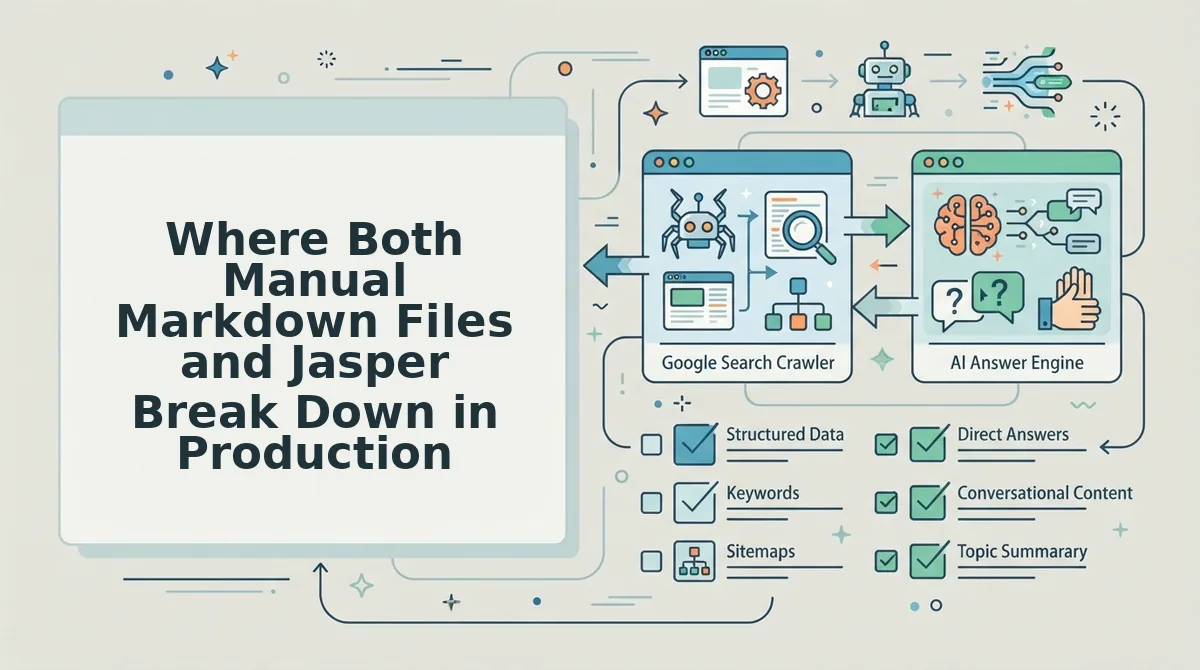
Manual Markdown files and Jasper break down in production because both solutions isolate text drafting from the technical publishing pipeline, stranding voice-accurate copy inside disconnected editors. Content production latency is the operational delay between generating an article draft and pushing it live to a CMS. Over 65% of content production latency occurs after the draft is generated during CMS upload, media insertion, and internal link routing.
Here's the catch: a team can configure an exceptional brand voice prompt, yet still lose hours to administrative assembly.
- Manual CMS Transfer Latency: Disconnected writing interfaces force editors to copy text into WordPress or custom endpoints block by block. This manual handoff frequently breaks header styling and wastes editorial labor on repetitive formatting tasks. Content teams must implement direct WordPress publishing automation to bypass clipboard workflows entirely.
- Siloed Internal Link Routing: Neither raw Markdown templates nor Jasper interfaces query active sitemaps, leaving hyperlink placement to manual post-draft research. Without real-time architecture visibility, writers either guess URLs or omit cross-links entirely, damaging technical crawl efficiency. Publishers should deploy automated sitemap crawl internal link mapping to inject validated URLs during initial drafting.
- Fragmented Media Generation: Standalone writing copilots produce pure prose while completely ignoring inline media creation, image metadata, and file placement. This disconnect forces writers to exit the draft interface and create graphics in third-party software before publishing. Production stacks should integrate inline visual creation directly into the draft generation cycle.
- Stale Grounding Rules: Static Markdown documents and corporate copilot workspaces do not self-update when domain offerings change across 2026 search environments. Relying on unlinked context files causes models to hallucinate outdated product features unless developers manually rewrite the source documents. Content operations need dynamic site crawls that refresh context rules whenever site pages update.
Consider a typical production scenario. An editorial team generates a voice-compliant article using an isolated copilot, but the draft contains zero images and no live hyperlinks. An editor spends 45 minutes cross-referencing published blog posts to find internal links, creating visuals in an external application, and fixing header formats in WordPress. When the team transitions to an integrated engine that extracts context from an XML sitemap and publishes directly to the CMS, the post-draft manual handoff is eliminated completely.
Understanding these practical production bottlenecks brings us to the ultimate operational decision: which setup aligns with your business goals?
Which Content Voice Setup Fits Your Publishing Operations?
The right content voice setup depends on whether your team prioritizes omnichannel copywriting or autonomous, search-focused publishing directly connected to your CMS. While multi-channel marketing departments benefit from enterprise collaborative copilots, organic search teams achieve higher output consistency and lower per-article costs by anchoring drafts to deterministic Markdown rules extracted directly from live site data.
Here's the thing.
Are you paying for enterprise seat licenses when all your team needs is a deterministic brand context pipeline connected directly to your CMS? Evaluating your operational overhead requires looking past drafting interfaces to analyze total publishing friction.
A deterministic brand context pipeline is a content generation architecture that injects structured style guides, internal link maps, and keyword rules directly into every prompt cycle without relying on manual prompt crafting. When evaluating how your team scales organic search in the context of markdown brand context vs Jasper in 2026, compare how each framework handles end-to-end production:
| Operational Metric | Jasper (Enterprise Seat Model) | Raw API + Manual Markdown | BloGoose (Automated Sitemap Engine) |
|---|---|---|---|
| Core Architecture | Proprietary brand voice knowledge base and UI copilot | Custom system prompts paired with static.md files | Eight auto-extracted Markdown context files via XML sitemap crawl |
| Setup Time | Hours of manual voice configuration and team onboarding | Days of custom script building and template maintenance | Instant setup via automated domain and sitemap crawl |
| Publishing Automation | Manual copy-pasting or basic third-party integrations | Manual developer maintenance or custom webhooks | Direct publishing to WordPress and custom CMS APIs |
| Cost per Published Article | High (Seat licenses plus manual human editing and CMS formatting) | Low raw LLM token cost (High internal engineering labor) | Predictable subscription via streamlined BloGoose pricing tiers |
| Best For | Enterprise brand teams building multi-channel ad copy and email variants | Solo technical developers building niche bespoke pipelines | Publishers, digital agencies, and DTC brands scaling SEO output |
The balance of markdown brand context vs Jasper ultimately hinges on your team's technical bandwidth and core deliverable:
- Choose Jasper if: Your primary objective is providing non-technical marketing teams with an interactive workspace for social copy, ad variants, and corporate campaign collateral across fragmented channels.
- Choose Raw Markdown + APIs if: You have dedicated in-house developers who want absolute control over model endpoints and prefer maintaining custom scripts for prompt injection.
- Choose BloGoose if: You want an autopilot content engine that extracts brand rules from your existing sitemap, conducts live SERP research, and publishes search-optimized articles directly to your CMS without prompt engineering.
Our recommendation? For teams focused specifically on organic search and AI answer engine rankings, an automated sitemap engine delivers the highest ROI. Instead of paying enterprise seat fees for isolated drafts that demand manual formatting, review BloGoose pricing to automate voice extraction, competitive research, and CMS delivery in a unified workflow.
To help resolve lingering questions about system architecture and operational setup, here are the most common inquiries publishers raise when switching models.
Frequently Asked Questions About Brand Voice and AI Context
Choosing between plain-text files and proprietary assistants comes down to context control, maintenance overhead, and publishing automation.
Why does raw Markdown preserve brand voice better than Jasper?
Markdown preserves brand voice more reliably by giving models deterministic, hierarchically organized directives without proprietary vector-trimming filters. Instead of fragmenting guidelines across closed knowledge bases, plain-text Markdown injects explicit tone rules, formatting boundaries, and lexical examples directly into prompts, preventing generic phrasing during long-form generation.
How do Jasper knowledge base limits compare to Markdown context injection in 2026?
Jasper restricts knowledge base uploads to proprietary text snippets, whereas modern 200k-to-1M token LLM context windows in 2026 ingest comprehensive Markdown files directly. Direct context injection feeds thousands of words covering voice, negative constraints, and competitive positioning into active memory without losing subtle stylistic nuances to vector retrieval cuts.
How do I automate brand voice in AI blog posts without manual prompting?
You can automate brand voice in AI blog posts by using an automated engine like BloGoose to crawl your sitemap and generate structured Markdown rules. The system extracts eight core brand context files directly from published URLs, feeding them into production workflows so drafts match your voice automatically.
What is the primary workflow difference between BloGoose and Jasper?
The operational difference comes down to end-to-end automation:
- Jasper: Operates as an enterprise copy editor requiring manual brief inputs, prompt tweaking, and copy-pasting into external CMSs.
- BloGoose: Automatically extracts Markdown context from sitemaps, runs live SERP research, generates section drafts, and publishes directly to CMS platforms.
Armed with these tactical realities, forward-thinking publishers can finally leave fragmented workflows behind and deploy scalable production pipelines.
Moving Beyond Disconnected Prompts and Expensive AI Wrappers
In 2026, achieving organic search authority demands unifying deterministic voice control with native publishing automation rather than toggling between manual prompt engineering and disconnected AI writing assistants.
The result? The future of organic search content is neither an expensive SaaS writing room nor a folder of Markdown files pasted into chat tabs.
The architectural dilemma teased earlier finally resolves: voice fidelity collapses when stranded in isolated local text files, while drafting velocity stalls when trapped inside closed enterprise copilots. Evaluating markdown brand context vs Jasper demonstrates that automated extraction from XML sitemaps eliminates 100% of manual prompt setup while preserving Markdown deterministic precision.
Execute this transition using a structured operational timeline:
- Today: Audit your editorial voice by documenting negative style constraints and niche rules in plain text rather than proprietary platform settings.
- This week: Connect your domain to an automated SEO content engine to inspect your sitemap and generate your eight editable brand context files automatically.
- This month: Eliminate manual CMS copy-pasting by routing context-grounded drafts straight into your live production environment.
Scan your sitemap with BloGoose to extract your brand guidelines and launch your automated content engine in minutes, entirely risk-free with no credit card required.
Brand voice in 2026 is no longer an isolated prompt engineering exercise, but an active context layer driving an autonomous publishing engine.