How to mine Reddit and forums for blog topics
You have a bookmark folder full of saved Reddit threads, and not one has become a published post. That folder is where good research goes to die. This guide shows you how to mine Reddit and forums for blog topics so the work ends in an outline instead of another saved link.
The confusion is understandable. Popular "Reddit SEO" videos from Rank Math and Engain treat Reddit as a publishing surface where you place links. If you finish one of those videos and start posting into subreddits, you have the direction backwards. Reddit pays off as a research surface you read from.
You'll learn why threads beat keyword tools for discovery, which copy-paste search operators surface the right threads, and how to log replies so they never return to that folder. The deliverable is a filled insight ledger. Watch for the one ledger column most people leave empty. It decides whether a topic is worth writing, and it appears near the end.
Once your ledger is full, BloGoose can turn it into a 30-day content calendar drafted in your brand voice.
Why Reddit threads beat keyword tools for topic discovery
Forums store the sentence a buyer actually typed. Keyword tools store a normalized version of it, with the frustration, context, and wording stripped out.
Phrase mining is the practice of collecting the exact words real people use to describe a problem, so your article answers them in their own language. Topic mining collects subjects. Phrase mining collects the sentences inside those subjects.
Think of a keyword tool as a restaurant's sales report. It tells you how many people ordered the soup. A thread is like overhearing the table, where you learn the soup was too salty and that someone asked for bread to fix it.
Reddit is a phrase mine, not a topic mine
This distinction answers the objection "Isn't this just copying competitors?" Topics overlap across every site in a niche, while phrasing reflects how your own readers think. Borrowing a reader's question is not copying a competitor's article.
Demand-focused approaches miss this layer. Greg Isenberg's startup idea mining and the Engain parasite-SEO pitch both stop at demand and never reach the phrasing a writer needs.
Recurrence beats upvotes
Upvotes measure agreement, not search demand. A 2,000-upvote rant is weaker evidence than the same question asked nine times across different months. A four-upvote thread where the same wording recurs is the strongest signal you can log.
A thread gives you three things that a keyword row cannot:
- The objection: why the reader hasn't solved the problem yet.
- The workaround: the fix people are already trying.
- The vocabulary: the exact terms to use in headings and in topic clusters.
How to find the right threads with copy-paste search operators
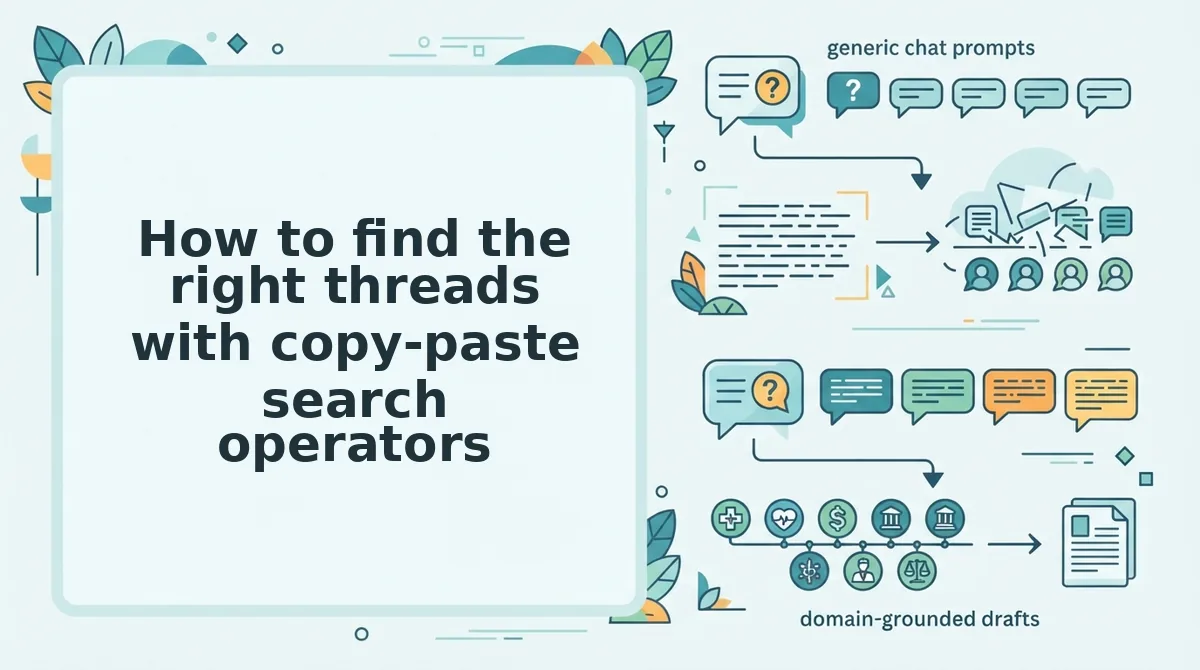
Pick three communities, then search them for questions instead of scrolling feeds. Search operators are filters typed into Google or Reddit search that narrow results to question-shaped threads.
Prerequisites: a browser, Google, and a blank spreadsheet. The full sequence takes about 45 minutes.
- Choose three communities (15 minutes). Score candidate subreddits or forums on three criteria. The first is question recurrence, meaning the same questions keep showing up. The second is practitioner mix, meaning people who do the work reply rather than only spectators. The third is moderation strictness, because strict moderation filters out spam. Success looks like three community names in your sheet that each score well on all three criteria.
- Type question-shaped Google queries (15 minutes). Paste these queries and replace the bracketed text:
- site:reddit.com "how do I" [your topic]
- site:reddit.com intitle:"?" [your topic]
- site:reddit.com/r/[subreddit] [your topic]
- Sort inside Reddit by comments (10 minutes). Search your topic within each subreddit, open Sort, and select Comments instead of Top. Success looks like long reply chains where people disagree, which is where you find objections and workarounds.
- Paste each thread URL into your sheet (5 minutes). Log the link only for now. You will extract the replies in the next stage.
What if your niche has no active subreddit? Mine the places where customers still ask questions in writing. Check the Q&A sections on review sites, search archived Discord or Slack community channels, and read vendor changelogs, where feature requests reveal unmet needs. Apply the same rule you use on Reddit and look for questions that repeat across separate months, not posts with the most reactions. These sources often contain more specific phrasing than large subreddits, because the people posting are already using the product.
One caution: the Writerify and Pinterify course clip teaches Reddit mining as keyword research. That approach produces a query list but no writing material, and writing material is what makes helpful content. BloGoose's site crawl adds your brand voice rules to that material automatically.
With your threads collected, the next step is to mine the replies and log them in a five-column insight ledger.
How to mine replies and log them in a five-column insight ledger
Mine replies by copying exact sentences, never paraphrases, into five fixed columns that force every quote to earn a spot in a specific section. Titles name the topic; replies carry the language and the objection.
Read the top three comment branches and capture the raw sentence verbatim before you log it. Paraphrasing at capture is how the signal dies.
- Verbatim phrase. The exact words, typos intact, inside quotation marks. This is what later becomes body copy or an H3, which is why it never gets tidied up at capture.
- Objection. The doubt the phrase is really expressing, named in three to five words. It maps to an FAQ entry or comparison section and tells a writer who never opened the thread what the friction was.
- Source plus date. The subreddit or forum, thread link, and the month it was posted. Dates matter because tool names and prices decay, and quoted language goes stale with them.
- Intent stage. Whether the poster is unaware, comparing, or ready to buy. Placement depends on it: comparison-stage language belongs mid-post, purchase-stage language near the CTA.
- Target section. The exact H2 or FAQ slot the row feeds. A row with no section is a bookmark, not research.
What should a Reddit research spreadsheet actually contain? Five columns and nothing else. Each row should be legible to someone who never opened the thread, which is why the phrase goes in quoted rather than summarized. A filled row for a setup article reads: "I set it up and nothing happened" â objection: silent failure â source: the subreddit, posted that month â intent: post-purchase â target: setup troubleshooting. If a row cannot fill all five cells, delete it.
A top comment that reframes the thread's own question is a candidate H2, not a footnote. Log it in the target section column as a proposed heading.
Cap the ledger at 15 rows per article. If it overflows, the topic is not tight enough to be one post; split it or cut the weakest rows.
Verbatim phrasing is also what gets lifted into AI answers, which is the practical core of AEO content optimization.
Which thread ideas pass the recurrence, saturation, and decay tests
A thread idea is validated only when it clears three tests, and each test returns one of three outcomes: write the article, demote to FAQ, or drop it.
| Test | What it checks | Outcome | Best for |
|---|---|---|---|
| Recurrence | The same phrase appears in separate months, not just one high-upvote thread | Pass: build the brief | Solo operators deciding which idea to write first |
| Saturation | Three or more page-one results already answer the question completely | Fail: demote to an FAQ entry | Publishers competing for snippets rather than full posts |
| Decay | Language tied to a specific tool version or price | Write it now or drop it | Review and comparison writers covering fast-moving software |
One-click Reddit-to-article converters, MEGA's reddit-to-blog tool among them, skip this gate entirely. That is the failure mode the tests exist to prevent: converting a single thread before anything has been validated.
Worked case: a phrase that recurs across separate months but fails saturation gets demoted to an FAQ entry rather than killed. Log the row against the FAQ slot and carry it into an SEO content brief.
Turn validated threads into a month of blog posts
The research is not the deliverable, the brief is. A 15-row ledger that never leaves the sheet is the same failure as the bookmark folder, only tidier.
Three moves today: delete the folder you have been hoarding, run one operator query against your niche's most active subreddit, and open a five-column sheet with the three-test gate written into the header row. Every row that survives becomes a section target, every section target becomes a calendar slot. The payoff from the thread that reframed its own question is a headline you did not have to invent.
That handoff is where most teams stall, and it is the one BloGoose automates: it crawls your domain, extracts voice rules, and ships validated topics as scheduled, automated SEO content straight to WordPress or your API. Start by dropping your domain into the setup wizard.