
How to organize topic clusters around detected pillars fast
Your content team spends weeks assembling 12-tab keyword spreadsheets, only to publish supporting articles that cannibalize your own established rankings. When you organize topic clusters around detected pillars, you anchor subtopics strictly to existing core pages with proven sitemap equity rather than chasing disconnected search volume. Traditional cluster advice assumes an empty domain, whereas established sites need automated pillar detection from existing index equity to build clean topic clusters around already-indexed URLs.
Deploying an AI SEO content engine simplifies this process by scanning your live sitemap to identify established topic hubs before generating new outlines. In this guide, you will learn how to extract core topic pillars, map targeted child URLs without cannibalization, and automate bidirectional linking across your CMS. This framework applies specifically to websites with crawlable XML sitemaps and indexed URLs, rather than brand-new domains starting without historical search visibility.
To organize your clusters rapidly without manual spreadsheet sprawl, execute three sequential phases:
- Isolate primary pillar URLs directly from your existing site structure and sitemap data.
- Group subtopics strictly by intent boundaries to prevent competing against your own indexed URLs.
- Construct bidirectional contextual links that signal clear topical authority to search and answer engines.
Later in this walkthrough, discover why targeting high search volume alone actively splits your topical authority, and which sitemap configuration signals your true hub pages before you draft a single word.
Prerequisites to Organize Topic Clusters Around Detected Pillars Fast
Organizing topic clusters rapidly requires identifying live URLs that already hold structural search equity before planning supporting content. Building clusters on a blank spreadsheet ignores current search performance, diluting crawl budget across pages that lack contextual relevance.
A detected pillar is an existing live URL demonstrating an established authority footprint, keyword breadth, and backlink equity, rather than an arbitrary keyword category brainstormed in isolation. Think of a detected pillar like an international airport hub: flights do not get scheduled into an empty field; they connect to an established terminal with existing runways, baggage handling, and air traffic control. In search architecture, the hub must already exist for child articles to route topical authority effectively.
What is a detected pillar within a site architecture? A detected pillar is a published page identified by analyzing an XML sitemap to confirm verified topical relevance, URL hierarchy, and internal linking equity. Unlike a conceptual topic cluster designed from scratch, a detected pillar already possesses indexing signals and historical crawl history from search engines. Establishing clusters around detected pillars allows technical teams to anchor new, highly specific subtopics directly to verified semantic hubs. This technical anchor ensures that newly published cluster articles transfer link signals upward while reinforcing the parent page for competitive search queries and generative citations.
How does the prerequisite technical workflow function in practice?
- Extract site structure: Crawl the XML sitemap to inventory every published post, category, and canonical URL path.
- Map internal link equity: Document existing parent-child paths within a centralized reference file, such as an internal link map, to prevent topic cannibalization.
- Align entity relationships: Pair supporting informational subtopics to the detected parent page to reinforce technical topical authority across both standard SERPs and answer engines.
Structuring supporting articles around verified pages ensures that crawl spiders recognize topical completeness immediately upon indexing. Reviewing your technical framework alongside dedicated AEO optimization practices prepares every node in your cluster to be cited accurately by search engines and conversational chatbots alike. Once you understand these technical prerequisites, the initial operational step begins with extracting verified URLs directly from your domain's live indexing footprint.
Step 1: Detect Established Pillar Pages via Sitemap and Authority Auditing
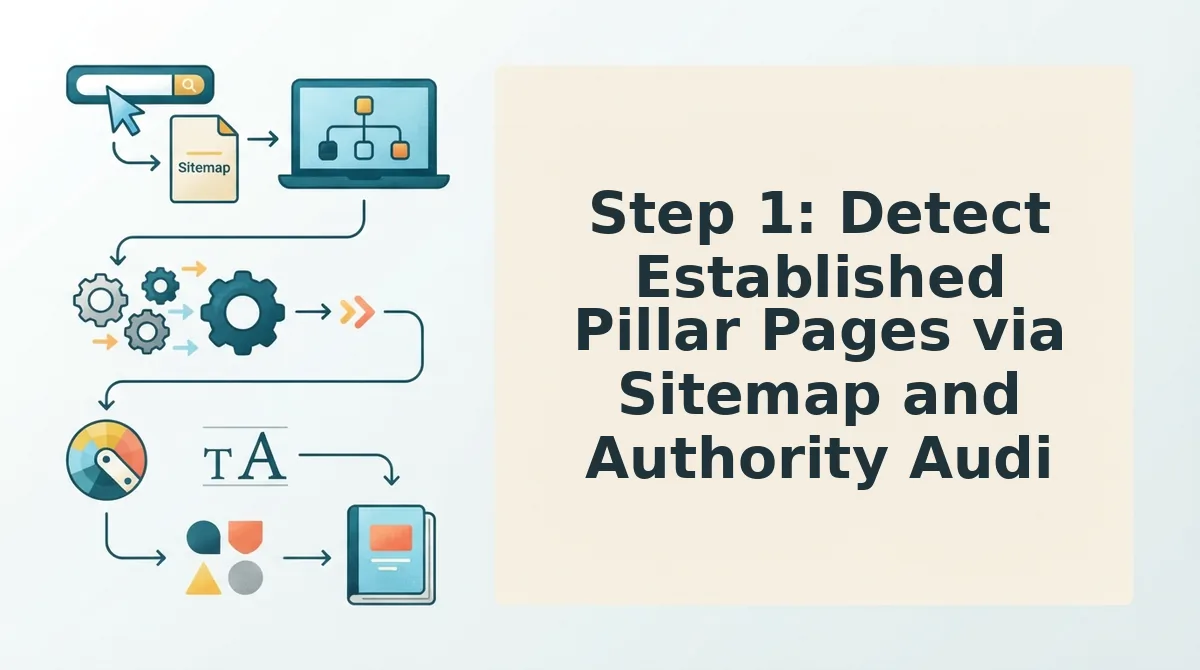
To detect established pillar pages fast, crawl your live XML sitemap and cross-reference page authority signals to locate the broad URLs that already capture topical impressions. Identifying these natural authority centers upfront prevents keyword cannibalization and ensures cluster content connects to proven root pages.
Reverse Pillar Extraction is an architecture-led auditing method that identifies authoritative core URLs from existing site index data rather than theoretical keyword lists.
Auditing a legacy blog often reveals a frustrating bottleneck: three overlapping guides split impressions for one head query. Which page should anchor the cluster?
Prerequisites and tools: You need an active XML sitemap URL, search impression logs, and access to a sitemap crawler. Estimated time: 10 to 15 minutes.
- Locate the raw XML sitemap in your root domain directory. Enter your sitemap URL into your auditing tool to extract all live indexable URLs. You should see a parsed list of published blog posts and subfolder directories.
- Score candidate URLs against 4-point pillar detection metrics: URL path depth, organic impression share, inbound internal link count, and intent breadth score. Pages with shallow directory paths (such as /blog/topic/), high inbound links, and broad informational intent score highest as potential pillars.
- Filter duplicate intent targets to eliminate internal cannibalization. Compare overlapping URLs covering identical topics and select the single page holding the highest impression share and internal link equity as the verified pillar.
- Export the verified core URLs to map cluster connections. Run an internal link map sitemap crawl to document each detected pillar before drafting new supporting articles. You should see a clear structural inventory detailing every confirmed parent page.
Worked Example: Resolving Topic Overlap
A publisher noticed their domain had three separate articles discussing search engine optimization basics, with each post siphoning impressions from the others. The operator entered the domain sitemap into the crawler to assess the three competing URLs across the 4-point pillar detection metrics. The audit revealed that one shallow-depth URL held 74 percent of the collective organic impressions and had thirty-two inbound internal links, while the other two lacked backlinks. The team designated the dominant URL as the master pillar, converted the two secondary articles into sub-cluster spokes, and established a clean parent-child relationship.
With your confirmed pillar URLs firmly locked in, the next strategic requirement is defining which supporting subtopics to produce without creating fresh keyword overlap.
Step 2: Map Supporting Subtopics with the Intent-Boundary Matrix
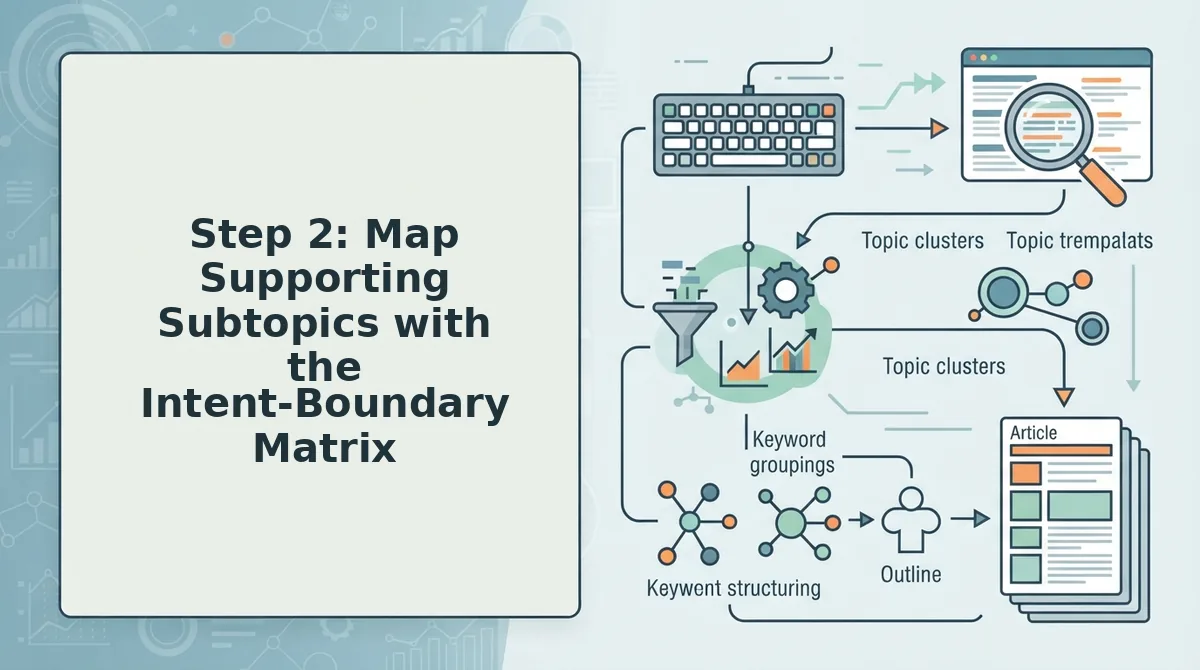
To map supporting subtopics without keyword cannibalization, isolate your core entity on the pillar page and assign distinct modifier rules across transactional, troubleshooting, and comparison intents to individual spoke articles. Brainstorming subtopics by search volume alone guarantees self-competition on the search engine results page because multiple URLs end up fighting for the same broad informational queries.
An Intent-Boundary Matrix is a governance framework that delineates search intent modifiers between a broad pillar page and its supporting spoke articles to prevent overlap. Establishing explicit boundaries forces every spoke URL to solve an isolated, long-tail problem rather than diluting the primary topic.
How do you establish clear query boundaries across a cluster? Keep the root entity modifier-free on the pillar page, then restrict supporting articles to narrow operational modifiers such as error codes, comparison pairings, or specific implementation verbs. When a spoke answers a single execution path, search engines recognize the supporting role of the page and pass topical authority directly back to the pillar.
Different workflows handle cluster mapping and subtopic generation with varying degrees of automation and manual oversight:
| Workflow Approach | Primary Capability | Modifier Enforcement | Best For |
|---|---|---|---|
| BloGoose | Automated brand context crawl and live SERP clustering | Programmatic spoke separation into Markdown context files | Best for lean growth leads and solo operators wanting hands-off cluster execution |
| Surfer SEO | Real-time NLP entity density and content scoring | Manual assignment via keyword research clusters and content editor scoring | Best for SEO specialists who prefer granular, real-time control over on-page keyword counts |
| Jasper | Enterprise multi-channel copywriting and campaign drafting | Manual topic mapping managed across custom project briefs | Best for enterprise marketing teams coordinating ad variants, emails, and collateral alongside blog drafts |
Choose Surfer SEO if your team relies on in-depth manual scoring inside a dedicated text editor before pushing content live. Choose Jasper if your primary bottleneck is producing broad multi-channel campaign copy beyond organic search.
Our recommendation is to define strict keyword boundaries upfront inside a structured document. BloGoose extracts these parameters directly from your sitemap into a dedicated target keywords markdown file, preventing subtopic collision automatically. Maintaining deterministic boundary rules at the cluster level ensures your supporting spokes elevate the authority of your detected pillar instead of competing against it. Once these intent boundaries are mapped, you can wire the internal link paths that programmatically reinforce your cluster's hierarchy.
Step 3: Wire the 3-Tier Internal Linking Architecture Fast
To wire a 3-tier internal linking architecture fast, connect every supporting post directly upward to its parent pillar, link laterally only between strictly related sibling subtopics, and block outbound contextual links to unrelated cluster silos. This structure funnels link equity straight to core authority hubs while preventing contextual dilution across topics.
Consider what happens when links cross boundaries without rules. A post about technical crawl budgets casually links to an article on email welcome sequences, scattering topical signals and diluting the equity needed to get cited in AI answers.
Prerequisites: Before starting, you need your approved cluster hierarchy and the generated internal-links-map.md file containing your canonical pillar and spoke URL assignments.
A 3-tier linking topology is an internal link distribution model that establishes upward authority flow, controlled sibling validation, and strict topical perimeter isolation.
- Wire Upward Pillar Reinforcement (Estimated time: 3 minutes per article). Open the draft in your editor, locate the introductory entity definition, and add an exact-match or partial-match contextual link pointing directly up to the parent pillar URL. You should see a clear anchor pointing up to the pillar page within the first 200 words.
- Insert Lateral Sibling Validation (Estimated time: 4 minutes per article). Scan the body text for natural semantic overlaps with sibling subtopics inside the exact same cluster, and add one to two lateral links to those sibling pages. You should see references connecting only tightly related concepts within the designated boundary.
- Enforce Cluster Perimeter Isolation (Estimated time: 2 minutes per article). Audit outbound in-content links to confirm no hyperlinks cross into an unrelated pillar silo. You should see zero outbound body links pointing to irrelevant topic groups, preserving clean topical boundaries.
What does this look like in practice?
Worked Example: A site setup wizard crawls a domain and generates an internal-links-map.md file identifying an indexing pillar alongside three subtopics covering sitemaps, API configurations, and crawl monitoring. The publisher creates the API configuration subtopic and places a direct link in the introduction pointing back to the main indexing pillar URL. Next, the publisher links laterally to the sitemap verification guide where XML schemas are mentioned, but strictly excludes links to the site's distinct ecommerce clusters. As an outcome, the search crawler traces clean topical lines between related nodes, consolidating contextual relevance on the core pillar without leaking authority across separate silos.
BloGoose extracts your full site map, drafts content directly against your internal-links-map.md rules, and automatically ships cluster-aligned articles to WordPress so your link architecture stays intact without manual editing loops. After deploying this structured linking hierarchy across your CMS, tracking measurable search and indexing signals verifies that your new cluster topology is performing as expected.
How to Check That Your Topic Cluster Architecture Worked
You verify that a topic cluster architecture worked by confirming query separation between URLs in Google Search Console, tracking crawl depth acceleration on internal links, and measuring entity citation consensus across AI answer engines within thirty days of deployment.
How do you prove within thirty days that your newly clustered spokes are lifting the parent pillar? Rather than monitoring delayed aggregate traffic, inspect technical crawl behavior and keyword distributions immediately after publishing your supporting subtopics. When cluster wiring functions properly, the parent pillar claims broad informational terms while supporting spokes absorb long-tail intents. This structural alignment eliminates internal keyword cannibalization, accelerates search bot discovery through clean internal links, and establishes topical authority that algorithms reward before conversions occur.
- Query separation verification in Google Search Console: This signal confirms that search bots no longer alternate ranking URLs for the same keyword set. Query separation is the structural condition where search engines assign distinct, non-overlapping search intents to individual URLs within a cluster. Filter the Search Console Performance report by your core topic queries to ensure only the pillar URL surfaces for head terms while spoke pages claim distinct long-tail variants.
- Crawl depth acceleration via XML sitemaps: This metric evaluates how rapidly search engine bots discover, crawl, and render nested subtopics without navigational friction. Efficient cluster architecture reduces click depth so crawlers reach spoke pages within two hops of the core domain index. Review Search Console crawl stats and server access logs to verify that newly submitted spoke URLs receive crawl requests within days of submission.
- Entity citation consensus across LLM search engines: This checkpoint tracks whether generative search engines synthesize your cluster as a definitive topical reference. Citation consensus occurs when multiple conversational models extract factual snippets and attribution links from your interlinked cluster pages. Run targeted thematic prompts matching your cluster across answer engines like Perplexity to confirm your pillar URL is cited as a primary grounding source.
- Impression velocity lift before organic click expansion: This leading indicator measures the rate of total search impressions across the entire URL group before click volume develops. Newly indexed spokes routinely experience rapid impression spikes within fourteen days while search engines calibrate topical relevance, which signals architectural success long before click-through rates peak. Track the combined impression curves of all cluster URLs inside Search Console performance filters to confirm algorithmic recognition.
- Internal link equity consolidation on the parent pillar: This check verifies that equity passed through reciprocal spoke links directly strengthens the core hub page. Supporting content must pass link value back to the primary guide to boost its competitive positioning on difficult terms. Monitor the average position metric of the root pillar URL for primary search terms to confirm ranking improvements as supporting spokes gain indexing status.
Even with systematic performance tracking in place, technical edge cases frequently emerge when managing cluster scale and CMS operations.
Frequently Asked Questions About Organizing Topic Clusters
Organizing topic clusters around detected pillars requires distinct intent boundaries, disciplined linking paths, and active taxonomy maintenance.
How many supporting spoke articles belong in a topic cluster?
A focused topic cluster typically requires five to ten supporting spoke articles to establish authority without diluting page equity. Broad industries might expand toward twenty subtopics over time, but launching five to eight tightly linked spokes ensures rapid crawl validation while preventing thematic drift across search engine result pages.
How do I resolve keyword cannibalization between an existing pillar and a spoke?
Consolidate overlapping search intent by differentiating URL targets or executing targeted 301 redirects to the primary asset. When two pages rank for identical queries, reframe the spoke toward long-tail informational modifiers while directing all internal commercial anchors exclusively back to the authoritative core pillar page.
How do I maintain topic cluster structures during CMS platform updates?
Preserve URL slugs, maintain taxonomy paths, and audit redirect mapping during CMS migrations. Platform transitions frequently break cluster integrity across three areas:
- Modified permalinks altering parent-child folder structures
- Stripped breadcrumb structured data confusing search engines
- Severed contextual internal links between pillars and spokes
How do organized topic clusters improve visibility in AI search answers?
Organized topic clusters supply AI answer engines with clear hierarchical context, establishing your site as a factual source for synthesized responses. When supporting spokes consistently reference an authoritative pillar with explicit definitions, LLM crawlers can extract direct answers and quote your domain in conversational search results.
Resolving these edge cases sets a solid operational baseline, but maintaining cluster governance at scale requires removing manual spreadsheet management entirely.
Operationalize Your Topic Clusters on Autopilot
Operationalizing topic clusters requires shifting from static spreadsheet audits to an automated publishing workflow that continuously synchronizes live sitemap architecture with active content production.
Stop treating cluster architecture as an annual manual spreadsheet exercise. The core finding teased at the start of this guide, eliminating the chaotic 12-tab keyword planning nightmare, is only realized when your live site structure directly informs every draft in real time. Disconnected spreadsheets inevitably rot within months. They create broken internal link paths, semantic drift, and search cannibalization the moment your publishing velocity accelerates.
How do you transform an abstract cluster diagram into sustainable organic market share?
- Audit your published XML sitemap to confirm high-authority parent URLs before drafting supporting assets.
- Establish strict intent boundaries across child pages to ensure each article answers a distinct query without overlapping.
- Drop your website domain into the BloGoose setup wizard to crawl your existing XML sitemap, extract Markdown internal link maps, and publish fully synchronized topic clusters straight to WordPress or your custom API.
When you replace fragmented manual planning with continuous, sitemap-derived clustering pipelines, topical authority stops being an exhausting maintenance bottleneck and becomes the automatic foundation of every page you publish.