
How to prevent editorial calendar sprawl across content teams
A 140-row spreadsheet, twelve open tabs, and abandoned draft rows usually signal that your editorial calendar has collapsed into disorganized sprawl. Preventing this operational drag requires replacing static backlog sheets with an AI SEO content engine that anchors production directly to verified site architecture. When fragmented sub-teams fight over conflicting publishing priorities, manual tracking sheets devolve into unwieldy wishlists rather than reliable deployment pipelines.
Teams usually stall under two predictable governance breakdowns:
- Unchecked duplicate briefs targeting identical search intent across overlapping categories.
- The phantom topic bottleneck, where claimed drafts remain locked in drafting purgatory for months.
You can permanently eliminate calendar bloat by enforcing strict architectural controls that tether every draft to structured topical authority hubs. In the sections below, you will learn how to audit existing backlog debt, establish automated production gates, and maintain clear contributor swimlanes. You will also uncover a surprising mechanism showing why expanding your scheduled titles can actually harm site-wide indexation when queues lack programmatic validation.
This system governs organic search workflows and direct CMS publishing; it does not address paid social campaigns or single-author personal blogs.
What Is Editorial Calendar Sprawl and Why Does It Derail Teams?
Editorial calendar sprawl is an operational breakdown where unplanned content ideas, disconnected tracking sheets, and unassigned drafts accumulate faster than a team can publish them. Unlike asset sprawl, which refers to live, unmanaged URLs decaying on your website, calendar sprawl represents unscoped roadmap debt that clogs planning queues and paralyses execution.
Editorial calendar sprawl is a condition where content roadmaps expand uncontrollably across disconnected documents, turning scheduled workflows into an unmaintainable backlog of unranked topics. It occurs when teams capture ideas across fragmented channels without grounding them in site architecture or search intent. As backlogs expand without publication throughput, schedules lose operational relevance. The planning environment quickly shifts from an active production pipeline into a digital warehouse of abandoned ideas, leaving publishing velocity completely stalled.
Think of an editorial calendar like an airport runway: if ground control queues dozens of unscheduled aircraft onto the tarmac without assigned flight paths or takeoff clearance, the entire airfield grinds to a halt.
How does this failure compound across cross-department teams?
- Phantom backlog entries: Ideas logged during brainstorming sessions sit indefinitely without assigned writers, brief outlines, or search intent validation.
- Unanchored keyword lists: Search terms are collected in spreadsheets without mapping back to existing site clusters, XML sitemaps, or pillar structures.
- Multi-channel status desync: Content statuses diverge across disparate trackers when updates logged in task boards fail to reflect draft progress in CMS repositories.
Consider a digital growth team tracking publication requests across scattered task boards, direct messages, and external spreadsheets. Writers draft isolated posts while search terms sit unassigned, causing production to stall as editors spend hours reconciling conflicting topic statuses. To fix this, the team replaces disconnected tracking documents with an automated engine that crawls their XML sitemap, extracts baseline brand context files, and generates a structured pillar calendar directly aligned with existing site coverage. This eliminates unanchored ideas and restores a direct route to scheduled publishing.
Consolidating keyword research and pillar scheduling into an automated, sitemap-grounded workflow ensures every planned article has clear intent before entering production.
Prerequisites for an Anti-Sprawl Content Planning Workflow
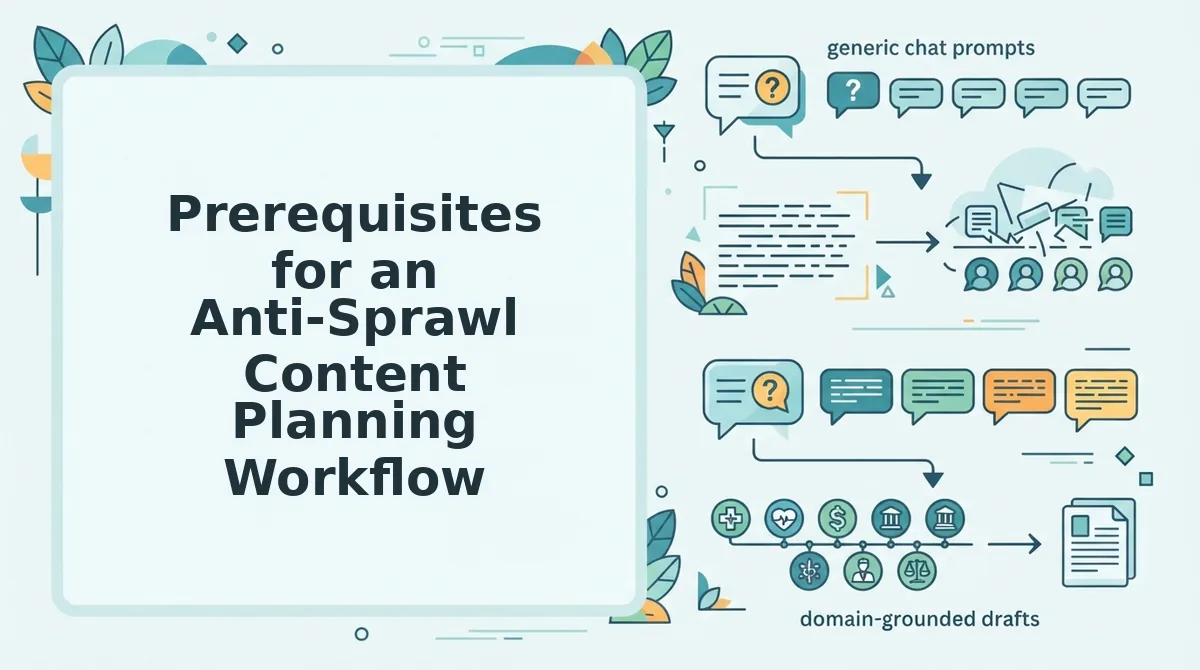
A sprawl-free content planning workflow requires an established information architecture, strict capacity limits, and sole editorial ownership before a single publication date is assigned to a calendar. Open-door brainstorming boards are directly responsible for the vast majority of discarded briefs because unvetted topic requests pile up faster than writers can publish. As the Content Marketing Institute emphasizes, implementing a pillar-based strategy that prioritizes site architecture over date-first ideation ensures editorial velocity serves search visibility rather than arbitrary deadlines.
Does your team maintain a backlog, or simply an unmonitored wishlist?
- Verified pillar index: A verified pillar index is a centralized inventory of core thematic clusters mapped directly to your site architecture. Without this baseline, ad-hoc brainstorms generate overlapping articles that cannibalize existing search impressions and confuse search engines. Audit your current XML sitemap, map published URLs into distinct topic clusters, and immediately reject any brief that does not fit an established pillar.
- Named editorial gatekeeper: A named editorial gatekeeper is a single leader holding unilateral authority to approve, shelve, or reject prospective content assignments. Distributed approval chains create diffuse accountability, allowing low-priority pitch ideas to flood your board without strategic vetting. Designate one senior editor to review pitches weekly against commercial criteria and purge unassigned suggestions every thirty days.
- Pre-allocated writer capacity benchmarks: Writer capacity benchmarks are hard caps on monthly throughput derived from verified historical delivery speeds rather than aspirational growth goals. Scheduling articles against speculative velocity figures inevitably triggers cascading delivery delays across entire quarters. Measure average delivery times across research, drafting, and optimization, then restrict calendar intake strictly to that production volume.
- Structured brief taxonomy: A structured brief taxonomy is a standardized submission schema requiring clear search intent, target entity coverage, and internal link destinations before work begins. Free-form topic ideas generate vague drafts that require extensive developmental rewrites or stall out in review cycles. Lock planning software behind a required template so writers cannot begin drafting without completed SERP research.
- Decommissioned brainstorming backlogs: Decommissioning backlogs is the deliberate elimination of open-ended idea repositories inside your project management software. Shared backlog lists quickly become graveyards of stale context that clutter pipeline views and divert editorial focus. Replace permanent idea columns with an immediate accept-or-delete triage protocol that forces instant decisions on every incoming topic.
How to Prevent Editorial Calendar Sprawl in 4 Practical Steps
To prevent editorial calendar sprawl, content teams must replace open brainstorm spreadsheets with an architecture-first intake queue that binds every pitch to an existing pillar before approval. This operational constraint halts production creep by forcing all content candidates through explicit authority requirements, strict time-to-production limits, and automated publishing pipelines.
Topical authority hub mapping is the structural practice of anchoring every supporting post directly to a primary core page and its related parent cluster. Before executing these steps, ensure you have an indexed XML sitemap, defined topical pillar URLs, and authenticated administrative permissions for your content management system.
- Map proposals directly to active topical authority hubs (Estimated time: 10 minutes per batch). Inspect your internal link map, review the target query, and assign the proposed title as a child node to an existing, published pillar URL. Reject any proposed topic that cannot claim at least three relevant internal linking targets within your existing site taxonomy. You should see every approved entry tied to a parent pillar slug on your primary dashboard, preventing rogue tangent posts from entering production.
- Route every pitch through a single gatekeeper (Estimated time: 15 minutes daily). Lock open access across team brainstorming boards and direct all contributors to a single, structured intake form requiring target search intent, primary keyword parameters, and cluster alignment. Assign one designated managing editor to review and triage submissions once per day, either greenlighting the concept or declining it at intake. You should see raw submissions restricted to a single read-only review queue rather than proliferating across disconnected tracking tabs.
- Apply a 30-day backlog sunset service level agreement (Estimated time: 5 minutes weekly). Open your active queue every Monday morning and filter for any approved pitch that has lingered in draft status past 30 calendar days. Archive these unwritten records to a cold backlog folder immediately rather than allowing them to clutter your sprint cycles. You should see your active planning board maintain an active queue depth of under 20 production-ready briefs at all times.
- Deploy direct-to-CMS automation instead of staging spreadsheets (Estimated time: 20 minutes initial setup). Connect your content creation queue to an autopilot content calendar configured to push generated drafts directly into your WordPress or custom API staging environment. Eliminate intermediate staging sheets by letting the engine handle draft generation, asset insertion, and publication scheduling in one automated loop. You should see completed articles appear directly in your CMS post list with draft status ready for final review.
Why do editorial calendars fail?
They fail because unbounded idea collection creates an illusion of momentum while hiding workflow bottlenecks. Restricting input volume and automating draft staging guarantees that only commercially viable, fully clustered search topics reach your production pipeline.
Centralized vs Decentralized Content Planning: Setting Team Boundaries
Editorial calendar sprawl is prevented by establishing clear workflow boundaries that separate topic ideation from publishing authority, ensuring single-threaded ownership over go-live schedules. Without strict role routing, uncoordinated submissions from disparate departments inevitably fragment your content schedule.
Who actually owns the final go-live date when product, sales, and SEO teams submit competing priorities in the same sprint?
When line-of-business contributors publish ad hoc without editorial gatekeeping, calendar integrity collapses. To resolve cross-departmental friction, organizations structure content operations around three operational planning models.
| Planning Model | Primary Strengths | Operational Trade-offs | Best For |
|---|---|---|---|
| Centralized Intake | Strict quality control, uniform brand tone, and zero schedule collisions. | Creates production bottlenecks; alienates subject-matter experts awaiting review slots. | Solo operators, early-stage startups, and regulated corporate environments. |
| Federated Production | Rapid output from specialized teams; high subject-matter depth across departments. | Causes keyword cannibalization, inconsistent quality standards, and scheduling overlap. | Large enterprises with independent business units and dedicated sub-editors. |
| Hybrid Command | Permits open topic ideation while funneling drafts through fixed validation protocols. | Requires disciplined adherence to automated routing and role permissions. | Growth teams, content publishers, and digital agencies scaling multi-author blogs. |
A role-based permission hierarchy defines structural access across your production pipeline:
- Viewer: Stakeholders who review calendar releases and production progress without editing privileges.
- Contributor: Subject-matter specialists who pitch concepts and draft copy without staging access.
- Gatekeeper: Managing editors who enforce brand guidelines, resolve keyword collisions, and validate technical criteria.
- Publisher: Technical administrators who possess direct CMS publishing keys and dictate live release dates.
Our Recommendation: Implement Hybrid Command
Choose Centralized Intake if you manage fewer than three active writers and require strict legal approvals. Choose Federated Production if individual business units operate self-contained publication channels. For modern search teams, however, we recommend the Hybrid Command framework.
Hybrid Command preserves departmental velocity without letting unvetted drafts overrun your roadmap. Contributors submit localized ideas, but technical validation and final deployment remain locked behind strict guardrails.
BloGoose operationalizes this framework by functioning as an automated AI SEO content engine. Rather than leaving teams to balance fragmented spreadsheets and manual drafting handoffs, the platform extracts brand context directly from your sitemap, grounds production in real-time SERP research, and ships structured articles directly to WordPress or your custom API.
How to Check It Worked with a Quarterly Calendar Audit
A quarterly calendar audit confirms anti-sprawl workflows by evaluating every unscheduled idea against rigorous kill criteria. A quarterly calendar audit is a systematic operational review that prunes redundant, unassigned, and misaligned topics from an editorial backlog. Enforcing strict kill criteria prevents low-intent topics from diluting publishing capacity.
Prerequisites: Gather your master topic backlog, published XML sitemap URLs, and internal cluster architecture before starting this review.
- Score candidate topics using the 4-point Content Calendar Audit Checklist (25 minutes). Open your master planning document and evaluate every unwritten entry against Search Intent Fit, Production Feasibility, Parent Pillar Mapping, and Staleness Score. You should see a categorized table that isolates high-potential drafts from low-value brainstorming notes.
- Apply hard kill criteria to purge stagnant concepts (25 minutes). Delete any entry sitting for more than 60 days without an assigned writer, any row carrying zero commercial or search intent match, and any entry generating duplicate topical intent against existing URLs. You should see non-performing backlog volume drop significantly without losing strategic coverage.
- Verify live URL gaps and pillar alignments (20 minutes). Cross-reference surviving titles against your existing sitemap to ensure each piece answers an unaddressed query rather than cannibalizing existing content. You should see every approved entry linked directly to an established parent pillar.
- Lock production deadlines for approved clusters (20 minutes). Schedule the vetted titles into your CMS queue with assigned owners and finalized brief requirements. You should see a clear, sprawl-free editorial queue containing only executable deliverables.
What does this pruning process look like in practice?
Consider an editorial backlog cluttered with 60 unranked, unassigned post pitches gathered across two quarters. In a 90-minute audit, an operator cross-references the list against live sitemap URLs to uncover overlapping targets. Applying hard kill criteria eliminates 35 ideas unassigned for over 60 days and 13 entries with zero verified search demand. The operator maps the remaining 12 high-intent cluster topics directly to core pillar pages, turning an unwieldy backlog into an actionable production roadmap.
Frequently Asked Questions About Editorial Calendar Governance
Editorial calendar governance prevents planning bottlenecks by locking production capacity, establishing strict intake rules, and eliminating low-priority topic bloat across content teams.
What is the difference between calendar sprawl and content sprawl?
Calendar sprawl happens pre-production when unvetted ideas, stakeholder wishlists, and unassigned briefs bloat your planning documents. Content sprawl occurs post-production when teams publish disconnected, low-value articles that dilute topical authority across your domain, waste crawl budget, and trigger keyword cannibalization across search rankings.
How do you handle urgent executive requests without breaking the editorial calendar?
Enforce a mandatory slot-swapping protocol where every urgent executive request replaces an existing calendar item of identical scope. Never stack net-new rows onto active production sprints. Instead, bump a scheduled topic back into the intake backlog to protect your delivery deadlines, publishing consistency, and team velocity.
Why does disciplined cluster publishing improve search indexation efficiency?
Publishing tightly focused topical clusters on a predictable schedule builds crawl momentum and strengthens internal link equity. When search engine bots recognize recurring publishing rhythms, it becomes substantially faster to ask Google to crawl new posts and earn discoverability for newly launched content.
How do teams measure editorial calendar bloat?
Teams measure calendar bloat by benchmarking active queue volume against monthly capacity using three diagnostic indicators:
- Unassigned briefs lingering untouched for more than two planning cycles
- Planned drafts lacking assigned search intent or cluster architecture
- Backlog volume exceeding actual monthly team throughput by more than three to one
Reclaim Publishing Velocity Without Planning Debt
Publishing velocity increases when teams eliminate planning debt through automated governance rather than expanding spreadsheet backlogs. True organic momentum is measured not by how many concepts sit in your queue, but by how few unassigned ideas linger between your roadmap and your live site.
To lock in operational speed, run your content operation against three non-negotiable boundaries:
- Topical gating: Reject any brief that does not tie to a verified search cluster or target keyword.
- 30-day sunset SLAs: Purge pitches that fail to enter production within one month to prevent stagnant backlog bloat.
- Direct CMS publishing pipelines: Route approved drafts straight from generation to production environments like WordPress without spreadsheet bottlenecks.
When you replace manual coordination with a direct engine, backlog maintenance disappears. You can review your strategy and test 3 free articles to experience an autopilot production workflow that turns site architecture into indexed search assets.
An editorial calendar should function as a high-speed dispatch pipeline rather than an archive of good intentions.