How to read ranking signals before choosing a topic
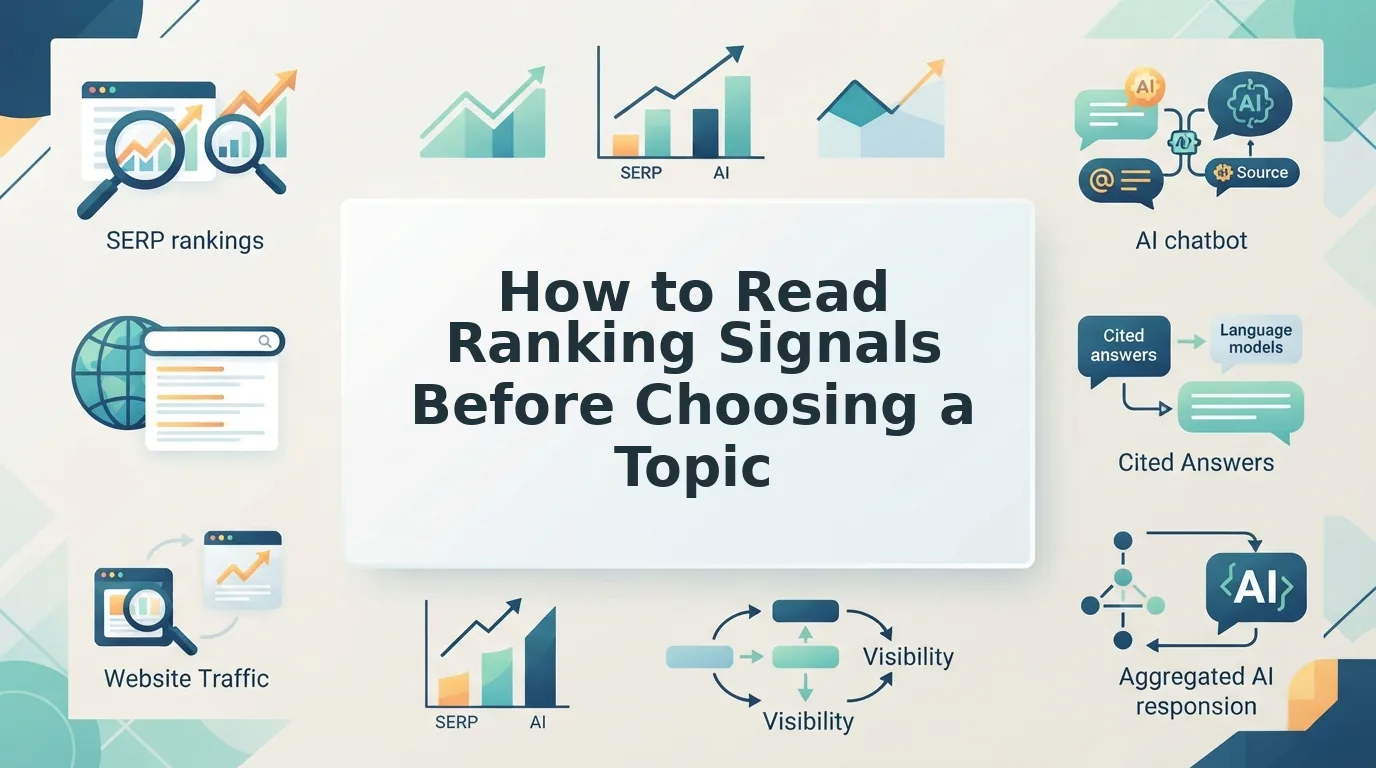
Few content bottlenecks hurt more than spending 12 hours drafting a guide, only to realize Google rewards interactive software tools instead of text. Inspecting ranking signals before choosing a topic prevents wasted editorial effort by revealing whether a standard blog post can actually compete on the live results page.
Which ranking signals should influence which blog topic I choose? Prioritize structural search engine results page (SERP) signals, including dominant page formats, intent classification, topical coverage breadth, and media parity, over static keyword volume. As Google Search Central confirms, automated ranking systems evaluate dozens of multi-signal factors beyond PageRank alone to match query intent. Auditing these live page traits before writing ensures your topic clusters align with what search engines already reward.
You can avoid common metric traps that mislead third-party tools by screening queries upfront. Ahead, you will learn how to separate durable layout traits from temporary algorithm noise, and use a four-step diagnostic filter to pass, pivot, or kill ideas, including why a high-volume keyword with low difficulty can still be completely unrankable for an editorial blog.
What Are Durable Ranking Signals in Live Search Results?
Durable ranking signals are structural layout traits and content formats on a search engine results page that persist across core algorithmic updates. Rather than reflecting temporary ranking boosts, these signals reveal the exact page architecture Google requires to satisfy search intent.
Think of durable signals like building codes for a commercial neighborhood: you cannot open a sit-down restaurant on a block zoned strictly for industrial warehouses. Similarly, you cannot rank a long-form article on a results page locked by functional utilities.
To read these cues, start with basic format parity by checking whether the top results are blog guides, product pages, or interactive tools. Next, evaluate search intent patterns by inspecting SERP features like AI Overviews, featured snippets, and video carousels. ly, audit topical coverage breadth across ranking domains to see if competitors rely on deep pillar hubs or isolated single posts.
Why do third-party keyword difficulty scores mislead content teams? Third-party difficulty metrics primarily calculate backlink counts and domain authority while ignoring live SERP layout constraints. For example, a software site targeting an informational how-to keyword might see a low difficulty score, only to discover the first page is dominated by free browser utility pages. Because searchers want an instant tool rather than written instructions, even a thoroughly researched guide will fail to displace those utilities. Automated platforms like BloGoose solve this by crawling your existing site structure to map content calendars around viable pillar opportunities rather than isolated keyword guesses.
How to Separate Durable SERP Signals from Algorithmic Noise
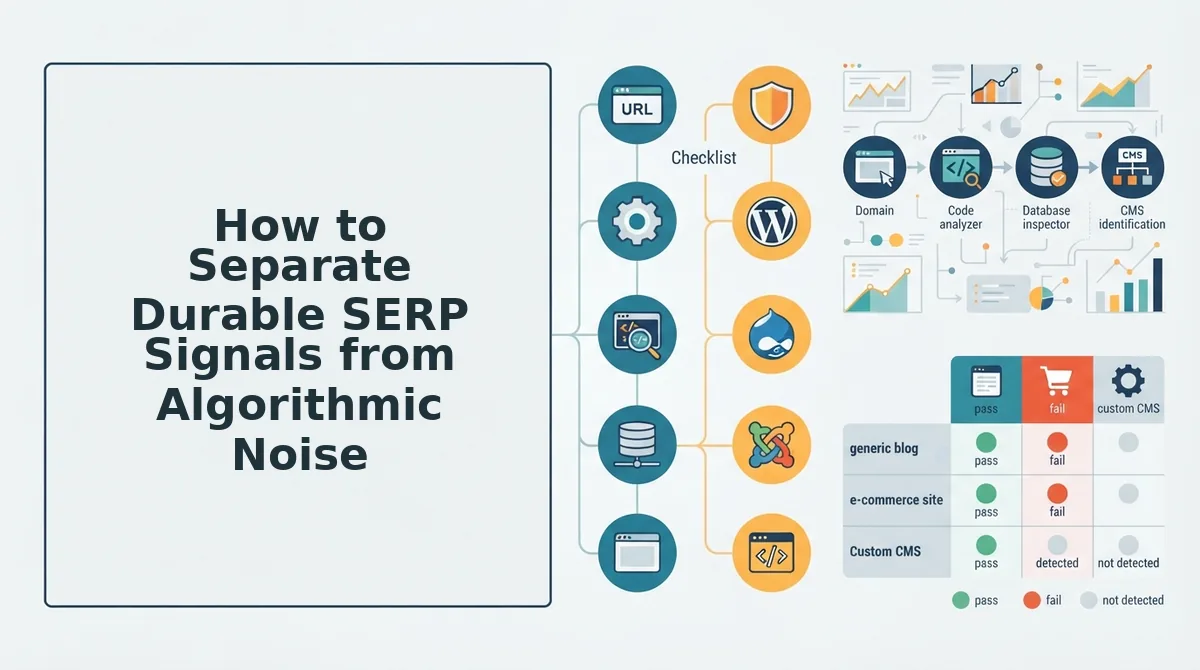
Separating durable SERP signals from algorithmic noise requires distinguishing established layout requirements from temporary freshness tests and volatile inclusions. Durable signals dictate your core content format, while transient noise should be ignored during editorial planning.
Third-party keyword tools and manual SERP checks each offer distinct advantages depending on your workflow. Keyword databases excel at rapid volume filtering for solo operators, whereas live SERP inspection reveals structural intent barriers that static metrics miss, making manual or automated SERP audits best for growth leads and publishers scaling high-stakes content clusters.
Search engines frequently test exploratory results, such as temporary Query Deserves Freshness (QDF) spikes during news cycles or solitary forum threads ranking briefly for long-tail queries. Chasing these transient anomalies leads teams to publish content after the freshness window closes. Instead, classify every observed cue using the Signal Durability Matrix before committing writing resources:
| Observed SERP Signal | Durability Classification | Editorial Action & Persona Fit |
|---|---|---|
| Dominant page type (e.g., calculators, guides, or category pages) | Durable Core | Match the exact page format; best for content managers aligning templates with intent. |
| Topical coverage breadth across ranking sites | Durable Core | Build supporting cluster articles before targeting the head term; best for SEO leads. |
| Media parity (required diagrams, tables, or embedded video) | Durable Core | Include matching visual assets in the brief; best for publishers competing in visual SERPs. |
| Domain age footprint of top-ranking sites | Secondary | Target longer-tail angles if legacy sites hold every top spot; best for newer domains. |
| Temporary QDF freshness bursts | Transient Noise | Skip evergreen production unless covering breaking news; best for agile newsrooms. |
| Single rogue forum thread inclusion | Transient Noise | Mine the thread for forum topics and pain points, but do not mimic thin forum formatting. |
Once you filter out transient noise, you can evaluate the remaining durable signals using the Pass, Pivot, or Kill topic selection framework.
How to Apply the Pass, Pivot, or Kill Topic Selection Framework
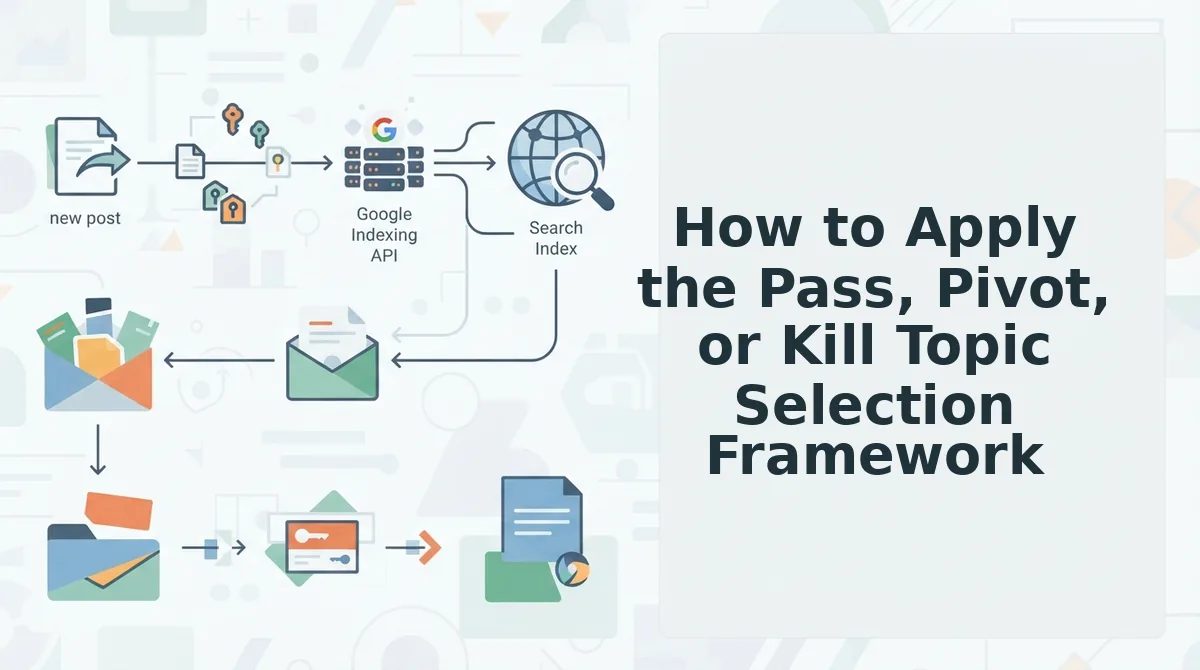
The Pass, Pivot, or Kill framework qualifies a topic candidate in under five minutes by evaluating the live SERP against your structural authority, format match, and commercial alignment. Running this sequential triage before drafting prevents wasted production cycles on keywords dominated by entrenched utilities, aggregators, or incompatible search intents.
Prerequisites: A target query idea, an active web browser in an incognito window with localized search settings enabled, and an established topic baseline or seo content brief detailing your existing topical cluster.
- Open an incognito browser tab and type your primary topic candidate into Google search (Time: 30 seconds). Inspect the top five organic positions to determine the dominant URL format. If four or more results are calculator tools, category pages, or government directories rather than editorial guides, declare an unrankable format mismatch and apply the Kill gate immediately.
- Analyze the intent posture of the top three editorial competitors (Time: 90 seconds). For example, if you input "Kafka event streaming architecture" expecting an introductory overview, but the top three positions feature deep architectural benchmark comparisons between distributed brokers, your informational angle fails the baseline intent gate. Instead of abandoning the topic, trigger the Pivot gate by altering your angle from a generic definition to an architectural comparison like "Kafka vs Pulsar Architecture for Event Streams."
- Evaluate SERP feature saturation (Time: 60 seconds). Scroll down the page and count high-friction layout modules, such as AI Overviews, People Also Ask boxes, and merchant product carousels. If the top-ranking results provide direct factual answers that completely resolve the query within the SERP interface, apply the Kill gate; if third-party websites still capture substantive organic citations and traffic, proceed to validation.
- Verify your site's structural parity (Time: 60 seconds). Compare your current cluster depth against the ranking pages' topical depth. If your site has supporting contextual pillars to satisfy the query's sub-intents, assign a Pass status. You should see a clear editorial angle mapped to an existing pillar cluster, confirming the keyword is cleared for writing.
Rather than manually repeating this triage across multi-tab spreadsheets for dozens of keyword variations, an automated content engine can connect your domain architecture directly to live retrieval criteria, generating voice-aligned content automatically.
How to Verify Your Topic Qualification Worked
You verify that topic qualification worked when a published URL achieves fast search engine indexation and records early keyword impression velocity within its first 14 days of release. These early indicators demonstrate that your initial assessment of durable search engine results page signals aligned directly with search engine retrieval patterns.
Tracking post-publication performance replaces speculative search metrics with clear diagnostic checkpoints:
- Crawl and Indexation Response: Confirm that search crawlers request and index the URL within 72 hours of publication, signaling clean architecture and absence of structural format rejection.
- Impression Emergence: Track Google Search Console performance data between day 7 and day 14 to verify steady impression growth across your primary keyword cluster and long-tail variants.
- SERP Layout Stability: Observe that your target page format maintains position stability against algorithmic shifts and AI Overview snapshot refreshes, validating your initial durability assessment.
The core resolution to topic regret is treating search signals as structural operational constraints rather than creative suggestions. Integrating automated research with programmatic AEO optimization ensures that every published asset matches live answer-engine retrieval criteria automatically.
Drop your website domain into BloGoose to extract your brand voice rules, identify qualifying cluster topics, and deliver rank-ready articles directly to your CMS.