How Ranking Signals for AI Answers Differ from Google Search
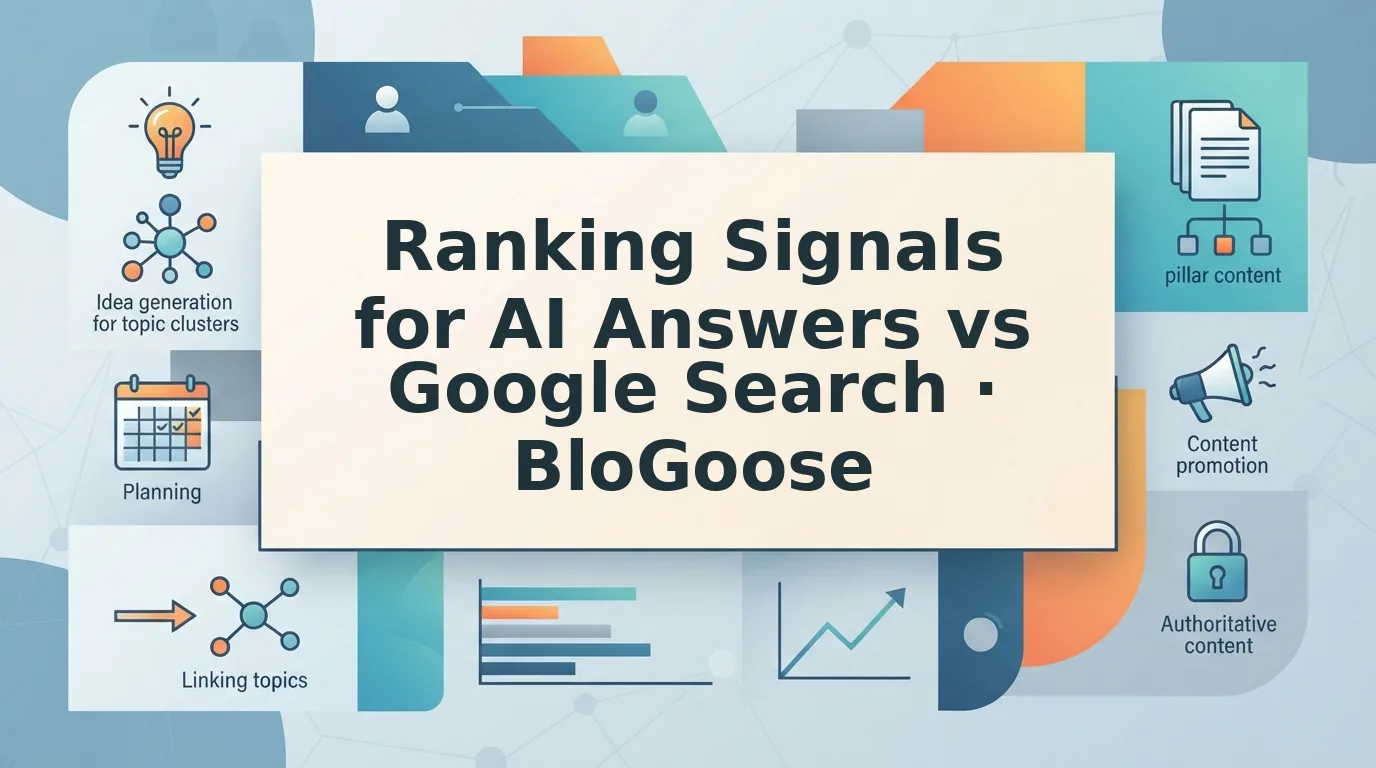
You hold the top organic spot on Google, yet an AI engine answers the user's prompt without citing your domain once. Traditional search prioritizes backlink authority and crawl efficiency, while generative engines evaluate extractable factual claims and semantic retrieval.
You will learn the exact ranking mechanics that separate neural answer generation from standard index retrieval. Deploying an modern AI SEO content engine bridges this gap by structuring modular, entity-dense data designed for synthesis. We will break down citation weights, vector retrieval behavior, and an overlooked structural flaw that quietly prevents authoritative domains from appearing in AI-generated answers.
Why do top-ranking URLs vanish from generative answers?
Consider a typical workflow: A publisher holds position one for an informational topic but remains completely absent from AI summaries. To fix this, the team implements targeted answer engine optimization strategies by crawling their XML sitemap and isolating concise, self-contained factual definitions. Shifting from monolithic copy to structured answer modules enables retrieval engines to extract factual units, establishing clear attribution in AI Overviews.
How Ranking Signals for AI Answers Differ from Traditional Search Signals
AI answer engines rank content using vector distance scoring and dense passage retrieval, whereas traditional Google search prioritizes PageRank link graphs and literal keyword matching. Instead of evaluating site-wide authority through domain backlinks, answer engines extract discrete passages that semantically resolve user intent with verifiable consensus.
Dense passage retrieval is an information retrieval framework that converts text snippets into multidimensional vectors to match semantic meaning rather than exact keywords. AI answer engines calculate vector distance across contextual embeddings, prioritizing passages that directly resolve user intent over pages with higher PageRank scores.
Traditional SEO platforms like Surfer SEO excel at calibrating keyword densities and real-time entity scoring for legacy search results. Similarly, enterprise assistants like Jasper provide high-velocity drafting for broad marketing campaigns. However, high backlink metrics and strict keyword frequency no longer guarantee generative inclusion.
Why optimize for crawlers that count links when answer engines evaluate semantic consensus?
When an AI model evaluates a source for generative citation, it measures contextual consensus across trusted web entities rather than counting outbound PageRank signals. A passage scores high when its semantic embedding directly aligns with the query vector and mirrors corroborated facts in the broader training corpus. If an article contains sprawling introductory text or hides factual takeaways beneath marketing fluff, answer engines discard the passage regardless of the domain's legacy search authority.
| Signal Dimension | Traditional Google Search | AI Answer Engines |
|---|---|---|
| Core Metric | PageRank link equity and anchor text profiles. | Vector distance scoring in dense passage retrieval. |
| Content Unit | Full page URL and overall domain architecture. | Self-contained, factual passage blocks. |
| Authority Proof | Third-party backlinks and domain age. | Contextual consensus and source corroboration. |
| Best for Persona | Best for legacy publishers targeting high-volume head terms. | Best for subject-matter experts targeting conversational queries. |
Choose traditional search optimization if your traffic relies primarily on navigational clicks and broad commercial keywords. Choose AI answer optimization if your buyers use LLMs and search chatbots to evaluate technical workflows and specific vendor capabilities.
Our recommendation is to optimize for passage extractability first. Structuring content around direct factual answers satisfies vector retrieval while preserving the topical depth required for organic rankings. Using an autopilot content engine that extracts site structure and grounds live research allows teams to generate citation-ready passages directly into their CMS.
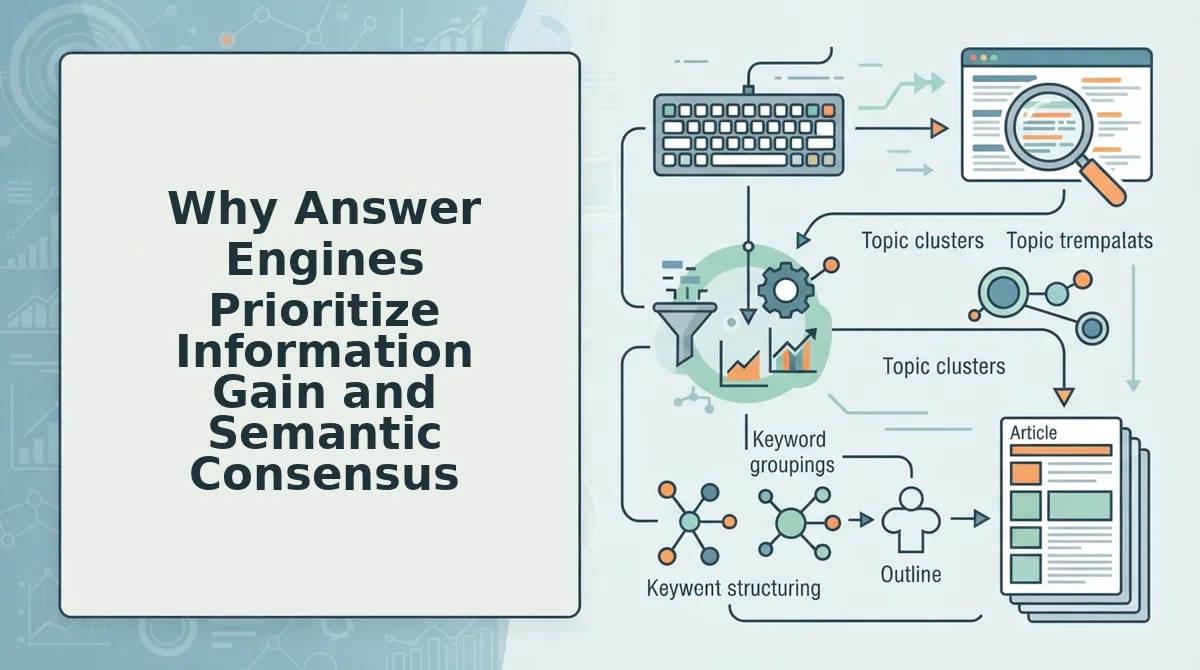
Why Answer Engines Prioritize Information Gain and Semantic Consensus
Answer engines prioritize information gain and semantic consensus because generative synthesis pipelines prune redundant text to conserve context window capacity while requiring multi-source agreement to verify factual claims.
Imagine reading twenty articles to solve a technical issue. If nineteen pages restate the same superficial background using slightly shuffled phrasing, you close those tabs and read the single source that provides an unrepeated technical breakdown.
Information gain is a search ranking metric that calculates the unique incremental knowledge an article adds to an existing query corpus. Under patented information gain score mechanics penalizing content with overlapping n-gram clusters and low entity variance, retrieval engines reward documents that deliver fresh entity relationships and distinct data points. When retrieval-augmented systems gather candidate documents to synthesize an AI overview, they retain high-gain passages and prune repetitive summaries. Understanding this dynamic dictates how to get cited in AI answers and chatbots across competitive search queries.
Think of an answer engine like an editor packing an emergency gear bag with strict weight limits. Carrying five identical flashlights wastes limited space, but carrying one verified light alongside distinct navigation tools ensures complete utility.
Large language models resolve the tension between factual reliability and unique coverage by evaluating candidate text through two distinct phases:
- Semantic Consensus: The engine checks whether core claims match facts present across established domains to prevent hallucinations.
- Information Gain Scoring: The system measures the mathematical divergence between the candidate document and previously ingested passages.
- Synthesis Retention: Passages containing high entity density and novel relational context survive token compression and form the final cited response.
Standard search algorithms reward documents that comprehensively match historical query intent. Answer engines operate differently: they reward baseline consensus to confirm safety, but they cite the specific passages that contribute original, non-duplicative information to the model context.
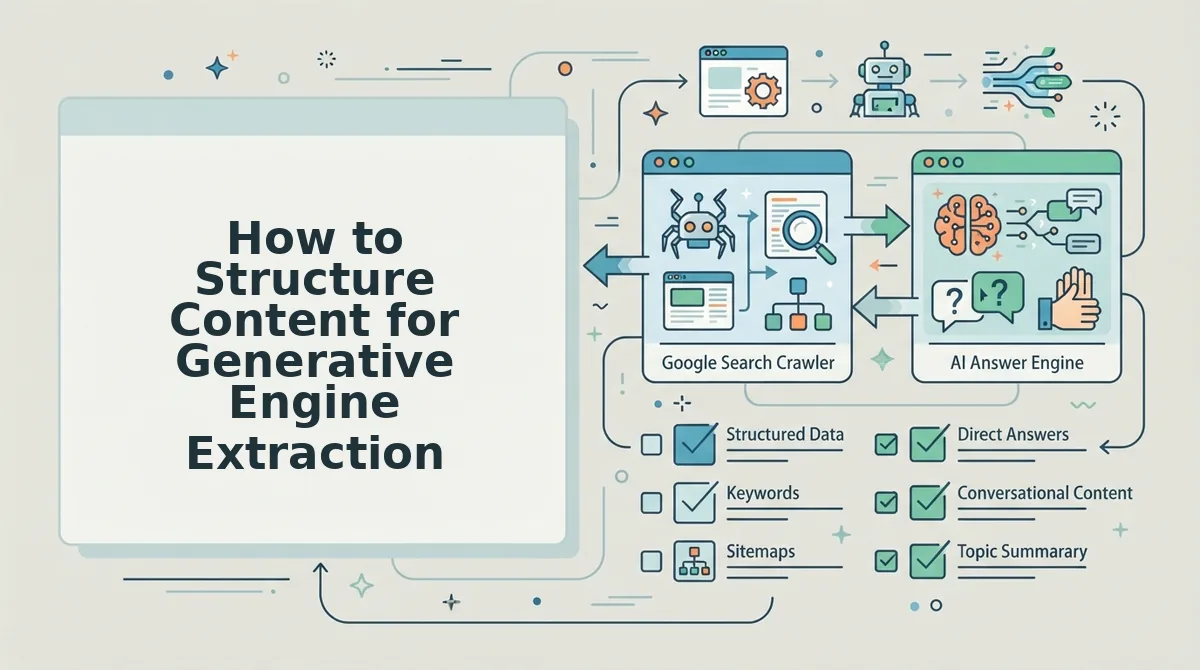
How to Structure Content for Generative Engine Extraction
To structure content for generative engine extraction, place a self-contained, 80-to-120 word declarative answer block immediately beneath an informational heading before providing supporting context. This passage-level structure allows generative search models to parse and ingest complete factual premises within a single context window.
Why do comprehensive long-form articles frequently lose citations to concise, modular passages? Passage extraction is the search retrieval process where an AI engine isolates, indexes, and quotes an autonomous paragraph from a webpage based on semantic relevance rather than full-page domain authority.
Prerequisites: A CMS post editor, your primary target query, and access to a structured data testing tool. Total implementation time: 15 minutes.
- Type a self-contained answer block into your editor directly beneath the subhead (5 minutes). Apply the exact 80-to-120 word extractive passage blueprint: start with a direct definition sentence (15 to 20 words), follow with a mechanical explanation of how the process operates (35 to 50 words), and conclude with the expected empirical outcome (30 to 40 words). Avoid starting with transitional pronouns or references to earlier sections. Expected outcome: You will produce an autonomous paragraph that an AI model can extract as a complete citation.
- Select dense narrative paragraphs and convert them into HTML lists (3 minutes). Highlight sequential actions, feature sets, or technical constraints and nest them inside ordered or unordered lists rather than compound sentences. Expected outcome: You should see distinct, scannable data nodes that search parsers can tokenize without ambiguity.
- Replace ambiguous pronouns with explicit entity names across every claim (3 minutes). Scan your draft for words like "it," "they," or "this tool" and replace them with the exact canonical product, brand, or protocol name. Expected outcome: Language models bind facts directly to your subject entity in knowledge graphs.
- Paste validated JSON-LD into your page header using Article schema markup (4 minutes). Open your site header settings and insert your structured data snippet to map your author, headline, and entity topics explicitly for search bots. Expected outcome: You should see a green checkmark with zero errors when testing the URL in your schema validator.
Formatting every post for passage extraction takes discipline. BloGoose provides an autopilot SEO content engine that turns your site structure into rank-ready, citation-optimized articles shipped directly to WordPress or your custom API.
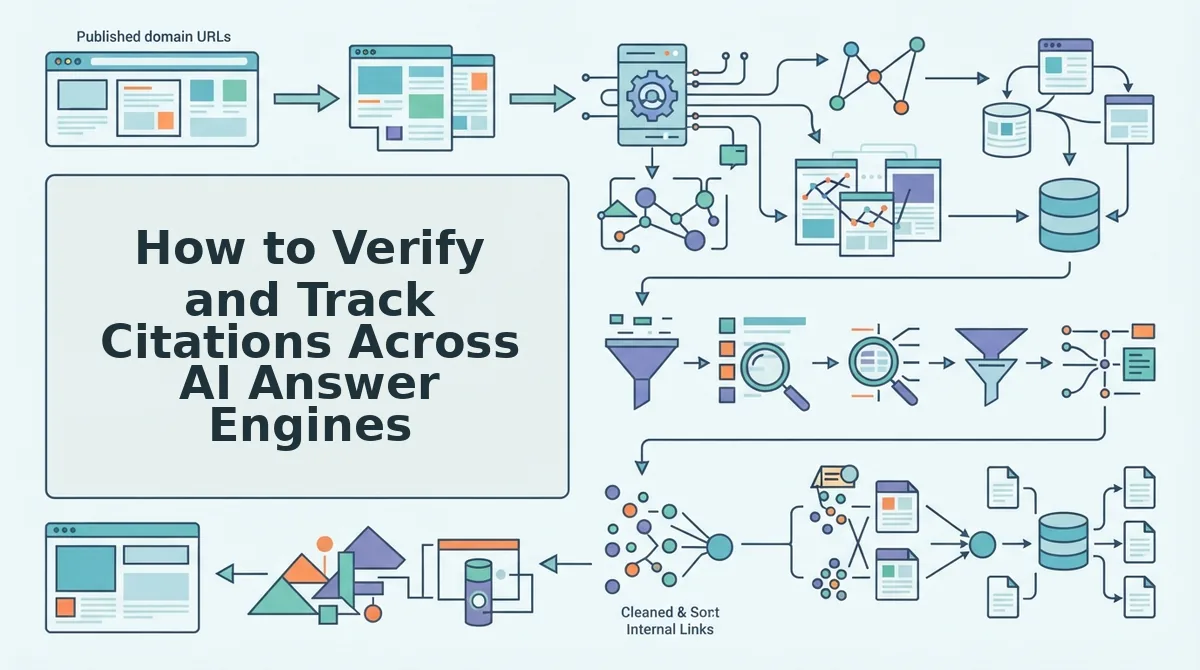
How to Verify and Track Citations Across AI Answer Engines
To verify and track citations across AI answer engines, operators must audit referral server logs for engine-specific user agents and run deterministic prompt queries against target generative models. Confirming visibility requires validating both backend retrieval logs and live answer attributions.
Imagine publishing an exhaustive technical teardown, watching organic impressions climb, but having zero visibility into whether generative models quote your conclusions. Tracking this requires two prerequisites: access to your web analytics or server log console, and clean test profiles across Perplexity, ChatGPT Search, and Gemini.
Synthetic prompt auditing is the practice of querying generative engines with structured, non-branded queries to observe whether a domain is cited as an authoritative source.
Parameter tracking protocols clarify how answer engines pass traffic. Generative engines utilize distinct referral hostnames and path variables when routing users to external sources. ChatGPT Search passes referrals from chatgpt.com or chat.openai.com, Perplexity appends platform tokens or resolves through perplexity.ai, and Gemini routes clicks through Google app referrer pathways. Filtering analytics views by these explicit referrer hostnames isolates AI-generated citations from standard web index traffic. Tracking these parameters over time reveals exactly which content structures get quoted in generative summaries.
Follow these steps to audit your citation footprint:
- Inspect incoming referral headers in your analytics platform (Estimated time: 5 minutes). Open your analytics property, navigate to Acquisition, and filter source dimensions by referrer domains matching chatgpt.com, perplexity.ai, or Gemini pathways. You should see isolated session counts confirming direct citation visits.
- Execute synthetic prompt queries using an incognito browser session (Estimated time: 10 minutes). Type your target informational keyword phrases directly into Perplexity and ChatGPT Search without mentioning your brand name. You should see your domain linked inside the footnote citations or reference carousel.
- Verify retrieval availability in your web diagnostics console (Estimated time: 5 minutes). Inspect server crawl logs to confirm answer engine web fetchers can read the markup; if freshness lags, ask Google to crawl new posts to refresh the primary index caches queried by AI systems. You should see an updated crawl timestamp confirming the URL is live.
Frequently Asked Questions About AI Search Ranking Factors
AI answer engines rank content by passage-level information gain, cross-source corroboration, and vector similarity rather than backlink weight.
- Plain-text consensus: Raw claims must be verifiable in body copy, not just metadata.
- Passage modularity: Answers must exist as self-contained semantic units.
Why does schema markup alone fail to secure AI citations?
Raw JSON-LD schema fails retrieval verification when the visible plain-text HTML lacks matching entity consensus. Retrieval-augmented generation pipelines verify structured metadata directly against rendered text before citing a source. If a factual claim appears only in code blocks without on-page context, generative models discard it as unverified noise.
What is the difference between anchor text signals and AI vector embeddings?
Traditional anchor text transfers targeted topical authority between URLs, whereas vector embeddings evaluate multidimensional semantic proximity. Google uses anchored links to deduce target page themes. Generative engines convert complete propositions into numerical coordinates, matching search intent against deep contextual meaning across an entire passage rather than relying on hyperlinked keywords.
How do answer engines verify factual claims compared to Google search?
Generative search models verify facts through automated cross-source corroboration rather than trusting domain authority alone. While Google weighs PageRank and domain history, answer engines check candidate claims against a consensus graph of trusted web sources. Content containing unverified outliers or unsupported assertions is bypassed to prevent generative hallucinations.
Why does content length matter less for generative engines than Google search?
Answer engines retrieve focused passages rather than scoring overall page length. Traditional search algorithms historically favored comprehensive long-form guides to satisfy broad keyword intents. Generative systems prioritize chunk-level information density, extracting direct, self-contained answers spanning forty to sixty words while discarding the decorative fluff surrounding them.
Next Steps for Dual-Optimizing Search and AI Answers
Dual-optimization requires treating your site architecture as both an indexable hierarchy for traditional search crawlers and an extractable factual database for generative language models.
Treating organic search visibility and generative answer optimization as conflicting workflows is a costly strategic mistake. High-growth publishers do not need two disconnected production stacks; they need a single pipeline engineered specifically around factual entity retrieval.
Shift your operational maintenance across these two essential discovery benchmarks:
- Quarterly content audits versus live semantic passage refreshes: Replace slow, URL-level keyword score checks with continuous semantic passage updates that refresh underlying entity data, benchmark statistics, and factual claims as your industry evolves.
- Independent context containment: Format every sub-argument so generative answer engines can extract authoritative, stand-alone solutions without needing to parse the entire broader page layout.
This operational shift resolves the core dilemma introduced earlier: publishers achieve dual visibility without split workflows when every asset delivers high information gain directly into the search extraction layer.
To eliminate fragmented multi-tool stacks and automate citation-optimized publishing directly to your WordPress or custom API, configure your domain on the $199 flat Pro plan.
The future of organic reach does not belong to publishers chasing volatile search algorithms, but to those whose structural clarity forces artificial intelligence engines to quote them as definitive consensus.