Repetitive sections in AI blog drafts and how to prevent them

Three H2s in your 1,600-word draft restate the same claim in three different costumes, and the introduction you wrote at word 40 reappears at word 900. You highlight, cut, and consider regenerating â then suspect a fresh pass will just reshuffle the same loop. Repetitive sections in AI blog drafts are exactly that experience, and they are not a quirk of the model.
You are right to be suspicious. The duplication is a structural defect carried in from the outline, which is why a stronger instruction or another hour of research changes the wording without changing the shape.
The fix is a five-part sequence that starts before you type a prompt: validate the outline, map sources to sections, draft one section at a time, cap each section at one new claim, and review the result against explicit rules instead of a feeling.
One step in that sequence â a table most writers skip entirely, because it happens before a single word is generated â cuts more duplication than any prompt tweak. It gets a worked example further down, along with the exact prompt shape that carries settled claims forward.
Why do AI blog drafts repeat themselves?
AI blog drafts repeat themselves because a single-pass generation carries no compacted record of what earlier sections already settled, so each new H2 rebuilds the argument from the thesis outward. Repetition is an outline defect plus a memory defect, not a style problem.
Semantic redundancy is two passages making the same claim in different words. It is not keyword density â density counts term frequency, redundancy counts repeated ideas, which is why a draft can pass a keyword check and still say one thing four times.
Think of a one-shot draft like a lecturer who never glances at their notes: every topic gets reintroduced as if the audience had just walked in.
| Cause | What it looks like | Fix |
|---|---|---|
| Long single pass | Section five re-derives the thesis | Draft section by section |
| Overlapping H2s | Two headings answer the same question | Ledger cuts before generation |
| No memory block | Earlier claims get rebuilt, not referenced | Carry a settled-claims list forward |
| Source reuse | One study stretched across four H2s | One source, one section |
Length makes this mechanical. A 1,600-word generation is one continuous response, and nothing inside it compacts the earlier sections into a short list of settled claims. By section five the only anchor left is the thesis sentence in the brief, so the new heading re-derives the same point from it â and the longer the draft, the more headings compete to restate that thesis. Adding research does not help when the same two sources get mapped to four H2s.
Have the outline, the draft, a brand voice or style guide file, and your own site pages open before you start. BloGoose automates that context step by crawling your site, extracting voice rules, and publishing finished articles straight to WordPress or your API.

How do you prevent repetitive sections in an AI blog draft?
Prevent repetition by fixing the outline before you generate: give every H2 one claim and one unique evidence slot, draft one section per prompt with a carried list of settled claims, and delete any row that cannot fill its slot. Structure changes first; wording instructions come last.
You need the outline, the draft, a brand voice or style guide file, and your own site pages as context â pulled cleanly via sitemap context extraction. Budget 25 to 30 minutes for steps 1 and 2 and about 20 minutes for review. Step 1 produces a ledger shaped like this:
| Claim | Evidence slot | Source | Verdict |
|---|---|---|---|
| Single-pass drafts carry no settled-claims record | Cause/fix table, row 1 | Outline notes | Keep |
| Each section draws on one source | Numbered step 2 | Brand voice file | Keep |
| AI writes better when you ask nicely | â | â | Delete |
- Write the claim ledger. Open a table with one row per H2 and fill claim, evidence slot, and source. You should end with exactly one row per section and no blank evidence slots.
- Assign one source per section. Pull candidates from live SERP analysis and note the source beside each row. Success looks like zero sources appearing twice.
- Draft one section at a time. Build a memory block â a settled-claims list, one line each â and paste it unchanged into every subsequent prompt. The section you get back should reference prior claims instead of re-arguing them.
- Cap each section at one new claim. If a draft section argues two, split the row or cut one. You should see the section shrink and the argument sharpen.
- Review against three repetition types. Tag each section as restatement, re-entry, or drift-return, then merge the offenders. The draft should read as one line of reasoning, not a loop.
Run SearchAtlas's 90-second single-topic draft demo through this ledger. Write the demo topic at the top, check each generated section's claim against a row, merge the two sections competing for the same point, and delete the one with no unique evidence. A "do not repeat yourself" line in the prompt would have changed wording only, because the overlapping outline would still be there.
If you draft from your own pages, connect them as context the way WordPress.com's support course on connecting an agent to your site describes, so each section pulls from a distinct page rather than the same thesis sentence.
That workflow tells you what should have happened; checking whether it did is a separate pass.
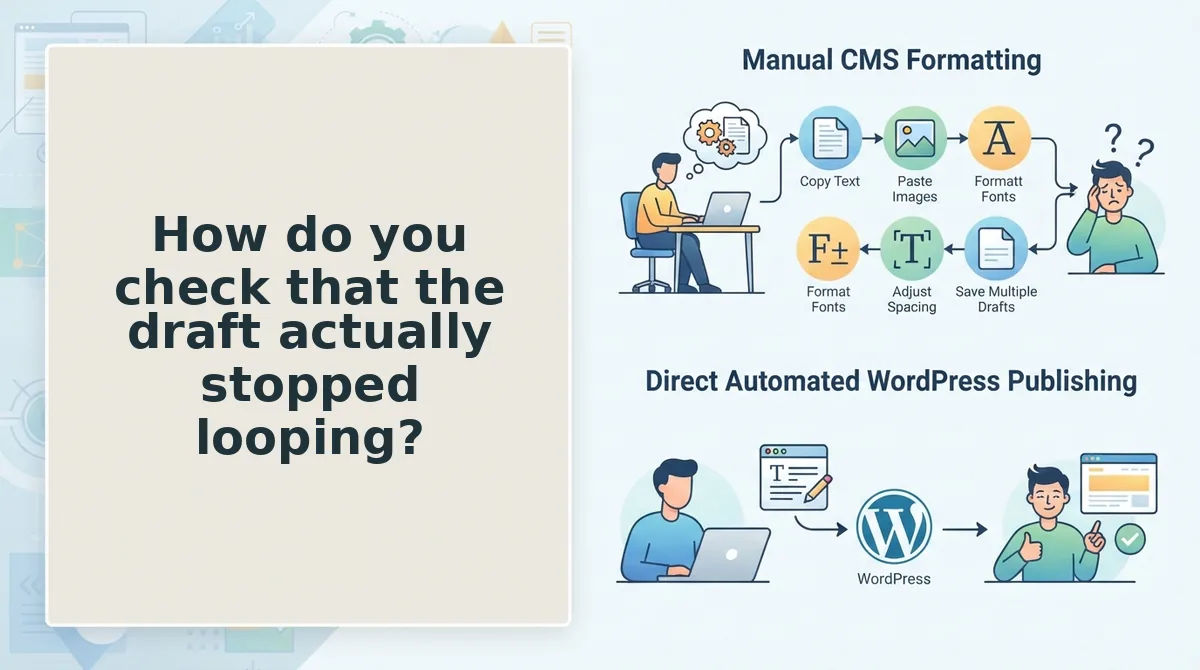
How do you check that the draft actually stopped looping?
Check a draft for looping with four tests: restatement (the same claim in new words), re-entry (a section reopening a settled thesis), drift-return (new material swerving back to the intro), and a claim tally (how often each ledger claim appears). Run them in that order and each one takes minutes, not a reread.
- Restatement check. Read each section's body and flag any sentence that only re-says an earlier claim in different vocabulary. The fix is deletion, not rewriting: one instance stays, the other goes. It matters because restatement is the most common defect and the cheapest to clear.
- Re-entry check. Read only the first sentence of every section, in sequence, and nothing else. If two openings re-establish a thesis already settled, that section is anchoring on the intro instead of on its own evidence. This is the fastest test in the set and catches loops a full reread blurs.
- Drift-return check. Read each section's closing line and ask whether it earns its place or swerves back to the introduction's point. New material that loops home usually belongs to a section that never had a distinct claim. Cut the return, keep the material.
- Occurrence tally. Count how many times each claim from the pre-draft ledger appears across the post. Anything above one needs a stated reason â a new evidence slot or a deliberate callback â or it is padding. This is the only test that produces a number you can hand to an editor.
To find duplicate ideas without rereading the whole draft, count first and read selectively. Put your outline claims in one column and tally each appearance; anything at two or more is a candidate, not automatically a fault. Then read only the first sentence of each section in order, then only the last. Openings that restate settled theses and closings that loop back to the introduction account for most visible repetition, and both are visible without reading the middle of any section.
Chunked, section-level drafting prevents most of this, but it charges you at the joins: each section is written without the voice calibration of the one before it, so seams show and tone flattens. Preview the rendered post before it publishes. Section-level drafting stops paying off when your subtopics overlap so heavily that two sections would compete for the same evidence â at that point the outline needs merging, not the draft splitting. If you are still choosing tooling, this comparison of Surfer SEO alternatives covers which options support section-level workflows.
BloGoose crawls your sitemap and extracts brand voice rules before drafting, so the claim ledger exists before the first section is written and the finished post ships straight to WordPress or your API.
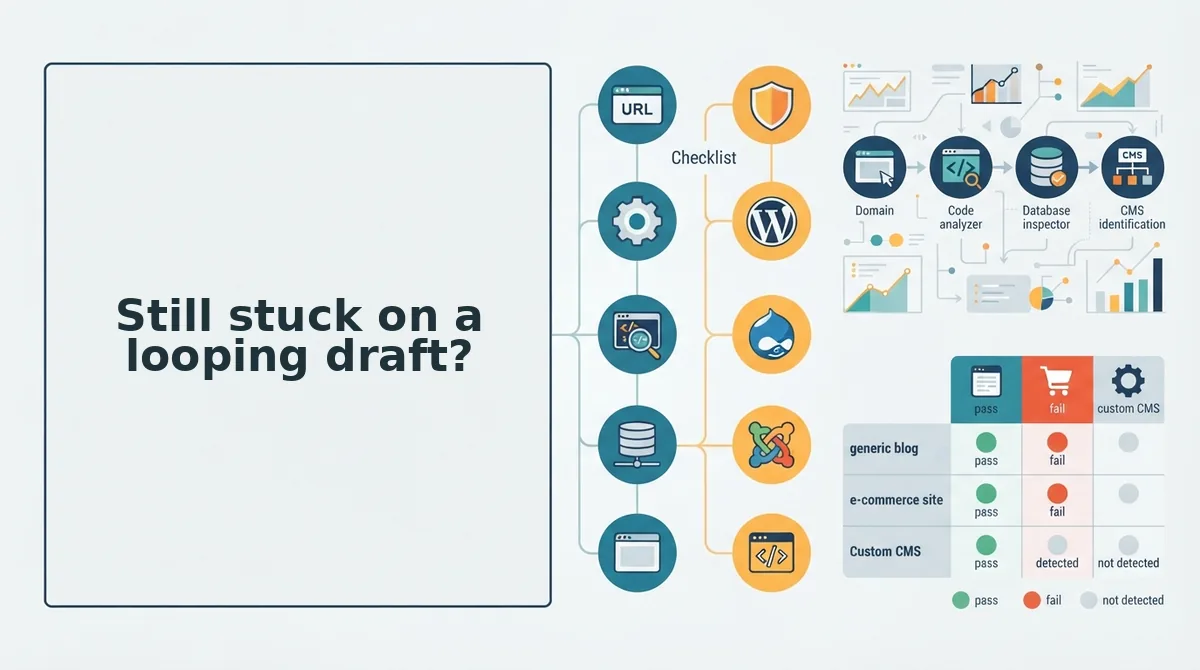
Still stuck on a looping draft?
The three real sticking points are edit order, citation cost, and when section-level drafting is worth the overhead.
My draft is already long and repeats itself. What order do I edit in?
Ledger first, cut second, rewrite last. List every claim the draft actually makes, delete duplicate instances so each claim has one home, then rewrite only the transitions at the cuts. Polishing sentences before you have the claim list means editing passages that should have been deleted.
Do repeated sections hurt AI citations?
Indirectly, yes. Answer engines extract one clean passage per claim, so four near-identical passages compete and dilute which one gets quoted. Consolidating a claim into a single evidenced passage gives the extractor an unambiguous target â the principle behind AEO content optimization.
How long must a draft be before section-level drafting is worth it?
Subtopic overlap is the right measure, not word count. Section-level drafting pays off once two sections would draw on the same evidence, which usually arrives around five or more H2s. Below that, one pass plus a claim check is cheaper.
Where to go once your drafts stop looping
Two fixes carry most of the weight: a claim ledger before you prompt, and a memory block that survives between sections. Both are cheap. Neither requires a new writing tool.
The stronger point is cost. Repetition caught at the outline stage is a deletion; caught after drafting it is an edit pass; caught after publishing it is a rewrite plus a redirect. The chunking workaround that opened this piece has the same shape â it prevents loops by narrowing each section's context, then bills you at the joins, where voice flattens and transitions need hand-stitching.
BloGoose builds a validated outline and per-section drafts from your existing sitemap and brand voice file, so the ledger exists before the prompt does. Start by dropping your domain into the setup wizard. Because publishing to WordPress removes the last manual gate, the outline is now the only place repetition gets caught for free.
Next step: see how the automated blog publishing engine carries a post from sitemap crawl to live URL.