Replace fragmented SEO tool stacks with an all in one engine
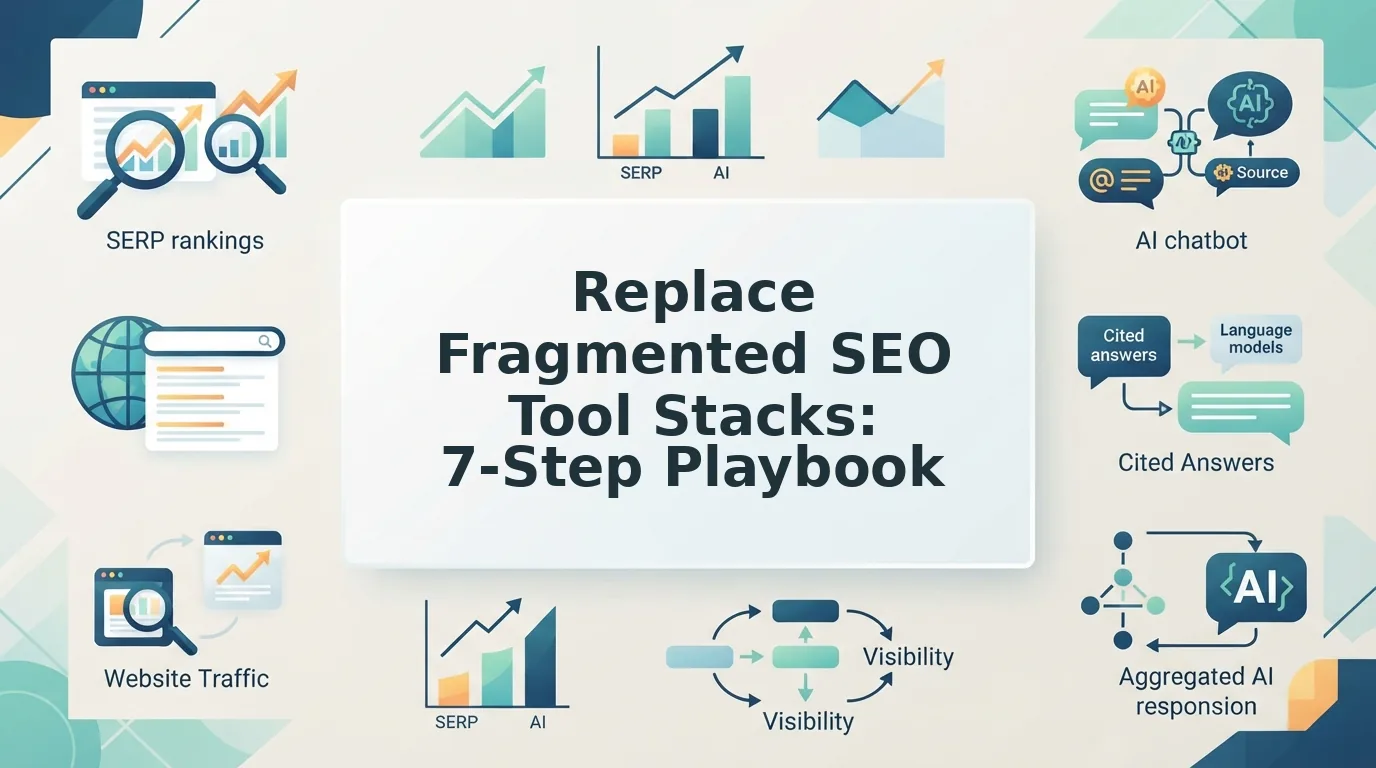
Your team pays for five SEO subscriptions, yet every article still takes three days to ship because someone has to copy keywords from one tab, paste them into a brief, rewrite the draft in a third tool, and manually upload the result to WordPress. YouTube creators like Lead Gen Hub now call fragmented stacks "dead" as a 2026 B2B reality, and the math backs them up: Semrush's top plan costs $549 per month, $6,588 a year, before you add a writer, an optimizer, and an indexing tool.
You already know the problem. The question is whether you can replace fragmented SEO tool stacks without losing the depth each tool promised. You can, and this guide shows you exactly how.
Here's the roadmap: first, we'll name the five failure modes that make multi-tool SEO quietly expensive. Then we'll map every legacy tool category to a keep, consolidate, or automate decision using a replacement matrix. Finally, we'll walk a seven-step consolidation playbook that closes the gap most teams miss entirely, ranking on Google while staying invisible to AI answers. Along the way, you'll see how an AI SEO content engine handles research, drafting, optimization, and publishing in one pass, including automatic brand voice extraction from your existing site.
One finding may surprise you: the most expensive tool in your stack isn't the one with the highest invoice. It's the one that silently drops context between handoffs, and we'll prove it in the next section.
Why Fragmented SEO Stacks Fail (The 5 Failure Modes)
A fragmented SEO stack is any workflow where keyword research, content briefs, writing, optimization, and publishing live in separate tools that require manual handoffs between each stage. The cost isn't just subscription fees, it's the compounding loss of context, time, and visibility that happens every time data moves from one dashboard to another.
Think of a fragmented stack like a game of telephone at a crowded party. The keyword researcher whispers a target phrase to the strategist, who passes a brief to the writer, who hands a draft to the editor, who exports it to the CMS. By the time the article publishes, the original intent, the specific query, the brand's voice, the internal linking plan, has been distorted or lost entirely.
Here are the five failure modes that make this inevitable, each with a concrete symptom and a consolidation fix.
1. Context Loss
Brand voice rules don't survive tool handoffs. Your style guide lives in a Google Doc, your tone examples live in a shared drive, and your writer works in a separate editor. The result is content that sounds generic because the writer never sees the rules in the same place they write.
2. Workflow Tax
Hidden hours spent re-entering data between tools add up fast. Copying a keyword from Ahrefs into a brief, pasting that brief into a doc, reformatting the doc for WordPress, and manually setting meta tags can consume 30 - 60 minutes per article. Across 20 articles a month, that's 10 - 20 hours of unpaid coordination labor.
3. Data Silos
Keyword research never reaches the writer in a usable form. The researcher exports a CSV, the strategist filters it, and the writer receives a list of phrases with no context about search intent, competitor angles, or which terms belong in headings versus body copy. The data exists, it just never arrives where the writing happens.
4. Cost Creep
Overlapping subscriptions compound monthly. A rank tracker here, a content optimizer there, an indexing tool on top, plus a separate AI writing subscription. Individually each feels justified; collectively they can exceed $1,000 per month for capabilities that a single engine could consolidate.
5. Citation Blindness
Ranking on Google but invisible to AI answers is the newest and most expensive failure mode. Traditional SEO tools optimize for search engine result pages, not for how ChatGPT, Perplexity, or Google's AI Overviews select and cite sources. Without AEO optimization, answer engine optimization, the practice of structuring content so AI systems can parse, trust, and quote it, your articles win clicks but lose citations, and AI-driven traffic bypasses you entirely.
Each failure mode compounds the others. Context loss makes writers slower, which increases workflow tax. Data silos force rework, which drives cost creep. And citation blindness means even the content that does rank underperforms in the channels growing fastest in 2026. The fix isn't a better individual tool, it's removing the handoffs where these failures live.
What a Consolidated Stack Actually Replaces
A consolidated stack replaces the manual handoffs between seven legacy tool categories, keyword research, SERP tracking, content briefs, writing, optimization, CMS upload, and indexing, with a single pipeline that keeps only what provides unique data, consolidates overlapping functions, and automates repetitive transfers. The goal isn't to delete every tool; it's to stop paying for coordination labor.
Open-source projects like OpenSEO and The Repo Explored show that MCP servers are already challenging paid SEO SaaS for basic research and tracking tasks. That pressure means the tools worth keeping are those with proprietary data or unique capabilities, not those that merely move information from one screen to another.
| Legacy Tool Category | Decision | Rationale | Best For |
|---|---|---|---|
| Keyword research | Keep (selectively) | Provides unique search volume and difficulty data no engine can replicate | Teams entering new markets who need raw query data |
| SERP tracking | Consolidate | Overlaps with rank monitoring built into consolidated platforms | Teams that only need directional movement, not daily granularity |
| Content briefs | Automate | Brief generation is a handoff, not a data source, it should happen inside the writing workflow | Teams publishing 10+ articles per month |
| Writing and drafting | Automate | AI drafting with brand voice extraction removes the manual composition step | Teams that need voice-accurate drafts without prompt engineering |
| On-page optimization | Consolidate | Optimization rules belong in the same system that writes, not a separate checker | Teams tired of optimize-rewrite-recheck loops |
| CMS upload | Automate | Direct publishing to WordPress or a custom API eliminates copy-paste entirely | Teams that publish to WordPress or custom CMS platforms |
| Indexing and AEO | Consolidate | Search indexing and AI citation readiness must be built into the content, not bolted on after | Teams targeting both Google rankings and AI answer citations |
The decision matrix logic is simple: keep only what provides unique data you can't get elsewhere, consolidate overlapping functions into one system, and automate repetitive handoffs that add no value. An automated SEO content engine applies this logic by crawling your site to extract brand voice, building pillar-focused calendars, and publishing finished articles directly to your CMS, removing the handoffs where context loss and workflow tax live.
Next, we'll turn this matrix into a step-by-step cutover plan.
The 7-Step Consolidation Playbook
Consolidating a fragmented SEO stack into one engine is a phased cutover, not a rip-and-replace. Follow these seven steps in order, and you can migrate without losing rankings, breaking publishing workflows, or leaving AI citation coverage behind.
Prerequisites: Admin access to your CMS, a list of every SEO tool you currently pay for, and one week of patience before you cancel anything.
- Audit your stack and log every manual handoff for one week. Open a spreadsheet and record every time content moves between tools: keyword research to brief, brief to draft, draft to optimization, optimization to CMS. Note the tool used, the time spent, and where errors creep in. You should end the week with a concrete list of 5-15 handoffs that a consolidated engine must eliminate.
- Map your content clusters before touching any tool. Open your sitemap and group existing URLs into topic clusters around pillar pages. Select one cluster with 8-20 pages as your pilot candidate. You should see a clear pillar-and-spoke structure that will serve as the migration test bed.
- Generate a baseline SEO content brief for the pilot cluster. Upload your pillar URL and let the engine crawl the cluster. You should receive a brief with target keywords, internal link suggestions, and content gaps, without manually assembling a spreadsheet.
- Extract brand context before you cancel anything. Run the site crawl on your full domain so the engine captures voice rules, formatting preferences, and entity patterns from your published pages. You should see a brand profile that reproduces your tone without prompt engineering. Keep your old tools active during this step.
- Run a parallel pilot on one content cluster. Publish 3-5 new or refreshed articles through the consolidated engine while your old stack still runs on everything else. Compare rankings, time-to-publish, and editorial review load side by side. You should see the pilot cluster match or beat legacy output within 2-4 weeks.
- Close the citation gap with AEO coverage, not just rankings. Review each pilot article for structured, quotable passages: direct answers, definitions, and stat-backed claims under 60 words. You should see at least one extractable answer block per article that an AI assistant could cite verbatim.
- Cut over and measure time-to-publish, not just rankings. Cancel redundant tools, route all new content through the engine, and track the hours from brief to live post. You should see time-to-publish drop by 50% or more within the first full month, and rankings hold steady through the transition.
Run this playbook on one cluster first. If the pilot holds rankings and cuts publishing time, expand the cutover to your full site calendar.
The Citation Blindness Trap (Why Consolidation Isn't Enough)
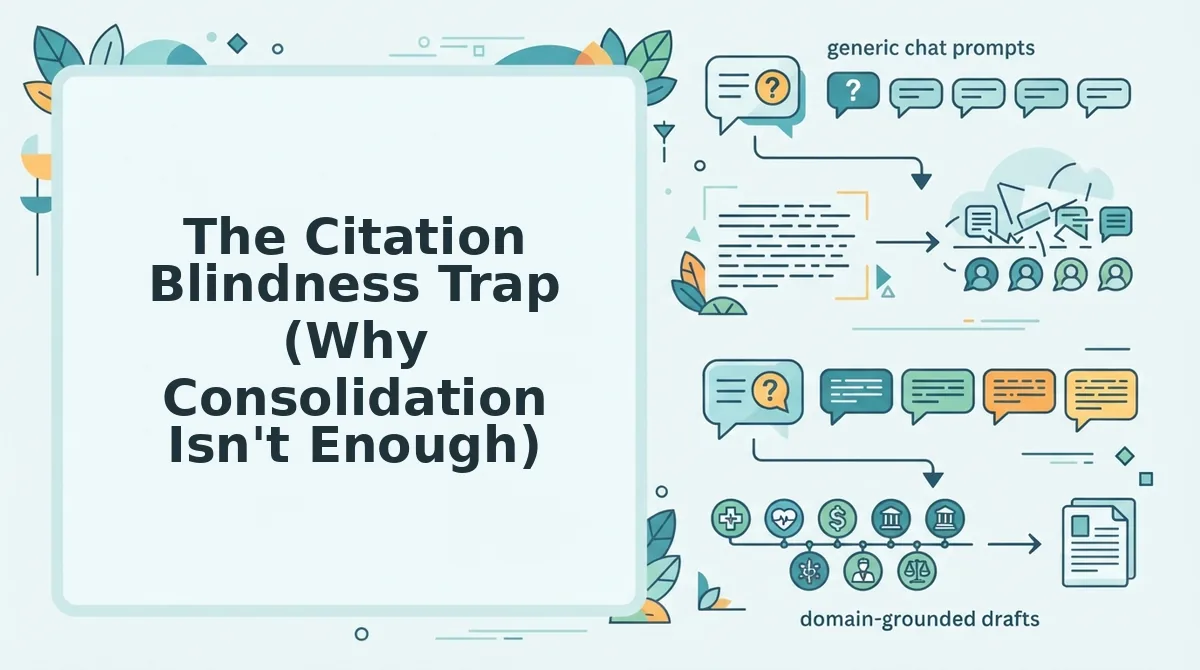
Citation blindness is the failure mode where a consolidated SEO stack ranks on Google but never gets quoted in AI answers, leaving half the search surface uncovered. Consolidating tools fixes operational fragmentation; it does not automatically fix answer-engine fragmentation.
Think of ranking on Google like having a storefront on a busy street. Getting cited in an AI answer is like being the shop the concierge recommends when a visitor asks where to go. You can own the best storefront on the block and still get zero concierge referrals if your content doesn't present itself as a quotable answer.
The gap comes down to structure. Google rewards pages that satisfy a query across thousands of words. AI answer engines reward passages that state a fact, definition, or stat in 40-80 self-contained words. A page can rank first for "what is AEO" and still never be cited because its answer is buried in a 2,000-word narrative.
Answer engine optimization (AEO) coverage is the practice of embedding structured, quotable passages, direct answers, entity definitions, and data-backed claims, throughout an article so AI systems can extract and cite them. Without AEO coverage, a consolidated stack is still fragmented: it serves one search surface while ignoring the other. For a deeper walkthrough, see how to get cited in AI answers.
Start Your Consolidation Pilot This Week
The open loop from the intro, whether consolidation can protect rankings while cutting tool sprawl, resolves to a clear yes, but only with a phased cutover. The end state is one system that ranks on Google and gets cited in AI answers.
Start by logging your manual handoffs for one week. Then run the pilot on a single content cluster. When the pilot holds, route everything through the AI SEO content engine and retire the redundant tools.
One cluster, one week of logging, one cutover decision. That's the whole migration.