How to replace prompt engineering with site crawl data
You've spent three hours this week rebuilding the same brand-voice prompt for the fifth time, and your publishing calendar still has a hole where Tuesday's article should be. The YouTube landscape tells the story of the confusion: "Prompt Engineering Is Dying" videos pull 40K views while "2026 Prompt Engineering Masterclass" demand keeps climbing. Here's the contrarian truth: prompt engineering isn't dead, it's being automated. If you're tired of managing prompt-engineering homework instead of publishing content, you're in the right place.
Agree: manual prompt crafting worked when you published twice a month, but it collapses under a real content calendar. Promise: by the end of this article, you'll know exactly how to replace prompt engineering with site crawl data so your drafts arrive pre-loaded with brand voice, keyword targets, and internal links. Preview: we'll quantify what manual prompting actually costs you, walk through the crawl-to-draft pipeline step by step, and reveal what a crawl extracts that a prompt never could. Stick around, the surprising part is how little of your prompt stack you actually need once a crawl does the heavy lifting.
What Prompt Engineering Actually Costs You
Prompt engineering is the manual work of writing, testing, and rewriting instructions that tell an AI model how to produce content matching your brand, topic, and format requirements. The hidden expense isn't the writing itself, it's everything you repeat every time you start a new draft.
Think of manual prompting like handwriting the same recipe card every time you cook dinner. The meal might turn out fine, but you're spending twenty minutes rewriting ingredients you already know before you even turn on the stove.
At the simple level, each new article starts with context reconstruction: you paste your brand guidelines, target keyword, tone examples, and formatting rules into a fresh prompt window. That's 15 - 30 minutes of copy-paste and mental re-orientation before a single word of the article exists.
At the intermediate level, inconsistency drift appears. Prompt wording changes slightly between sessions, "conversational but professional" becomes "friendly yet authoritative", and your published articles start sounding like they came from five different writers. Revision cycles lengthen because you're fixing voice drift instead of substance.
At the advanced level, you hit the scaling ceiling. Nir Gazit of Traceloop put it bluntly: manual prompt crafting doesn't scale. When your calendar demands ten articles a week across five topic clusters, the prompt-engineering layer becomes the bottleneck, not the writing.
This is the Prompt Tax: a four-part cost model for manual prompting. First, context reconstruction time, the minutes lost re-establishing brand rules per session. Second, inconsistency drift, the compounding quality debt from slightly different instructions. Third, revision cycles, the extra editing passes required to fix voice and structural drift. Fourth, the scaling ceiling, the hard limit where prompt homework consumes more time than publishing itself. Most teams feel the tax as a vague sense that content "takes too long," but naming the four components makes it measurable and fixable.
When you replace prompt engineering with site crawl data, you eliminate the first two Prompt Tax components entirely and shrink the third, because the crawl supplies consistent context automatically instead of asking you to reconstruct it manually.
How Site Crawl Replaces Manual Prompt Context
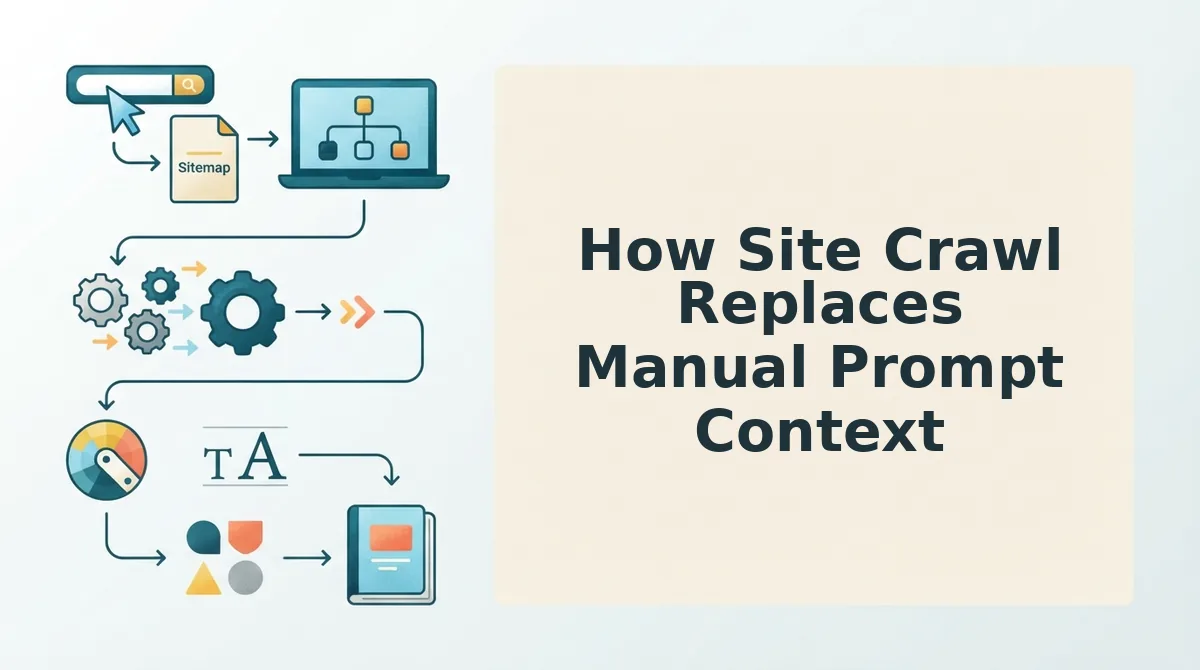
A site crawl replaces manual prompt context by automatically extracting your brand voice, keyword targets, and internal link structure from your published pages, then feeding that data into every article draft. You need a domain with a working XML sitemap and an AI SEO content engine like BloGoose that performs the crawl and generation in one pipeline.
- Enter your domain into the setup wizard. Type your site URL and click Start Crawl. The engine locates your XML sitemap automatically, you should see a confirmation that your sitemap was detected within 30 - 60 seconds.
- Let the crawler inspect your published pages. The system reads your existing articles, landing pages, and category structure to learn how you actually write. Expect this to take 2 - 5 minutes depending on site size. You should see a page count appear as pages are indexed.
- Confirm the CMS stack identification. The engine detects whether you run WordPress, a custom API, or another platform. Verify the detected platform in the Publishing tab, a green checkmark means the connection is ready.
- Review the 8 brand context files. The crawl generates structured files including style-guide.md, target-keywords.md, and internal-links-map.md. Open each file to confirm the extracted voice rules match how you actually write. These files replace the prompt fragments you used to paste manually.
- Generate your first article. Select a topic from the pillar-based calendar and click Generate. The draft arrives with brand voice, keyword placement, and internal links already applied, no prompt writing required. You should see a finished draft in 3 - 5 minutes.
Each generated article ships directly to WordPress or your custom API with AI included, closing the loop from crawl to publish without a single manual prompt. That pipeline is what makes the next question worth asking.
What a Crawl Extracts That a Prompt Can't
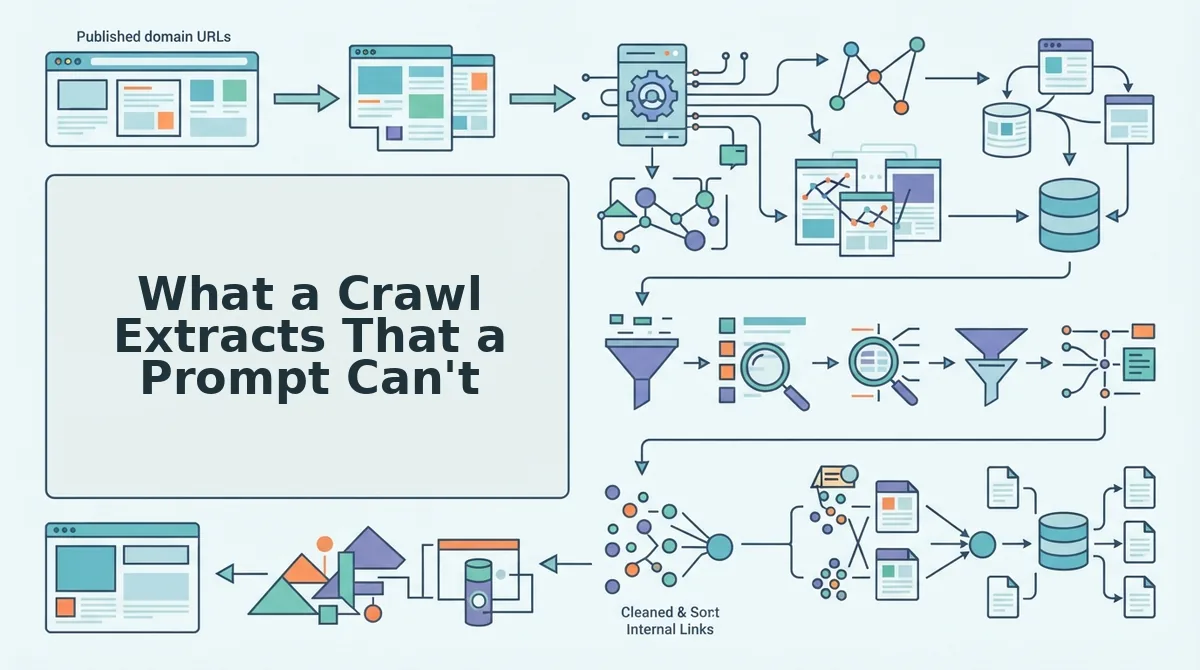
A site crawl extracts structural and linguistic data from your published pages that a single prompt cannot access: internal link maps, brand voice patterns, topical gaps, and CMS constraints. A prompt only knows what you paste into it; a crawl reads what your site already proves.
| Capability | Manual Prompt Engineering | Site Crawl Extraction |
|---|---|---|
| Brand voice capture | Requires you to describe tone, vocabulary, and style rules from memory | Analyzes existing published content to detect recurring phrasing, sentence rhythm, and terminology automatically |
| Internal link map | You must manually list related URLs for every article | Builds a complete internal link graph from the XML sitemap, enabling contextual linking without manual lookup |
| Topical gap detection | Depends on your own keyword research and content audit | Compares crawled pages against pillar topics to surface missing subtopics and cluster opportunities |
| CMS constraint awareness | You must remember formatting rules, category structures, and metadata conventions | Reads technical signals from the site itself, so drafts match your publishing environment from the start |
Manual prompt engineering remains strong for one-off creative tasks where you control every input. Tools like InteractX show that structured prompting frameworks still save analysts hours on repetitive data work. But for publishing at scale, the bottleneck is context transfer, not creativity.
Internal link map extraction is the clearest differentiator. A sitemap crawl reveals exactly which pages exist, how they connect, and where new articles should link, information no prompt can reconstruct reliably from memory. Brand voice extraction from existing content works the same way: the crawl reads hundreds of published sentences to learn how you actually write, not how you think you write.
Best for solo operators and small teams: manual prompt engineering, because you retain full control and pay only for the AI tokens you use. Best for publishers, agencies, and DTC brands publishing weekly: crawl-based extraction through a platform like BloGoose's site crawl and brand context extraction, because the context is gathered once and reused across every article without repeated prompt setup.
If you publish more than four articles per month, the time saved by automated context extraction outweighs the flexibility of hand-crafted prompts. The crawl does not replace your judgment; it removes the repetitive work of re-explaining your site to an AI every time you write.
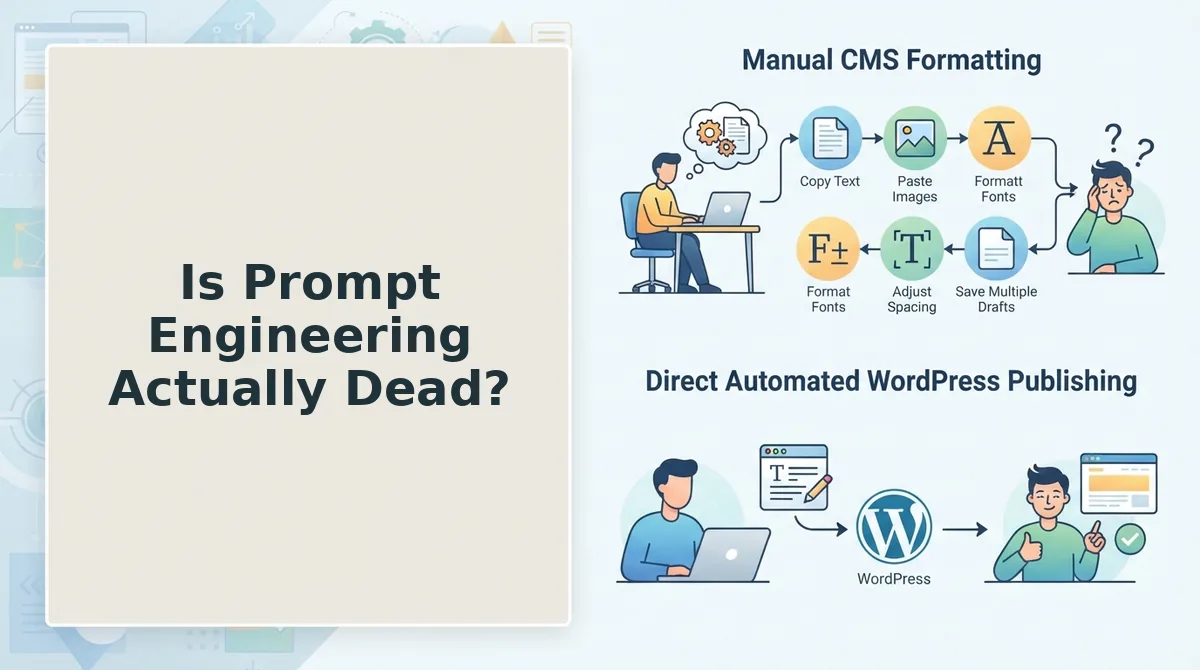
Is Prompt Engineering Actually Dead?
Prompt engineering is not dead, it has been automated. The skill of structuring context for AI has moved from a manual typing task into crawl-based systems that assemble context from your site automatically.
- Prompt engineering is being automated, not eliminated. The core skill, giving an AI the right context, still matters. What changed is that crawl-based platforms now assemble that context from your sitemap, published pages, and brand voice rules without you typing it out each time.
- The YouTube split reflects two different audiences. Ishan Sharma's video "Prompt Engineering Is Dying" (40,049 views) speaks to casual users who will rely on AI defaults. Meanwhile, InteractX shows structured prompting frameworks still save analysts hours on repetitive data work. Both are right for their audience.
- Manual prompting still wins for one-off creative tasks. When you need a single email, a brainstorming session, or a custom analysis, writing a careful prompt is faster than setting up a crawl. The skill remains valuable for non-repetitive work.
- Crawl-based context wins for recurring publishing. When you publish weekly blog posts, re-explaining your brand voice, internal links, and topical gaps in every prompt is wasted effort. A crawl captures that context once and applies it to every article.
- The contrarian middle position is the practical one. Prompt engineering is not dead for individuals doing varied tasks, and it is not alive as a manual chore for publishers. It has been absorbed into the infrastructure of crawl-based content engines.
If you are still pasting the same brand guidelines into every AI chat, you are doing prompt engineering that a site crawl and brand context extraction workflow can automate. The skill shifts from writing prompts to reviewing outputs.
FAQ
Direct answers to the most common questions about replacing prompt engineering with site crawl data.
How can site crawl data replace prompt engineering for blogs?
Site crawl data replaces prompt engineering by extracting context automatically instead of manually. The pipeline has five steps: crawl your sitemap to map all pages, extract brand voice patterns from existing content, detect topical gaps against pillar topics, build an internal link map for contextual linking, and apply CMS constraints so drafts match your publishing environment. This removes the repetitive work of re-explaining your site in every prompt. The AI receives richer, more accurate context than a human typically pastes into a chat window, because the crawl reads every published page rather than relying on memory.
What does a site crawl extract that I can't put in a prompt?
A site crawl extracts your internal link map, which shows exactly how pages connect and where new articles should link. It also detects brand voice patterns across hundreds of published sentences, not just the examples you remember. Topical gaps and CMS constraints are read from the site itself, so the AI drafts content that fits your existing structure without manual description.
Why does brand voice extraction from existing content matter?
Brand voice extraction matters because you write differently than you think you write. A crawl analyzes recurring phrasing, sentence rhythm, and terminology across your published pages, capturing patterns you would not describe in a prompt. This produces articles that sound like your site, not like a generic AI default.
Do I still need to know how to write prompts?
Yes, for one-off creative tasks like brainstorming, email drafting, or custom analysis. Manual prompting remains faster than setting up a crawl for a single request. For recurring blog publishing, crawl-based context removes the need to re-explain your site every time.
Is prompt engineering a dying skill?
Prompt engineering is not dying; it is being automated for repetitive publishing workflows. The underlying skill of providing good context still matters, but crawl-based systems now assemble that context from your site automatically. The human role shifts from writing prompts to reviewing and refining outputs.
Start with a crawl, not a prompt
Prompt engineering was always a workaround for missing context. A site crawl removes the gap entirely. When BloGoose reads your published pages, sitemap, and internal linking structure, it already knows what your brand sounds like, which topics you own, and where the content gaps sit, before a single word gets generated.
The shift is bigger than saving time. It changes what "optimization" means. Instead of refining instructions to coax quality from a model, you refine the source data the model learns from. That's a structural advantage, not a stylistic tweak.
Here's the sequence that replaces your old workflow:
- Run a crawl first. Drop your domain into the setup wizard and let BloGoose extract brand voice, topic clusters, and technical context automatically.
- Review the pipeline. See how crawl data turns into a pillar-focused calendar with rank-ready drafts, no spreadsheet stitching required.
- Automate publishing. Ship finished articles straight to WordPress or your API and let the autopilot SEO content platform handle the loop.
The open loop from the start, whether prompt engineering is a skill worth keeping, resolves here: the skill that matters now is knowing what to crawl, not what to type.
Your site already contains the answers. Stop writing prompts to rediscover them.