
How to Research Content Gaps for Answer Engines and Chatbots
You hold position one on standard search engine results pages, yet ChatGPT cites an obscure niche blog as its primary source. Traditional rank-1 URLs are frequently bypassed by LLMs when their content merely summarizes high-level industry consensus without direct factual answers.
Diagnosing these blind spots requires auditing direct answer structures rather than traditional search volume. Implementing a modern AI SEO content engine helps you pivot from basic keyword tracking to identifying gaps in generative visibility. When you learn how to research content gaps for answer engines, you can map conversational gaps, format extracts for LLMs, and resolve a hidden query-intent mismatch that systematically locks high-authority sites out of AI summaries.
Consider this workflow:
- Situation: Published pages hold top rankings but never get cited by conversational answer bots.
- Action: Crawl the XML sitemap to extract competitor gaps and analyze live SERP patterns against your published pages.
- Outcome: You pinpoint missing factual data points and restructure sections into self-contained answers.
This strategy focuses strictly on public informational queries where generative bots synthesize consensus across multiple web sources. To align your site structure with conversational search models, implement repeatable AEO optimization. Understanding this shift begins with recognizing how answer engine gaps diverge from traditional keyword deficits.
Prerequisites and Core Concepts: What Is an Answer Engine Content Gap?
An answer engine content gap occurs when search results deliver high-level topical consensus but omit the granular parameters, technical specs, or definitive solutions required by retrieval-augmented generation pipelines. An answer engine content gap is a structural deficit where search index pages repeat generic concepts but fail to supply the precise operational data that large language models need to answer user prompts. While traditional keyword gaps measure whether a page includes specific search terms, answer engine gaps focus on missing information depth. When retrieval-augmented generation systems scan documents to synthesize a response, they bypass repetitive summaries and cite only the sources providing verified facts, concrete specifications, and distinct parameter values.
Stuffing semantically related keywords into an article produces zero lift in generative citations. Modern answer engines do not tally string frequencies to determine authority; they evaluate factual utility and contextual completeness.
Think of traditional search like a library catalog pointing patrons to the right shelf, while an answer engine is a researcher transcribing a single, exact measurement from a page. If ten manuals index the phrase "engine oil" but omit the exact viscosity grade, the researcher cannot complete the instruction. AI answers abandon pages that merely announce a topic without resolving it.
Understanding this distinction requires separating linguistic presence from information retrieval:
- Keyword Gaps (Lexical Match): Focus on absent vocabulary, query variations, and entity density to convince ranking algorithms of topical relevance.
- Answer Gaps (Informational Retrieval): Focus on missing computational logic, sequential steps, conditions, or verified facts needed to fulfill a prompt.
At an advanced level, retrieval systems parse content into vector embeddings to resolve user intent. When competing pages only offer surface-level guidance, an autopilot content engine targets these voids by anchoring articles in explicit parameters, exact workflows, and unambiguous conclusions that models can parse and quote directly. Once you grasp this conceptual shift, you can systematically uncover these informational voids across your target queries.
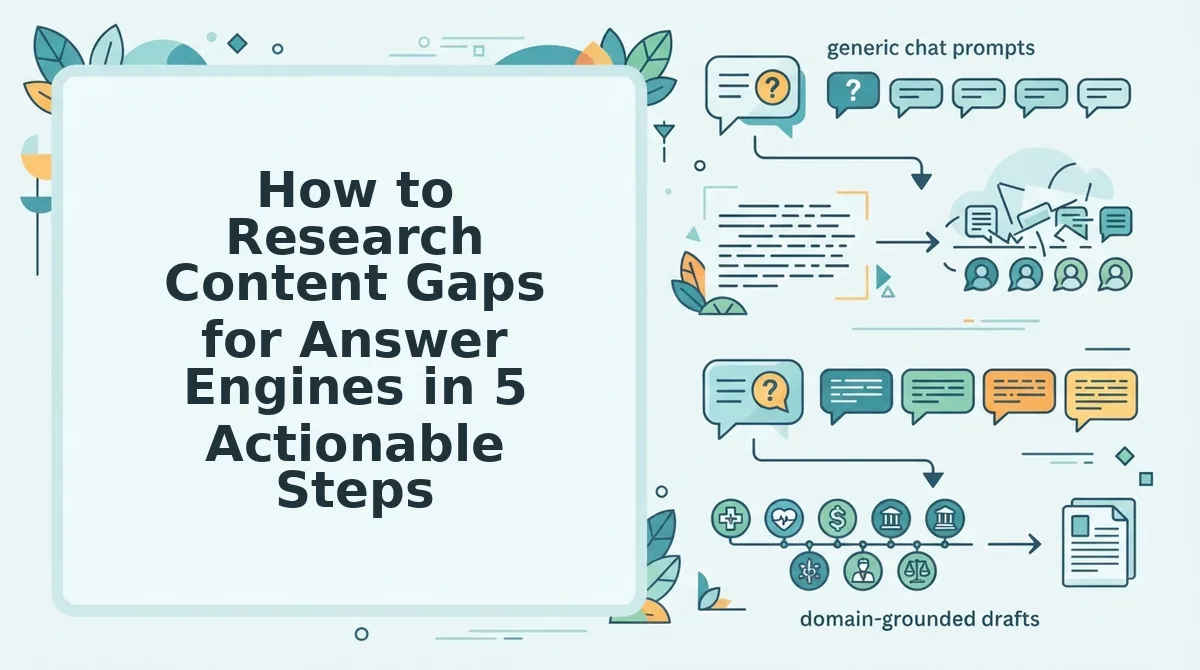
How to Research Content Gaps for Answer Engines in 5 Actionable Steps
Researching content gaps for answer engines requires auditing baseline search results, isolating the shared consensus across top sources, and targeting the exact informational vacuums left unaddressed by AI answer models. By mapping what language models fail to synthesize, you identify the missing passages search engines need to cite.
How do you extract uncovered questions without purchasing expensive enterprise seat licenses?
The Consensus Stripping Protocol is an analytical workflow that isolates the lowest-common-denominator facts shared across the top three organic results to identify an exact informational vacuum. Before starting this 45-minute process, ensure you have an active browser window, an extraction spreadsheet, and a target query cluster.
- Inspect top-ranking SERP competitors (10 minutes). Open an incognito browser window and run your primary search query. Review the top three ranking organic pages and copy their core claims, definitions, and data points into your spreadsheet. Expected outcome: A centralized list of the repetitive baseline information that standard search algorithms already treat as common knowledge.
- Mine community discussions for research voids (10 minutes). Search user forums, niche communities, and social threads using your core phrase paired with modifiers like "how do I" or "workaround". Extract recurring edge cases and unanswered bottlenecks using methodology insights from Stuckler Consulting on synthesizing rapid research voids. Expected outcome: A documented inventory of practical user problems that traditional articles ignore.
- Prompt answer engines to isolate synthesis failures (10 minutes). Open your target AI chatbot, paste the primary user query, and evaluate the generated response against your community spreadsheet. Flag generic summaries, hallucinated technical steps, or skipped nuances. Expected outcome: A clear log showing where the language model lacks factual context or produces vague generalities.
- Map the informational delta (5 minutes). Select the rows in your spreadsheet where community pain points overlap with answer engine omissions. Subtract the baseline facts gathered during your live SERP analysis to isolate net-new angles. Expected outcome: A prioritized list of high-intent content gaps ready for direct coverage.
- Draft modular, direct-answer passages (10 minutes). Write self-contained, 80-to-120-word factual blocks that solve the exact missing steps identified in your delta map. Place a direct-answer lead sentence in the first line of each section, supported by technical mechanics. Expected outcome: Rank-ready modules formatted specifically for search engine passage indexing and chatbot retrieval.
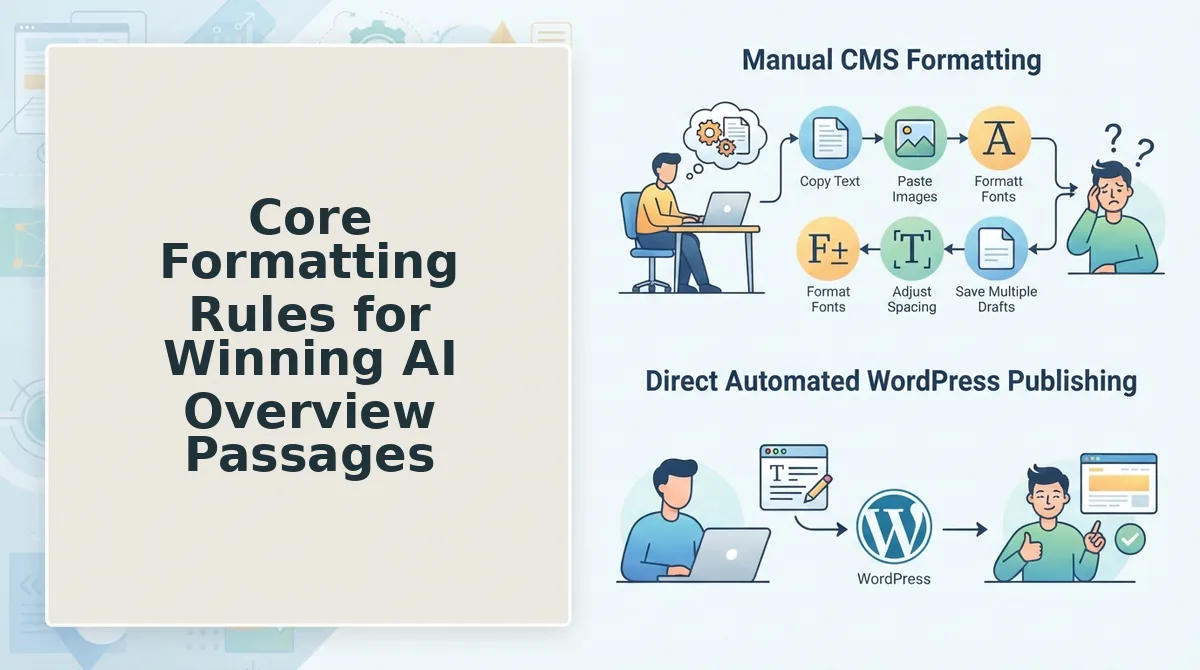
Rather than manually pulling SERP consensus and stitching spreadsheets across separate writing tools, you can automate your topic workflows. BloGoose acts as an AI SEO content engine that crawls your sitemap, conducts real-time search research, extracts competitor gaps, and publishes citation-optimized articles directly to WordPress or your custom API. Executing this tactical process successfully requires understanding the underlying scoring mechanism separating generative citations from standard rank tracking.
Information Gain Audit vs Traditional Keyword Matching
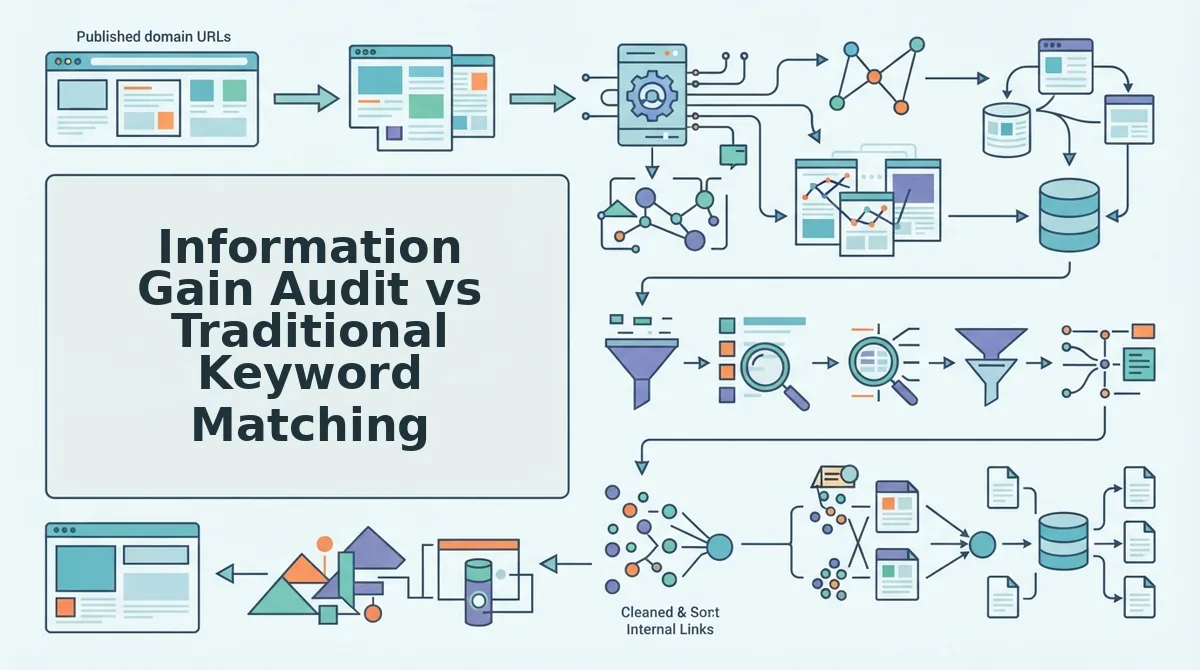
An information gain audit measures the novel factual delta a document contributes to a topic, whereas traditional keyword matching assesses lexical coverage and entity frequency across an entire URL. While traditional search crawlers score page-wide keyword relevance to rank web documents, retrieval-augmented generation (RAG) engines extract discrete text chunks scored on factual uniqueness.
Information gain is the semantic measure of unique, non-redundant factual data that a passage adds relative to existing indexed content.
Consider auditing an identical query across both standard search engine indices and a vector-retrieval pipeline. Traditional optimization validates that a page contains target phrases, related terms, and appropriate header tags to compete on standard SERPs. However, a vector pipeline parses documents into smaller text chunks, embedding them into semantic clusters. If your content matches search terms but repeats consensus facts already present across higher-authority domains, the language model drops your passage during synthesis. Understanding how to get cited in AI answers and chatbots requires moving beyond keyword repetition to engineer standalone passages with high factual density.
RAG Extraction Decision Matrix
| Evaluation Dimension | Traditional Keyword Matching | Information Gain (RAG) Audit |
|---|---|---|
| Target Unit | Complete URL and page layout | Semantic passage chunk |
| Primary Signal | Term frequency and entity density | Factual uniqueness and semantic distance |
| Evaluation Mechanism | Inverted index algorithms | Vector embeddings and cosine similarity |
| Core Strength | Secures classic SERP organic ranks | Supplies extractable chatbot citations |
Decision Framework: Choosing Your Approach
Both strategies serve distinct discovery mechanisms, and balancing them depends on your primary distribution channel:
- Choose Traditional Keyword Matching if you are building transactional landing pages or navigational assets where searchers seek a specific domain destination. Best for: E-commerce store operators and local service businesses.
- Choose Information Gain Audits if you produce informational guides, product comparisons, or educational clusters where AI engines summarize answers. Best for: Content publishers, growth leads, and solo operators scaling topical authority.
Our recommendation: Establish baseline topical relevance with traditional keyword mapping, but audit every individual section for information gain. Search engines index pages, but answer models cite unique answers. To turn these unique answers into pullable citations, you must structure each passage to match algorithmic retrieval criteria.
Core Formatting Rules for Winning AI Overview Passages
Winning AI Overview passages requires structuring content into discrete, self-contained 80 to 120-word textual blocks that answer conversational queries without relying on surrounding context. Large language models and search extractors favor these dense semantic units because they minimize retrieval ambiguity and fit token limits for synthesized answer snapshots. Passage chunking is the architectural practice of isolating atomic answers using explicit entity anchors, declarative topic sentences, and strict structural criteria. By formatting gap-filling answers into modular blocks, you ensure retrieval engines can ingest, parse, and cite your text directly.
Why do dense modular structures beat long-form storytelling every time? Retrieval algorithms index semantic boundaries, not atmospheric prose.
- Lead with an affirmative declarative statement: This is the practice of answering the target query in the very first sentence beneath a question-driven subhead. Answer engines prioritize direct lexical resolution because hedged language signals low information gain. Draft your opening sentence by stating the primary entity, the core action, and the factual outcome before providing secondary context.
- Define explicit entity boundaries immediately: This rule establishes the exact classification, taxonomy, and operational scope of a topic before elaborating on mechanics. AI knowledge graphs favor explicit categorical definitions because boundary clarity prevents hallucinated entity associations. Execute this by applying a standardized entity-definition syntax immediately after your opening claim.
- Cap target extraction blocks at 80 to 120 words: This constraint limits an individual answer section to a self-contained micro-passage that fully resolves a specific subtopic. Large language models prioritize 80 to 120-word self-contained answer blocks over expansive narrative sections because they match typical retrieval-augmented generation context windows. Audit your drafted answer block by verifying that removing surrounding paragraphs leaves the passage entirely understandable on its own.
- Strip contextual pronouns from topic openers: This editorial rule removes ambiguous referring terms such as "this," "these," or "it" from subheadings and passage openings. Chatbots extract isolated text snippets out of sequence, meaning unresolved anaphora causes retrieval systems to reject the passage for referential ambiguity. Scan the first sentence of every section to replace every relative pronoun with the exact entity or tool name.
- Convert narrative advice into numbered criteria constraints: This technique converts qualitative explanations into sequential, measurable parameters and operational thresholds. Search engines prefer structured conditions because discrete logic allows algorithms to generate AI Overview lists with zero synthesis friction. Convert your explanatory paragraphs into ordered sequences featuring quantifiable criteria instead of subjective narrative descriptions.
Once you publish passages built around these constraints, you must track whether AI engines actively index and reference your text.
How to Verify Your Content Closes the Gap in AI Search
To verify that your content successfully closes an answer engine gap, submit your target informational queries into live AI engines 48 hours post-indexing to confirm models quote your page as the primary source.
A share-of-model verification matrix is a structured testing framework used to measure how frequently an AI answer engine quotes your domain versus competitor domains for targeted topic prompts. Answer engines confirm a gap is closed when generative summaries incorporate your unique data points, definitions, or procedural steps into citation pills and reference footnotes.
Prerequisites: A live URL and active access to Google, Perplexity, and ChatGPT with web search. Before testing, ask Google to crawl new posts to confirm the URL is fully parsed.
Did the engine adopt your new information gain, or is it still serving stale competitor text?
- Build your verification matrix in a spreadsheet (Time: 5 minutes). Record three query types for your topic: a direct entity definition, a comparative scenario, and an operational process question. You should see a clean three-row testing template ready for benchmarking.
- Submit each prompt through unauthenticated search sessions in Google, Perplexity, and ChatGPT (Time: 10 minutes). Type each query into the search bar without naming your brand or leading the model. You should see an AI Overview or generated answer generate with linked reference citations.
- Inspect footnote references and synthesized text for source attribution (Time: 5 minutes). Check whether the AI answer mirrors your unique entity framing and includes your URL in the citation carousel. You should see your domain actively displayed as a cited authority; if the engine defaults to legacy competitors, add more structured factual data to your page.
To help refine your approach further, here are answers to the most common questions regarding answer engine gap discovery.
Frequently Asked Questions About Answer Engine Content Gaps
Answer engine content gaps occur when published resources fail to supply the unambiguous, high-density facts required for generative synthesis. Addressing them shifts your focus from chasing query frequency to supplying verifiable data points that large language models can extract without hallucination.
How quickly do answer engines cite newly resolved content gaps?
Answer engine systems operate on immediate retrieval extraction cycles rather than traditional indexation lag. While standard search crawlers often take days to recalibrate PageRank and discover link updates, modern AI search platforms query live web indexes and extract factual data within minutes if the passage syntax is unambiguous.
Why do pages ranking in Google's top three get omitted from AI chatbots?
AI search models prioritize incremental information gain over legacy domain metrics. When a top-ranking URL merely summarizes existing SERP consensus without providing original data points, clear entity relationships, or standalone insights, generative models skip the page in favor of syntactically tighter primary sources.
Resolving AI visibility requires three immediate actions: identify the specific factual nodes your competitors omit, format your explanations into self-contained thirty-word answer blocks, and monitor citation inclusion across clean user sessions.
To automate this research and publish voice-accurate, citation-ready clusters directly to your CMS, you can test 3 free articles on BloGoose.
Traditional search engines reward pages that match user queries, but answer engines only cite content that resolves factual ambiguity.