
How to schedule draft intervals for blog automation
You hit run on your content workflow, generate fifty perfectly formatted guides in minutes, and publish the entire lot directly to WordPress before lunch. Within three weeks, the euphoria fades: your Search Console coverage dashboard fills with "Discovered - currently not indexed" warnings while server logs reveal search bots barely touched your newest URLs.
Flooding search engines with unmetered bulk posts exhausts your domain's crawl budget and signals low-effort spam patterns. Deploying an AI SEO content engine requires disciplined cadence control rather than instant publication dumps. This guide outlines how to calculate draft publishing intervals, structure pillar rollout velocity, and maintain automated distribution without triggering algorithmic crawl suppression, though site age and incoming link profiles will naturally set upper limits on discovery speed.
Here is what happens when you pace the pipeline properly:
- The situation: A newly crawled site imports existing sitemap structures but risks search bot neglect by queueing 30 draft posts simultaneously.
- The action: The publisher configures automated publishing intervals to release two cluster articles daily across a 15-day window while pinging the Google Indexing API post-publish.
- The outcome: Search crawlers regularly revisit the site on an established timetable, indexing fresh cluster URLs systematically rather than stalling them in discovery queues.
Curious why shortening your publishing gap from twenty-four hours to twelve can actually stall your internal link authority? Managing publication intervals directly inside BloGoose aligns your autopilot content calendar with real-time indexing triggers to keep discovery steady. Understanding this dynamic begins with examining the automated crawler defenses triggered by sudden volume spikes.
Why Instant Mass-Publishing Triggers Search Engine Surge Defenses
Instant mass-publishing triggers search engine surge defenses because sudden output spikes signal programmatic spam and risk overwhelming server infrastructure. Flooding an XML sitemap with dozens of simultaneous articles prompts search bots to throttle crawl activity and delay indexation.
Search engine surge defense is an automated crawler safeguard that restricts site indexing speed when an abnormal increase in newly published URLs is detected. When a site suddenly pushes hundreds of pages at once, Googlebot initiates host-load rate limiting. Instead of crawling every new page, the crawler measures your server capacity and slows its request frequency to prevent downtime. This sudden discovery velocity spike causes search algorithms to classify the rapid expansion as potential scaled content abuse, pushing unindexed URLs into discovery queues rather than the primary search index.
Think of crawler capacity like a residential circuit breaker. Powering a single light bulb draws steady current, but plugging in dozens of high-draw appliances at the exact same instant trips the breaker to prevent electrical failure.
At an architectural level, search bots track discovery velocity against historical baselines. Googlebot monitors host-load rate limiting behavior during abnormal spikes in HTTP 200 responses across previously dormant XML sitemaps. When a domain that previously returned static responses suddenly serves hundreds of fresh status codes, safety thresholds engage immediately.
Mass-publishing triggers three specific defense stages across your domain:
- Host-load throttling: Googlebot intentionally scales back concurrent HTTP connections to keep your web server from exhausting memory or CPU resources.
- Discovery queue deferral: Crawlers drop excess URLs into a holding status like "Discovered - currently not indexed" to verify server stability over time.
- Algorithmic quality dampening: Pattern-recognition models flag unverified content clusters for deeper freshness and entity scrutiny before granting visibility.
Staggering your releases across predictable draft intervals avoids these automated containment protocols. Spacing keeps crawl consumption smooth before you ask Google to crawl new posts through indexing workflows. Determining the exact spacing your site requires depends entirely on how established your domain is in the eyes of search algorithms.
Recommended Publishing Intervals by Site Maturity and Authority
Publishing intervals must scale alongside your domain's historical crawl frequency, pacing from 12-hour gaps on brand-new sites to 45-minute jittered windows on established authority domains. This structured pacing prevents search engine crawler rate limits from stalling indexing across new topical clusters.
How fast can you safely schedule automated content without overwhelming your site's crawl budget?
The Domain Velocity Matrix is a publishing framework that aligns daily output volume and draft spacing to a website's age, crawl frequency, and existing index equity.
Setting automated draft intervals requires matching your release speed directly to crawler expectations. New domains under six months old should publish a maximum of one to two posts per day spaced by twelve hours. This conservative pacing establishes an initial crawl history without signaling low-quality spam automation. Maturing sites between six and twenty-four months can safely scale to three to five posts daily spaced by four to six hours as search bots visit more frequently. Established authority domains can deploy ten or more posts daily using a randomized forty-five to ninety-minute jitter to maintain natural delivery patterns.
| Site Tier | Domain Maturity | Daily Safe Volume | Draft Interval Pacing | Best For |
|---|---|---|---|---|
| Tier 1: Greenfield | Under 6 months | 1 - 2 posts/day | Strict 12-hour spacing | Solo founders and niche site builders establishing initial index trust |
| Tier 2: Maturing | 6 - 24 months | 3 - 5 posts/day | 4 - 6 hour intervals | DTC brands and growing publishers expanding topical authority clusters |
| Tier 3: Authority | 24+ months | 10+ posts/day | 45 - 90 minute randomized jitter | Digital marketing agencies and large media publishers managing high-scale output |
Which interval fits your current growth stage?
- Choose Tier 1 if your domain has fewer than 50 indexed pages and search engines visit your sitemap intermittently.
- Choose Tier 2 if your published articles receive steady organic impressions and get crawled within 48 hours of release.
- Choose Tier 3 if your platform maintains strong backlink authority and search bots crawl your site continuously throughout the day.
Enterprise tools like Jasper excel when corporate teams need multi-channel ad copy and isolated marketing variants. Similarly, Surfer SEO provides valuable granular scoring for individual document entity density. However, neither system automates cadence schedules based on your underlying site structure.
Our recommendation for most operators is the Tier 2 maturing cadence: publishing three articles daily spaced every five hours. This rate deploys approximately 90 contextual articles per month, expanding topical depth quickly while keeping crawl activity predictable.
To safely automate your schedule, run an automated sitemap crawl to detect your existing content depth and structure a balanced editorial calendar directly inside your publishing engine. Once you identify your site tier, translating that pacing into an automated production pipeline requires setting up the right queue mechanics.
How to Schedule Draft Intervals for Blog Automation Step by Step
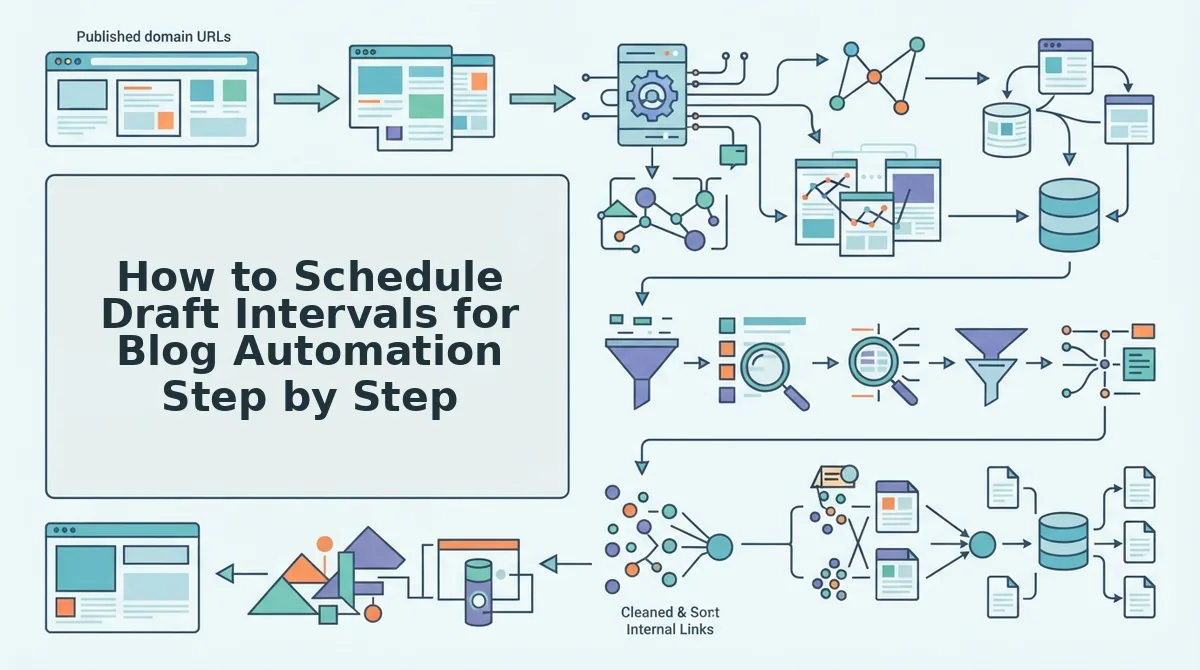
To schedule draft intervals for blog automation, calculate your baseline posting cadence, apply a timing jitter to prevent footprint detection, buffer drafts inside your content queue, and automate crawl requests upon publication. Setting this automated sequence guarantees organic distribution patterns without requiring manual calendar adjustments.
Timing jitter is a deliberate randomization applied to recurring task intervals to simulate natural human activity. Without variance, static delivery triggers algorithmic filters.
Before beginning, prepare three prerequisites: an authenticated connection to your CMS or custom API endpoint, an inventory of structured article drafts, and verified credentials configured according to the Google Indexing API guide.
- Establish your staging buffer in the queue settings (Estimated time: 5 minutes). Click your publishing engine dashboard, open the Queue Settings panel, and enter a minimum threshold of five complete drafts. You should see a green badge indicating an active staging buffer that prevents the system from running dry between generation batches.
- Define the base cron recurrence delay (Estimated time: 3 minutes). Navigate to the Scheduler tab, select your preferred publishing frequency, and set your baseline publishing interval (such as every 48 hours). The queue interface will display scheduled release targets mapped evenly across your upcoming calendar.
- Apply the mathematical jitter formula to schedule timestamps (Estimated time: 5 minutes). Input the formula
Base Interval ± Random Variance of 15 - 45 minutesinto the execution offset field. This breaks predictable programmatic timestamp symmetry so post releases land at natural, irregular intervals like 10:18 AM or 2:41 PM rather than rigid on-the-hour marks. - Enable automated webhook pings for instant crawl requests (Estimated time: 4 minutes). Toggle the Search Engine Indexing Hook to active and map your API service key to the post-publish event trigger. You should see a successful 200 OK test response verifying that search engines receive immediate crawl pings the second a scheduled post goes live.
Are you still manually calculating delay formulas and pushing articles across multiple disconnected tools?
You can replace manual spreadsheet calculations and API scripting with BloGoose. Deploying an autopilot content engine automatically extracts your brand voice, schedules pillar-focused clusters with built-in cadence pacing, and ships optimized articles straight to WordPress or your custom endpoint. However, timing intervals represent only half the equation; how you interleave distinct topic clusters across those time slots is just as crucial.
Architectural Rules for Interleaving Topic Clusters Across Queues
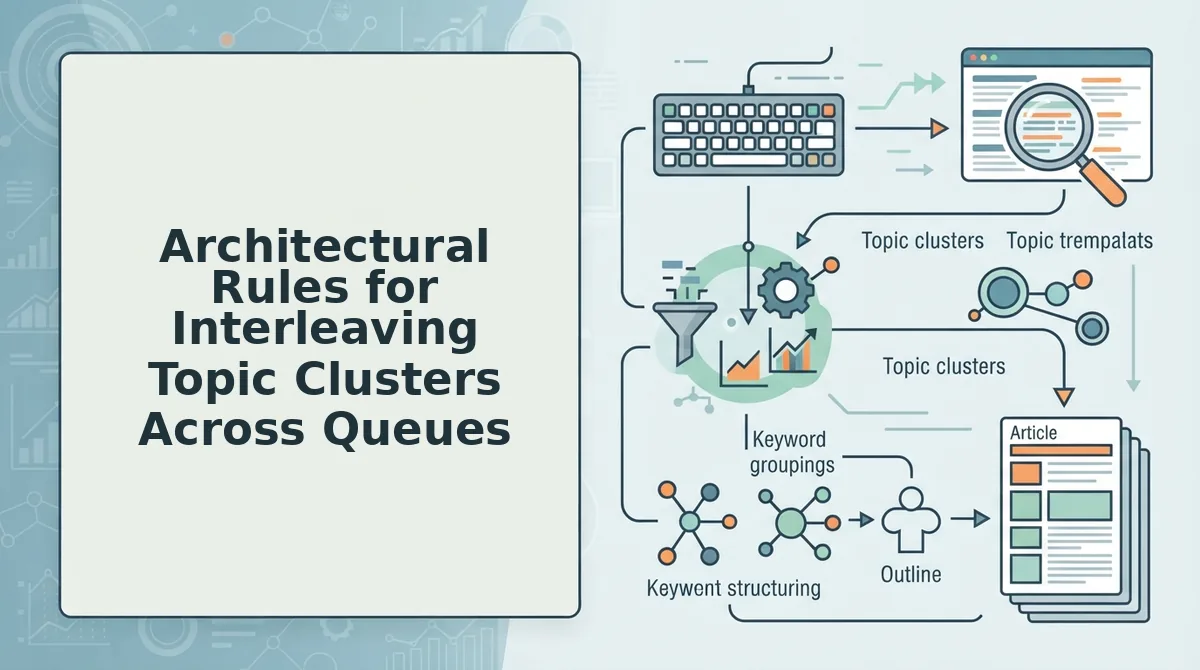
Interleaving topic clusters across queues distributes new articles cyclically across separate site categories to prevent topical keyword cannibalization and crawl congestion. Round-Robin Cluster Interleaving is a scheduling architecture that rotates automated publication drafts across multiple category silos instead of exhausting a single cluster in a single queue run.
Most publishing teams dump twenty related pieces into one silo sequentially, believing it accelerates category authority. It actually triggers cannibalization risks and skews crawl priority away from the rest of your domain.
- Rotate parent categories using round-robin distribution. This method sequences every successive automated draft through distinct category queues so no single topic taxonomy receives back-to-back uploads. It keeps crawl patterns organic across the entire site architecture and eliminates temporary internal competition among closely related URLs. Configure your scheduler to cycle sequential releases across parent categories A, B, and C in order rather than running single-cluster batch drops.
- Delay supportive child posts until the primary pillar is crawled. This scheduling dependency holds all narrow sub-topic drafts in draft status until search crawlers complete discovery of the central category hub. It guarantees that subsequent contextual internal links route equity upward to a recognized destination URL rather than an unindexed draft placeholder. Audit your XML sitemap logs to verify hub discovery before releasing secondary nodes in your topic clusters.
- Separate semantically overlapping variants across distant calendar slots. This timing rule spaces closely related search intents several publishing cycles apart rather than releasing them within the same week. It prevents search bots from viewing freshly indexed, complementary pages as duplicate attempts to rank for the identical root query. Map keyword intent overlaps in your master queue spreadsheet and mandate a multi-week buffer between near-synonym titles.
- Cap individual category frequency at one post per queue cycle. This boundary restricts any single content bucket from occupying more than one publish slot in a multi-day queue loop. It prevents localized category flooding while forcing balanced domain-wide expansion across all active content initiatives. Set CMS automated routing rules to reject consecutive category assignments in your draft delivery queue.
- Anchor every interleaved draft to an existing indexed peer. This internal linking policy requires newly generated queue drafts to reference an already live URL from an adjacent silo before publishing. It creates natural cross-cluster semantic bridges that accelerate discovery across disparate sections of your site. Pull confirmed URLs directly from your site sitemap file and inject two cross-silo links into each draft before queuing.
After configuring your interleaved queue architecture, monitoring how search bots respond to your publishing rhythm ensures your setup delivers the expected indexation results.
How to Verify Queue Health and Search Bot Crawl Pacing
You verify queue health and search bot crawl pacing by cross-referencing your publishing schedule with Google Search Console Crawl Stats and raw server access logs. This process confirms whether search engine spiders have synchronized with your automated publishing cadence or are lagging behind your release schedule.
Crawl pacing is the rate at which search engine bots fetch pages from a website over a specific timeframe. Verifying this pacing ensures search spiders discover newly published automated drafts without triggering crawl budget bottlenecks or server delays. When an automated queue releases content at regular intervals, search bots gradually synchronize their visit frequency with those predictable drops. Operators verify this balance by reviewing crawl request volume, HTTP status codes, and server response times to ensure Googlebot consumes new URLs smoothly as soon as the automation pipeline publishes them.
Think of crawl pacing like a postal carrier walking a neighborhood route. If you place outgoing mail in your box every weekday at the exact same hour, the carrier learns your pattern and checks your box reliably instead of wandering by at random times.
How do you confirm this synchronization is functioning on your domain?
Start by evaluating Google Search Console Crawl Requests by Response Type to confirm a sub-300ms average response time during scheduled drops. Maintaining an average response latency below 300 milliseconds proves that your hosting stack handles automated publishing events without exhausting database connections or causing bot timeouts.
To take inspection a step further, filter your raw server access logs directly for verified Googlebot requests during your scheduled posting windows.
- Consistent HTTP 200 responses prove that search bots are processing newly scheduled draft URLs without encountering generation errors.
- Spikes in HTTP 429 or 5xx codes signal that your draft queue intervals are firing too aggressively for your current server capacity.
Routine log verification ensures that your publishing automation remains aligned with search bot discovery rates. To clarify common edge cases regarding delivery timing and CMS behavior, review the tactical questions below.
Frequently Asked Questions About Draft Interval Scheduling
Automated draft interval scheduling spaces out content releases to maintain steady search indexing and protect server resources.
Why does scheduled blog automation miss publish deadlines in WordPress?
WordPress misses scheduled draft timestamps because default WP-Cron only triggers when a visitor loads a page. Low-traffic websites fail to execute scheduled events on time. Replacing WP-Cron with a persistent system crontab forces the server to publish queued drafts at exact chronological intervals without depending on pageviews.
What is the ideal draft interval for automated publishing?
The ideal draft interval ranges between 4 and 24 hours based on domain age and indexing speed. Newer blogs perform best publishing every 24 to 48 hours to protect crawl budgets. Established domains with rapid indexing can safely compress delivery down to 4-hour intervals across content clusters.
How do automated draft intervals affect search indexing?
Automated draft intervals create a consistent crawl cadence that encourages search bots to return to your sitemap predictably. Spacing out publication events prevents crawl budget exhaustion and suppresses anti-spam velocity alerts. In contrast, sudden bulk releases cause discovery delays because search crawlers throttle unverified bulk URL spikes.
What happens if you publish multiple automated posts at once?
Publishing multiple automated posts at once risks crawl truncation and search engine spam flags. When dozens of articles appear simultaneously, search spiders rarely index the entire batch in one pass. Staggering publications across defined hourly intervals ensures every post receives dedicated crawler attention and proper internal link processing.
Addressing these core constraints paves the way toward building a truly autonomous publishing architecture.
Building a Resilient Hands-Off Publishing Engine
A resilient hands-off publishing engine treats publication timing as a crawl-budget governor rather than an editorial convenience. Most operators obsess over content generation speed, yet search engines prioritize indexable consistency over raw volume. Automated pacing eliminates the trade-off between publishing velocity and crawl health by matching your output cadence to your domain's real-time bot capacity.
Deploy this operational framework using three concrete milestones:
- Audit server crawl logs to identify your baseline daily Googlebot fetch frequency.
- Interleave draft queues across alternating clusters to prevent topical cannibalization.
- Configure your CMS delivery layer to stagger drafts across programmatic buffer intervals.
Aligning cluster delivery with server response rates resolves search engine surge defenses before they trigger algorithmic throttling. Head over to BloGoose to test 3 free articles and build an autopilot pipeline tuned for rapid search discovery.
Predictable release cadences convert erratic crawling into dependable indexation by proving to search algorithms that every new URL deserves immediate attention.