
Sectional AI Drafting vs Single Prompt Generation for Blogs
You spend 45 minutes crafting a 600-word megaprompt, only to watch the model return an 850-word surface-level summary that ignores your technical constraints. The debate over sectional AI drafting vs single prompt generation boils down to how large language models handle context boundaries under heavy compute loads. Single prompt generation collapses because large language models routinely compress long-form requests down to 800 - 1,200 words regardless of prompt length due to training alignment defaults. Sectional AI drafting solves this limitation by generating content heading by heading.
Dealing with prompt-engineering homework and generic AI mush drains publishing velocity. Deploying an AI SEO content engine that breaks articles into modular passes ensures every subheading maintains depth and topical relevance. In this breakdown, you will learn how both approaches handle context boundaries, how token limits govern quality, and how to build citation-optimized articles efficiently.
Consider the operational difference during a real content run:
- The monolithic run: A publisher inputs a competitive topic into a standard chat window, receiving shallow commentary that skips technical mechanics and ignores primary keyword positioning.
- The sectional run: An automated engine takes an outline, pulls live search signals, and drafts each subsection against saved Markdown context files, producing complete coverage.
Later, we unpack a hidden token degradation trigger that quietly ruins single-prompt factual accuracy halfway through a draft. This guidance applies directly to organic search articles and informational blog posts, while excluding short-form social copywriting.
To determine the most viable infrastructure for your search strategy, it helps to analyze how these methodologies stack up across critical production benchmarks.
Sectional AI Drafting vs Single Prompt Generation: Direct Comparison and Evaluation Criteria
Sectional AI drafting constructs long-form articles incrementally by isolating specific subheadings and context windows, whereas single-prompt generation attempts to output a complete post in one unstructured completion. While single-prompt systems seem faster upfront, sectional workflows consistently yield superior factual accuracy, voice retention, and search citation readiness across 2,000+ word drafts. Operating section by section prevents the token saturation that causes large language models to wander off-topic.
Sectional drafting is an architectural generation technique that feeds distinct context instructions, SERP data, and style guidelines into sequential model runs rather than forcing an entire outline into a single prompt.
Many teams assume one-click generation is the most efficient path to scale organic search publishing. That assumption falls apart once drafts enter editorial review. Compressing an entire long-form outline into one prompt introduces severe context decay, forcing writers to manually scrub robotic transitional phrases, fix logical drift, and verify ungrounded claims.
| Evaluation Criterion | Single-Prompt Generation | Sectional AI Drafting |
|---|---|---|
| Token Governance (2,000+ words) | Context decays midway, causing truncated explanations and repetitive section endings. | Fresh token allocations per section preserve uniform depth across the entire outline. |
| Hallucination Vectors | High risk; the model invents facts as the prompt window becomes saturated. | Low risk; modular runs verify context against specific reference files. |
| Voice Fidelity | Drifts quickly into generic filler and robotic transitions as output lengthens. | Remains anchored to brand context files throughout every subheading. |
| Editorial Control | Low; regenerating a flawed section requires re-running the entire draft. | High; operators can adjust, inspect, or refine individual sections independently. |
| Operational Overhead | Low initial generation runtime, but high manual revision and CMS formatting time. | Structured drafting upfront, but minimal post-generation cleanup. |
Every content production workflow involves clear operational trade-offs:
- Choose single-prompt generation if: You need instant concept scratchpads, short social updates, or basic briefs under 500 words. This approach is best for solo operators handling light ideation where topical nuance is secondary.
- Choose sectional AI drafting if: You target competitive search keywords, require deep context retention, and ship full clusters directly to your CMS. This approach is best for growth leads, digital agencies, and professional publishers.
Evaluating drafting architecture requires weighing immediate output speed against the downstream labor required to publish clean, voice-accurate search content. Our recommendation is sectional drafting for any production blog post targeting organic search or AI answer engines. To experience how modular generation enforces brand context across complete articles, test 3 free articles directly on your site.
Understanding these operational trade-offs highlights a core mechanical bottleneck within neural networks. To understand why monolithic prompts deteriorate so quickly, we must inspect how compute and attention mechanisms operate under heavy prompt payloads.
Why Single Prompts Degrade Long Content Quality
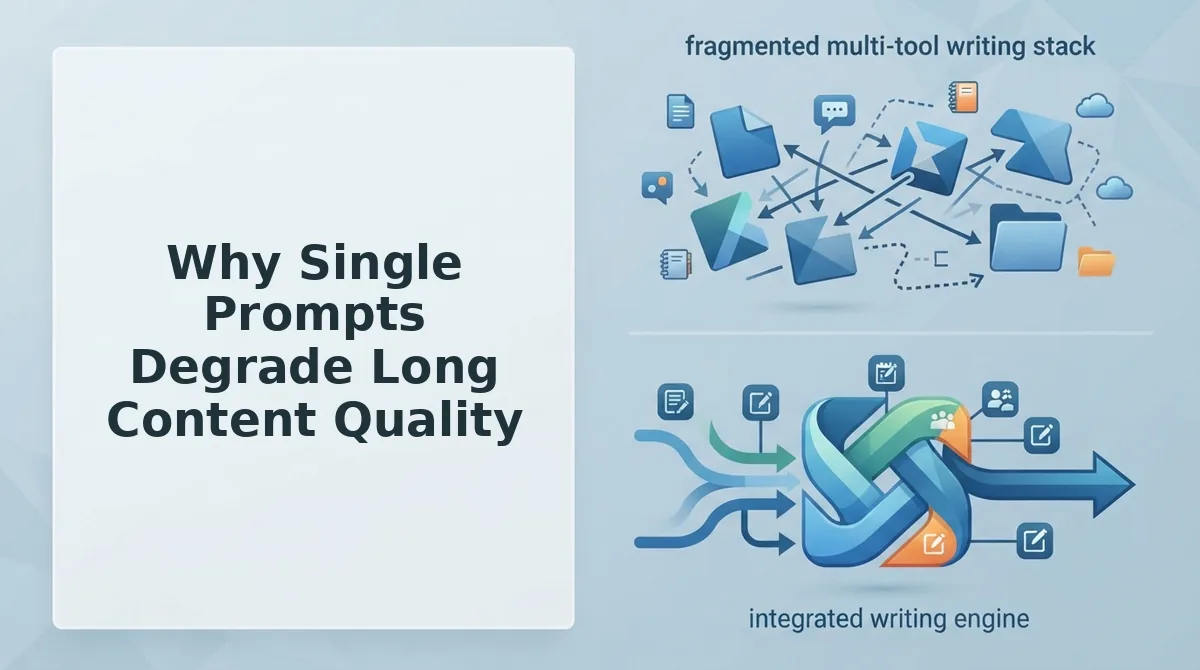
Single-prompt generation degrades long-form content because sending an entire article request in one pass forces the model's attention mechanism to divide compute across competing instructions, which flattens topical depth. This structural bottleneck causes output to regress toward generic summaries rather than detailed domain insights.
Single-prompt generation is the practice of requesting an entire end-to-end article using a single instructions payload sent to a large language model. Why does a model with a context window exceeding one million tokens still produce surface-level fluff when asked for a comprehensive guide in one shot?
Context dilution is the architectural degradation of output quality that occurs when a single prompt overwhelms an AI model's attention mechanism with competing objectives. When an operator asks for an outline, research facts, tone alignment, and thousands of words in a solitary prompt, the model distributes its fixed processing weight across all requirements. Consequently, the attention assigned to domain depth shrinks. This causes reinforcement learning from human feedback length biases to trigger early conclusions, producing generic summaries, repetitive transitions, and shallow generalizations instead of actionable technical analysis.
Think of prompt execution like an orchestra conductor attempting to coach eighty musicians simultaneously during a live show instead of rehearsing section by section. The broader the command, the weaker the individual performance.
At a baseline level, large language models do not write with conceptual memory. They predict the next most probable token based solely on the active context provided in that specific inference call.
As demonstrated in IBM Technology principles on context engineering versus naive prompt engineering, token budgets within a prompt get fractured across competing directives. Naive prompt engineering forces the model to balance voice rules, formatting, structural outlines, and factual data retrieval inside one computational pass, exhausting its reasoning capacity before drafting begins.
This dynamic triggers three compounding architectural failure points:
- Attention dissipation: Transformers calculate mathematical relationships between all tokens in a prompt, meaning every added instruction lowers the attention weight given to core subject matter.
- Instruction trade-offs: When a prompt mandates strict constraints, such as negative constraints, voice rules, and internal link logic, the model prioritizes syntactical compliance over narrative substance.
- RLHF length bias: Models tuned through reinforcement learning from human feedback are conditioned to produce concise conclusions, prompting the engine to prematurely wrap up complex subtopics.
When operators demand total execution from a solitary prompt, the engine inevitably sacrifices analytical depth for compliance. Sectional execution eliminates this compromise by isolating the model's focus per section.
By eliminating competing attention demands, modular generation unlocks structural consistency across large editorial assets. These technical mechanics translate directly into tangible competitive advantages on the SERP.
Measurable Strengths of Sectional AI Drafting
Sectional AI drafting produces higher-ranking blog posts because it isolates generation tasks into modular blocks, preventing context degradation and hallucination spread across long articles. Sectional AI drafting is a content architecture method where an engine generates, validates, and refines an article one discrete heading at a time rather than producing an entire piece in a single prompt.
Consider this scenario: an ungrounded model outputs a 2,500-word post with three hallucinated source citations scattered across the middle subheadings. In a monolithic generation, fixing those fabrications requires reprompting the entire text, risking structural drift and style collapse across previously sound paragraphs. When you draft section by section, you simply rewrite the flawed block while keeping the surrounding verified sections completely intact.
- Isolated Token Allocation: Allocating fresh token limits to individual headings prevents the compression decay that ruins long monolithic generations. This ensures that concluding sections receive the exact same depth, analytical focus, and semantic density as opening introductions. To apply this, structure your generation pipeline so each H2 prompt only receives relevant parent context and specific section instructions.
- Verifiable Factual Grounding: Confining the generation model to narrow subject boundaries stops the drift that generates hallucinated data. Academic research tools like Jenni AI workflows demonstrate how isolating section boundaries allows precise factual citations without blowing context limits. You can deploy this pattern by feeding distinct factual source data into each dedicated section prompt rather than overloading a single master context window.
- Granular Tone and Rule Adherence: Breaking an outline into separate modules lets you apply precise formatting constraints to specific subsections without confusing the LLM. Global style instructions often decay across long single prompts, but sectional drafting allows target rules to govern individual paragraphs consistently. You can enforce exact constraints across every block by loading dedicated markdown brand context files directly into each sectional run.
- Deterministic Inline Media Placement: Generating targeted content blocks enables you to programmatically position contextual images, data tables, and callouts exactly where readers require them. Monolithic outputs routinely drop media in arbitrary locations because the model loses awareness of layout depth. You can implement this by requiring each section pipeline to return both the semantic prose and its corresponding inline image prompt before moving down the outline.
Are you still piecing together disconnected prompts and manually repairing degraded long-form articles?
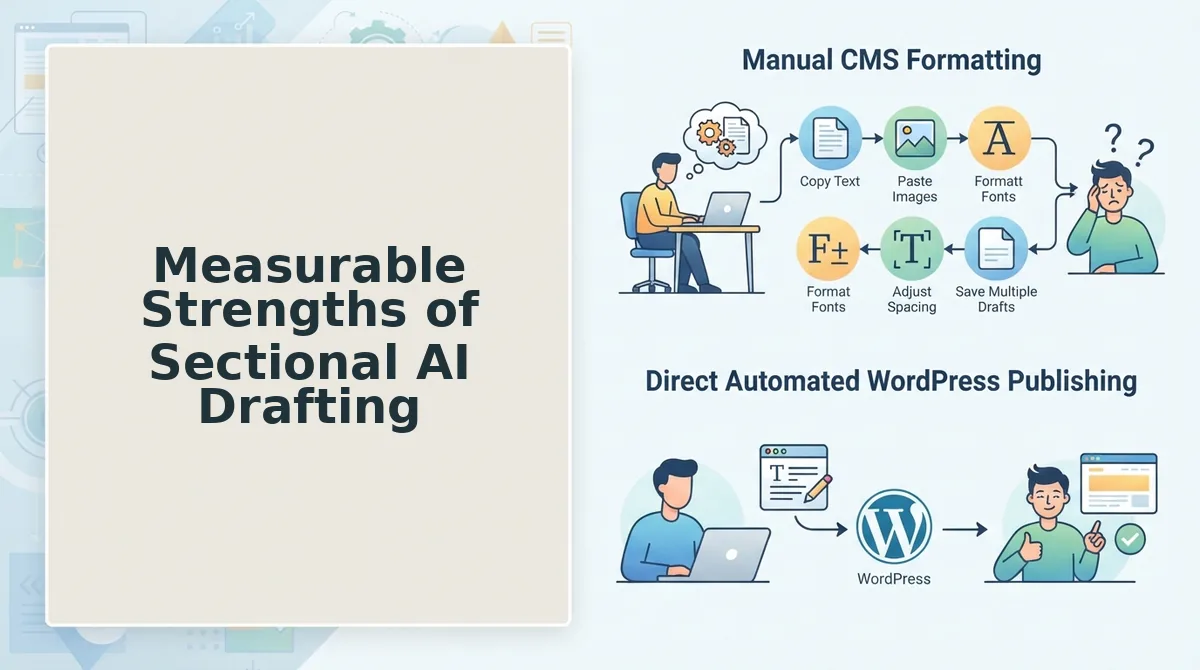
BloGoose replaces multi-tool friction by crawling your site structure, extracting voice parameters into context files, and generating modular, citation-optimized articles that publish directly to WordPress or your custom API.
Even though modular generation is critical for technical guides, not every publishing scenario justifies a multi-stage workflow. Identifying where monolithic prompts remain viable prevents unnecessary operational overengineering.
When Single Prompt Generation Still Works Best
Single prompt generation works best for short-form, low-complexity formats under 750 words where maintaining narrative continuity across subheadings is unnecessary. Running multi-step modular agent pipelines for brief announcements, meta descriptions, or quick email blasts adds unnecessary latency without improving output depth.
Single prompt generation is an approach where an entire asset is produced in one continuous LLM completion pass from a single set of user instructions. For concise formats, this direct execution path remains faster, cheaper, and entirely sufficient.
Topical degradation benchmarks reveal clear structural thresholds. Forcing short copy into a sectional assembly engine is pure operational overengineering.
Why build an elaborate multi-stage workflow just to draft a 300-word release note?
Here is an execution matrix mapping out when monolithic prompts deliver better returns than sectional engines.
| Format | Length Range | Recommended Approach | Best Persona |
|---|---|---|---|
| Product Release Notes | 200 - 500 words | Single Prompt | Best for Solo Operators needing instant turnaround on feature logs. |
| Curated Email Newsletters | 300 - 700 words | Single Prompt | Best for Growth Leads sharing curated bullet points and summaries. |
| Deep-Dive Technical Guides | 1,500 - 3,500 words | Sectional AI Drafting | Best for Content Publishers building comprehensive search clusters. |
| Commercial Comparison Pages | 1,200 - 2,500 words | Sectional AI Drafting | Best for SEO Teams targeting high-intent buyer keywords. |
Single-pass outputs excel when the context window does not suffer from attention dilution. When an LLM only needs to produce three or four paragraphs, it retains structural instructions, formatting constraints, and voice criteria accurately across the entire text.
Use this decision framework to match the method to the job:
- Choose single prompt generation if your total word target sits below 750 words, your content requires zero entity sub-clustering, and your asset does not rely on extensive live SERP extraction.
- Choose sectional AI drafting if your target extends beyond 1,500 words, covers multiple technical subtopics, or requires structured schema and verified citations.
Our recommendation is straightforward: keep single-prompt generation for standalone short-form assets, product updates, and email snippets. Reserve sectional drafting for pillar content where multi-angle SERP coverage and depth determine search visibility.
Once you identify which assets require modular execution, the next priority is setting up the workflow programmatically. Here is how to configure an automated pipeline that enforces context boundaries at scale.
How to Automate Sectional Drafting and Manage Pipeline Boundaries
Automating sectional drafting requires structuring an end-to-end pipeline that extracts site context from an XML sitemap, processes headings through isolated LLM calls, and compiles the verified sections into a single post payload. Sectional content automation is an architecture that generates articles segment by segment against strict contextual constraints rather than requesting entire drafts in one prompt.
How do you eliminate prompt fatigue without spending three hours babysitting iterative chat turns? Manual chat window workflows force writers to manually copy outlines, past sections, and style rules into every prompt. You can replace this fragmentation by running an autopilot content engine that handles memory state across clear pipeline boundaries automatically.
Prerequisites: Before starting, you need a live XML sitemap reflecting your URL taxonomy and administrative API access or webhooks enabled on your target CMS platform.
- Type your website domain into the setup crawler. Enter your root URL into the domain input field and select Start Crawl (1 to 2 minutes). The system inspects your XML sitemap, identifies published URL paths, and extracts brand voice rules into eight editable Markdown files, including
style-guide.mdandseo-guidelines.md. You should see a green confirmation checkmark next to your detected CMS stack and generated files. Note that if your sitemap structure lacks organized categories or contains broken paths, the crawler may pull inconsistent topical context that requires manual file editing. - Select target keywords from live search analysis. Click Research, type your seed topic, and trigger the live SERP query (under 30 seconds). The pipeline extracts competitor gaps and structures an outline containing designated heading boundaries. You should see an outline map where each section heading possesses clear word targets, intent definitions, and required entities.
- Execute isolated section prompt batches. Click Generate Draft to run the modular execution loop (2 to 3 minutes). The engine feeds each heading to the LLM sequentially, combining the specific subtopic with your extracted context files while omitting token-wasting earlier paragraphs. You should see real-time progress indicators populate each section card with finished text and inline visual assets without context drift.
- Send the compiled article to your publishing endpoint. Review the assembled preview layout and click Publish (instant). The engine aggregates the individual sections into a unified document and ships it directly to your WordPress installation or custom API webhook. You should see an active post draft appear in your CMS dashboard with preserved heading hierarchy and image tags.
Implementing this architecture resolves the most pressing generation bottlenecks, but operational questions often arise during integration. Below are direct answers to common queries regarding modular content automation.
Frequently Asked Questions
Sectional drafting produces higher-ranking search content than single-prompt generation because it isolates context windows to prevent model drift, hallucination, and superficial summaries across long articles.
Why does writing a 3,000-word blog in ChatGPT require prompt chaining?
Writing 3,000 words in ChatGPT requires prompt chaining because large language models hit generation completion ceilings and compress later sections when prompted all at once. Breaking the article into chained sub-prompts preserves context depth, forces adherence to structural outlines, and ensures comprehensive semantic coverage across every single subtopic.
What is sectional AI drafting?
Sectional AI drafting is an automated workflow that generates an article block by block, treating each heading as an independent generation task. This method injects distinct research data, style parameters, and semantic keyword targets into each section rather than relying on one broad, multi-thousand-word model request.
How does sectional generation reduce AI hallucinations?
Sectional generation reduces hallucinations by narrowing the factual retrieval scope to specific subtopics and grounding each heading in isolated reference data. When an LLM processes tight constraints per prompt, it avoids inventing unsupported statistics or filler examples to satisfy arbitrary overall article length requirements.
How do I ask Google to crawl new sectional AI posts faster?
You can ask Google to crawl new posts immediately by submitting URLs through the Google Indexing API or submitting an updated XML sitemap in Search Console. Automated engines trigger these API crawl requests immediately upon CMS publication to expedite search indexing.
Does sectional AI drafting take longer to run than a single prompt?
Yes, sectional drafting requires more execution time because it triggers multiple sequential API calls, outline validations, and contextual research checks. While a single prompt generates generic copy in thirty seconds, sectional execution takes several minutes to deliver verified, citation-ready articles that require minimal human editing.
With these foundational concepts established, publishers can systematically restructure their editorial workflows to maximize search visibility and content depth.
Upgrading Your Long Form Publishing Architecture
Modern search engines and AI answer engines reward modular drafting boundaries because granular, step-by-step content generation eliminates context degradation and preserves factual depth across every heading. Treating prompt engineering like creative writing homework guarantees generic, mid-tier output. Treating content production as an automated publishing pipeline delivers reliable topical authority.
The teased performance gap from the beginning of this guide resolves to a simple architectural reality: single megaprompts compress context, while sectional drafting expands topical coverage to satisfy both Google algorithms and chatbot citation engines.
To upgrade your publishing stack from manual prompts to an automated workflow:
- Audit your existing library to identify comprehensive long-form articles that suffered from single-prompt hallucination or thin subheadings.
- Break your content production into discrete operational layers: SERP research, structured outlining, isolated section drafting, and direct CMS synchronization.
Why keep wrestling with disconnected chat interfaces and manual formatting?
Drop your website domain into the BloGoose setup wizard to automatically inspect your XML sitemap, extract your brand voice rules, and build an automated content workflow ready for direct CMS publishing.
Sectional AI drafting wins because answer engines cite verifiable depth, not the speed of a single generation command.