
Run a Sectional Content Review Loop to Match Search Parameters

Most teams run one full-draft review, hit publish, and never notice that the "pricing" section drifted into feature comparisons while the "how it works" section buried the answer under three paragraphs of setup. A sectional content review loop fixes exactly that failure mode, and it's the step competitors skip.
You already know a single read-through isn't enough. What you may not realize is that whole-article reviews systematically miss section-level drift because your brain corrects for context as it reads. This guide gives you a repeatable verification process that checks every H2 against its target search query before anything goes live. You'll learn how to score intent match per section, revise failures without rewriting the draft, and lock in a loop that compounds ranking gains over time.
If you're publishing from an AI content engine that generates sectional drafts with per-section target queries, this loop slots directly into your workflow. One surprising finding: most "optimized" articles fail verification on at least one section, and the fix is rarely more content.
What Is a Sectional Content Review Loop?
A sectional content review loop is a repeatable process that verifies each H2 section of a blog draft against its target search query before publishing, then revises failures and re-checks until every section passes. Instead of reviewing the article as one unit, you review it section by section against the specific query each section is meant to answer.
Think of it like a restaurant expediter checking every plate before it leaves the kitchen. A whole-article review is the manager glancing at the table from across the room. The expediter checks each dish against its ticket: right protein, right sides, right temperature. The sectional loop does the same for content, each H2 is a ticket, and the target query is the order.
Whole-article reviews miss section-level drift because readers and reviewers unconsciously smooth over gaps when context flows from one section to the next. A section that fails its query in isolation can look fine inside a full draft. The loop removes that illusion by applying verification per section, not per article.
At the intermediate level, the loop adds an intent-match score for each section: does the H2 answer the query's dominant intent, informational, commercial, transactional, or navigational? At the advanced level, the loop feeds revision decisions back into your drafting system so future articles start closer to passing. BloGoose's sectional draft workflow already attaches target queries to each H2, which makes the verification step a direct lookup rather than a guessing game.
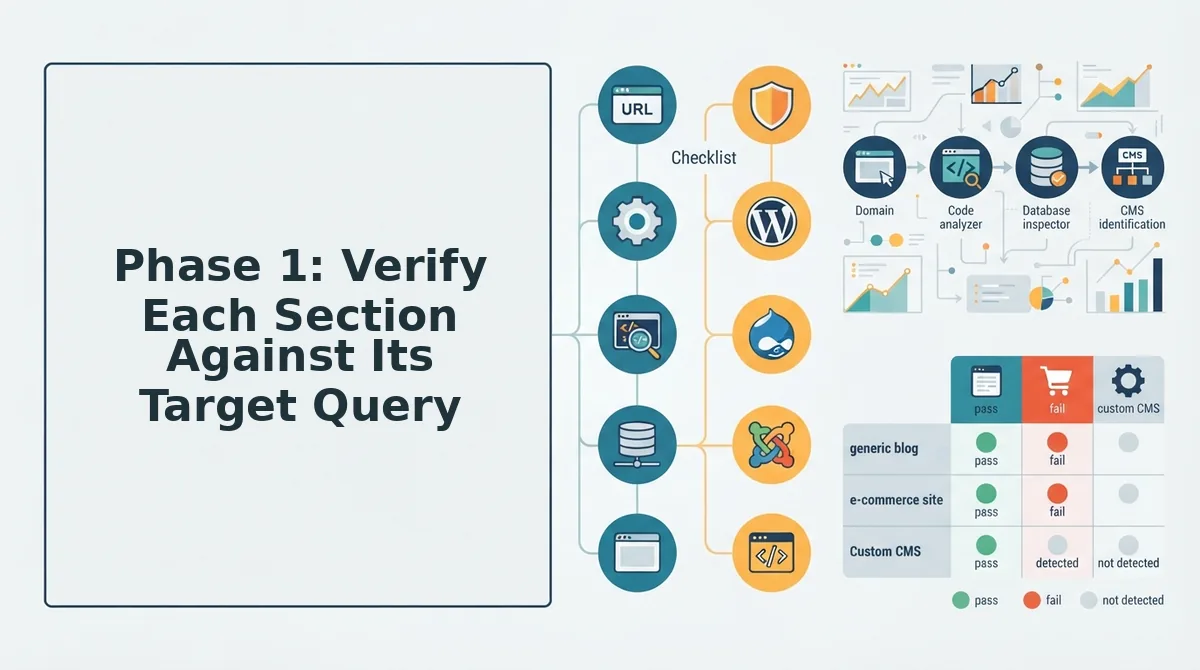
Phase 1: Verify Each Section Against Its Target Query
Verification is the first pass of the loop: you check every H2 section against its assigned target query and score whether the section answers that query's intent. You need your draft with visible H2s, the target query mapped to each section, and a simple pass/fail table. Budget 10-15 minutes for a 2,000-word article.
- Open your draft and list every H2 in a table. Create columns for H2 heading, target query, intent type, and pass/fail. If your draft comes from an AI content engine that generates sectional drafts, the target queries are already attached to each section, copy them directly into the table.
- Read each section in isolation, without the surrounding H2s. Cover the sections above and below, or copy the section into a blank document. Ask one question: does this section answer the target query on its own? You should be able to state the answer in one sentence after reading.
- Label the intent type for each target query. Mark it informational (user wants to learn), commercial (user compares options), transactional (user wants to buy or act), or navigational (user wants a specific page). If the section's content serves a different intent than the query, mark it fail.
- Apply the pass/fail criteria and record the score. Pass means the section answers the query directly, matches the intent type, and does not bury the answer under unrelated setup. Fail means the answer is missing, delayed past the first paragraph, or aimed at the wrong intent. You should end with a completed table showing one row per H2.
Here is the scoring table to use:
| H2 Heading | Target Query | Intent Type | Pass/Fail Criteria |
|---|---|---|---|
| What Is a Sectional Content Review Loop? | sectional content review loop | Informational | Pass if definition appears in first 50 words and matches query intent |
| Phase 1: Verify Each Section | how to verify blog section against search query | Informational | Pass if steps are actionable and answer the "how" directly |
| Pricing | [product] pricing | Commercial | Pass if pricing details or comparison appear; fail if only feature talk |
Any section marked fail moves to the revision phase, where you fix the drift instead of rewriting the whole article.
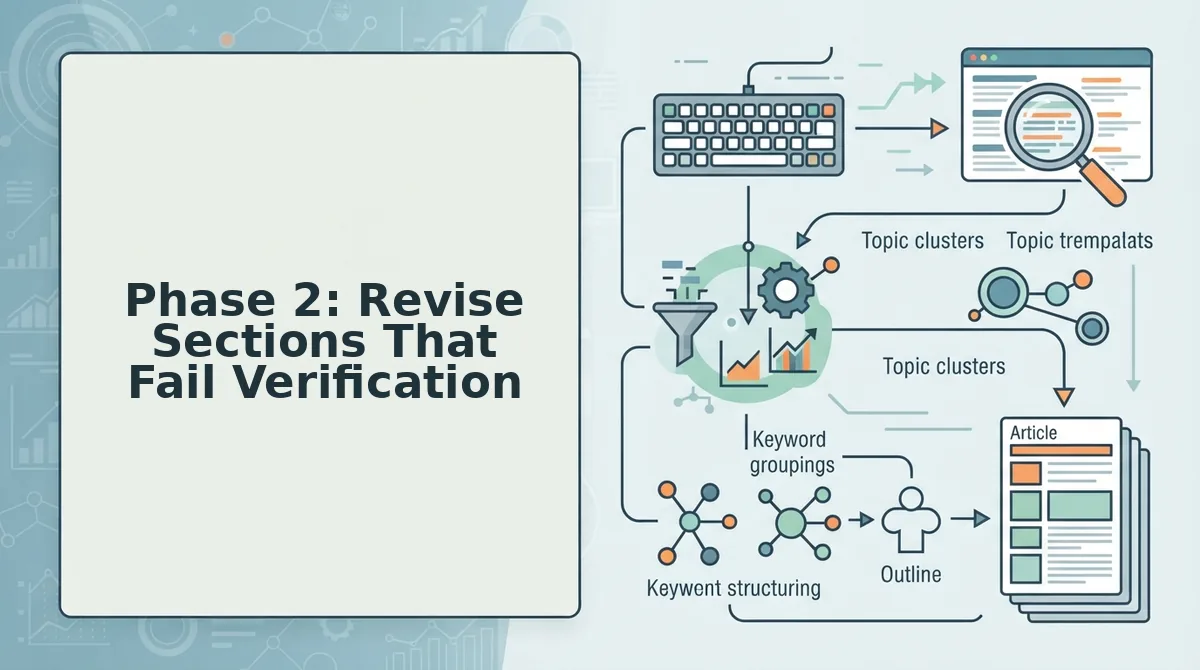
Phase 2: Revise Sections That Fail Verification
Revision is where the review loop earns its keep: you fix only the sections that failed Phase 1 checks, not the whole draft. You'll need your Phase 1 verification notes, the original target query list, and access to your CMS or draft editor. Budget 20-40 minutes per failing section.
- Open your verification notes and sort failures into three buckets: drift, thin content, and missing answer passages. Drift means the section answers a related but different query. Thin content means the section lacks depth or specific data. Missing answer passage means no 80-120 word block directly answers the target query. You should see a clear list of which sections need which fix.
- Rewrite the H2 heading first for any drifted section. Match the heading language to the target query's phrasing. For example, if the target query is "best AI blog writer for WordPress" but your H2 reads "Choosing an AI Writing Tool," retitle it to "Best AI Blog Writer for WordPress: What to Look For." You should see the heading now mirror the query intent.
- Expand thin sections by adding one concrete data point, example, or step per 150 words. Open the source material or your research notes, then insert the missing specificity directly after the claim it supports. You should see each paragraph now contain at least one verifiable detail.
- Insert a 80-120 word answer passage directly under the H2 for sections flagged as missing one. Type a self-contained paragraph that restates the query, gives the direct answer, and adds one supporting detail. You should see the passage readable as a standalone answer if extracted.
- Re-run the Phase 1 verification checklist on revised sections only. Check intent match, heading alignment, and passage presence. You should see all three checks pass before moving to Phase 3.
Troubleshooting: Common section-level failures and fixes
- H2 drift: The heading targets a broader topic than the query. Fix: rewrite the H2 to include the query's core phrase.
- Thin content: Paragraphs make claims without evidence. Fix: add one statistic, example, or step per claim.
- Missing answer passage: No extractable block answers the query directly. Fix: write a 80-120 word passage that restates and answers the query.
- Keyword stuffing: The query phrase appears unnaturally. Fix: rewrite sentences to use natural language variations.
Worked example of H2 drift: A 5-section draft targeting "AI SEO content engine" has H2 #3 titled "How AI Tools Help with Marketing." The verification step flags it because the query intent is about SEO-specific content engines, not general marketing AI. The fix: retitle H2 #3 to "How an AI SEO Content Engine Automates On-Page Optimization" and rewrite the section body to cover keyword mapping, internal linking, and meta generation. The drift is caught and corrected before publishing.
Phase 3: Re-check Revised Sections in Isolation
Isolated re-checking is the practice of evaluating each revised section independently, without reading the surrounding sections, to confirm it fully satisfies its target query on its own. Think of it like a chef tasting each sauce separately before combining them into a dish, a sauce can taste fine in the pot but clash on the plate.
Most publishers review drafts in a single linear pass, which misses cross-section inconsistencies and lets a weak section hide behind strong neighbors. The contrarian move is to treat every section as a standalone article fragment. Open the revised section alone, read only that section, and ask: does this answer the target query completely if a reader lands here directly?
Start simple: copy the revised section into a blank document and read it without the article's intro or surrounding H2s. Then move to intermediate: check that the section's H2 matches the query, the first paragraph delivers a direct answer, and a self-contained 80-120 word passage exists. Advanced: run the section through AEO passage checks to confirm it can be extracted cleanly by answer engines without losing context.
The exit condition is concrete: every section passes intent-match verification and AEO passage checks. If a section fails either test, return to Phase 2 for that section only. Without a defined exit condition, revision cycles become infinite, you keep polishing prose instead of shipping content. Set the bar once, meet it, and move to release.
Why isolated re-checks matter for AI answer engines: When Google or an AI chatbot extracts a passage to answer a user query, it pulls that passage without the article's surrounding context. A section that only makes sense when read after the previous section will fail as a standalone answer. Isolated re-checking simulates how answer engines actually consume your content, one passage at a time, judged on its own completeness. This is why the one-pass review trap is dangerous: you read the draft as a flowing narrative, but search engines and AI crawlers index it as discrete, query-matched fragments.
Phase 4: Release and Log the Review Outcome
Release happens only after every section passes Phase 3 isolation checks. You'll need your review log template, the final draft, and publishing access. Budget 15-20 minutes for logging and release.
- Open your review log and create a new entry with the date, article URL or slug, and target query list. Record which sections failed verification, what fix was applied, and the final pass/fail status. You should see a complete audit trail for this article.
- Publish the article through your normal CMS workflow, or route it through BloGoose's automated publishing workflow if you use one. The review loop finishes before automated publishing takes over, so the system ships only verified content. You should see the article live with all sections intact.
- Tag the log entry with the failure types you encountered, drift, thin content, or missing passage. Over time, this tag data reveals which section types fail most often. You should see patterns emerge after 10-15 logged articles.
- Reference the log before drafting your next article on a similar topic. Open past entries for the same query cluster and review the fixes. You should see faster first drafts because known failure patterns are already documented.
Your review log is a compounding asset: every fix you record makes the next draft cheaper to produce. Once the loop is closed and logged, you're ready to answer the most common questions about running sectional content review loops.
Frequently Asked Questions About Sectional Content Review Loops
A sectional content review loop is a repeatable four-phase process that verifies each article section against its target query, revises failures, re-checks in isolation, and logs outcomes before publishing. It catches drift that single-pass reviews miss.
How do you run a sectional content review loop on blog drafts?
Run four phases in order: verify each section against its target query, revise sections that fail, re-check revised sections in isolation, then release and log the outcome. Each phase gates the next, so no section ships without passing verification against its assigned search parameter.
How do I know if a section answers its target query?
Check whether the section's first sentence directly states the answer the query asks for, without requiring the reader to scroll or infer. If a section opens with background context instead of the direct response, it fails verification and needs a rewrite.
How many review passes does a sectional content review loop need?
Most drafts need two to three passes: one verification pass to flag failures, one revision pass to fix them, and one isolation re-check to confirm fixes work standalone. Complex sections targeting high-competition queries sometimes need a fourth pass.
What is the difference between a sectional review loop and a full content audit?
A sectional review loop checks individual sections against their assigned queries before publishing, while a full content audit evaluates an entire published page or site after the fact. The loop is preventive and granular; the audit is retrospective and page-level. Running the loop reduces the number of fixes an audit later uncovers, and it aligns with the same section-level verification principles that help content get cited in AI answers.
Why does a section pass a full-page review but fail sectional verification?
Full-page reviews evaluate flow, tone, and coherence across the whole article, which can mask a section that drifts from its target query. Sectional verification isolates each block and asks one question: does this section alone satisfy the search parameter it was assigned? Drift becomes visible only under that isolation.
Start Your Sectional Review Loop Today
The sectional review loop adds time to your publishing workflow, but it eliminates the section-level drift that single-pass reviews systematically miss. A full-page read catches tone problems; only isolated verification catches a section that answers a neighboring query instead of its own.
The four phases compound: verification flags drift, revision corrects it, isolation re-check confirms the fix, and logging builds a record of what passed and why. After two or three cycles, you stop guessing whether a section matches its search parameter, you have logged proof.
The loop fits naturally into BloGoose's sectional draft workflow, where each article section is generated, optimized, and published against an assigned query. Start your next draft by running Phase 1 verification on every section the BloGoose AI SEO content engine produces, then let the loop carry the rest. Your search rankings and AI citation rate will reflect the difference.