
How to Draft Blog Sections Without Generic AI Phrasing
You've published three posts this month, and every single one opens with "In today's fast-paced digital landscape." You're not a bad writer, you're trapped in a drafting loop that rewards generic filler over genuine insight. The Ahrefs Podcast interview with Ryan Law confirms what most content teams already feel: publishing even one quality article per week is a struggle, and the promise of AI-assisted workflows has only intensified that pressure. Meanwhile, Simon Scrapes' blunt video title, "Stop Writing Blog Posts With AI", captures the growing frustration with robotic, same-sounding output.
Here's the truth: sectional drafting for AI blog posts is the missing layer between a blank page and a publish-ready article. You're right to be tired of editing AI mush. You're right to want a system that doesn't require prompt-engineering homework before every paragraph. And you're right to suspect that the problem isn't AI itself, it's how you're feeding it.
This guide will show you a repeatable 5-stage framework that turns any blog section into a voice-accurate, research-backed block of content. You'll learn why single-prompt drafting fails, how to structure section briefs that prevent topic drift, and where to run quality gates before assembly. By the end, you'll have a workflow that plugs directly into an autopilot SEO content engine, no manual publishing loop required.
One surprising finding ahead: the fix isn't a better prompt. It's breaking the draft into pieces small enough that generic phrasing has nowhere to hide.
Why Single-Prompt AI Drafting Produces Generic Content
Single-prompt AI drafting is the practice of feeding one large instruction to a language model and expecting a complete, publish-ready article in return. It fails because one prompt is asked to do the work of ten: research, outline, draft, edit, fact-check, and align with brand voice, all in a single generation pass.
Think of it like asking a chef to plan the menu, shop for ingredients, cook every course, plate it, and wash the dishes, all in one uninterrupted motion. The result is edible but forgettable. The same collapse happens in writing. When a model has to allocate its attention across an entire 2,000-word article, it defaults to the statistical middle: safe transitions, recycled intros, and conclusions that restate the obvious.
Four failure modes emerge consistently. First, generic intros, the model opens with broad, universally true statements because it hasn't been given a specific angle for the section. Second, topic drift, by paragraph four, the article wanders into adjacent territory because no per-section boundary was defined. Third, no per-section research, the model draws on general knowledge rather than targeted sources, producing surface-level claims. Fourth, weak transitions, sections feel stitched together because the model wasn't instructed on how each block should connect to the next.
Simon Scrapes' video argues against using AI for blog posts entirely, but the real issue is workflow architecture, not AI itself. Yves Lummer's prompt-based approach, while thoughtful, lacks section-level structure, which is precisely why it still produces generic copy. The contrarian reframe is this: the problem isn't your prompts. It's that you're asking one prompt to do the work of ten.
When you compare an AI content engine vs chat window workflows, the difference becomes clear. A chat window gives you one shot at a coherent draft. A structured engine breaks the article into discrete sections, each with its own brief, research inputs, and quality gate. That architectural difference is what separates content that ranks from content that merely exists.
Here's the passage worth indexing: single-prompt drafting produces generic content because language models optimize for the most probable next token across an entire document. When the context window spans 2,000 words, the model averages out specificity to maintain coherence. When the context window spans 300 words, a single section, the model can afford to be precise, because there's less surface area to keep consistent. Smaller drafting units create higher information density per paragraph.
The 5-Stage Sectional Drafting Framework
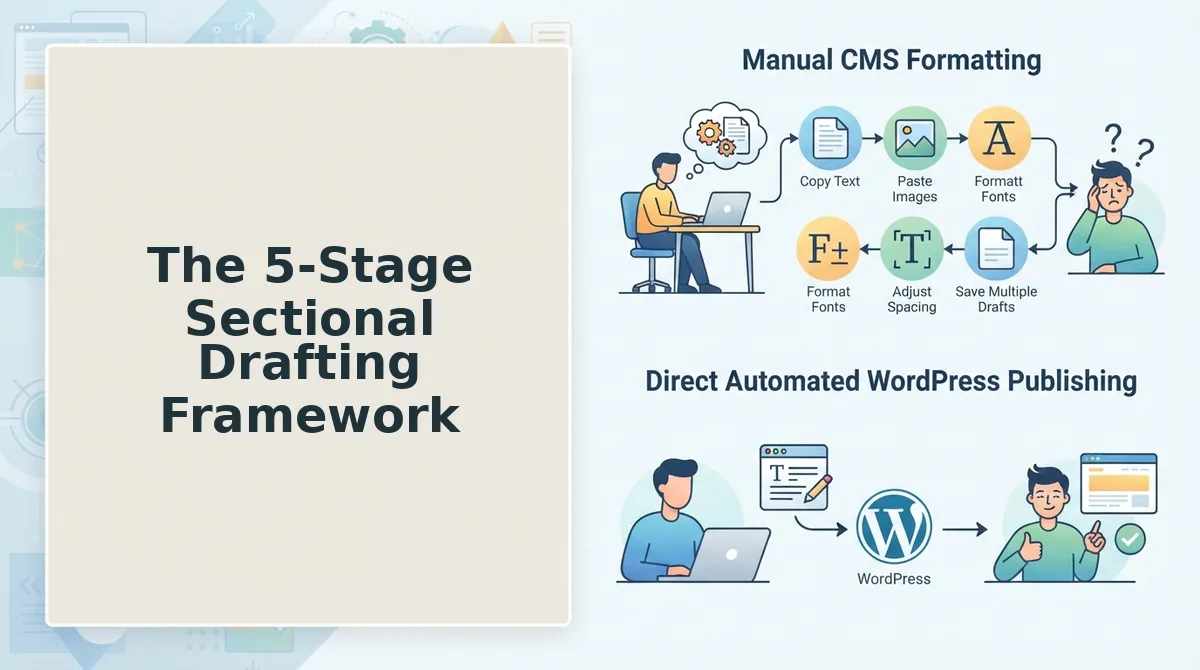
The 5-Stage Sectional Drafting Framework is a repeatable workflow that breaks every blog section into five sequential passes, Section Brief, Agent Draft, Quality Gate, Voice Alignment, and Assembly, so each block is researched, drafted, and refined independently before the full article is compiled.
Prerequisites: You'll need your target keyword, a section-level outline, and a brand voice reference file. If you haven't built one yet, start with a markdown brand context file and pair it with brand voice writing examples so the model has concrete patterns to match.
- Section Brief, 5 minutes per section. Write a 3-4 sentence brief that states the section's purpose, the specific question it answers, the angle it takes, and the transition it must set up. Expected outcome: a one-paragraph scope document that prevents topic drift before drafting begins.
- Agent Draft, 2 minutes per section. Feed the brief to your AI writer as a standalone prompt. Instruct it to draft only this section, not the full article. Expected outcome: a 250-400 word block with a clear opening claim and no recycled intro language.
- Quality Gate, 3 minutes per section. Run a checklist: Does the first sentence make a specific claim? Is there a number, example, or named source? Does the section answer exactly one question? Expected outcome: a pass/fail decision. If it fails, return to Stage 2 with a revised brief.
- Voice Alignment, 4 minutes per section. Compare the draft against your brand voice file. Rewrite any sentence that uses generic phrasing, passive voice, or filler transitions. Expected outcome: a section that sounds like your brand, not like a default model output.
- Assembly, 10 minutes per article. Order the sections, write connective transitions between them, and add the introduction and conclusion last. Expected outcome: a complete draft where every section stands alone and flows into the next.
Pro tip: Run the voice alignment pass on each section separately. A 2,000-word draft drifts from brand voice by section three. A 300-word section draft rarely drifts at all, the context window is small enough that the model can hold tone consistency from first sentence to last.
Here's the passage worth indexing: sectional drafting works because it shrinks the unit of work. When a model drafts 300 words instead of 2,000, it can maintain a specific angle, match a defined voice pattern, and avoid the statistical averaging that produces generic filler. Each section gets its own brief, its own draft, and its own quality gate, so weak sections are caught and revised before they contaminate the rest of the article.
Next, see how this framework stacks up against the old way of doing things in a side-by-side comparison.
Single-Prompt vs. Sectional Drafting: A Side-by-Side Comparison
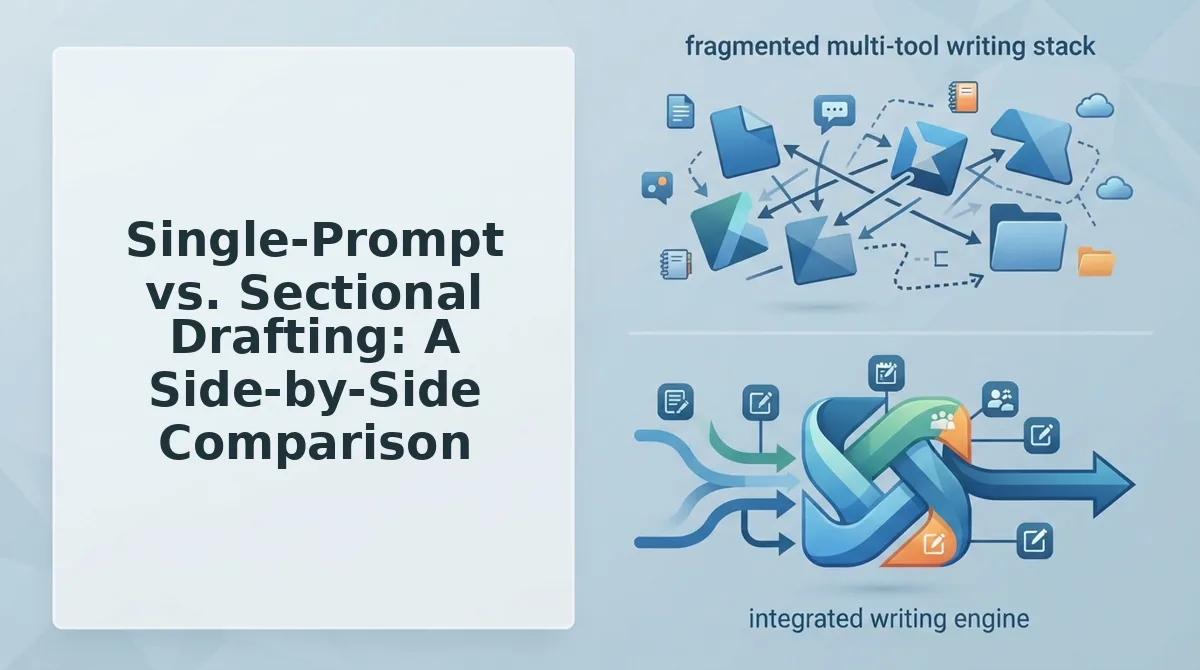
Single-prompt drafting asks one AI call to produce an entire article from a title and keyword; sectional drafting breaks the article into briefed, independently drafted blocks that are assembled after review. Both workflows can publish content, but they diverge sharply on voice consistency, research depth, and editing time once articles exceed ~800 words.
Single-prompt workflows, including Yves Lummer's prompt library approach, where a reusable mega-prompt is pasted into a chat window, are fast to start and require zero setup. The tradeoff appears downstream: the model fills gaps with generic transitions, drifts off-topic after the first few hundred words, and flattens your brand voice because it has no per-section context to anchor to. Sectional drafting costs more upfront effort per brief, but each section gets a dedicated goal, keyword, and source list, which is why the editing pass shrinks from a rewrite to a polish.
For a deeper breakdown of why chat-window prompting underperforms structured engines, see our comparison of AI content engine vs chat window workflows.
| Dimension | Single-Prompt Drafting | Sectional Drafting |
|---|---|---|
| Intro quality | Generic opener; often restates the title | Intro is briefed last, after section context exists |
| Research depth | Shallow; no per-section source mapping | Each brief lists sources and the question to answer |
| Voice consistency | Drifts after ~500 words; no brand context file | Anchored by brand context files per section |
| Editing time | High; full rewrite often required | Low; review loop catches issues per section |
| Transition quality | Weak; filler phrases between topics | Transitions drafted after sections are finalized |
| Ranking potential | Limited; thin content and topic drift | Higher; sections map to search intent clusters |
Failure modes to watch: single-prompt drafts commonly produce generic intros, topic drift after the first subheading, no per-section research, and weak transitions that read like glue text. Sectional drafting eliminates these by design, but it requires discipline: every section needs a brief before drafting starts.
Best for solo operators testing content ideas: single-prompt drafting. It is free, instant, and fine for validating whether a topic resonates before you invest in structure. Best for growth leads and publishers who need rank-ready clusters at scale: sectional drafting, ideally inside an autopilot SEO content platform like BloGoose that automates the brief-to-publish loop without manual spreadsheet coordination.
How to Write a Section Brief (Template Included)
A section brief is a short instruction block that tells the AI exactly what one section must accomplish, which question it answers, and how it fits the article's internal linking and CTA strategy. Writing one takes 3-5 minutes per section and eliminates the ambiguity that causes generic AI output.
Prerequisites: a target keyword list (ideally managed in a target keywords markdown file), a working article outline, and access to your brand voice rules. If you have not built a full SEO content brief for the article yet, do that first, the section brief inherits its constraints.
- Open your outline and select the section you are drafting next. Do not draft sections in order; draft the ones with the clearest search intent first. You should see a one-line summary of what the section covers.
- Type the section goal as a single sentence. Example: "Explain how BloGoose pricing tiers map to publishing volume." The goal must be specific enough that a wrong answer is obvious.
- Write the question this section answers. Use the phrasing a searcher would type: "How much does an AI content engine cost per month?" This anchors the section to search intent.
- Enter the target keyword and its expected placement. Specify one primary keyword for the section, plus where it should appear: H2, first sentence, or a subheading. You should see the keyword appear in your brief's keyword field.
- Set the format and length. Choose from list, table, step-by-step, definition, or comparison. Add a word count range (e.g., 250-350 words). This prevents the AI from padding with filler.
- List the internal link target and CTA stage. Specify which page to link and whether the section should include a soft CTA (mention a capability) or no CTA at all. You should see both fields filled before you draft.
Annotated example, "Pricing" section brief:
- Section goal: Explain how BloGoose pricing scales with publishing volume, without inventing specific dollar amounts.
- Question to answer: "What does an AI SEO content engine cost for a small team?"
- Target keyword: AI SEO content engine pricing
- Format: Comparison table (tiers vs. included features)
- Length: 300 words
- Internal link target: https://blogoose.com/seo-content-brief
- CTA stage: Soft, mention automated publishing to WordPress, no hard sell
When every section has a brief like this, the AI never has to guess what "good" looks like, and neither does your editor.
The 3-Pass Quality Review Loop
The 3-Pass Quality Review Loop is a structured editing sequence. Structure, Voice, Facts, that catches the three failure modes most responsible for AI content that never ranks: sections that miss their brief, voice that drifts from brand rules, and claims that cannot be sourced. Run all three passes on every section before it enters your CMS.
Prerequisites: the completed section draft, its section brief from the previous step, your markdown brand context files, and a source list for any factual claims. Budget 10-15 minutes per 1,000 words across all three passes.
- Open the section brief and run the Structure pass. Read the draft against the brief's section goal and question to answer. Check that the target keyword appears where specified and the format matches (list, table, comparison). You should see a one-to-one match between brief fields and draft output; if the section answers a different question than the brief, mark it for rewrite before moving on.
- Open your brand context files and run the Voice pass. Compare the draft's sentence length, tone markers, and terminology against the brand rules. Flag any phrase that sounds like a generic AI default, "in today's fast-paced world," "unlock the power of," "delve into." You should see the draft read like a continuation of your existing published pages, not a new author.
- Open your source list and run the Fact pass. Verify every statistic, price, date, and named claim against a source. If a claim has no source, either add one or delete the claim. For guidance on source formatting, see our post on citing sources in AI-drafted content. You should see zero unsourced factual assertions remaining.
This loop is the fix for "AI mush", the vague, confident-sounding prose that reads fine on a skim but collapses under editorial review. Most teams skip the Voice and Fact passes because they are tedious, which is exactly why their AI content never ranks: search engines and AI answer engines both penalize unverifiable claims and inconsistent voice. An autopilot SEO content engine like BloGoose automates the brief-to-draft step, but the review loop remains the human checkpoint that turns drafts into defensible, rank-ready sections.
With the review loop in place, the remaining questions are mostly operational, which is what the FAQ below addresses.
FAQ: Sectional Drafting for AI Blog Posts
Sectional drafting breaks a blog post into independently briefed, generated, and reviewed sections so each one carries specific evidence, voice rules, and structural intent instead of one diluted prompt output.
How do I draft blog sections without generic AI phrasing?
Write a separate brief for each section that names the exact claim, evidence, tone, and reader takeaway before generating any text. Then run a three-pass review loop checking factual accuracy, voice consistency, and structural flow. Generic phrasing disappears when the AI has narrow, concrete instructions per section instead of one broad prompt.
What's the difference between sectional drafting and one-prompt generation?
Sectional drafting generates each part of a post from its own brief, so every section gets focused context and a distinct job. One-prompt generation asks a single prompt to handle research, structure, tone, and examples at once, which produces averaged, repetitive language. Sectional drafting yields sharper transitions and fewer filler sentences.
How many sections should a blog post have for sectional drafting?
Most posts work well with five to eight sections, each covering one distinct subtopic or reader question. Fewer than five sections often forces multiple ideas into one brief, recreating the generic-output problem. More than eight sections usually signals scope creep that dilutes each section's evidence and voice.
Can sectional drafting work with ChatGPT or Claude?
Yes. Any model that accepts structured prompts can run sectional drafting. The method depends on your briefs, not the model. ChatGPT and Claude both respond well to section briefs that specify claim, evidence, tone, and length. The quality difference comes from how narrowly you define each section's job before generation.
Why does AI produce generic phrasing even with detailed prompts?
Because one detailed prompt still asks the model to optimize for too many goals at once: research, structure, tone, examples, and transitions. The model averages those competing demands into safe, mid-register language. Splitting the work into section-level briefs lets each generation optimize for one clear outcome, which produces more specific phrasing.
Sectional drafting is a workflow problem, not a writing problem
The contrarian reframe holds up under pressure: the problem isn't your prompts. It's that you're asking one prompt to do the work of ten. Every stage of sectional drafting exists because a single AI call collapses too many decisions into one output. Research, angle selection, brief writing, drafting, and review are distinct cognitive tasks. When you separate them, the generic phrasing disappears because the AI never has to guess what you want.
Here's what changes when you adopt the 5-stage framework and the 3-pass review loop:
- Your briefs do the heavy lifting. A section brief with a direct-answer sentence, target word count, and forbidden phrases removes ambiguity before drafting starts.
- Your review passes catch what drafting misses. Pass one kills clichés, pass two verifies facts and internal links, pass three checks voice and rhythm.
- Your output becomes citable. AI answer engines quote content with clear structure, concrete data, and standalone insights, exactly what sectional drafting produces.
You don't need to run this workflow manually across five tools. The BloGoose AI SEO content engine automates the sectional drafting pipeline with internal AI agents that handle research, brief generation, drafting, and the quality review loop in sequence. You approve the output; the engine handles the fragmentation.
Start sectional drafting with BloGoose today. Check BloGoose pricing and connect your site to begin producing rank-ready, citation-optimized sections without prompt engineering or spreadsheet coordination.
One prompt can write a paragraph. Ten disciplined prompts can write a page that ranks, and gets quoted.